04
May
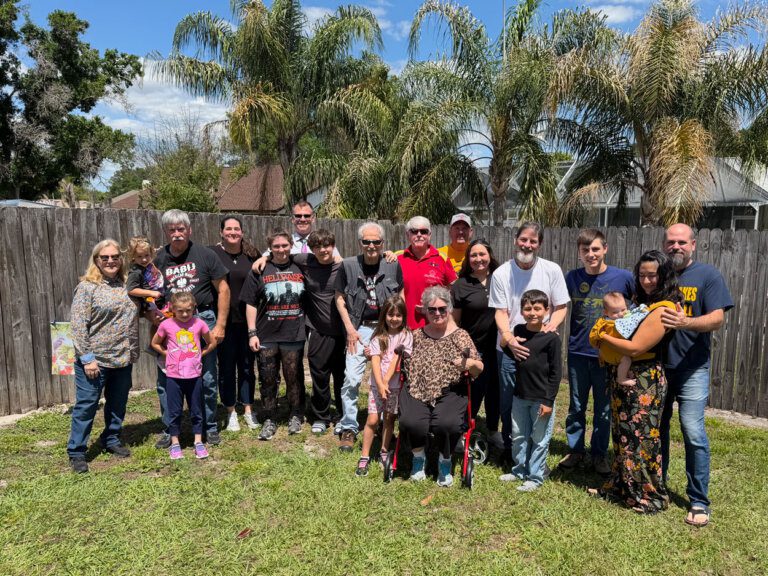
Land O’ Lakes Reunion 2026

Views: 0
Views: 0
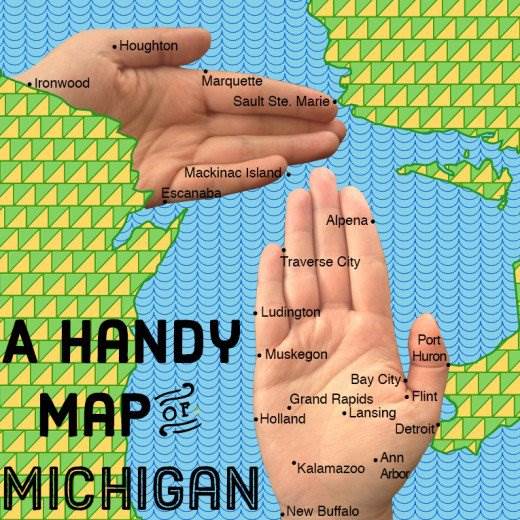
Every Michigander has done this at least a hundred times. Someone asks where you’re from, and instinctively, you hold up your right hand, point to a spot, and say “right here.” It’s universal. It doesn’t matter if you’re in Michigan or across the country. The hand comes out, and suddenly everyone understands.
This image maps out major Michigan cities on the hand, and it’s surprisingly accurate. Detroit is down at the base of the thumb. Lansing is in the middle of the palm. Traverse City is on the pinky. Sault Ste. Marie is at the tip of the index finger. Mackinac Island is right there on the side of the middle finger. It works.
The Upper Peninsula gets its own hand, which makes sense because it’s a separate landmass. The UP is the left hand, and you can point to Marquette, Houghton, Ironwood, and Escanaba just as easily. Two-handed Michigan geography. It’s efficient.
Views: 0
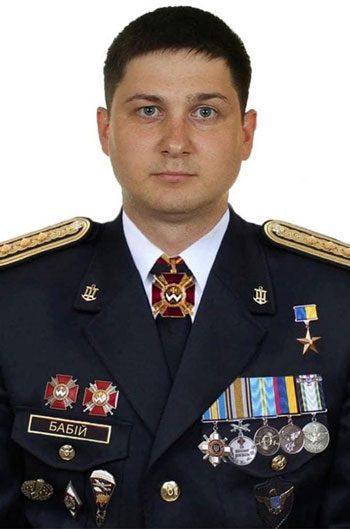
On August 19, 2023 a TU22M3 bomber and two other similar planes from which Russians launched missiles across Ukraine were blown up at the Solka airport near Moscow. As it turned out, this operation was conducted by a group from the Main Intelligence Department led by Lieutenant Colonel Oleg Babiyem. Oleg Babiy – Lieutenant Colonel of the Chief Intelligence Department , together with his command penetrated into the territory of Muscovy and hiked 600 kilometers behind enemy lines.
After destroying the planes, Oleg and his men began to retreat and were ambushed. Oleg, fighting to protect his men, died in battle with the Moscow barbarians. The name of this hero had not been reported for a long time, but today, on the occasion of celebrating the Day of the Security Service of Ukraine, a message naming the officer and his brothers was published on the news networks. Now everyone knows his hame and can talk about his exploits!
Back during the Soviet Union era, our heroes were unknown, and our media and the public at large did not choose to inform society nor the whole world about the feats of our Ukrainian heroes back then. They were mentioned once or twice a year – and that was it. So we need to start talking about and honoring our heroes every day!
No other country in the world would ignore such celebrations, except maybe our Ukrainian state, which seems to keep everything a secret.
Oleg is a Hero, and his story is a scenario for a compelling global blockbuster. May God grant that the whole world might witness such a film based upon the exploits of a Ukrainian spy. Dear teachers and professors, please share this hero’s story with your students. The future of Ukrainian should feature the history and exploits of such heroic patriots.
Oleg was born on October 22, 1990 in the city of Milovice in the Czech Republic. He studied at school No. 49 in the city of Lviv. In 2011, he graduated from the Hetman Petro Sahaidachnyi Academy of Land Forces, Air Mobility Department. He has participated in the Russian-Ukrainian war since 2014. From the first days of the full-scale invasion, he organized and carried out special operations in the temporarily occupied territories of Ukraine and in the territory of Russia, for which he was repeatedly awarded.
Before the beginning of Russia’s full-scale invasion of Ukraine, Babiy lived with his family in Bucha.
Babiy’s last operation was the destruction of three Russian Tu-22M3 bombers at the Soltsi airfield in the Novgorod region, which effectively completely destabilized the operation of airfields and long-range aviation bases and reduced the Russian Federation’s ability to strike Ukraine with Kh-22 missiles.
During the mission on August 30, 2023, a reconnaissance group led by Babiy entered into battle with special forces of the Russian FSB. Covering the departure of his comrades, Babiy was mortally wounded. For his bravery, he was honored with the title of Hero of Ukraine with the award of the Order of the Gold Star. Babiy is survived by his wife and two young children, the youngest daughter was only a year old at the time of his father’s death. He was buried on September 8, 2023 at the Forest Cemetery.
On January 22, 2024, on the Day of Unity of Ukraine, a memorial plaque in his honor was unveiled on the facade of school No. 49 in Lviv, where Oleg Babiy studied. In Lviv, in the area of houses on Hnata Khotkevycha Street, 40, 42, 54 and the lyceums “Oriyana” and “Sikhivsky” it was approved to create a square with an area of about 0.5 hectares, named in honor of Oleg Babiy.
Today, let’s lay flowers on the graves of Heroes who died for Ukraine, and let’s not forget to congratulate the living..
@Ivan Vozniuk
Shared via Creative Commons.

Views: 0

Anita Joyce – named “Anita” after our paternal Grandmother Anna Chuda – a farmer’s daughter from a village in what is now Western Ukraine – and “Joyce” after our Mother Elsie – also a farmer’s daughter from Snover up in the Thumb – spent her adult life caring for others, including the sick, the elderly, and ironically the terminally ill in hospice care – both strangers and family – including her husband Jose´ as well as both of our parents Elsie and Paul, all while raising three beautiful, creative, and talented children.
Visiting Anita during her years at “The Village” – while much too infrequent – could turn into an adventure as we found out during our initial sojourn to see her. We had gone out for a brunch at a local restaurant and upon returning Anita had trouble getting her security pass to work at the access door to the facility. Either it was invalid or she wasn’t positioning it properly so it could be read by the sensor.
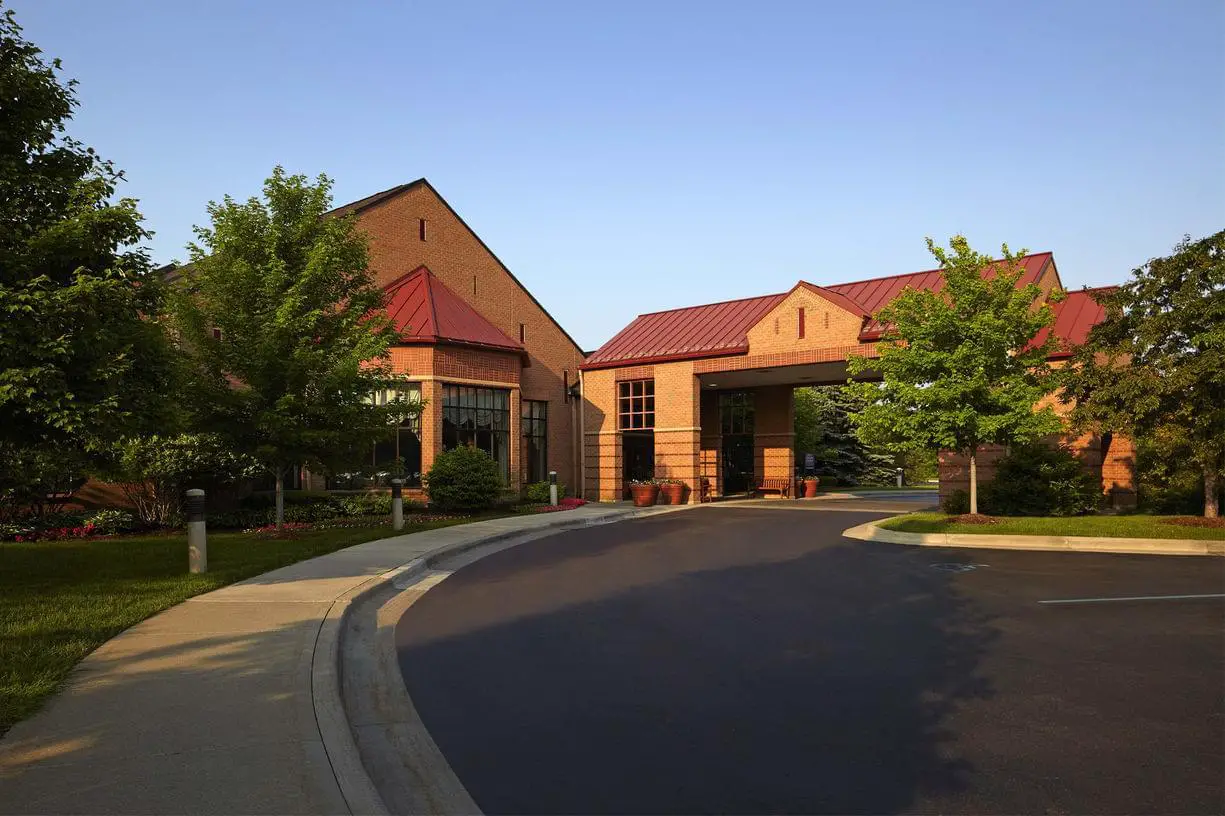
I made an attempt to take the key card from her but she shoved it back in her purse and said: “I know another way in. Follow me.” And off she went down the sidewalk – all of us in tow – toward a freight loading dock where we ascended a flight of concrete steps and continued on through a storage area and its access door leading to residency levels of the building. “Loss of cognitive thinking” aside, Anita was still smart enough to figure out how to bypass the Village’s security measures and get back to her room. So much for access key card safeguards!
Plus – during our most recent visit with Anita in 2023 – David, John and I were warned by both Erin and Carrie that – before we entered the Assisted Living access elevator – to make sure that she couldn’t see the elevator access code because once she knew it she might try to free herself from the confines of the Village Assisted Living area.
“Freedom’s just another word for Nothing Left to Lose.”
This just brings home – especially to us Seniors – the absolute need and complete lack of affordable elder care in our country. In a recent article published in the San Francisco Chronicle titled “Lack of Eldercare Is Unconscionable“, its author Courtney Martin points out:
“By 2050 the number of Americans with Alzheimer’s and dementia will nearly double. That’s twice the weight on a system that can’t even be called a system.”
Anita was – how can I say it – fortunate to have the care and support she needed right up to the end [including $4,000 for an ambulance ride to the hospital]. Un-fortunately there are – and will be – millions of us [140 million est.] who will not be so lucky. But DGMS.
There’s also a family anecdote related to our mother Elsie’s passing – which also happened just prior to the Christmas holidays. Ma loved making pies – apple, pumpkin, lemon meringue – you name it. She also loved eating them as well. According to Anita, during one of her last meals taken at her assisted living site [which Ma referred to as “The Prison”], Ma was served a slice of banana cream pie. After thoroughly savoring every last crumb of this delectable dessert, she put her fork down on the plate and declared:
“When I die i want a piede of this pie buried with me.”
…or words to that effect. So what happened prior to her interment later that Spring? Anita made sure a slice of banana cream pie was placed in the urn with Ma’s ashes. True story.
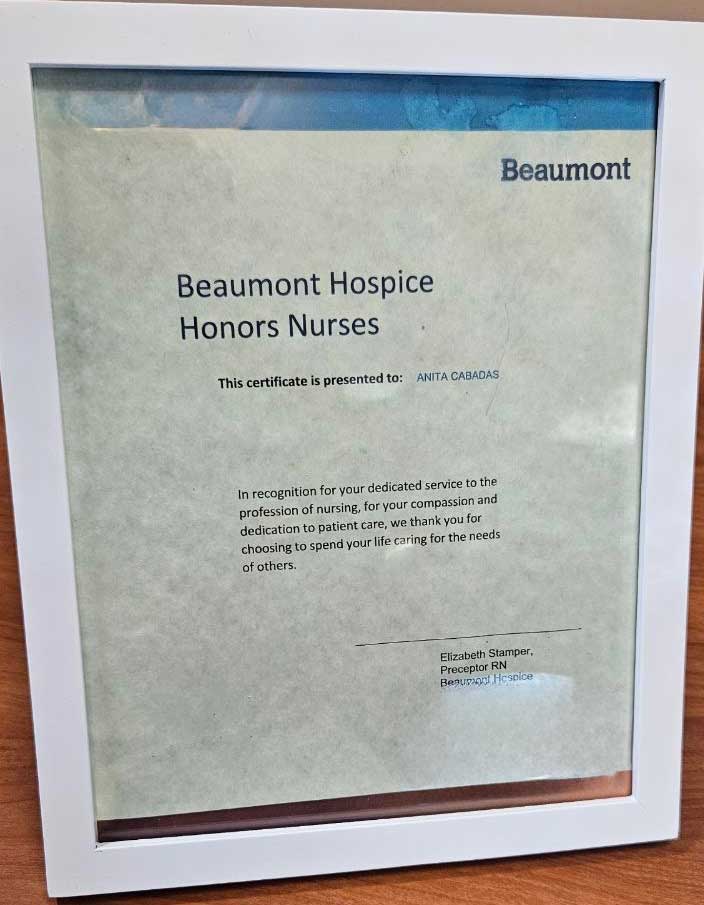 I’m told Anita was an honors graduate in high school – much to the awe and admiration of more than a few of us – and most recently was honored by her peers for her years of service by being awarded the Beaumont Hospice Certificate:
“in recognition for your years of dedicated service to the profession of nursing, for your compassion and dedication to patient care, and for choosing to spend your life caring for the needs of others”.
And that she did.
I recently checked my snail mail box and in it was the card I had sent Anita for her 78th birthday last November 13th. The envelope was labeled:
“Return to Sender – Attempted – Not Known – Unable to Forward”.
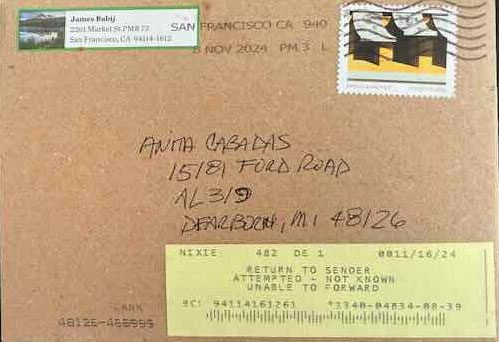 So I concluded that either I had the wrong address or that Anita may have been moved to another unit – perhaps into hospice care – before the postage date. I recall she sometimes jokingly claimed she was born on a Friday – the Friday the 13th meme of course. But her actual calendar “birth day” had fallen on a Wednesday in 1946.
Part of the message I’d inserted in the card had to do with how my penmanship for letters and greetings cards was often indecipherable – even my signature – especially when compared to Ma’s which was flawless, with no spelling errors or un-dotted “i”s or un-crossed “t”s. And now we just send text messages – relying on AI algorithms to correct any errors. So… my handwriting will likely never get any better. Right?
Anyway, my message closed with the following:
“Mom. I miss her, and you…..and the hugs and the kisses and the Birthday Cakes and Candles.
I hope and pray that you are safe and warm in these challenging times. Birthdays are all about celebrating one’s heritage with family and loved ones. They certainly are for me and I miss doing so with you – both on your special day and every day. I love you!”
[A short note about the pictures posted here: Clicking on a photo will expand it to full size [techies call this a “Lightbox effect”]. To close the Lightbox click the “X” in the upper right corner of the picture.]
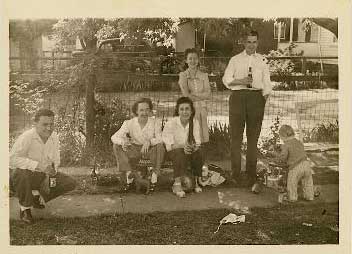 One of the earliest photos of Nita – which we received courtesy of Cousin Barry – was taken circa 1948 by Barry’s father Peter in the backyard of Dad and Mon’s first house in Detroit – 14472 Cedargrove shortly after our family moved there from Croswell where Anita was born in late 1946.
Pictured in this photo are Uncle Pete’s wife Mae [center] seated on a kid’s wagon. Directly behind her is our Aunt Estelle standing next to her brother – Daddy Paul – who’s holding a bottle of beer in his hand while to his left attempting to get back in her baby carriage is Anita – aged two [or so].
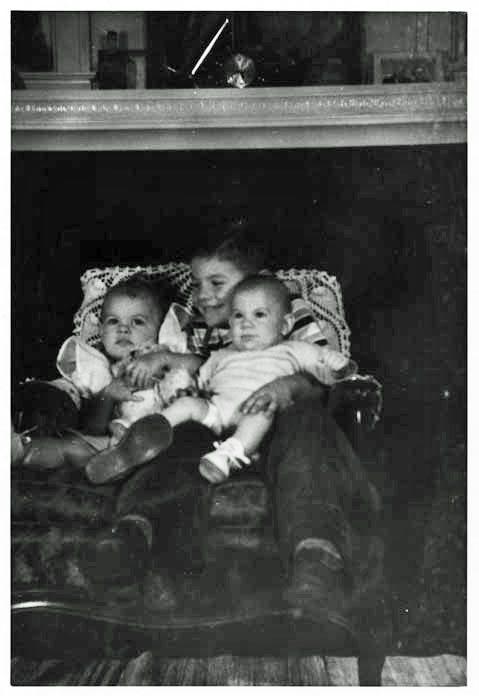 Soon – as sibling O.G. – I was ultimately assigned the enviable task of holding my younger siblings – securely in my lap – while we were positioned for the family portraits taken by our erstwhile shutterbug father to document – for each family celebration, be it a holiday, graduation day, birthday, vacation, or reunion.
None of the other sibs seemed to mind including Nita who appeared to enjoy posing for Papa no matter the occasion especially if she got to wear a new dress and as she got older – even a pair of “bobby sox”. Hey. This pampering and posing made us all feel like we were special – a fidgeting, frolicking family of fledgling movie stars and none of us shone brighter than Nita – especially with a captivating smile that would light up our world in an instant. All you had to do was was call out her name – “Nita”. Or as Brother Dave nicknamed her “Neetz”.
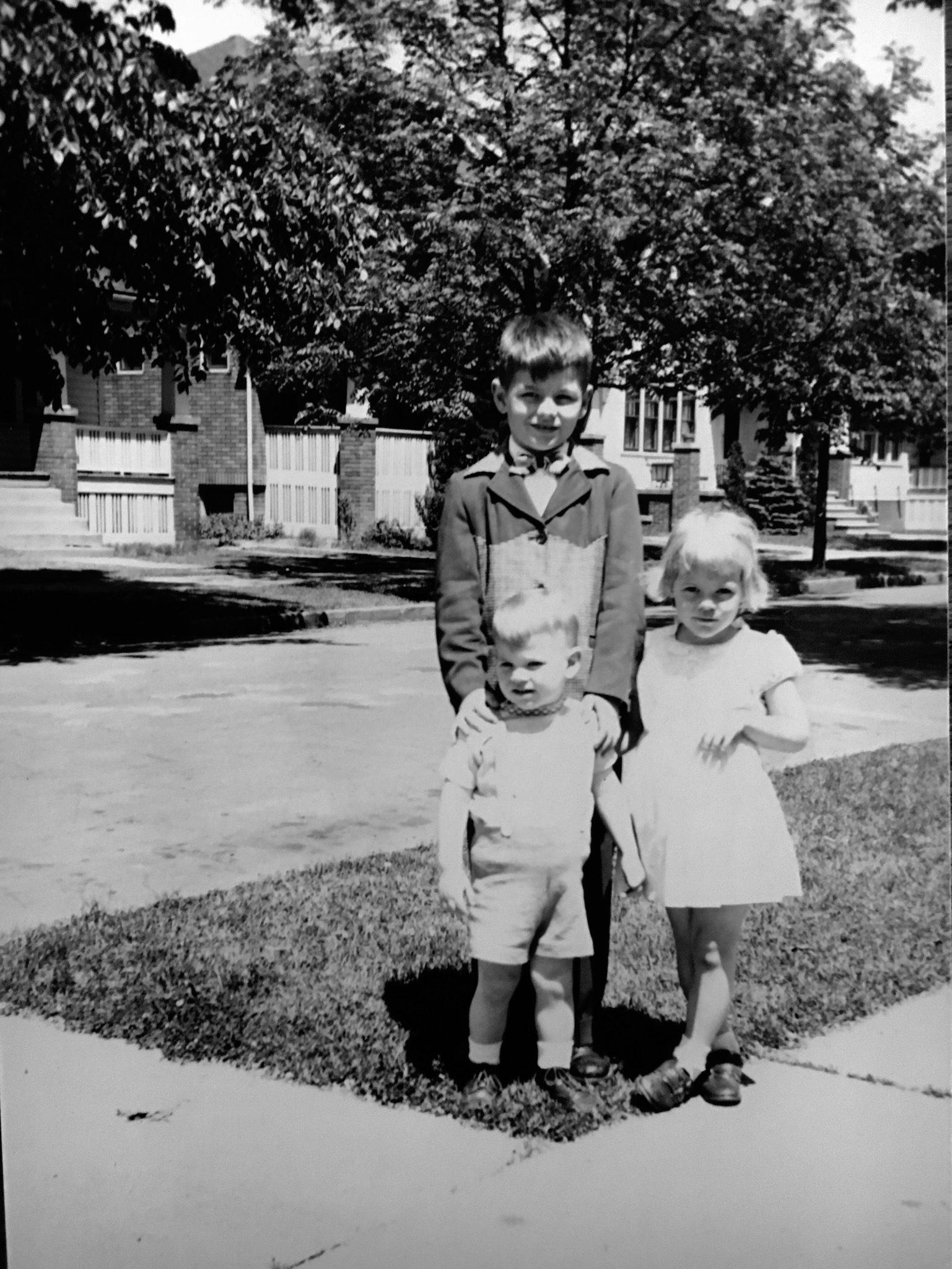
Here’s one taken a few years later – circa 1950 out on the”front yard” that summer.
It had to be on a Sunday ’cause Nita was wearing a dress and P.J. and I were all dressed up to the “Nines” or maybe just an Eight and a Half.
Notice there are no cars on the street. Every house had a garage and a back yard to park cars in. We even used to play baseball down the block where at the cross street intersection with Cedargrove, the four corners of the sidewalk served as home plate and bases.
But no sliding was allowed and you had to watch out for occasional traffic – especially the Good Humor Ice Cream truck.
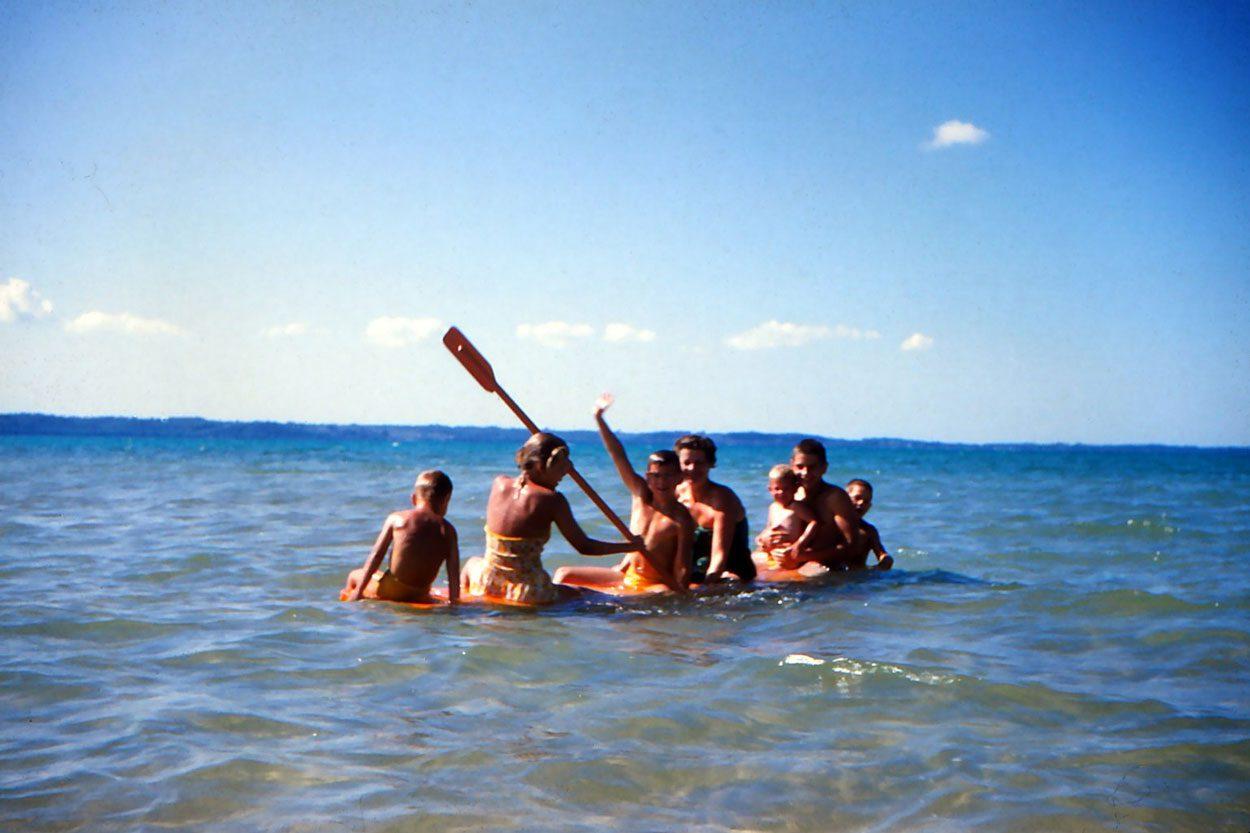
Each summer – or so it seemed – Ma and Dad would load us all into the Ford station wagon – with Dave in front seated between them and the rest of us spread out in the back around the luggage – which in later years was strapped to a rack atop the car’s roof – and head North up Route 27 into lake country – our favorite destination being Glen Lake located near the tip of “The Mitten” with access to the Sleeping Bear Sand Dune near Lake Michigan.
Above is a photo taken sometime in the late 1950’s with Ma and “The Brood” seated on a surfboard afloat in the shallows of Lake Michigan near the beach with Brother Dave secured in my lap and Nita at the helm – paddle in her hands!
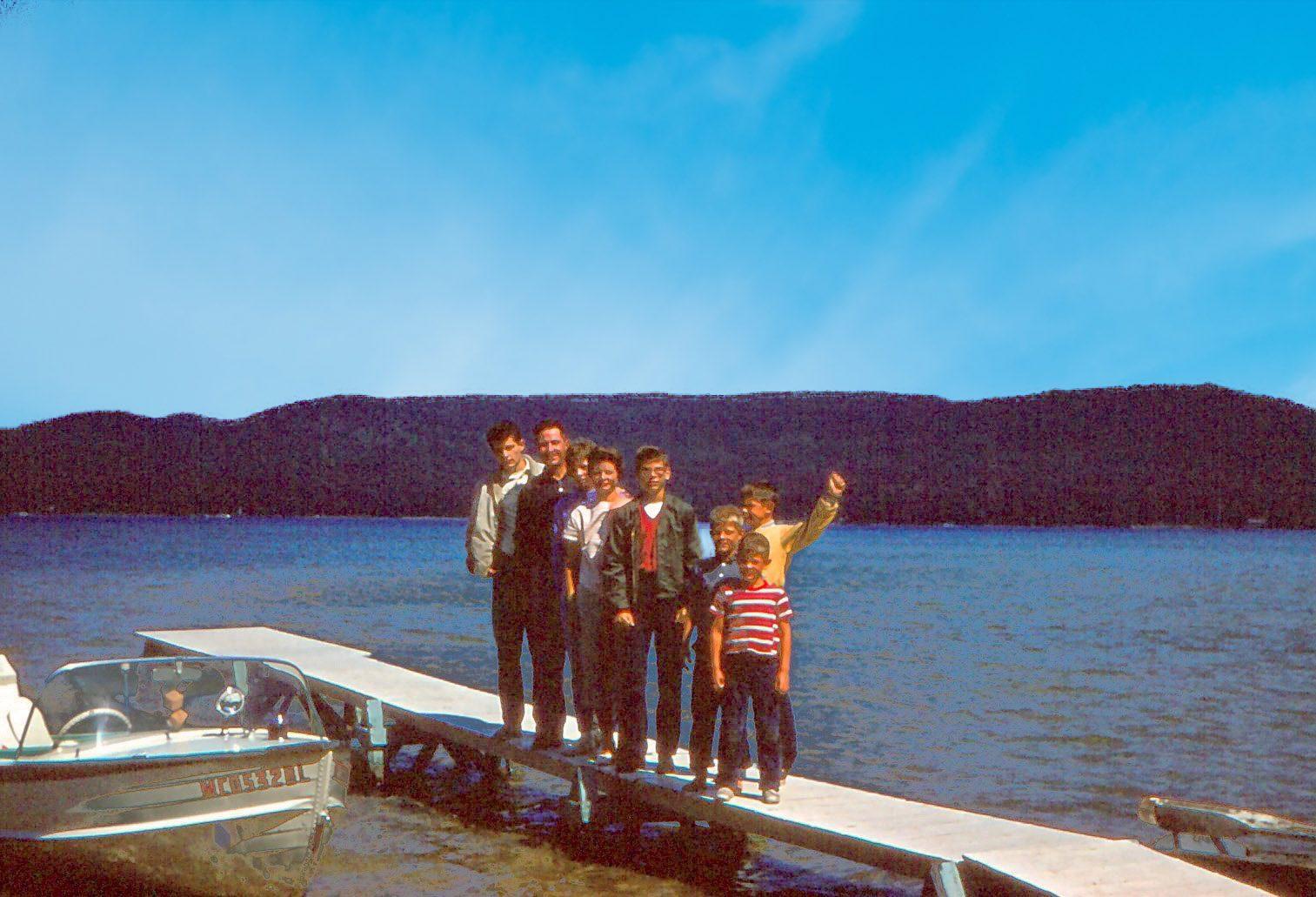
Below is another photo taken on the dock at Glen Lake a few years later – probably by camera bug Marty Schultz – with the whole family in the picture – including Dad.
 This photo – taken ca. 1959 in the backyard on Kinmore Court – most likely marking Nita’s graduation from Grade School – features she with brothers John, Dave, and Dan each holding a kitten or cat!! Meow!
Now Dave is seen here even tickling the cat’s belly which – if you’ve ever had a cat as a pet – you absolutely never do or you risk getting bitten or at least scratched. Seriously.
But Dave turned out to be a true “cat person”. Just ask him.
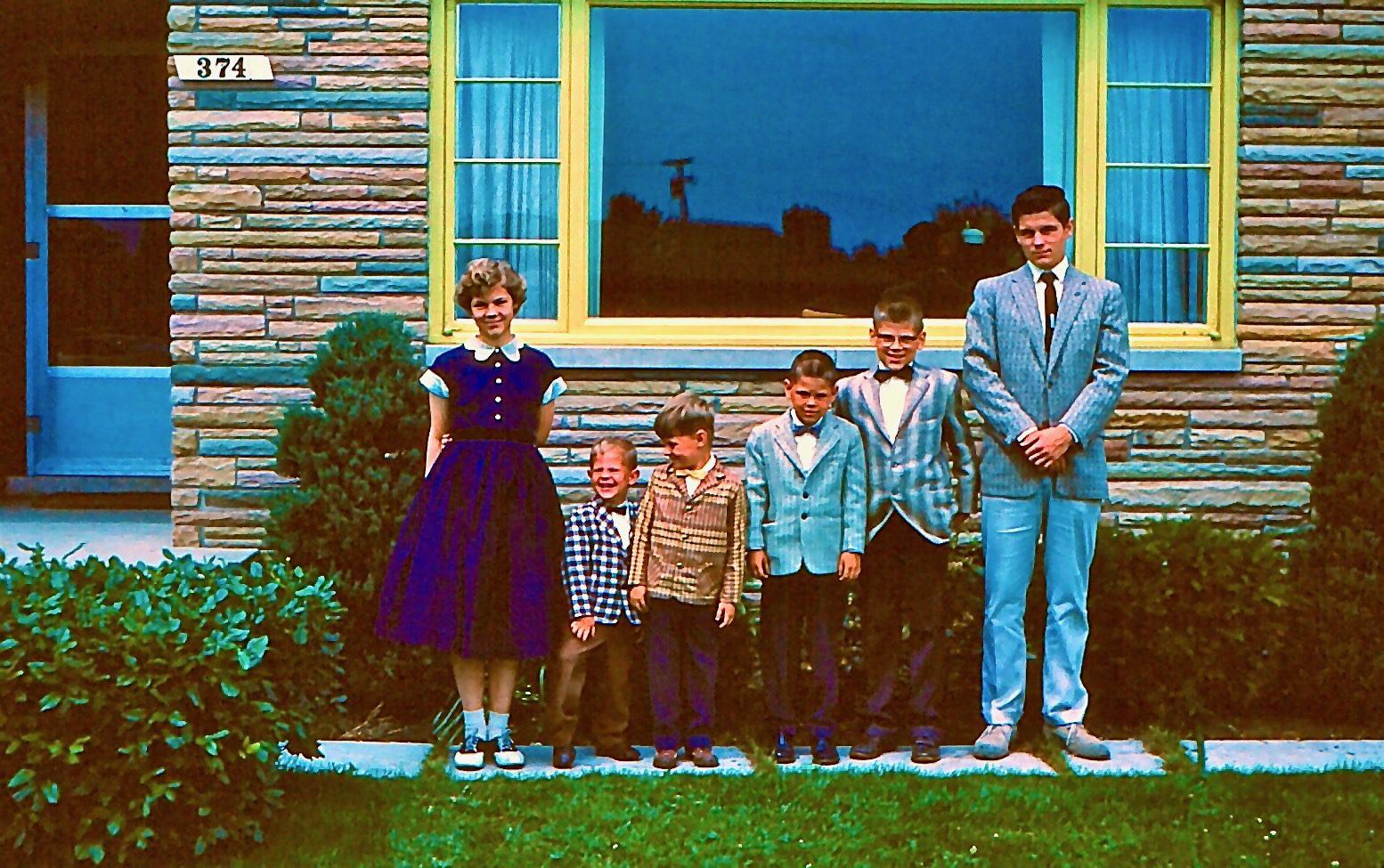
Here’s another classic siblings portrait – taken on a summer Sunday on Kinmore Court with Nita and I positioned as photo bookends.
Nita is striking a pose resplendent in bobby socks with a fashionable haute couture blue dress of the era.
The rest of us are decked out in sport coats and ties – hand-me-downs likely – and arranged by height, while Dave photobombs [maybe it was either his or P.J.’s birthday] – circa 1960.
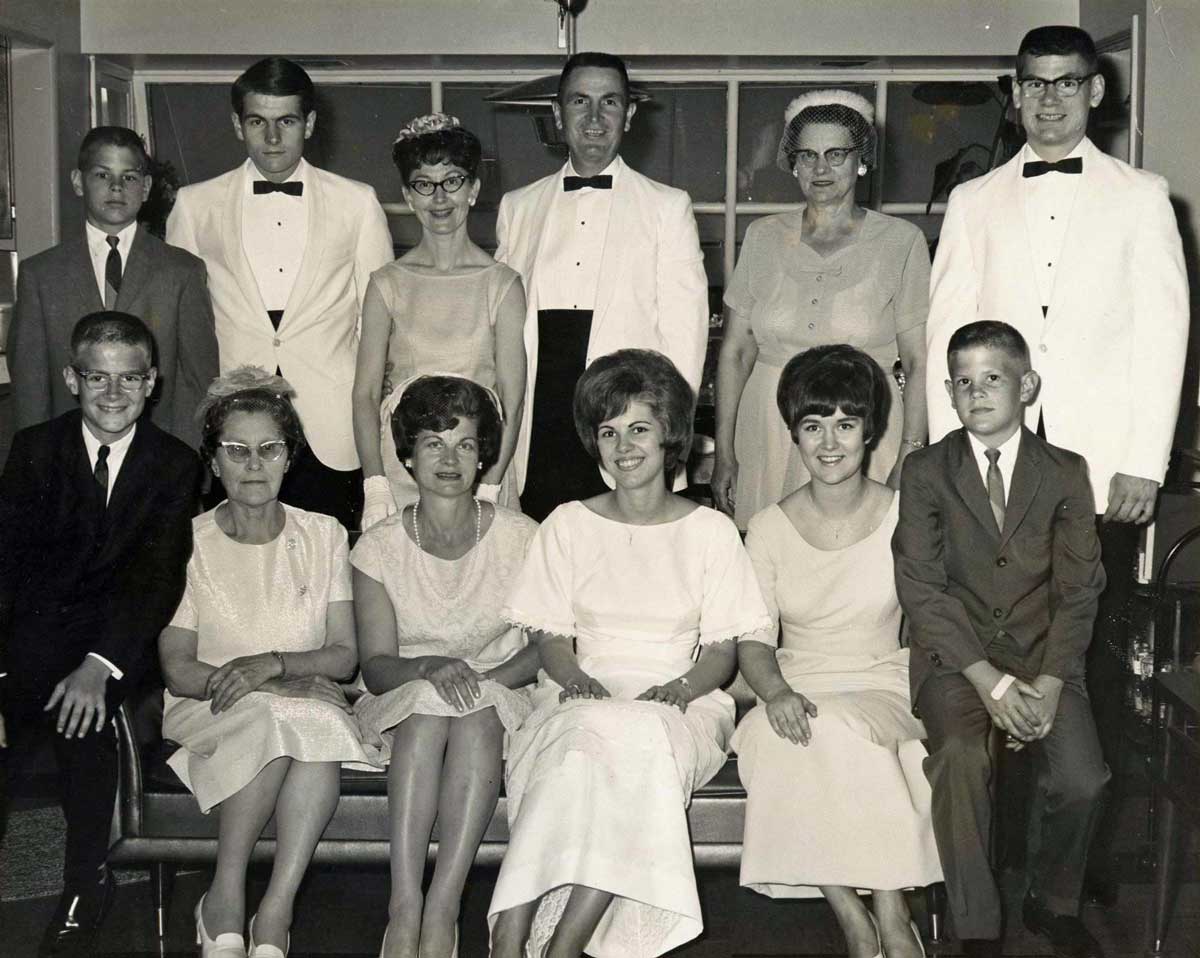 This classic portrait was taken after Nita & Joe’s wedding in 1965. Talk about family. Not only are Mom & Dad and all of us siblings in the shot, but seated to Mom’s right is Gramma Anna Chuda Babiy whose granddaughters Anita and Anne Spearman, seated together at Mom’s left – are both named after.
Plus, standing directly behind Mom is Dad’s sister our Aunt Estelle Spearman and to Dad’s left standing is Mom’s eldest sister our Aunt Mary Rogers.
And all of us were truly dressed to the nines.
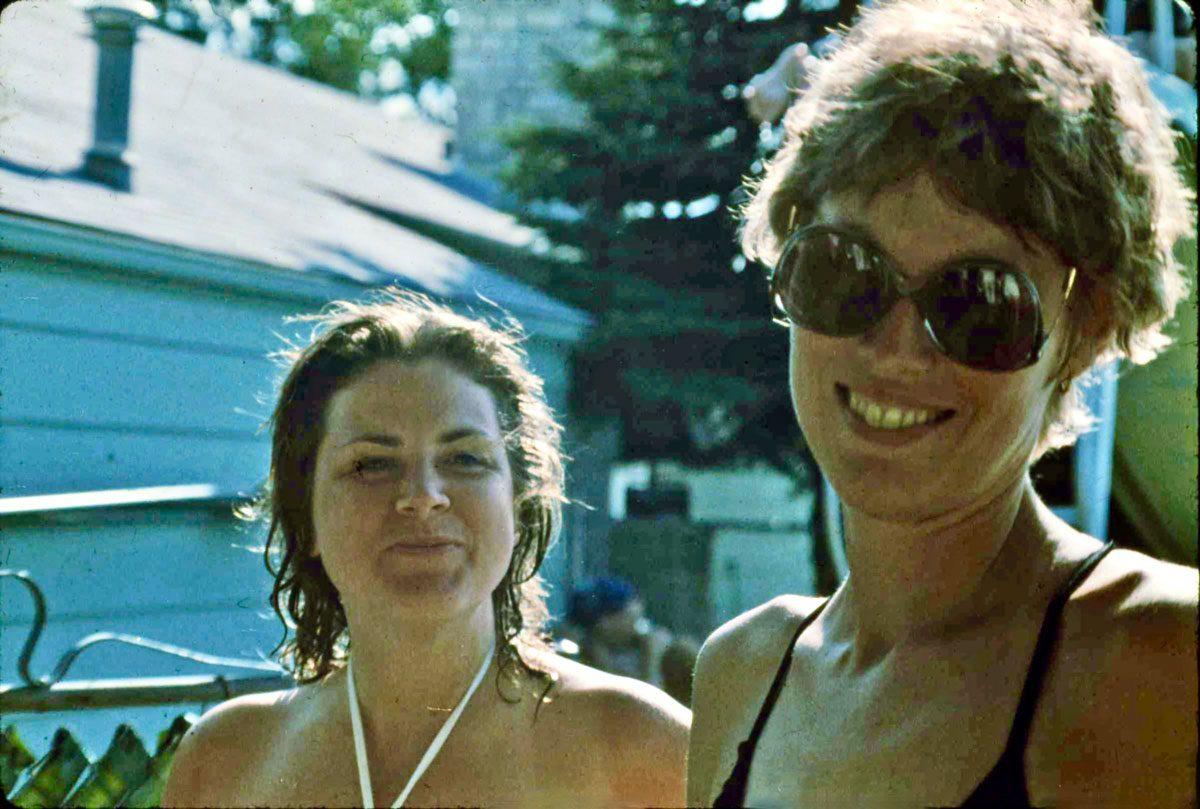
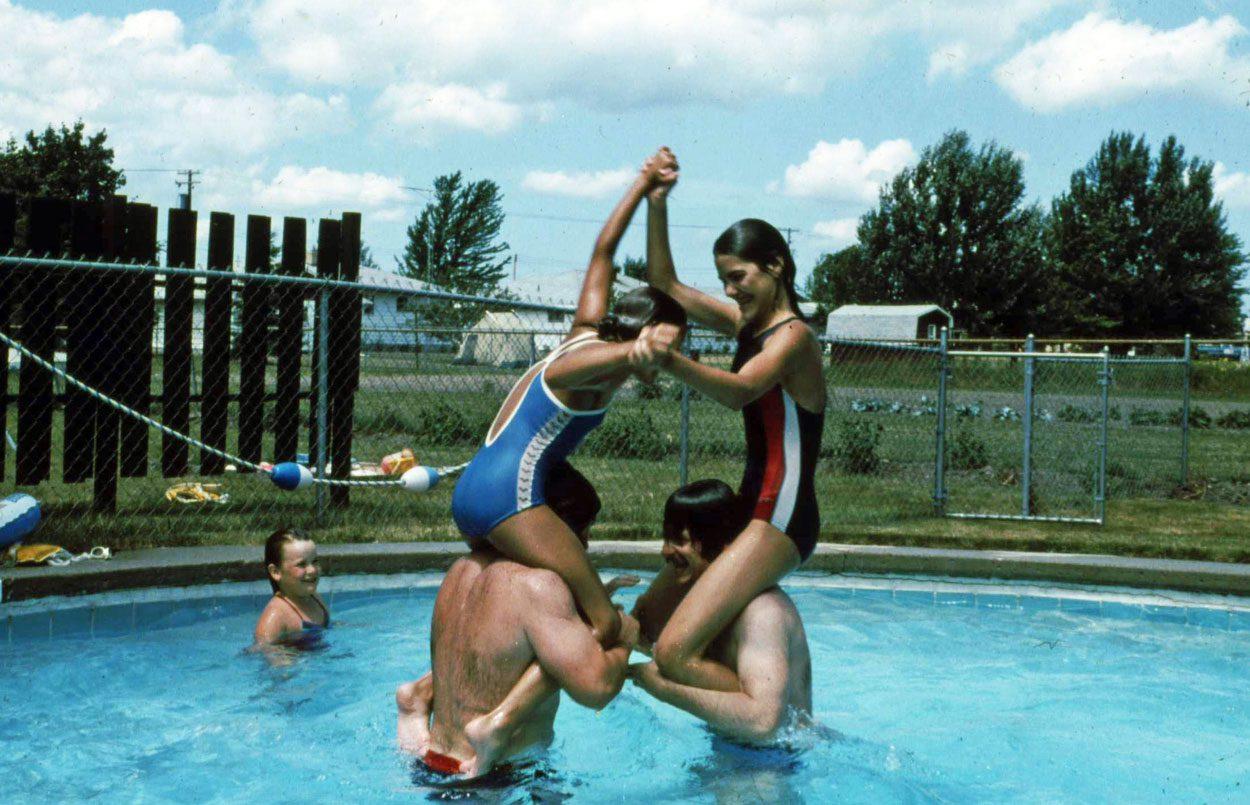
A word about the Feature Image and the one posted here. They were taken during the Summer of 1983 at a pool party celebrating the marriage of cousin James Davidson to his wife Cheryl the day before.
It marked the last time we had a gathering of the Babij/Blashill extended family clans that was attended by most of the living siblings/cousins, including all of the Davidsons – Mary Kay and her husband Art Basil; Susan and husband Jerry List – a former star athlete who suffered from MS; Lorna; Mark; plus James and bride Cheryl of course.
 Also in attendance were Mom’s sister Mabel and her son Richard “Dick” Van Conant and all of us Babij’s [or should I say “Babiy’s” – but perhaps that’s for another story].
Mom and Dad were there as well as; brother Paul Jay and wife Patricia with their children Bryan, Todd, and Jonathan; plus brother Dan and then wife Karen with daughter Krystn.
Brother John was present together with Anita, husband Joseph “Jose” Cabadas, son Joseph “Joselito”, as well as daughters Carrie Ann and Erin whom together became the life of the party at one point – taking over the pool itself including its slide.
You can view a slideshow showcasing this 1983 event by clicking the link provided here. Also we have also posted two photo galleries dedicated in loving memory to our beloved sister Anita. See the button links below.
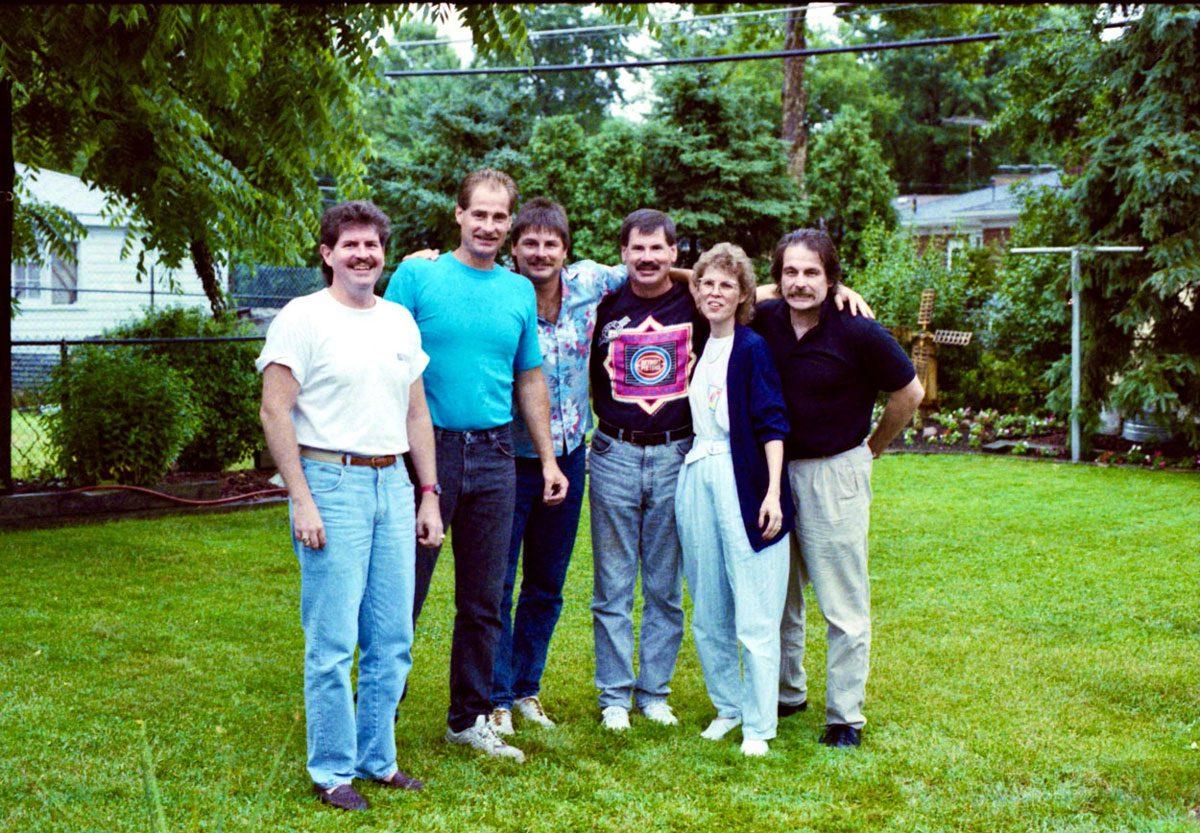
It’s May of 1991 – and our parents are celebrating their 50th Wedding Anniversary.
So we’re visiting Joe and Nita at their Warren Avenue digs and Joe manages to coax us into posing – right to left by age – for another family photo op.
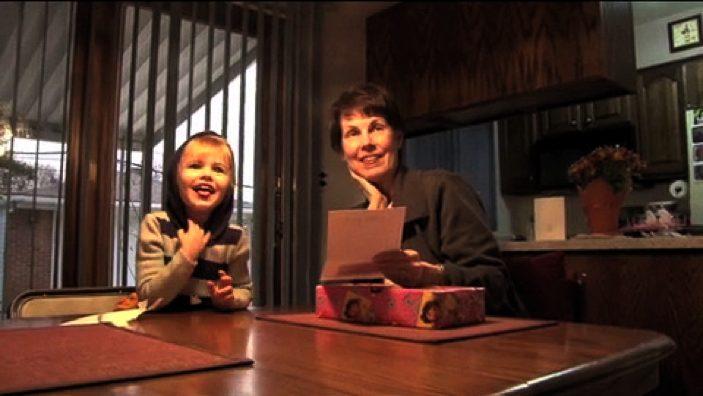
Then there were birthdays. Here’s a video compiled by Brother John shot in 2010 in celebration of Nita’s 64th. Just click on the image above.
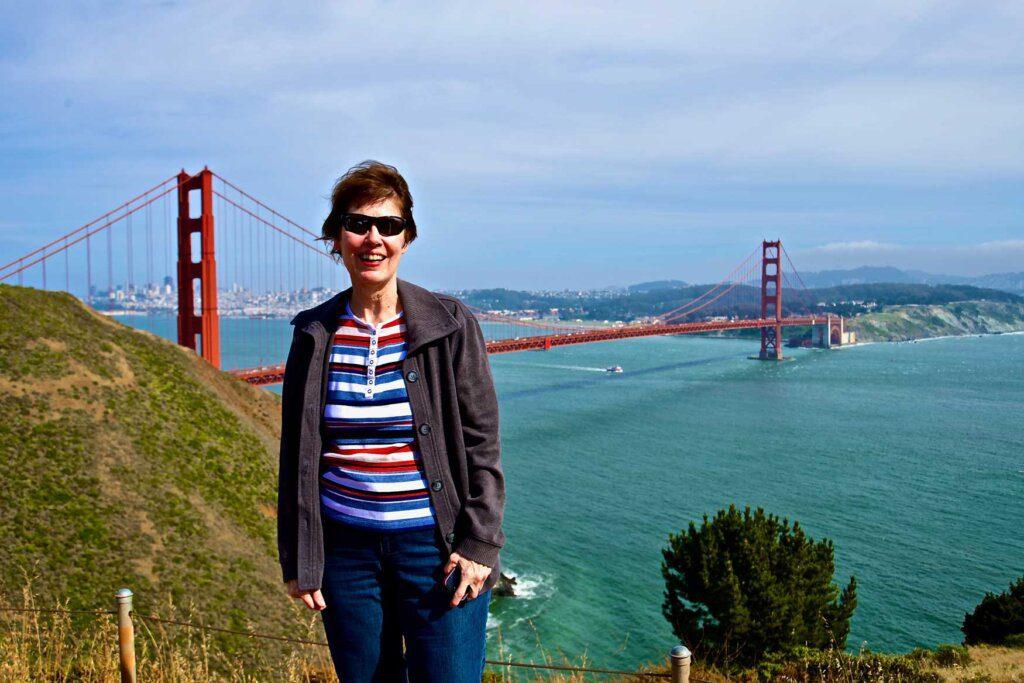
In 2013 Anita and Joe visited us in San Francisco where they were able to tour Napa Valley and its wineries; walk among the giant redwoods in Muir Woods; take a Ferry Ride on the Bay cruising under the Golden Gate Bridge and past Alcatraz; and pose for picture vistas from the Palace of Fine Arts, Land’s End, and Twin Peaks. I mean we locals never do this except when family or friends visit.
You can view the video by clicking the image above.
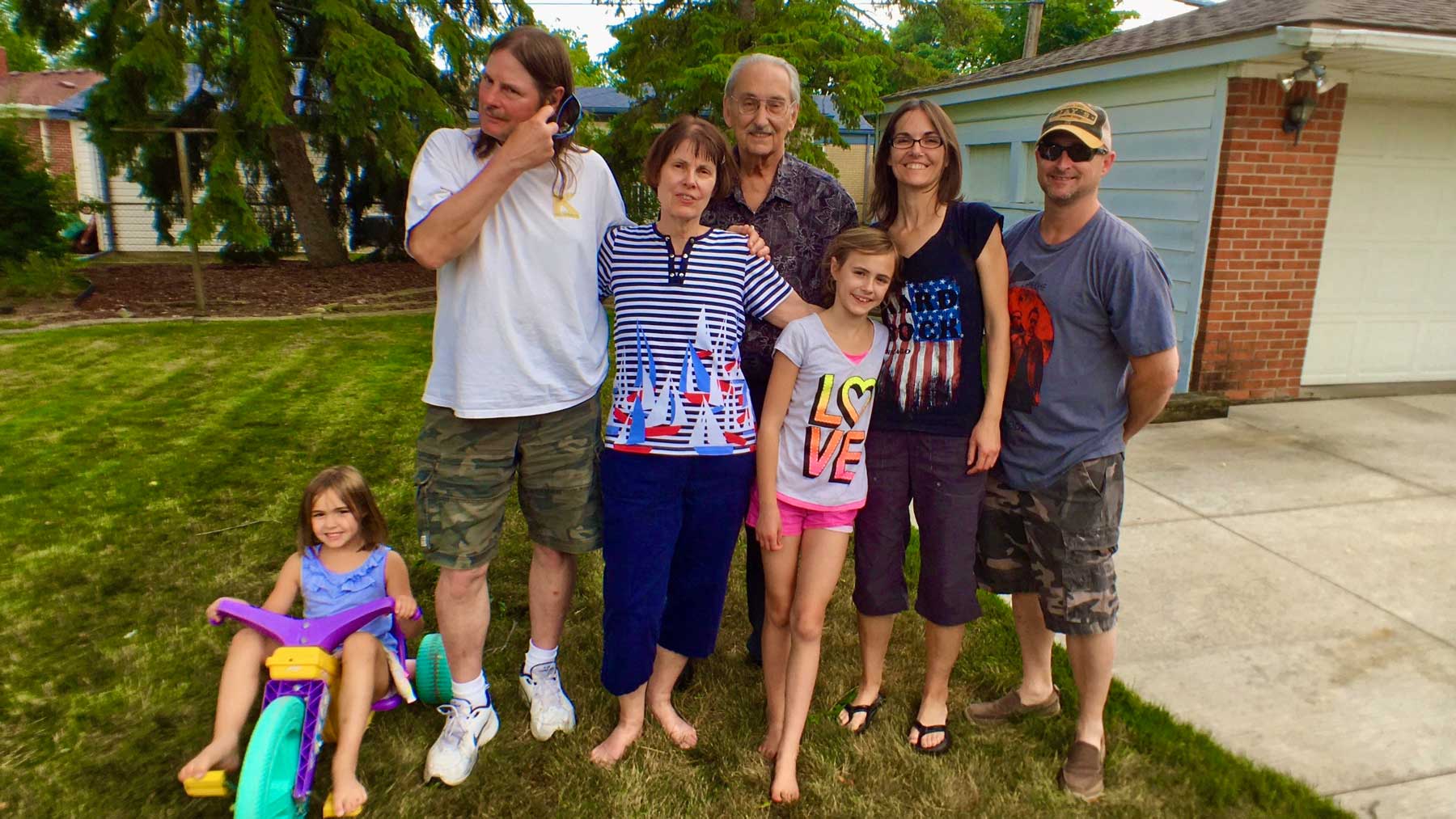
It’s the Summer of 2016 and the clan is gathering for Kim and Jessie Long’s wedding near Saint Clair. John and I stop by Anita and Joe’s to visit along with Carrie & Scott Caillouette and their daughters Noelle and Madeline and pose for a quickie.
 Anita and I at a Northville restaurant on her birthday in 2017. She is holding a pashmina shawl gifted to her by my partner Marcia Anderson.
I had recently come back home from Florida where I met up with both brother Paul and wife Pat – as well as cousin Anne Chavez – where we had piled into a car and driven South to Fort Myers for a visit with Anne’s mom – our Aunt Estelle – whom at the time was 90 years old.
You can check our our video posts Baika and The Tryzub Tales documenting both of these events.
Earlier that year I had traveled to Eastern Europe – first alone to Ukraine where I’d secured the services of a tour guide – Diana Borysenko – whom had taken me to our Babiy ancestral villages in the Terebovlia region of Ternopil Oblast where we searched the local cemeteries for family tombs, met with the town school master, and visited the State Archive in Ternopil.
In those archives we were able to find the birth record for our paternal Grandfather John [Ivan] Babij [Babiy] – photos of which I wanted to share with Aunt Estelle – and everyone. Hence the trip to Florida and the dinner in Northville.
Our other Eastern European destination was with Marcia, her daughter Artemis and her husband Sabin to his home town in Romania during which Sabin and his father took us on a week-long tour of Transylvania and many of its historical sites including Bran’s Castle – the alleged home of Vlad The Impaler. You can check out our video Tara Romaneasca and several galleries of the visit by clicking the highlighted links in that video post text.
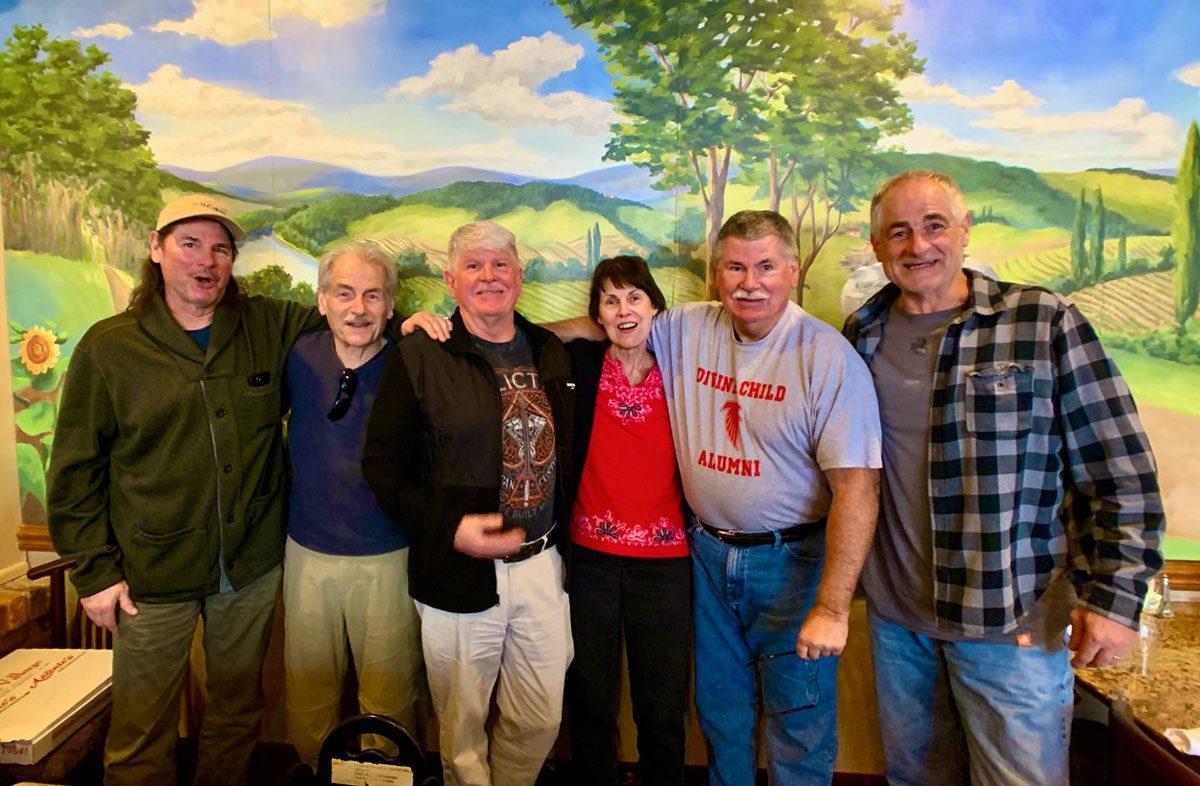
This photo was taken at Antoinio’s a local restaurant in Dearborn Michigan near Anita’s assisted care facility in 2019. It was the last photo taken of all six Babij siblings together. And as Luck or Fate or Great Contingency Planning has provided – we also have a video of more historical family events including one – titled Thumb Prints.
It features our tour that year of the family burial sites; first in Snover – meeting up with our cousins James Davidson and his sister Mary Kay – who passed away earlier this year; then on to visit the Croswell Babij gravesites, including a trek across the Swinging Bridge and ending at the reunion dinner featuring Nita and all of the siblings together with extended family. Enjoy.
Also you can view our Holiday Video Card For Anita slideshow which we published here during the Christmas Season in 2020.
Plus….we’ve just added button links below – first to a gallery that documents Anita’s life via photos taken between 1948 and 2024 titled Memento For Anita – a second button linking to a gallery titled Anita Joyce Memorial Celebration – as well as a link here to a short video titled Anita Joyce Cabadas – A Family Gathering both depicting celebrants whom attended Anita’s Memorial Luncheon that followed her funeral services at the Allegria Village chapel on December 30, 2024.
In Loving Memory Anita Joyce Cabadas November 13 1946 – December 8 2024.
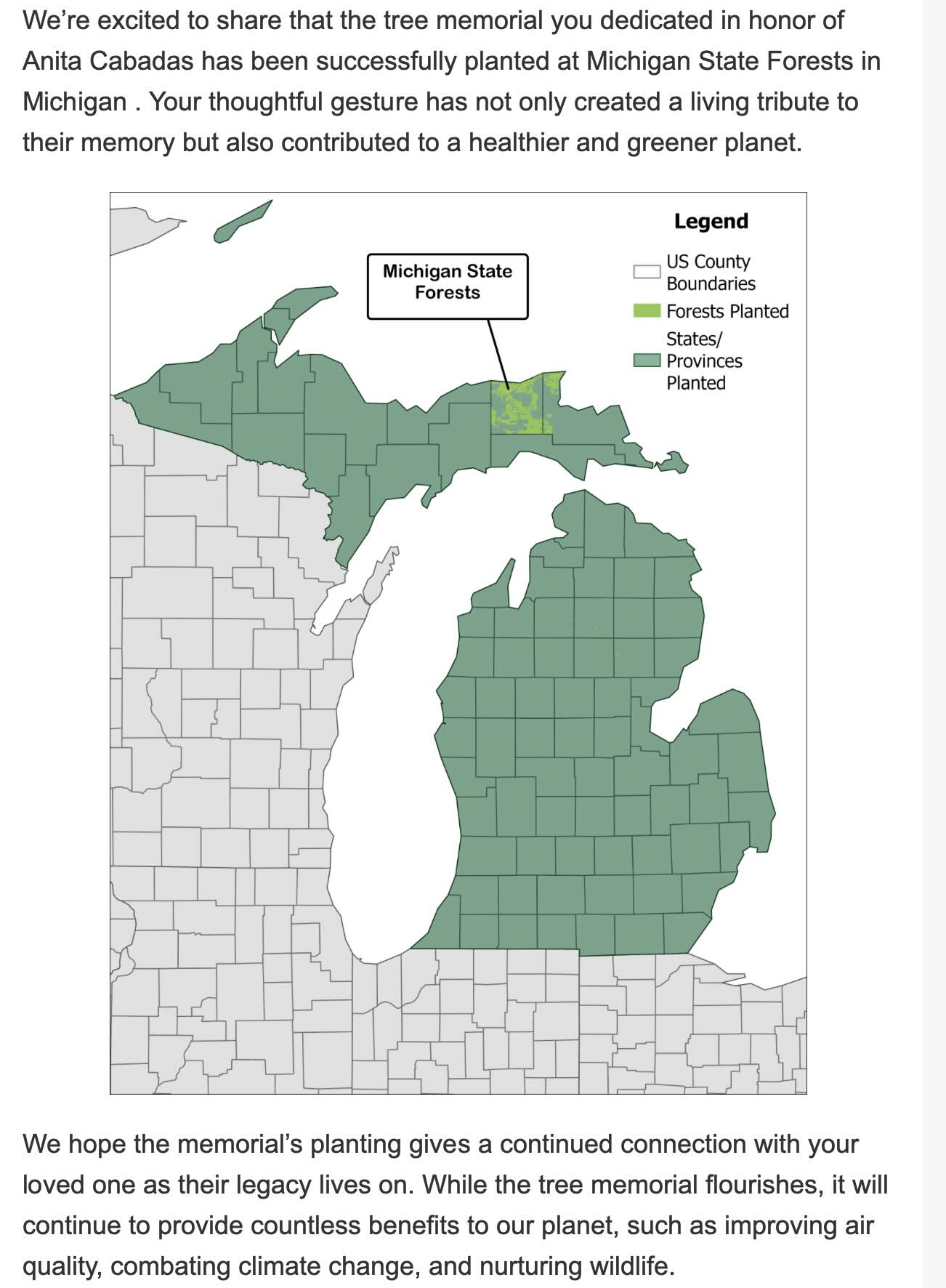
Just got this message from the “A Tree To Remember” folks. We had elected to have a tree planted in the Michigan State Forest as a memorial for Anita and – it has – in the U.P.!
Check out the photo and text of the message.
© Ruthenians.net MMXXV. All Rights Reserved.

Views: 0
We had a dinner recently to celebrate my birthday at a local restaurant whose cuisine was advertised as being “vegan sushi”. Now you might ask “how is this possible”? How can a Dragon or California roll be considered “vegan”?
Well, the short answer is to substitute vegetables for fish, and prepare dishes sushi style, like a cucumber and avocado roll with kimchi; or shitaki nigiri; or unagi nigiri made instead with eggplant; or teriyaki tofu nigiri. Needless to say we had great fun exploring the menu including a spicey nigiri style entree made with sliced beets over rice that came with a caveat for the diners: one of the items on the plate would have an extra dose of ghost-pepper added to its sauce. A common practice according to the waiter was to allow the plate to be passed around without indicating to the diners which sushi was the ghosted one so whomever turned out to be the lucky diner would subsequently need to down a shot of sake as an “antidote” for their scorched esophagus. It was decided to mark the affected piece of sushi with red-colored piping (which might actually contain the more pungent dose of pepper sauce) and whomever was the most adventurous of us four could opt to have a go at it. Well that left me out. Despite spending a wonderful time celebrating my special day with family injesting the tasty cuisine at the sushi parlor, ghost pepper and spirits are not my cuppa. You laugh but have you ever tried to scarf down a super-spicy *amuse buche*? First your throat, then your intestines catch on fire, next your eyes start to water, and then the sweats begin. Break out the fire extinguisher.
Besides the thought of it kinda reminded me of a scene from a BBC whodunit or an old radio mystery show like Suspense! during which a protagonist with a napkin neatly tucked into the collar of his shirt is sharing a meal while making jokes and laughing with others at a dinner table then suddenly has a seizure, collapses and does a faceplant into his soup.
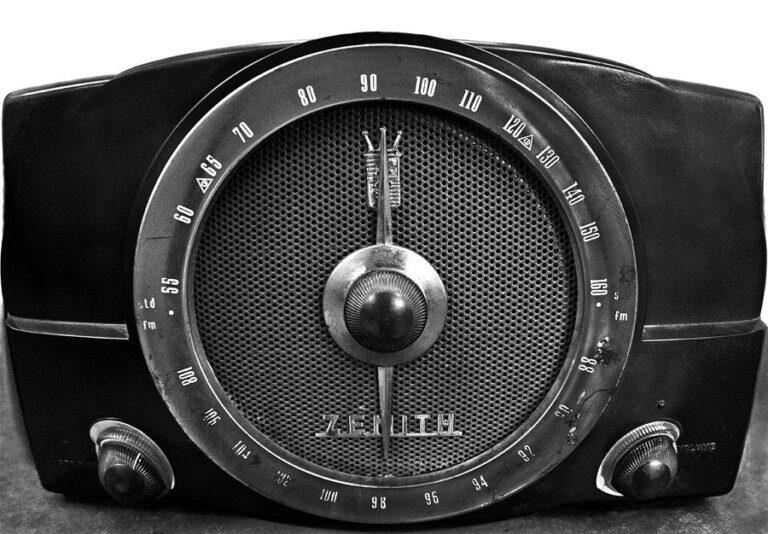
But then I’m just an O.G. whose history with the mass media goes back decades listening to classic radio shows that emanated from a small box with a clock and frequency/volume dials on its face strategically located on my night stand next to my bed. The Lux Radio Theater and The Screen Guild Theater would broadcast adaptations of Hollywood movies, performed before a live audience, complete with cast members from the original films. Suspense, Escape, The Mysterious Traveler and Inner Sanctum Mysteries were a few of the popular thriller anthology series one could easily become addicted to. My favorites shows as a whippersnapper included “Melody Ranch” featuring the singing cowboy Gene Autry yodeling his rendition of “Back in the Saddle Again” ; “The Lone Ranger” – a show that originated from a station with the “call sign” WXYZ located in our hometown of Detroit; and “The Shadow” whose opening lines were:
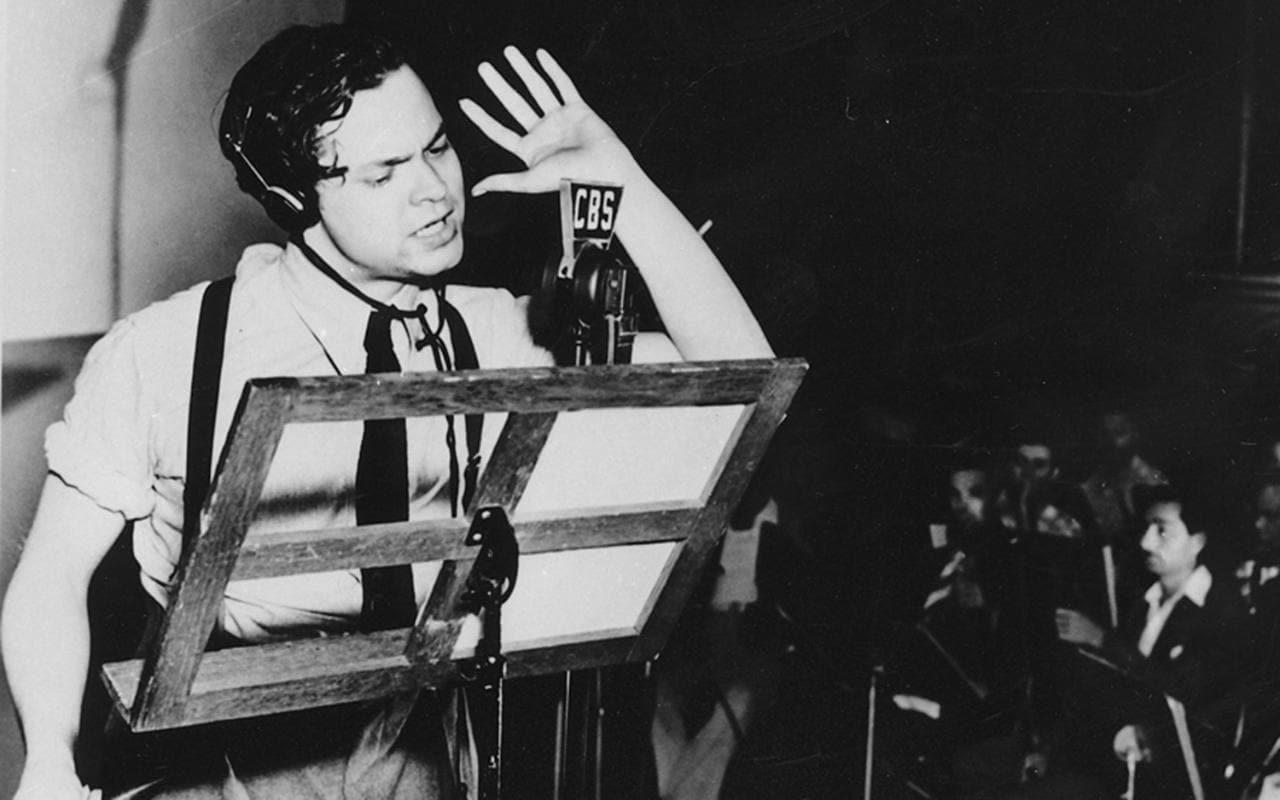
Of course the most famous – or we might say the most infamous show of all time would have to be the version broadcast on October 30, 1938 by the CBS Radio Network of the H.G. Wells classic “The War of The Worlds” via The Mercury Radio Theatre On The Air featuring Orson Welles – a little before my time – and one I would not actually hear in person for another 30 odd years after the original broadcast. More on that a bit later.
So what are these “call signs” anyway? They’re sort of acronyms of 3 to 4 letters in length – used to designate commercial radio and TV transmitter stations for a given country. In the U.S. those East of the Mississippi began with a ‘W’ and those located West of the river started with a “K” – with a few grandfathered exceptions. So, for instance the first radio news program was broadcast on August 31, 1920, via the station 8MK – call sign WWJ – in Detroit. Owned by a local newspaper The Detroit News, the station covered the local election results. Later these station call signs would be appended by either the two character call signs “AM” [amplitude modulation] or “FM” [frequency modulation] which designates how a station’s carrier wave was tuned for broadcast.
The marketing environment and content for audio media back in the days of the Golden Age Of Radio was completely owned, controlled and broadcast by essentially 4 Networks – National Broadcasting Company [NBC] – [originally NBC Red], American Broadcasting Company [ABC] – [originally NBC Blue], Columbia Broadcasting System [CBS], and Mutual Broadcasting System [MBS]. Plus radio during that era presented easy inexpensive access to media that by design was scheduled to air at a specific time, so listeners would tune-in to a favorite program as a part of their daily routine, and thereby become effectively conditioned to plan their day around the dial – a media marketer’s dream come true.
My first “live” encounter with mass media radio was when I was 8. Dad had a friend whose surname was Marko whom he’d either had for awhile or met while in the Navy (my assumption) who lived in Chicago with his family. For the July 4th holiday that Summer, Dad decided to gather up Mom, baby P.J., sister Anita, and myself and make our way either by train or car the 300 miles to The Windy City to visit the Markos.

[I do believe it was by rail as I dimly recall wandering through the massive 14 story Michigan Central Station located in the Corktown district of Detroit with its amazing Beau Arts style interior to board a train at some point in my early years.
But I could be mistaken plus I like to tell strories, so who knows?]
Be that as it may, we made our way to Chi-Town and on or near the Fourth, and posed for photos on the steps to the Marko’s house.
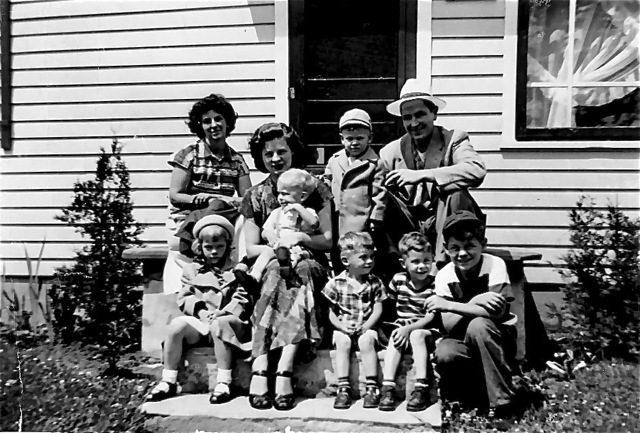
Later that week we all went downtown to the ABC Civic Studios to see the morning WENR radio/TV simulcast of Don McNeill’s The Breakfast Club. Once inside we were directed to our seats near the center of the theater. As we were just getting acclimated to the sights and sounds in the theater, one of the show’s producers came up to Dad and started talking with him. After a few moments, Dad turned to us and said : “They want us to get up on stage. I guess we’re the largest family in the audience today!” So off we went – all five of us.
Then the show began with its classic opening theme song – recited – not sung – by host Don McNeill:
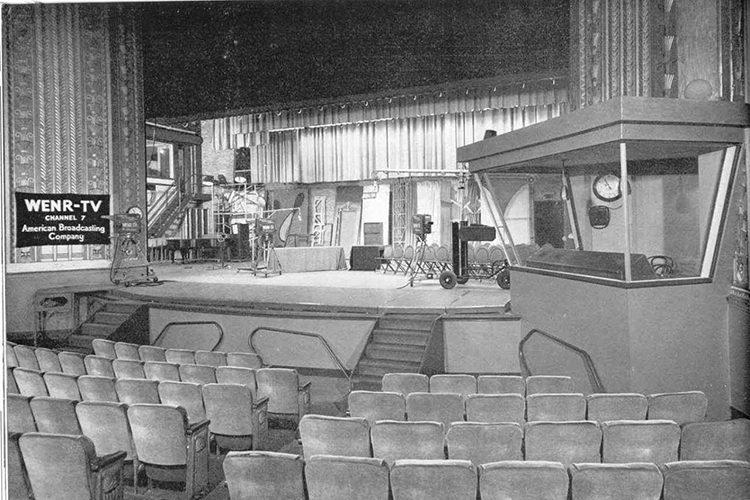
Once backstage we stood and watched transfixed as the broadcast proceeded. I was particularly taken both by the activity of the crew and cast members, scurrying around to their stage positions on cue, as well as the colors and intensity of the lighting – a fascination I would put to good use decades in the future as a member of the swing gangs at Fox Studios and careening around the streets of L.A. at night in a grip truck loaded with camera gear and lighting equipment we’d deploy to illuminate on-location scenes for the “no budget” feature films we shot. To do this we’d clamp onto public power receptacles using a power converter designed by none other than Alex Funke – then teaching at UCLA film school – who would one day share Oscars for special effects for his work on The Lord of the Rings Trilogy. In those days, it seemed everyone trying to “make it” in LaLa Land were actually making a living waiting tables, tending bar, teaching, or on the dole. Nowadays they’re probably doing all of the above as well as driving for Uber or Door Dash.

Anyway, Mom and Dad were eventually ushered before the host Don McNeill for an interview and my guess is that they were coaxed into singing one of their duets like “Apple Blossom Time” – but I don’t remember for sure I was so overwhelmed by stage fright. However I am sure that at a prompt by host Don McNeill, a stage hand led me up to a microphone and I was coaxed into singing “Old MacDonald had a farm…”. All I could do was focus on the mike – for sure bigger than any Good Humor creamsicle – that was literally jammed into my face – and somehow manage to stumble through a couple of verses of the classic nursery rhyme before cutting my solo short after:
“duck duck here, duck duck there, here a duck, there a duck, everywhere a duck duck, Old MacDonald had a farm ee-eye, ee-eye-oh”…
…then pause to glance back up to Ma and Dad with a sheepish grin. They laughed and the audience seemed to get a kick out of it too.
After that, Ma was gifted a new Lewyt vacuum cleaner and for my warbling I was awarded a tennis racket which over the years I used seemingly for everything else but tennis since I was no aspiring Hall of Fame tennis star like – wait for it — Don McNeill. 🙂 Yes…an equally famous namesake of our illustrious radio host. One might even wonder whether that tennis racket freebie was by inference a part of the script?
My attraction to the mass media would grow in the succeeding years – both radio and especially the “new” medium of television viewed via a 12 inch screen in black and white – which exposed us to programs like the Howdy Doody Show which featured host “Buffalo Bob” Smith – a name derived from a blending of “Buffalo Bill” and Bob Smith’s birthplace of Buffalo, NY – and a puppet named Howdy Doody – as in the idiom “howdy-do”. One expression from this show that in itself has become timeless is the reaction Buffalo Bob would sound when greeting the character Chief Thunderthud: “Cowabunga!”
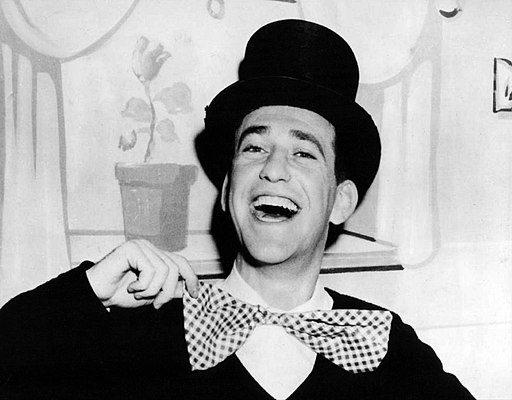
And who could forget the legendary children’s lunch show “12 O’Clock Comics” [AKA “Lunch With Soupy Sales”] broadcast live from WXYZ-TV in Detroit featuring the completely improvised zany antics of Soupy Sales together with the hand-held puppet characters of White Fang and Black Tooth.
Soupy was a big Jazz record collector. He also had an evening show called Soupy’s On featuring great Jazz musicians including Coleman Hawkins, Louis Armstrong, Duke Ellington, Billie Holiday, Charlie Parker and Stan Getz who appeared on the show. Plus Miles Davis even made six appearances.
You have to check him out, although sadly the episodes from the original series that aired in Detroit were not saved. However, Brother John has managed to find a rare, completely improvised, studio-only camera clip of Soupy’s “Lunch With Soupy” show featuring a surprise visit by a stripper – completely unbeknownst to Soupy. Of course we cannot show it here but we do have a link to a YouTube interview of Soupy during which he talks about it.
Call signs were deployed not only for commercial stations in the US and around the world. The military used station call signs for braodcast communications as well as ship-to-shore communications. Every command, unit and division, each ship and plane, and military instillation had a call sign. The United States Army uses fixed station call signs which begin with W, such as WAR, used by U.S. Army Headquarters. The Navy uses call signs beginning with “N” and the Air Force uses “A”.
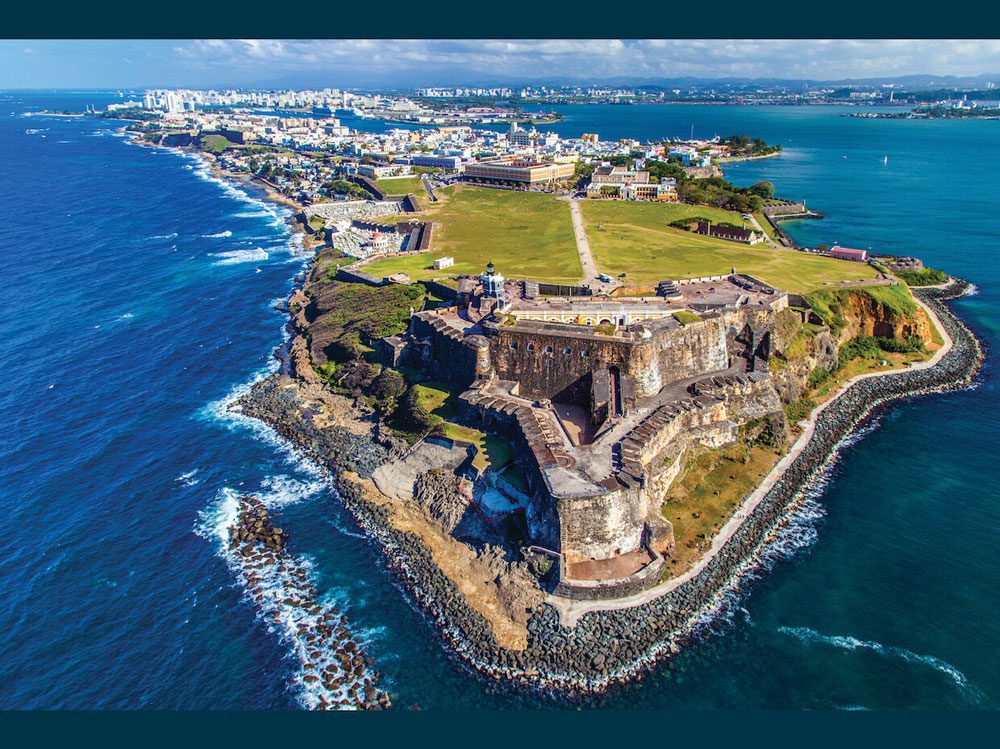
My initial duty station in the Navy was given the call sign “NAU” pronounced “new”. It was a Communications station in the Caribbean with transmitters that connected it via point-to-point radiotelegraphy and microwave signals with other stations and ship at sea in the area. You know, one of those places no one was supposed to know about that was surrounded by high fences and patrolled night and day by security forces.
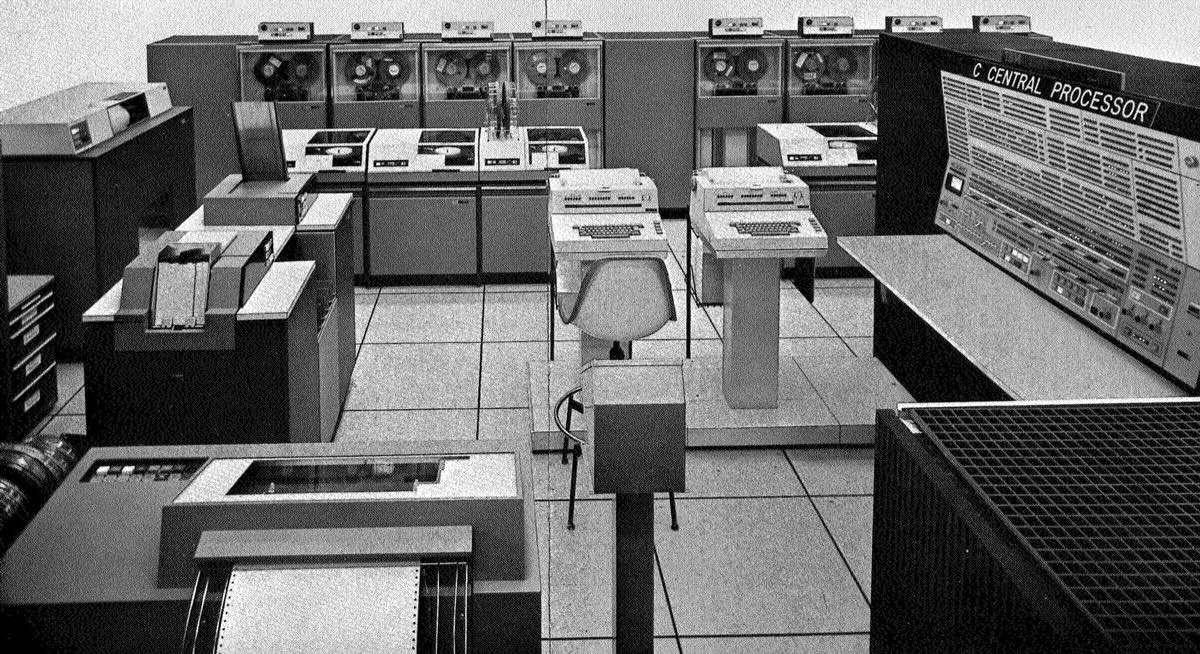
So here I was – declared an “officer and a gentleman” by act of Congress – but in reality a complete newbie to the technology behind and inherent in this duty station – technology that was supposed to be my job to handle. I was confronted with and confounded by rooms filled with row upon row of devices with blinking lights clattering away 24/7; card punch machines interfaced by a QWERTY keypunch device used to literally punch out a program employing an early version of the basic programming language onto a card or series of cards, which were then scanned via a reader to produce paper tapes which in turn were loaded onto a reel to be processed via an IBM computer [similar to the one pictured here] – that took up an entire room by itself – for broadcast over a secure network to the world.

One circumstance I was completely capable of handling was to take advantage of the amenities offered a young single guy in the sub-tropics, like complementary room and meals at the BOQ, and the use of a nearby swimming pool where on my off-duty hours I could work on my saltwater tan at the taxpayers’ expense, take sips from my favorite beverage, and – completely riveted – page through Joseph Heller’s scintillating anti-war novel Catch 22.
Be that as it may, one of my most poignant memories of that time was spent standing a mid-watch – an all-nighter – observing activities in the Comcenter while its teletype machines were burping out page after page of text reports on the Detroit riots of 1967. My home town in flames. The following year I would witness the Chicago anti-war riots duing the 1968 Democatic Convention from a TV in the BOQ on Treasure Island. Our country in chaos – a redux which we seem to be heading towards once more.
Later that Summer I would participate in anti-war demonstration marches through Golden Gate Park – dressed in civvies of course. In 1970 these demonstrations would morph into mass protests fueled by the Nixon administration’s further escalation of the Vietnam war as well as the Kent State massacre that, having been broadcast globally over both radio and TV, would eventually spread nationwide, spark fears of a national insurrection, and close many college campuses for the remainder of that school term.

Today we are witnessing a resurgence of that anti-war climate both worldwide as well as by GenZ college students nationwide in response to the Israeli attacks on Palestinians in Gaza, one important difference being that as of this publishing the Mass Media has literally been forbidden by its corporate owners to discuss the Palestinian side of the conflict either on air or via blogs for fear of airing or publishing anti-semitic rhetoric which could cast a critical shadow over Israel’s attempts to defend itself. While that may be relevant the truth is that such policies tend to restrict the frequency of free and open discussions about the war and its repercussions and do nothing to resolve the war itself. Plus my thoughts are that since by definition Palestinians and Israelis are both semitic peoples, this war itself is clearly anti-semitic. Besides, wars never solve anything, they just create more hate. And who’s to blame? Try dog spelled backwards who doesn’t seem to even give a howl. [DGMS].

So, having been in communications in the Navy provided the inspiration to continue exploring communications opportunities in the mass media field once I became a civilian again. And upon “retiring” from the Navy I applied for and was accepted at the University of Washington’s Communicatons School located in the communications building, the top floor of which featured a series of teachers offices, media editing rooms, production studios, and the broadcast facilities of the university’s FM radio station whose call sign was KUOW.
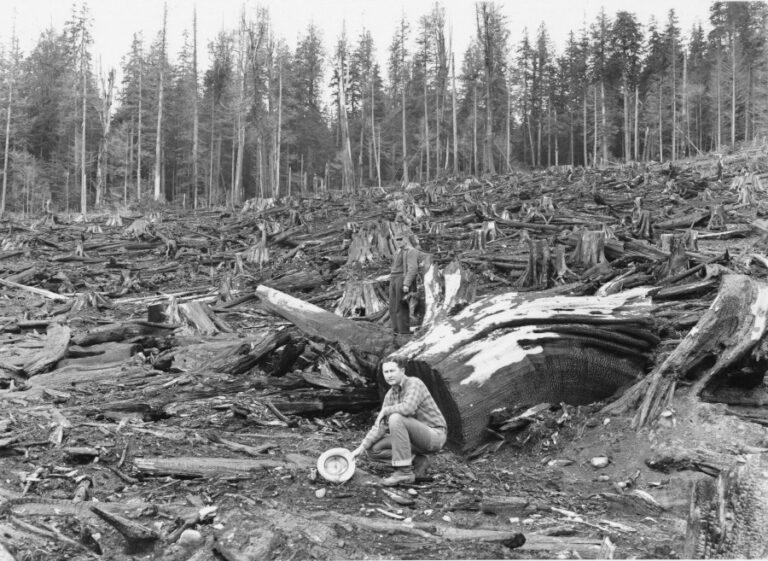
For the next two years I would completely immerse myself into the media complex of the school, attending classes and lectures, participating in extra curricular projects like filming the environmental devastation resulting from the clearcutting of the nearby forest that was part of the Quinault Indian Reservation by Georgia-Pacific [both then and now a part of Koch Industries – you know the Koch Brothers]. The tribal council were then actively suing the Bureau of Indian Affairs – which had historically been tasked by law to oversee forest management policies and distribution on the reservation – for mis-management of the forest resources that the tribe depended upon for survival [the tribe eventually won the suit].. We shot the film [16mm] using cameras borrowed from the local PBS station KCTS -TV – then owned by the university – and cut the developed film negatives in one of the editing rooms in the basement of the Communications Building – my very first attempt to edit a film.
For another project, an instructor for a writing class I was taking had somehow gotten hold of an early prototype VCR that used three-inch reels of half-inch videotape that we used for class projects. Shooting was challenging since you had to literally strap on the bulky recorder and balance the camera with its long cable attached to a port on the side of the VCR to even take a shot. The real problem was technically editing the result which involved a dubbing process of starting and stopping both source and master machines in sync in order to produce a coherent result. Needless to say it was a learning experience in every sense of the term..
Sound editing was another media technical skill that one needed to master. Learning how to duck the music under a narration, add sound effects to a track, or master the art of the segue were key skills necessary for landing a job in both radio and TV or film. Timing is everything a paramour once chided me. 🙂 During one such class the instructor Irv Broughton , who also published his own literary quarterly and whom I would later join on a legendary cross country literary quest, began reminiscing about his favorite old time radio shows when he let me in on a little secret.
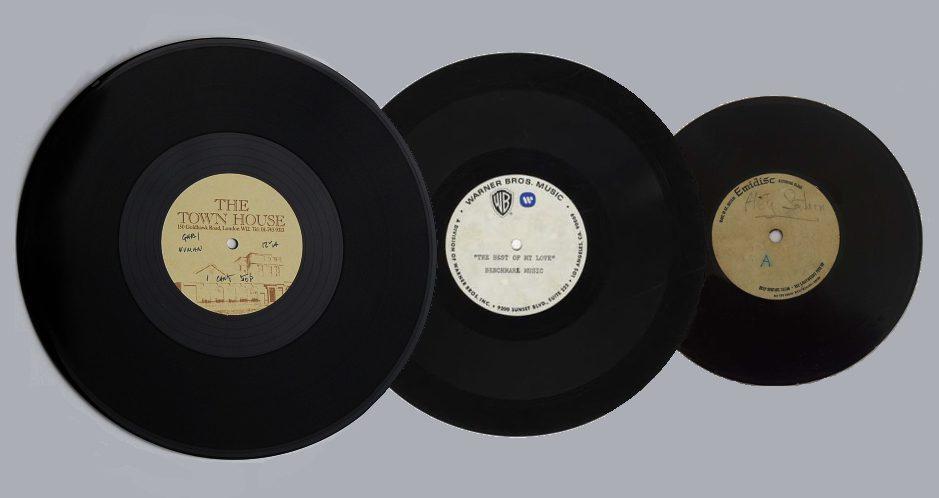
These discs called electrical transcriptions [ET] – often 12″ to 16″ in diameter – were actually made from aluminum with a coating of cellulose nitrate shellac, upon which radio broadcasts were etched and archived for future use. Staffers at KUOW had apparently found boxes of these discs stored in an old transmitter site that once belonged to a local radio network affiliate station.
Plus…KUOW was looking for volunteers to help transfer the contents of these discs to audio tape. Needles to say I wanted to be first in line, and later that very afternoon I was – anxiously seated in a chair in front of a turntable in the archive, it’s shelves filled with stacks of boxed discs, all neatly labelled by network and show. And on the table next to the turntable sat a box of 7″ reels of audio tape waiting to be loaded onto the reel to reel tape machine situated nearby. A quick glance at those shelves confirmed not only that I was surrounded by broadcast radio history, but also that I was in radio heaven.
Sooo..care to guess which show was one of the first that I transferred to tape? I’ll put a link to it below so you can have a listen at your leisure when convenient [it’s an hour long].
The lecture halls were on the ground floor of the Communications Building where a class of 50-100 students would meet several times a week for a talk given by a professor on topics to be covered for the specific class they were enrolled in. One particular lecture series that captured my attention was titled “Communications in Theory and Practice” given by a professor whose name escapes my cluttered mind some decades later. His talk that day covered the recent history of the mass media back then and its influence on popular culture – a presentation which initially began with an outro audio clip from a very popular old-time radio mystery show from back in the day, broadcast over the lecture hall’s P.A. system:
One important difference with these recitations was that unlike other such lectures, at its end the entire class would have to undergo a previously prepared snap quiz on the subject and content of the talk they’d just heard which – when added to others the class would experience throughout the course’s term – would determine one’s final grade for the class. That being said…. you had to stay focused for every class and take great notes [there were no Cliff’s Notes] … plus no checking out that blonde in the front row.
So, once his lecture ended, the instructor produced copies of the snap quiz from a nearby briefcase, gave them to the T.A. to hand out, and we had 20 minutes to complete the questions listed on its pages. These pop quizzes were always both challengingly thorough and humorously entertaining with some kind of twist somewhere in its layout and this one did not disappoint. There, located at the bottom of the last page was the final query of the quiz:
What bears Bitter Fruit and Who Knows?
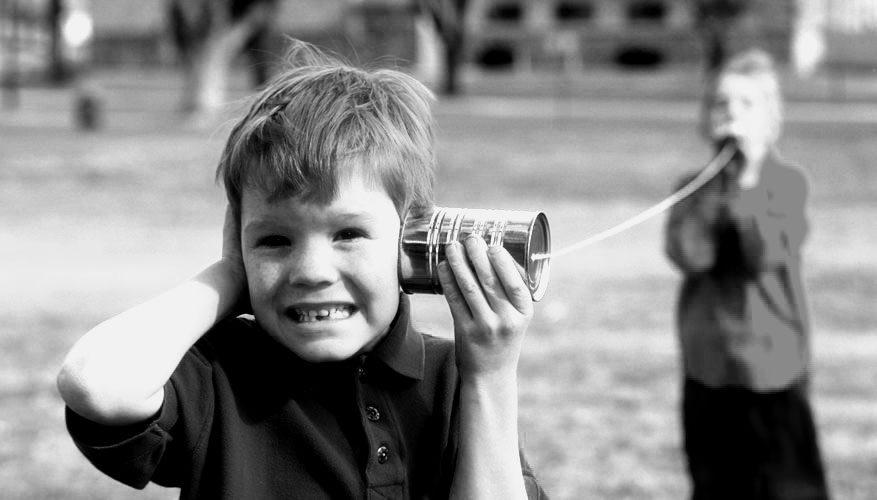
During another such talk given by the same professor, we were fortunate to participate in an extraordinary communications experiment – a rumor chain – AKA Grapevine Communications. The way this test “worked” was to place everone in the class in a seat directly behind the person in front of them – except for the front row of course – row by row – front row to top. Each person in the front row was given a pad of paper on the first page of which was typed a story consisting of a paragraph with several key bits of information.
We were given a minute [60 seconds] to read the message, then prompted to fold that page back over the top of the pad so as to completely cover the original message and secure the folded page with a rubber band, then hand-inscribe a synopsis of that message on the newly uncovered page, and subsequently when prompted to, pass the pad to the person behind us who would do the same – row by row – up the chain to the top.
When the final message on each pad was compared with its original, the two messages were always quite different, in some cases completely unrelated which – by design – clearly demonstrated the inherent long-term distortions we as informers/informants incorporate into the narratives we’ve heard then subsequently relate to others. We tend to filter such chronicles through our own learned anxieties, prejudices, experiences, and opinions, then often elect to focus not on the details actually contained in the message we are recounting but our opinions on what that message should contain. Our instructor called this process – selective perception –
a cognitive process where people selectively attend to certain aspects of their environment or particular stimuli while ignoring others.

And this discriminatory process exposes a predominant methodology deployed by the mass media – back then and continuing now – for controlling public awareness about socio-political and economic programs, practices, and issues including the process of either extolling or exposing the personalities associated with the issues being explored. Social media jumps right off the “page” – literally on our computer screens, where through the medium of electronic mobile devices, pundits openly express their constitutional right to freedom of speech but do so in ways that morph opinion into fact or make no distinction between the two. This is called “news” with a panel of talking heads gaslighting opposing views with claims of “fake news” and “alternative facts” coupled with the implied tautological assertion that “the truth is what I say it is”. [DGMS]
Need an example from the “real world”? Okay, for a classroom project exploring the subject of newsworthy reporting, I interviewed the News Director for one of the local Seattle network TV stations during which I queried him about the process of news gathering: who the people were that did the reporting; how were they assigned to stories; what were their tasks; how were these reporters evaluated; what kind of background did they need and basically what type of person gets hired. [He took one look at me dressed in an my old Navy officers coat with my long hair and beard and said pointedly: “You wouldn’t get hired”]. My final question was, who gets to choose what kind of story makes the news? He replied:
“The news is what I say it is”.
Eventually I did a live audition as the host for KUOW’s 4-7 PM weekday broadcast of the program All Things Considered from National Public Radio [NPR], the network’s then fledgling newscast which had premiered in May 1971 nationwide. Since KUOW was a charter member this was a big deal, especially for a student whose only previous live experience behind a radio mike was singing “Old MacDonald Had a Farm” more than two decades before.
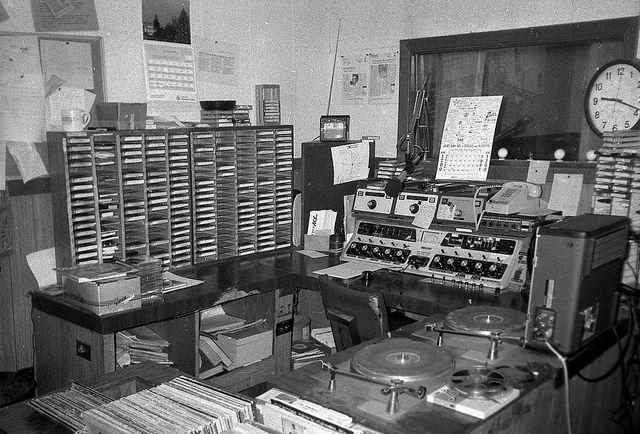
Plus there was a set of routines an announcer had to master in order to ensure un-interrupted on-the-air transitions and segues run from the control booth. You had to be a D.J. and be able to flawlessly cue LPs and audio tapes so that they started promptly when launched – no “dead air”. For the sixty second musical transitions between segments of the show provided by NPR, you had to be ready to “pot down” the music while “potting up” your voice intro that included the station’s ID plus a series of blurbs about the content of future programming to be aired – then close with a station ID outro and “pot down” your audio while bringing up the audio level of the background music. No “dead air”. BTW, “pot” stands for “potentiometer” – the volume dials or sliders on a typical control room dashboard like the one pictured here.

Then there was the five minute break in the All Things Considered broadcast for member stations to air local news which if memory serves happened at 5:55 PM each weekday that meant you had to access KUOW’s news cubicle – a glass enclosed space with a table in the middle and two teletype machines against a wall, one networked into the Associated Press [AP] newswire and the other to UPI [United Press International] – that would periodically burp out pages of text regarding the local weather and the “newsworthy events” of the day. Between control booth on-air tasks, you had to periodically dash over to the news cubicle, assemble text printouts from the teletype machines in some logical order for broadcast, then edit the text itself making sure you had enough to last the length of the news-break, and make sure to place the weather forecast at the very end because you always closed with the weather predictions because your audience expected it because – especially in Seattle – they needed to know if it was going to rain.
KUOW’s programming was by and large wall to wall classical music and opera interspersed with news breaks and “live” or pre-recorded interview shows throughout the day. And once in a while I’d substitute for a host who was sick or needed some time off – especially on a Sunday – when after scrambling up several flights of stairs at or before 6 AM – I’d burst into the master control room, turn on the lights, and give the transmitter site a “rap on the horn” so they could power up the station’s transmitters. Then I’d proceed into my shift and follow the script so to say – spin the recordings that were listed; perform the news breaks and announce the day’s programming until relieved.
One such relief person was a young student who had a deep and resonant voice – basso profondo it’s called I believe -that was so sonorous I swear it sometimes caused the windows of the control room to vibrate. His name is Steve Reeder, who would go on to spend nearly a decade in Chicago teaching at the university level and broadcasting there from WFMT-FM then subsequently return to the Seattle area to work at KING-FM for decades I’m told.
Steve enjoyed a Friday evening time slot at KUOW that – if memory serves – ran from 8 PM to Midnight and he had some ideas about the kind of contemporary programming he’d like to air during his shifts. However the music library at the station was a bit scarce for genres other than the classics. Most radio stations build their music libraries over time from promotional discs they receive via music publishers whom are eager to get their performers and music heard by the public, so freebies meant free air time.
Consequently, this entailed completing several tasks that had to happen – soon. One was convincing the station manager to first alter KUOW’s classical programming ethos to include a few hours of contemporary performances on Friday nights and second to reach out to the popular music labels like Atlantic, Columbia, Warners, RCA, Capitol, etc. for promotional copies of their current releases. Another was to bring in copies from our own personal libraries to air. Fortunately Steve was very good at getting his ideas heard because within days he got the green light from the powers that be to begin airing his programming for the time slot and I would be along for the ride as his sidekick.
The “plan” initially was that Steve would begin the shift and air content of his own choosing: music tracks, interviews, live in-studio sessions, and pre-recorded events, then I would finish the shift with content of my own choosing that contained similar programming options which for me meant the primary focus would be on Jazz.
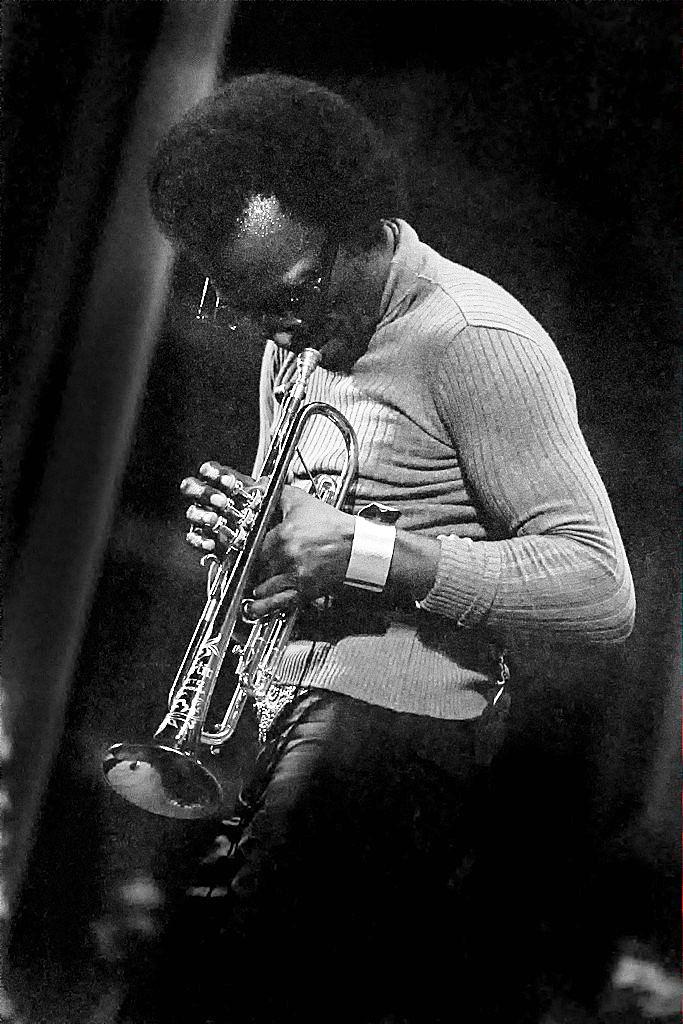
Ever since I was a child, listening to recordings my parents had by Glenn Miller and Benny Goodman I was fascinated by the genre. This Jazz allure continued on into my college years when I started to sneak into after hours clubs in the Detroit area – there called “Blind Pigs” because the Pigs were on the “take” and turned a blind-eye to what was happening in them – which was Jazz and…well you know. I used to play the recordings of the great pianist Bill Evans at parties back then, even after my girl friend at the time called the music boring. Or maybe she meant I was boring. In any event, I suppose that was one reason why I took her to see John Coltrane at the Drome Lounge in the Detroit ghetto where he proceeded to blow the roof off of the place. Boring my ass.
Anyway, back in the early 1970’s the most popular genre in Jazz had been pioneered by the legendary Miles Davis. It was called “Fusion” or “Jazz Fusion” and as the term implies it was a blending of classic jazz rhythms and phrasings with rock and roll and the blues [sometimes also called “Funk”]. And Fusion’s most favored performers were Miles himself [his album “Miles In The Sky” remains arguably the first Fusion album of it’s genre ever recorded] plus artists either influenced by or former bandmates of Miles like: Herbie Hancock, Chic Corea [Return To Forever], Wayne Shorter & Josef Zawinul [Weather Report], Tony Williams [Lifetime], guitarist Larry Coryell, and the then rising star in the Fusion Galaxy guitarist John McLaughlin AKA “Mahavishnu”, leader of the Mahavishnu Orchestra. For my segment I briefly used McLaughlin’s recording of “Follow Your Heart” as its theme.
We worked “live”, manually mixing tracks together either by segueing the audio from one turntable perhaps playing “Rawalpindi Blues” from Carla Bley’s Escalator Over The Hill under another turntable spinning “Miles Runs The Voodoo Down” from Miles’ Bitches Brew album or by starting clean, one track outro to a succeeding track intro. But unlike the classical programming at KUOW, we had no plan – no prepared list to go by – at least I didn’t in the beginning. It was all improv. I had a friend who even loaned us several original 78rpm discs by Louis Armstrong and Jelly Roll Morton so we could tape them for a future airing. Steve and I would also set up the studio for live recordings, usually small groups, solo performances for voice and guitar or piano, and on one occasion a percussionist who soloed for 30 minutes. This meant fewer audio issues with mike placement and mixing for the resultant broadcast audio which we would also tape for the performers.
Every media event – be it a news show or a podcast or a Taylor Swift concert or a halftime extravaganza at the Super Bowl – has a script; a schedule for what happens when and who is involved. Radio audio is no different. From the advent of ETs to audio tape to digital recordings – the content for those old-time radio shows, newscasts, historical events, live performances, and interviews was pre-recorded for broadcast at a future time. Why not music?
Toward the end of April 1972 I was approached by KUOW’s station manager who introduced me to four UW journalism students whom had been gathering support, equipment, and funding to start a non-commercial radio station whose call sign would be KCMU-FM that was to be completely student managed, operated and staffed, which would be initially housed in spare studio spaces on the third floor of the communications building adjacent to those occupied by KUOW. They desperately needed experienced staff to run the show and wanted to know if I’d be interested. I immediately agreed but cautioned them that I was due to graduate in June so my commitment would have to be short term.
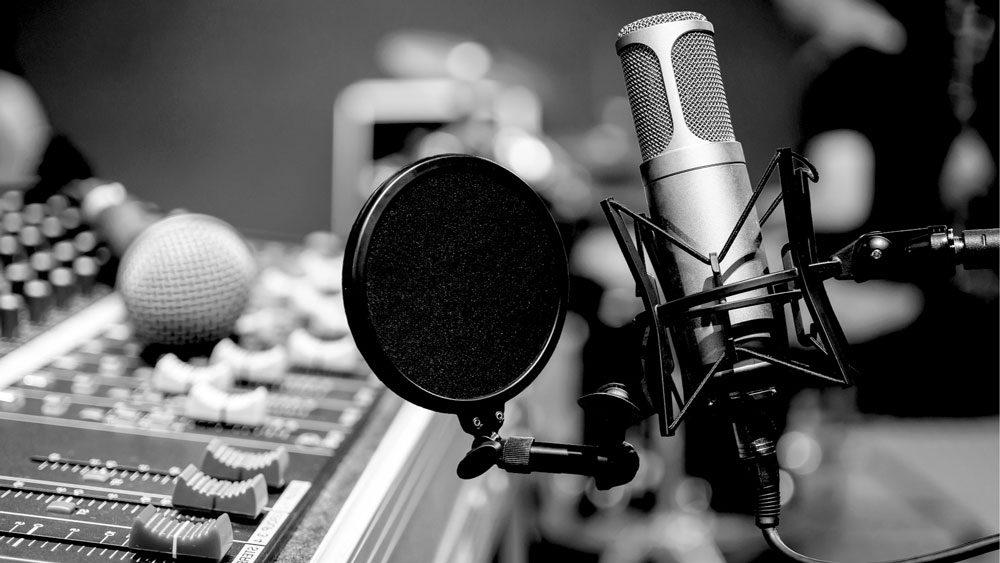
So in mid-May the station started broadcasting via its 10 watt transmitter. I would come in to the studio for my shift, turn on the power, read some news briefs I’d assembled, talk about station programming and what was happening on campus, and play some jazz for an hour or so. Soon I realized that it would be a more efficient use of my time if I pre-recorded my shows and made some others as backups for the staff to air once I had departed – my first attempts at creating playlists. The trick was to record them in a way that focused solely on the music content: spin the tracks in a multiple series – 3 to 4 one after the other – announce their credits – spin the next series of tracks and do the same over and over for an hour or more.
Little did we know at the time, but playlists would become the program format du jour especially for streaming music-related content going forward. Initially, as with Steve and I, it would be via live programming sessions, much the same as that originated by KCRW-FM in Santa Monica on its seminal “Morning Becomes Eclectic” program that would wind up being webcast along with other KCRW series literally all over Southern California and beyond. The program is a three-hour adult album alternative music program first airing in 1977, broadcast live every weekday and is one of the first and certainly most influential music playlist programs to grace the airwaves. The show is repeated twice daily on KCRW’s music webcast, and live performances are also sometimes available.
Of the programs aired over KCRW, one of my favorites were those that featured the raspy sonorous baritone of Joe Frank weaving his fantastical dark monologues recorded over loops of percussive beats and drones. Here is what Francis Ford Coppola says about listening to one of his absurdist recitations:
I came upon Joe Frank’s work by accident a number of years ago while driving to my home in the Napa Valley late at night. I couldn’t believe the originality and sheer brilliance of what I was hearing.
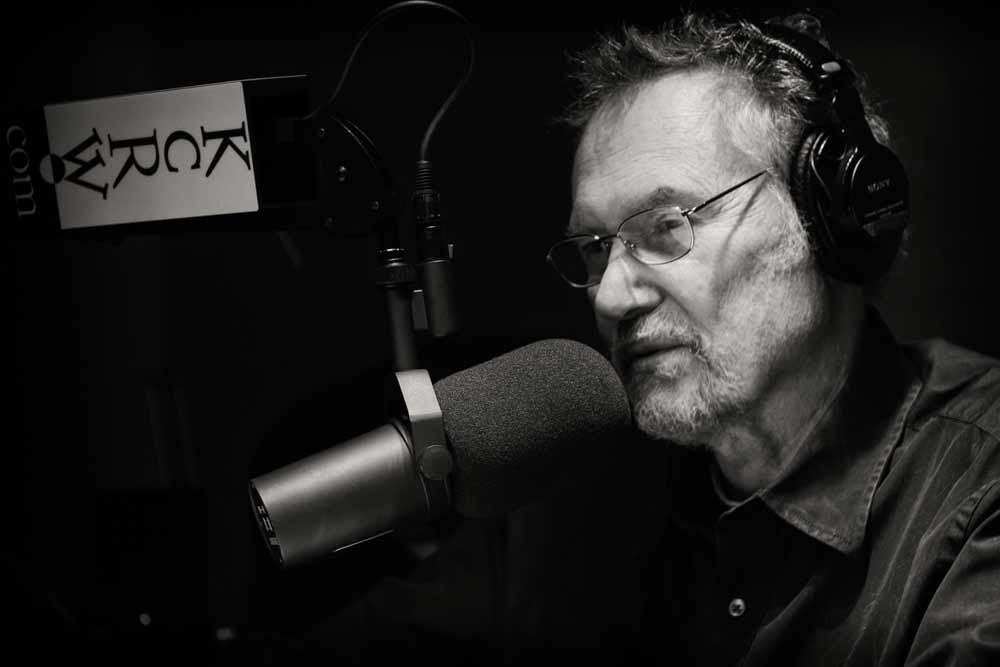
You do really have to listen to his shows at night – preferably alone – maybe driving in your car along a two lane blacktop “blue highway” as author William Least Heat Moon called them, in order to have some sense of the hypnotic power of Joe Frank’s surrealist … enchantments I would call them because I didn’t want them to end. I was hooked. Don’t believe me? Then check out the link provided below to one of his shows – all of which are also available on his website.
Here’s a clip from The River – an episode from his “Somewhere Out There” series:
Joe Frank’s radio career began at WBAI in New York where he became one of the co-hosts of All Things Considered. In 1986 Joe relocated to Santa Monica to begin work at KCRW, hosting and performing in several diverse series of radio programs starting with, “Joe Frank: Work in Progress”. In 1991 he won a Peabody Award for that series.

I was also a big fan of the hilarious Sci-Fi novels of Douglas Adams including The HItchhiker’s Guide To The Galaxy which was adapted into a radio series by the BBC for broadcast in England in 1978 and subsequently by National Public Radio in the US and CBC Radio in Canada. The series followed the adventures of hapless Englishman Arthur Dent and his friend Ford Prefect, an alien who writes for The Hitchhiker’s Guide to the Galaxy, a pan-galactic encyclopedia and travel guide.
The theme music for the series ” Journey of the Sorcerer” was written by Bernie Leadon of The Eagles and the series featured music composed by a who’s who galaxy of pop, rock and classical artists including: The Beatles, Pink Floyd, György Ligeti, Brian Eno and Robert Fripp, Stomu Yamashta, Terry Riley, Patrick Moraz, Jean Michel Jarre, Isao Tomita, Richard Strauss, and even Louis Armstrong.
And if that’s not enough to whet your whistle, an avid listener would also be given the answer to the Ultimate Question of Life, the Universe, and Everything which is:
 Maybe that was why the show was the only radio show ever to be nominated for the Hugo science fiction awards.
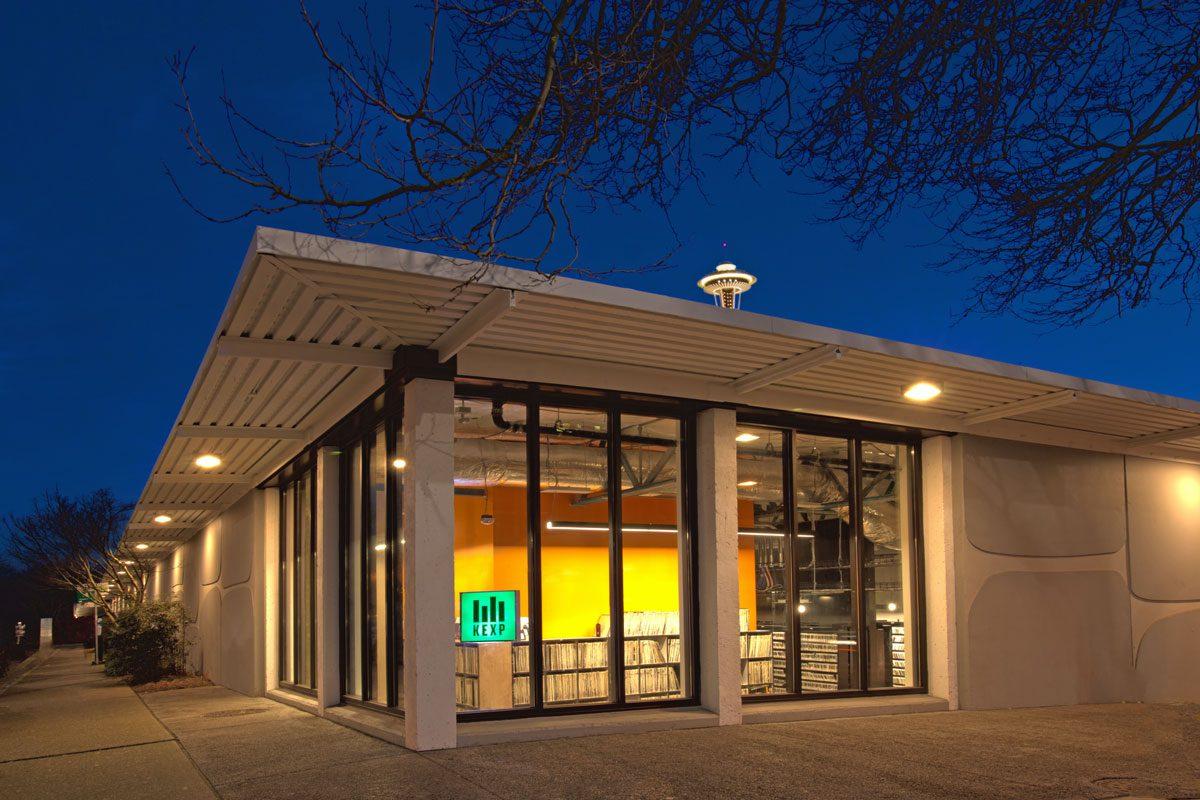
A recent article in the SF Chronicle by Aidin Vaziri caught my eye regarding plans for a Seattle-based nonprofit radio station with the call sign KEXP to begin broadcasting in the Bay Area after having purchased the signal frequency 92.5 FM for $3.75 million that had been formerly assigned to station KREV that had gone bankrupt in 2023.
My initial reaction was how does that happen? How does a non-profit radio station come up with the jack for the $3.75 million to score such a deal, especially in a market that supposedly has been shedding jobs and venues for the past several years post-pandemic? This was answered via Vaziri’s interview with the station representatives including CEO Ethan Raup during which it was revealed that funding for the acquisition of the 92.5 FM frequency came from a $10 million endowment left to KEXP from a listener in 2017. Plus the station itself has an annual operating budget of $15 million and “sources the remaining funds from grants, corporate underwriting, and other sources”.
KEXP also has an audience of “nearly 200,000 weekly listeners on the airwaves with an additional 100,000 online listeners. KEXP’s YouTube channel meanwhile has 3.2 million subscribers and nearly 1.7 billion views.”
Hmmm. Nuff said.
The past incarnations of stations broadcasting with the frequency 92.5 FM included one of my faves – KJAZ which was an all jazz radio station located in Alameda, CA founded in 1959 and one which I was a devoted listener to as a San Francisco resident during my tenure in the Navy there from mid 1968 to mid 1970. Today it is simulcasting KEXP’s broadcasts with the call sign KEXC.
Also included in the supporting paragraphs of Vaziri’s article was a brief mention of the origins of KEXP itself. Originally founded in 1972, it was created and operated by a number of University of Washington students utilizing borrowed equipment which included a 10 watt transmitter – barely powerful enough to transmit a signal as far as 15th Ave a few blocks away.
What is not revealed in the article was that the station initially used spare radio broadcasting facilities located on the third floor of the university’s Communication Building which were adjacent to the University of Washington’s exisitng pubic radio station KUOW. Plus since the university’s designation of the Communications Buiding was CMU [for communications], the fledgling station’s call sign was KCMU which it broadcast under for nearly 30 years.
By 1982 the station had become listener-supported and was becoming a center for a new music genre which would become known as *grunge*. In 2000, KCMU moved out of the communications building to “new digs” in Kane Hall and according to the WiKi: “started streaming high-quality, 128-kilobit-per-second MP3 compressed audio over the internet, becoming the first station in the world to offer online audio of this quality.” In 2001 the station became KEXP funded largely through grants from Paul Allen’s Experience Music Project [EMP].
But what none of these sources revealed was that a year later – according to an email I received from sources at KEXP announcing the station’s 30th anniversary in May 2002 that – much to my surprise – KCMU was the first student-run FM station in the country and I was fortunate enough to be one of those founding student staff members.
Cowabunga!
I was watching an interview on the local PBS station conducted by Jeffrey Brown on the growing popularity of Podcasts. It is estimated that this audio format has grown into a $25 billion industry with nearly half a billion listeners annually among which Spotify claims as its top-performing podcast from Joe Rogan which has over 14 million subscribers. And suddenly Big corporate money saw a commercial opportunity involving the control and packaging of a new art form – much the same as they’d already done with print media, film, and TV.
But things subsequently have changed and very quickly. These large media conglomerates soon realized that they weren’t getting their return on investment [ROI] and what followed within a year were massive layoffs in the media and tech industries – as well as in the podcasting field. One of the reasons for this reaction by corporate media is the lack of control over the content- i.e. copyright control for how those podcasts as intellectual property [IP] are aired and paid for. Yes, you do have Spotify and its network outlets – SiriusXM and its network – Audacity Inc. – as well as others – but there is a broad spectrum of social media platforms that potential audiences browse for content to share, including YouTube, Vimeo, Meta, X, WhatsAp, Pinterest, Instagram, and others. And these social media subscribers get that content for free.
As reported by Sam Becker of Fast Company, the Mass Market Media industry [MMM], including print media, has also been shedding both outlets and jobs over the past few years.
“And for 2023 as a whole, more than 21,400 media jobs were lost, the highest (excluding 2020) since 2009, when more than 22,300 jobs were cut.”
According to Gabriel Kahn, professor of professional practice of journalism at the USC Annenberg School for Communication and Journalism, and a former newspaper correspondent and editor:
“In a way, what we’re seeing is a cluster of headlines that are the consequence of a problem that’s been happening for ages. Overall, the media is grappling with—and has been grappling with for decades now—finding a sustainable business model, and clawing money back from Big Tech firms that not only hoovered up advertising dollars but also trained generations of people to expect content for free.
“It’s an industry that was built off of two major revenue streams: advertising and subscriptions. For more than 20 years now, Big Tech [Social Media, Search Engines, Media Sharing Platforms] has drafted a blueprint of the business plan for the news media, and that’s never worked out for the news media.”
What we hear and see now on public media stations [NPR and PBS] are large blocks of time – up to a fortnight – spent several times year for fund-raising in order to pay for the privately-produced programming aired via their frequency channels; programming owned by a handful of multi-national conglomerate entities whose primary minions control the fiscal playgrounds of financialized capitalism, meaning public audiences won’t see or hear content that is either critical of or contrary to the libertarian views and policies of the plutocracy, plus the fees collected from subscribers and the stations themselves for this programming tend to be passed on to the stakeholders as dividends instead of being used to help sustain the industry itself, much like what has historically been happening on Main Street vs Wall Street for the past decades thanks largely to the Quantitative Easing [QE] policies of the FED which have hyper-inflated asset prices across the board that in turn have “trickled-down” to become the primary cause of the current inflationary trends in the real economy. So much for public media – but DGMS.
As detailed in an article titled “The Life and Death Of Hollywood” published via Harper’s Magazine, Daniel Bessener, contributing editor at Jacobin states:
“The new effective bosses of the industry—colossal conglomerates, asset- management companies, and private-equity firms— had not been simply pushing workers too hard and grabbing more than their fair share of the profits. They had been stripping value from the production system like copper pipes from a house—threatening the sustainability of the studios themselves.
“According to research by Bloomberg, in 2013 the largest companies in film and television were more than $20 billion in the black; by 2022, that number had fallen by roughly half. From 2021 to 2022, revenue growth for the industry dropped by almost 50 percent.
“The industry as a whole is now facing a broad contraction. Between August 2022 and the end of last year, employment fell by 26 percent—more than one job gone in every four.
As A.J. Liebling said, “Freedom of the press is limited to those who own one.”
And the arrival of increasingly prevalent generative AI machine learning and deep learning content creation doesn’t bode well for the job market going forward as well. According to a recent post on Futurism:
“For years, any American kid eying a stable, future-proof job was told to “learn to code. Now in 2025, anyone who followed that advice faces a painful reckoning: a decade of booming computer science enrollments has created a massive pile-up of graduates entering an abysmal job market.
“Tech companies are planning to lay off 141,159 jobs this year so far, per the report, up from 120,470 over the same period in 2024.”

Plus the use of chatbots like ChatGPT does not augur well for media sourcing control for content providers either. These generative machine learning AI algorithms will be programmed and deployed going forward by Big Tech as well resulting in the same or similar copyright issues that have plagued Mass Media content providers in the past. A case in point is the advent of Podbean AI, positioning itself as “the ultimate solution for AI-driven editing, generation, and optimization” featuring “Cutting-Edge AI Audio Optimization and Content Generator”.
What is the old catchphrase – especially as applied to those so-called Tech Giants?
“Steal from one it’s called plagiarism. Steal from many it’s called research“.
As promised here are links to a couple of episodes from Radio’s storied past: The Mercury Radio Theater of The Air production of The War of The Worlds plus Joe Frank‘s blending of the absurd with reality titled Just Get Me Out Of Here. Enjoy!
And seriously do support the local programming from your public media stations, plus national news series like All Things Considered and music webcasts like Morning Becomes Eclectic.
Plus if you’d like to listen to some of our recent Playlists or view some of our historic or contemporary video performances just click the appropriate link. Just remember:
We aree time travelers – one and all. Each step we take in the Present marks a transition from the PAST into the FUTURE. The only constant is change. And as mere mortals we are all renters.
All Content unless otherwise notated © MMXXIV Ruthenians.net. All rights reserved.
Shared via Creative Commons
Views: 0
The year 1994 was a tumultuous one for that brought significant changes to my career that included job & residence changes plus the beginnings of a new relationship that would reshape my life going forward. Marcia and I had briefly met at a party given by friends the year before. At this time those friends had gone on vacation and Marcia was staying at their house taking care of their dog while I was tasked to periodically check the mail and see if she needed anything.
Well, we hit it off – went to see some shows; met for dinners; did some local hiking. And then our friends returned and after a brief period of time Marcia was off once more to Nepal where she planned to live for several months – or more! Nepal. Halfway around the world and I just had to go and see her.
September 15, 1994
I cannot go back…..Knowing this I take an 11,000 mile step into an unknown place that is my unrealized and unfulfilled self, throwing off the weight of a mantle of self-doubt, dread and regret . This journey begins in my mind and ends in my heart, a trip fueled by love and bound only by the limits of inner space.
As John Crowley writes:
“To go out you must first go in, and to go in you must first go out.
Here I go!
September 17 1994
Passion. An ocean I travel in a flimsy craft made up only of my capacity for love. A sometimes stormy sea – ascending and descending peaks and troughs – at one with a wave of angst, and yet separate – distinct – riding wherever it may take me. Slowly it builds – increasing with each breath – then overcomes me and I am consumed with love again feeling whole – connected – fulfilled. I hope Marcia knowns how deeply she brings this to focus and hope she feels it too!
I listened – “participated” in a tape on Self-love – a course I took in AA and thought I’d matriculated from – during which the “Ally” directed me to touch my heart with my hand and tell myself that I loved me and was my best friend. I cried – big salty tears of joy – realizing that I felt guilty – so guilty for just “Receiving”. I worked overtime at giving, often confusing “giving” with “communicating” words. I must learn to receive and to feel worthy. I cannot go back over bridges that lead to worth-less-ness.
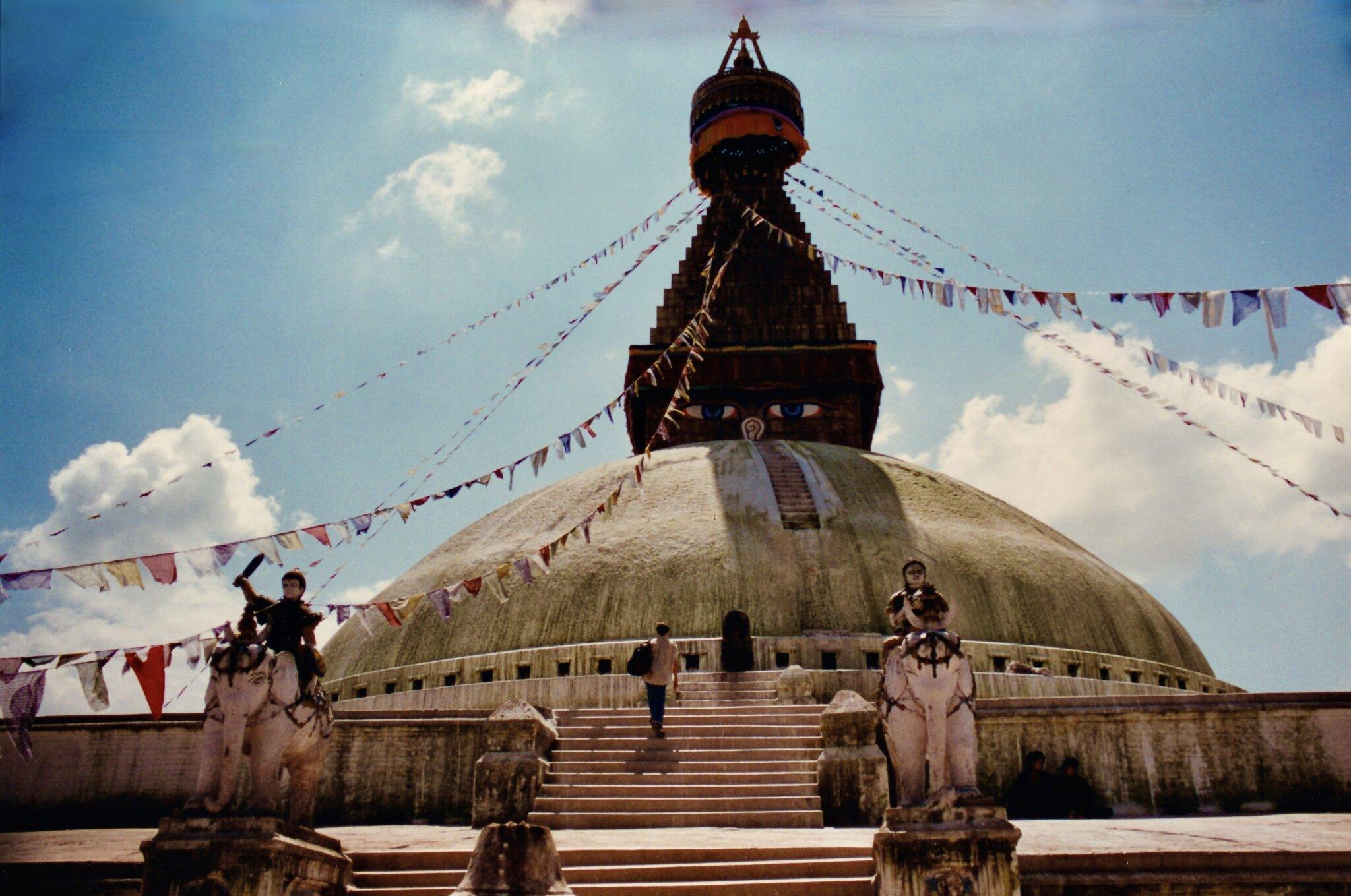
The plane descends out of the clouds and touches down at Tribhuvan International Airport taxiing up to awaiting passenger ramps close to a ground-level covered pedestrian walkway leading to the main terminal building. I de-plane and proceed with the other passengers along the walkway a few paces until I happen to glance up at an open air balcony adjacent to the terminal building and catch site of a woman standing apart from the other onlookers. It is Marcia. I step out from beneath the passageway to where I can be seen and wave. Immediately Marcia waves back excitedly. Nepal at last!
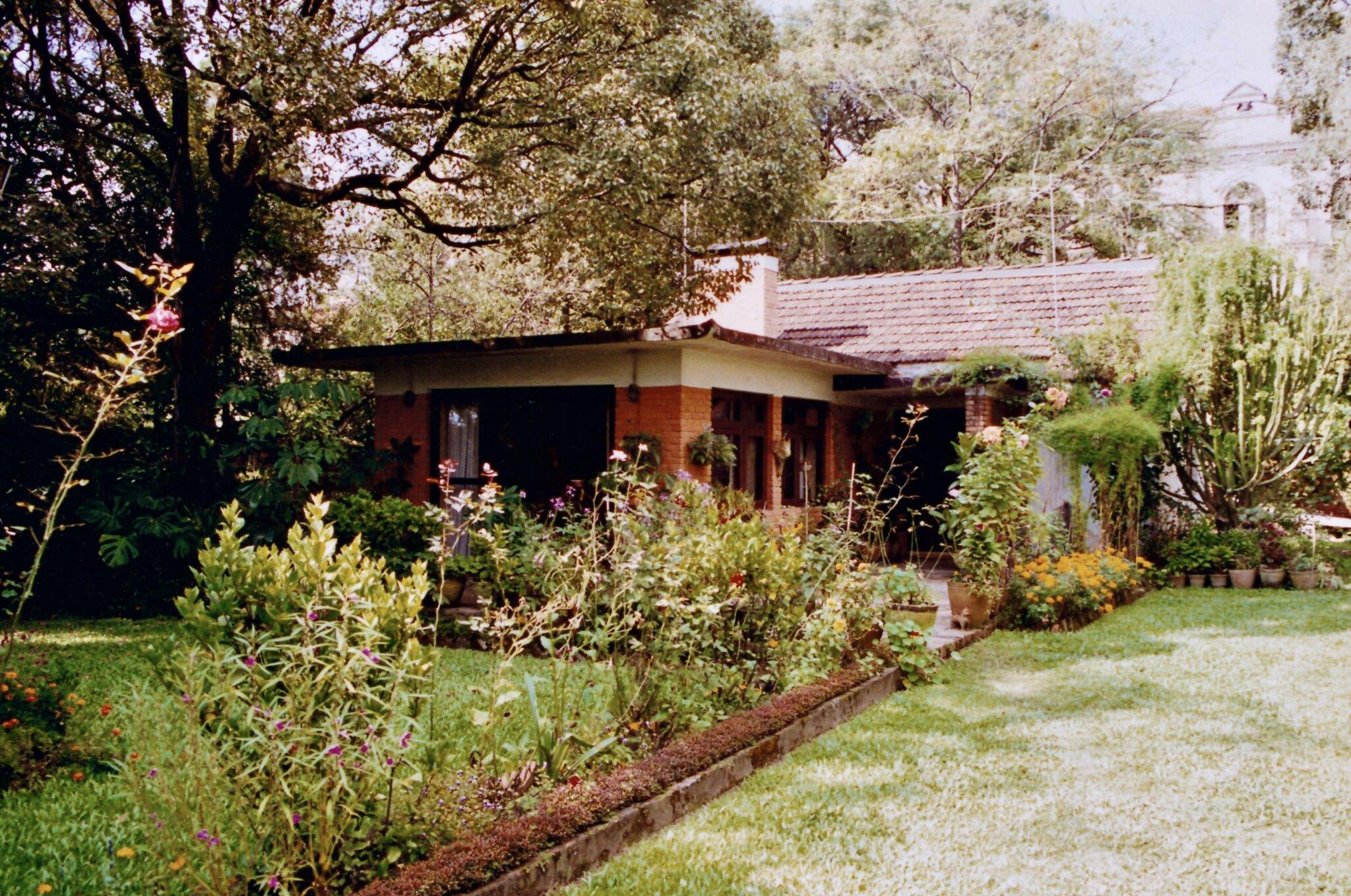 Nervously, I gather myself up physically and emotionally, collect my baggage, and pass through customs to where Marcia stands in a waiting area outside the terminal. We embrace quickly [public displays of affection between the opposite sexes are frowned up in Nepali culture] then board a Tuk Tuk rickshaw taxi for a ride through town to a house Marcia has arranged for us to stay for the duration of our visit.
Kathmandu at first sight appear like a village growing rapidly – uncontrolled and un-controllable; muddy, dusty, dirty – teeming with life. People. animals, vehicles of all description; cars, motor scooters, bikes and tuk tuk taxis. Buildings falling down and being re-built back up again. The air is filled with smoke and dust searing my throat and lungs making it difficult to breathe. And yet, on every corner there seems to be a shrine to a Hindu deity of one sort or another, so I am moved by the devotion of the people to enlightenment and joy, even though outwardly they seem to have very little to be thankful for yet, inwardly it would seem they have what I crave the most – peace, serenity, and love.
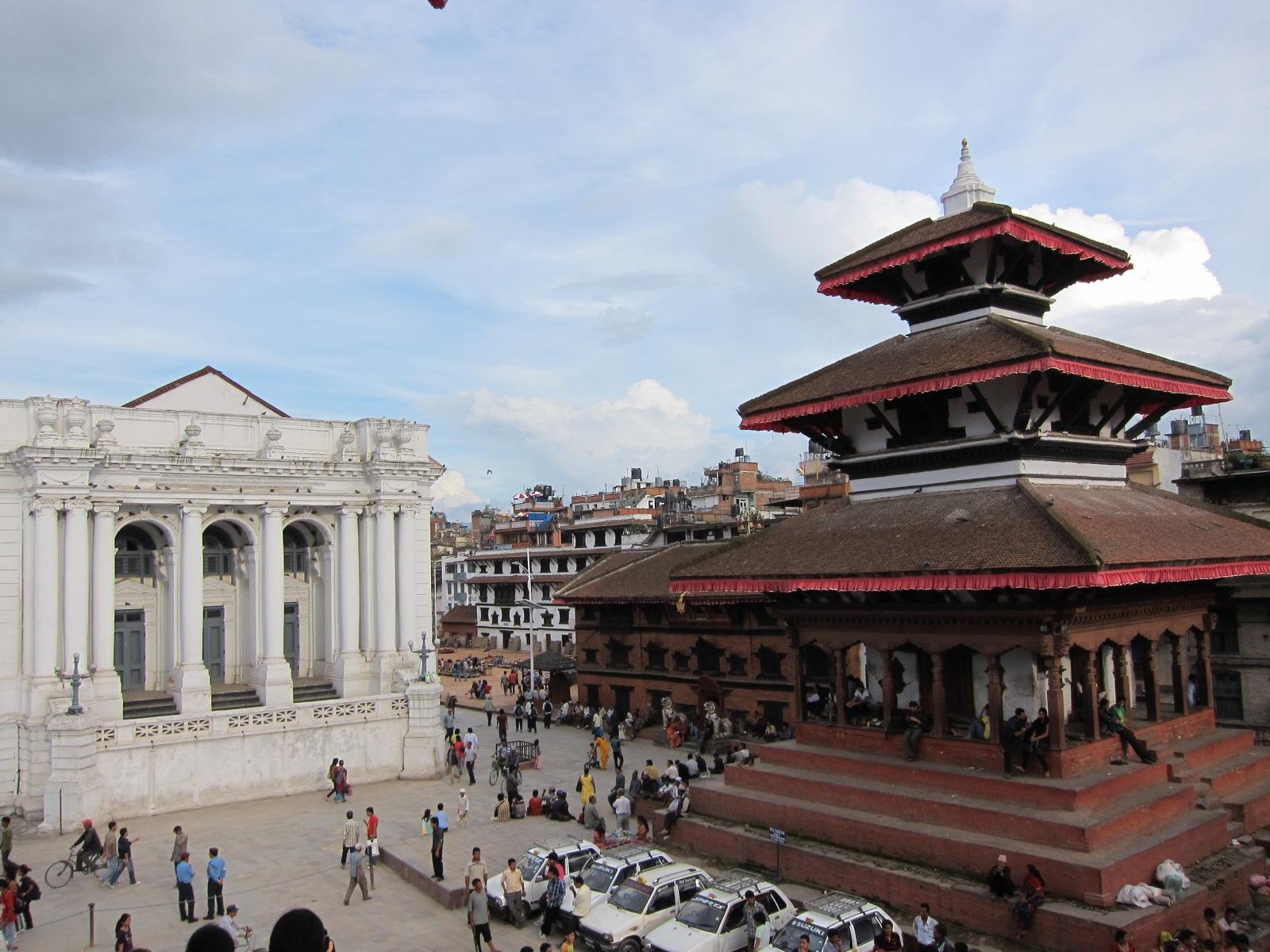 I have arrived during Indra Jatra – a Hindu holy festival celebrating the end of the monsoon season and commemorating the founding of Kathmandu in the 10th Century. Right on cue it started to rain as Marcia and I walked the streets from shrine to temple along with throngs of devoted followers. We stop at the Durbar Square, Kathmandu’s city center dating from the 3rd Century, which is dominated by two towering Hindu shrines standing next to a huge white edifice – a government building seemingly teleported from colonial England and glaringly appearing to be out of place.
It is in front of this building that Marcia suddenly clasps my hands beneath the ponchos we are wearing. My heart flutters. Just then a group of men spin out of the crowd carrying a large float in the shape of a “bull” scattering celebrants in their wake. Suddenly they are right on top of us and ram into me knocking me backwards. I am stunned by the force of the blow.
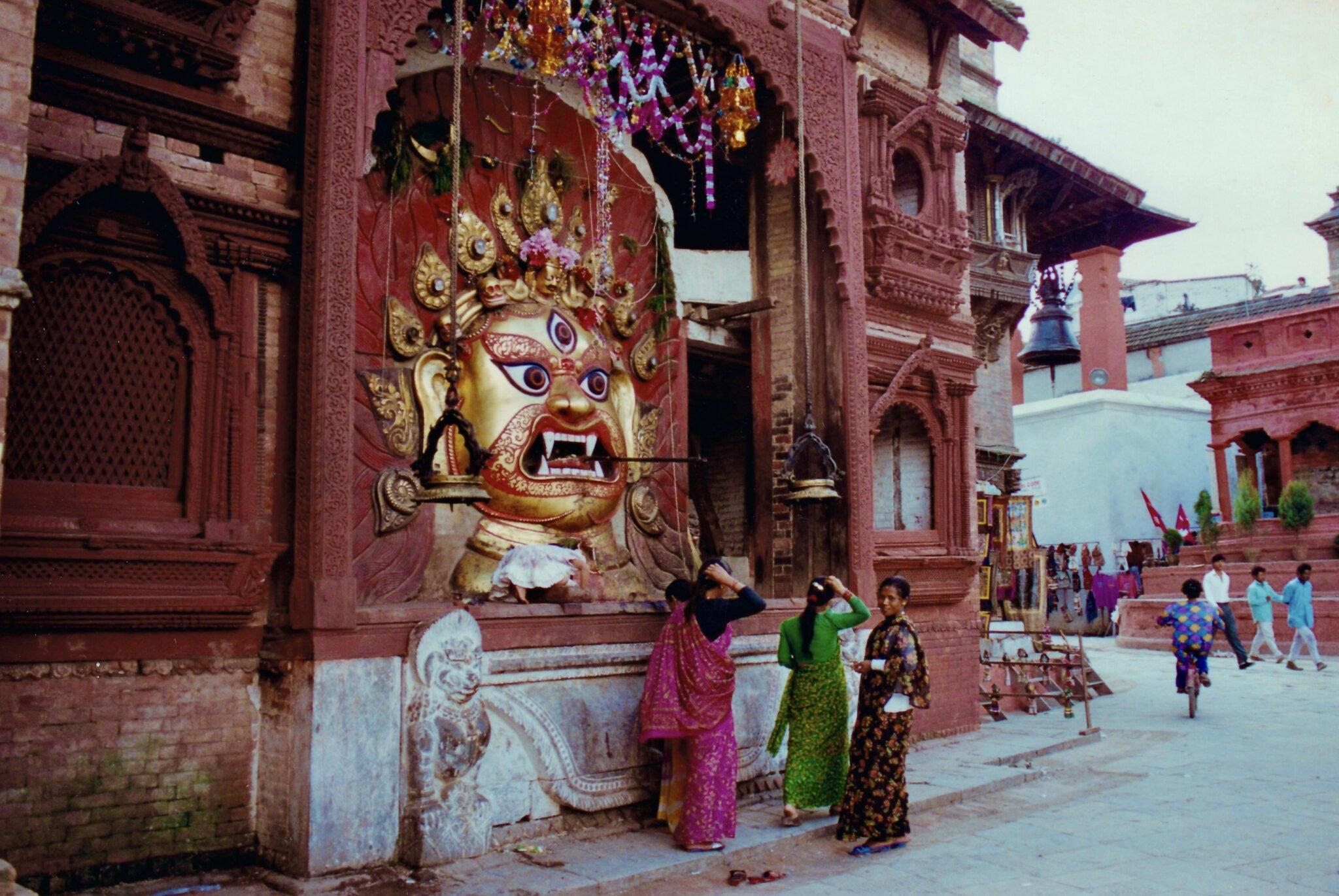
The bull [possibly the Hindu deity Bhairava] then does a half spin, the men beneath it one by one begin to lose their balance causing the entire float to collapse onto the pavement to the groans of the crowd.
Quickly Marcia grabs my hand and we ascend the steps of a nearby temple – a safer place to view the rest of the celebration. Later as part of a large gathering on the square we witness the procession of the Living Goddess Kumari – the virgin bride and her lengthy entourage – as it parades through the streets to much cheering and fanfare.
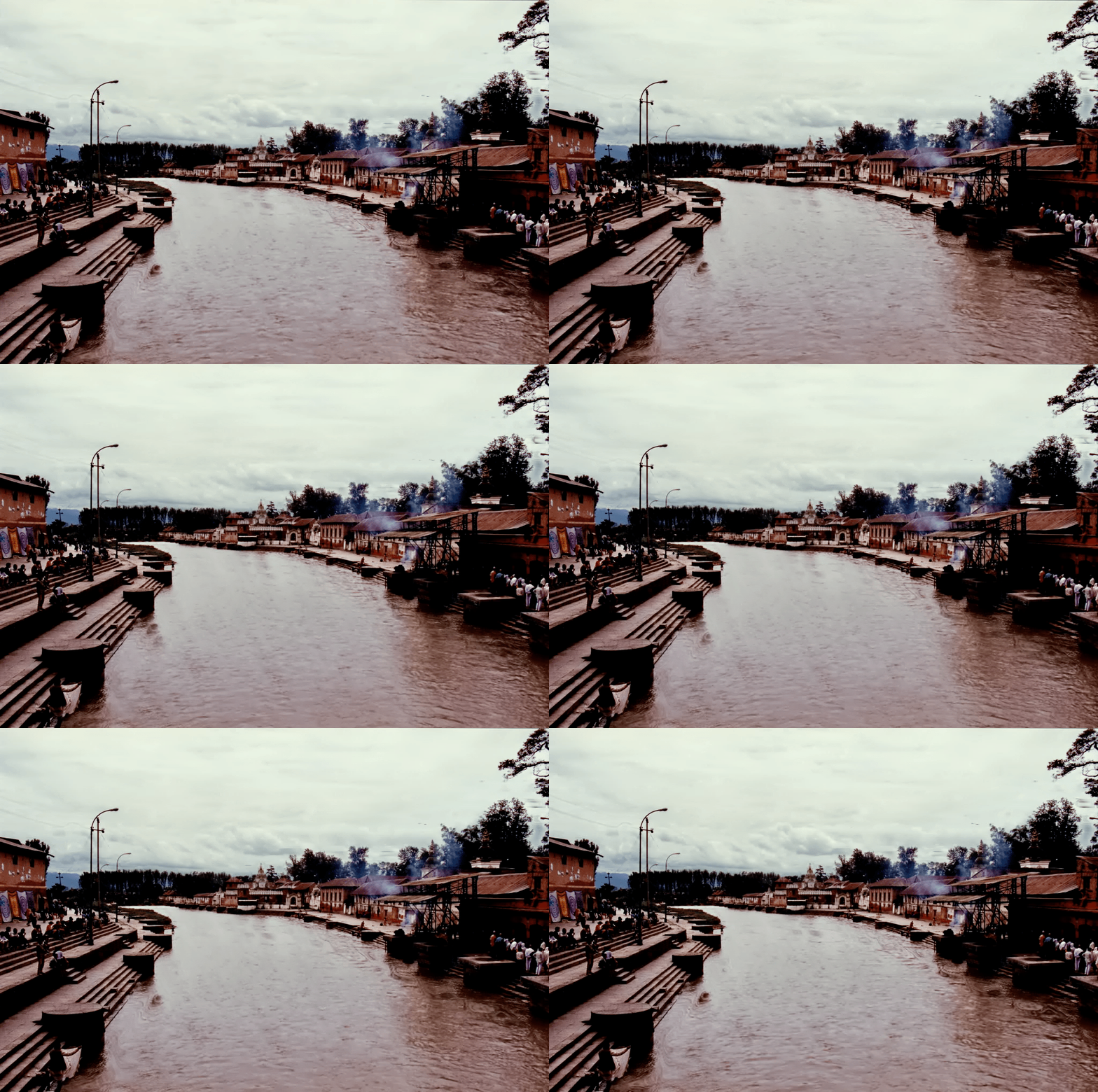
A “kamikaze” bike ride across Thamel dodging motor scooters, tuk tuks, and foot traffic to Durbar Square through the market district. It would make a fascinating video of life in Kathmandu [see our version later in another post]. Talk about having your senses piqued to capacity. Then it’s on to the Bagmati River where we visit Pashupatinath Temple, “a sprawling collection of temples, ashrams, images and icons raised over the centuries” along the banks of the Bagmati, dedicated to Lord Pashupati and subsequently classified as a World Heritage Site in 1979. This temple represents an ancient Hindu concept stating that death should not be feared and sex should not be ridiculed. As a result, there is a ritual cremation ground extremely close to the temple, as well as sensual artworks on the temple’s roof. Many pilgrims to the site want their lives to end here and are cremated at this temple so they may be purified by the sacred waters of the Bagmati.
Got a bit of the “Fajardo Quickstep” – a Borinquen slang term for the runs. Probably the result of some rancid cooking oil which is used in practically everything in this town. Not good for the LDL count.
In the A.M. I sat in for a lecture on Buddhism with a group of college kids from Boston. While they nodded off in varying degrees of consciousness, I was rapt. Total attention for an hour mesmerized by the energy of these Nepalis.
Feeling much better so we ventured out to do some shopping for the trek. It is still very cloudy and smoggy and there is some concern whether we’ll be able to see anything in the mountains.
Through early morning fog we climb out of Kathmandu Valley. Motoring around a curve we are suddenly bathed in sunlight and below us we see a vast expanse of rice paddies, the road ahead a ribbon winding into the distance far below. The bus makes frequent stops, often to navigate past many landslides caused by the recent monsoons that partially cover the roadway as we follow the Kali Gandaki River heading East toward Pokhara. At one point we even have to disembark from the bus and on foot cross a narrow bridge that was damaged by the same storms.
Re-boarding the bus, we are again jouncing over rough roadway stretches, winding around blind curves – the only other vehicles being other buses – no cars. We do see one cyclist and a couple of land rovers. But the exhaust fumes from the bus are making us both feel nauseous even though we’ve got our face masks on and we can’t wait for the trip to end. Eight hours later it finally does.
We stumble off the bus and collect our belongings only to be confronted by a cacophony of shouts from a crowd of taxi drivers – held at bay by the local constabulary – all begging to take us to their own special hotel. Marcia recognizes one named Krishna so we board his tuk tuk. Along the way to the hotel, Marcia negotiates for a guide and porter and a taxi ride to “New School” – the starting point for our trek next morning.
For dinner we have some Dahl baht (rice and lentil soup) which likely will be our steady diet for the next few days.
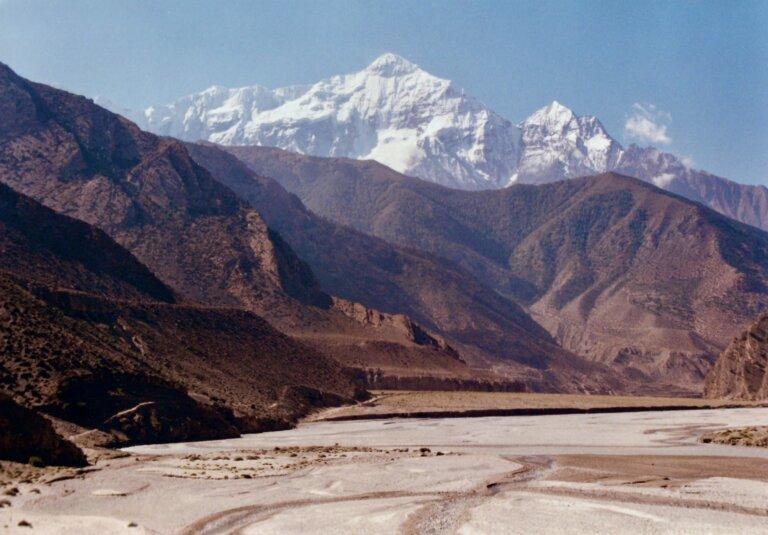
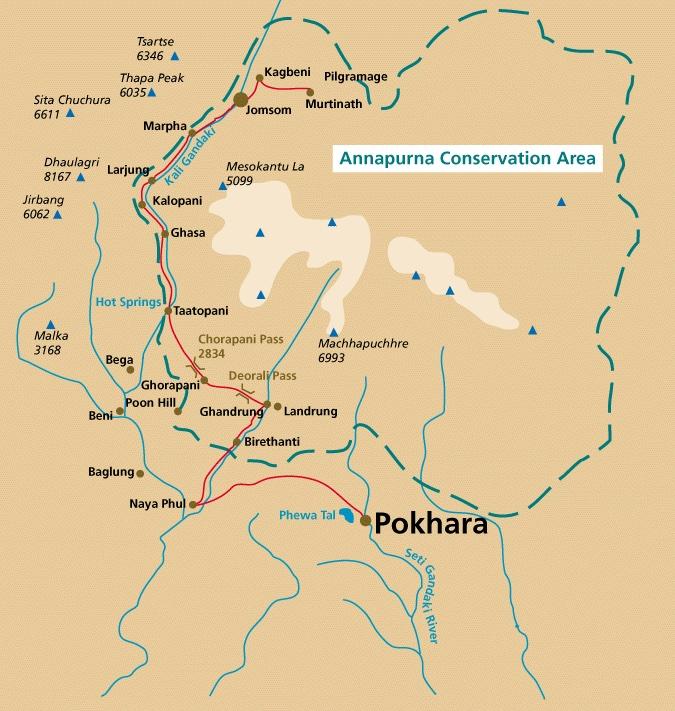 The trekking route – from Pokhara to Jomosom to Muktinath along the Kali Gankaki River Gorge – through the deepest canyons on Earth.
According to the Wiki: The Kali Ghandaki Gorge lies between the mountains Dhaulagiri, elevation 8,167 metres (26,795 ft) to the west and Annapurna I, elevation 8,091 metres (26,545 ft) to the east. If one measures the depth of a canyon by the difference between the river height and the heights of the highest peaks on either side, this gorge is the world’s deepest.
The river is older than the Himalayas. As tectonic activity forces the mountains higher, the river has cut through the uplift. The upper part of the gorge is inhabited by the Thakali people, and is sometimes known as Thak Khola. This region is known for extinct shaligram [ammonite] fossils, revered as one of five non-living forms of Lord Vishnu that date as far back as the Cretaceous Period [more than 60 million years ago].
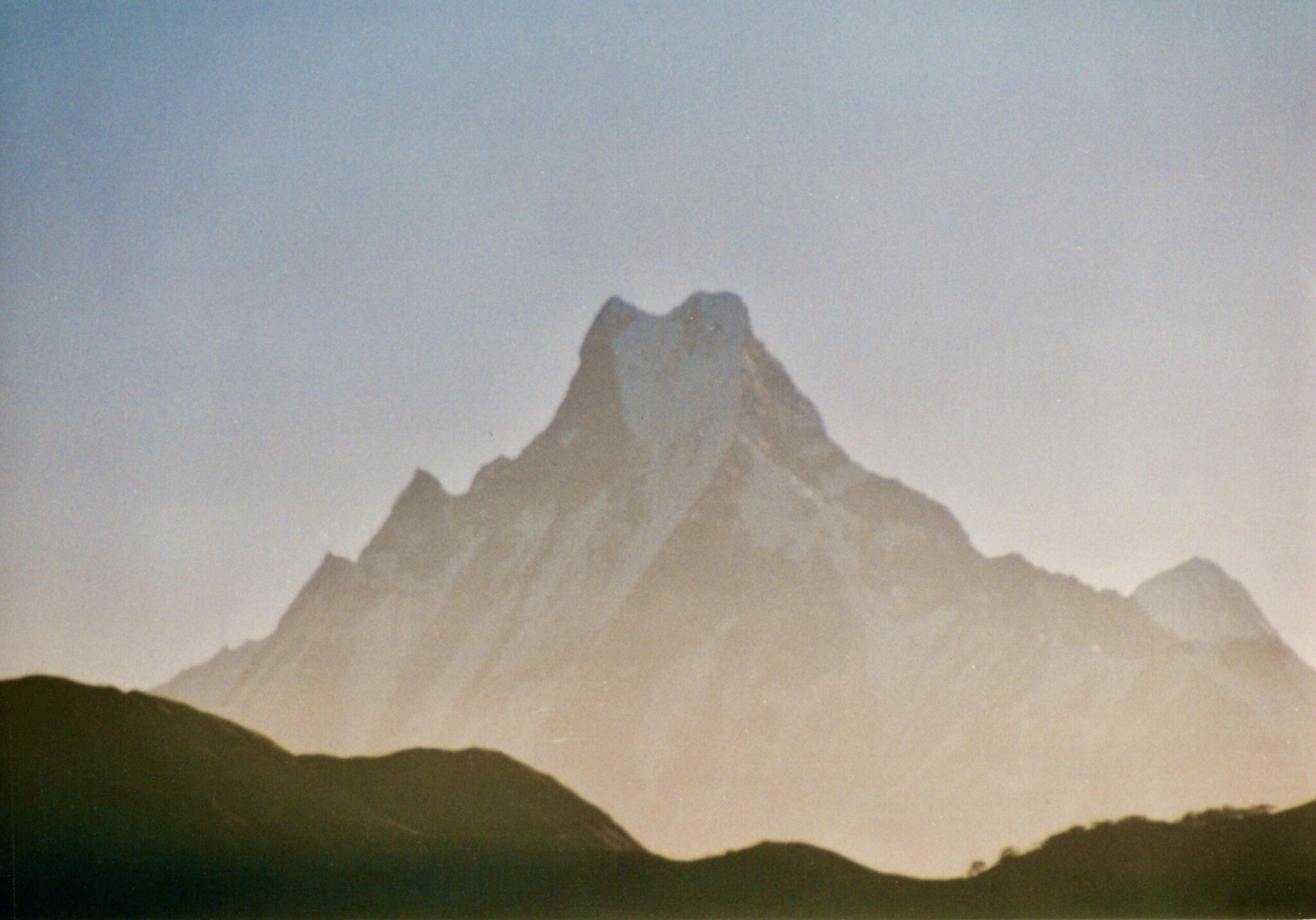
We’re off with our porters Madhu and Tatsu — taking a tuk-tuk taxi which will save us a day’s trek along the trail from Pokhara, On the horizon we view Machapuchare or “fish’s tail” in Nepali – a tall finger of white above the clouds greeting and beckoning us onward. We are ecstatic and beg the driver to pull over so we can take some photos. Machapuchare’s summit has never been “officially” climbed although there are reports of a New Zealand climber, Bill Denz, making a successful yet illegal attempt to reach the summit in the early 1980s.
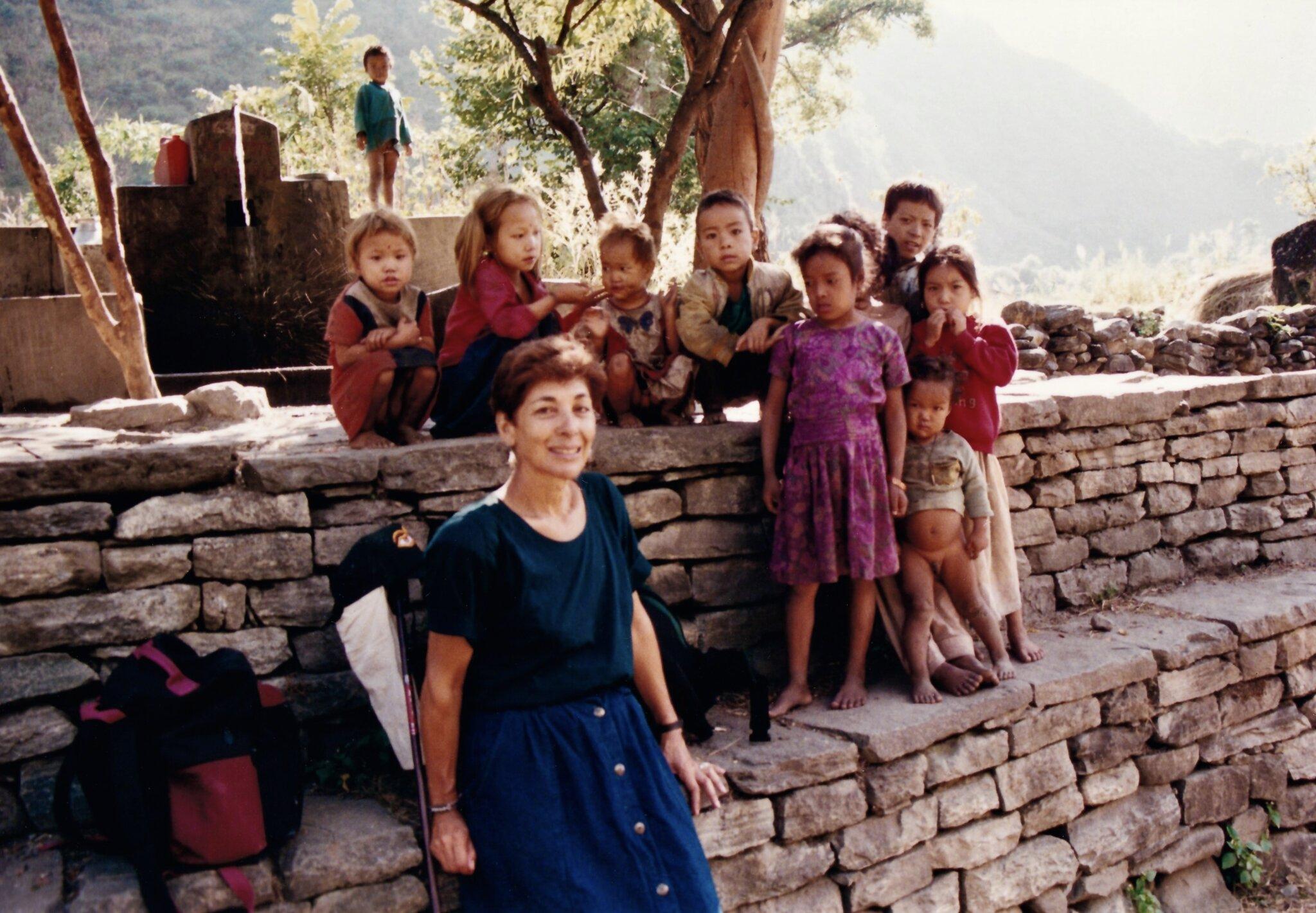 Passing through the morning mist and clouds we begin the trek to our first destination – the “New School” at Tikhedhunga where we’ll stay at a guest house next to a new secondary school. Shouldering our packs, we’re off through meadows and across foot bridges. All along the way we encounter Tibetan porters lugging huge bundles and even galvanized pipes on their backs bound for Ghorepani – the “donkey trains” of the Himalayas ferrying food and provisions [in the early 1990s roads going North did not exist in this part of the Kali Gandaki – only trekking paths]. Along the way we meet a few other trekkers and a group of children on their way to school who agree to pose for a picture or two.
About two hours out we view the trail as it meanders along a small cliff and through a rice paddy with a small hut in the distance. A photo op! Reaching for my camera I take my eyes off of the path for a second and stumble over the cliff. Only Madhu my porter saves me from a bath in the river. With both my pride and knee bruised, we continue on finally reaching Tikhedhunga, near the dreaded Ulleri Steps [an estimated 3300 stone steps reaching an altitude of 6400 ft.] our resting point for the night.
I laid awake that night worrying about my knee and the possibility of encountering leeches [we’d heard stories] and as if to heighten my fears if begins to rain. Marcia’s serene presence calms me.

We ascend the Ulleri Steps from Tihkedhundra criss-crossing mountain slopes and terraced rice and millet fields, hiking through oak and rhododendron forests on past Ulleri and several small settlements to Ghorepani [“horse water” in Nepali]. 6 hours of steady climbing – an ascent of over five thousand feet in less than a day. We are exhausted and can barely breathe because of the altitude. This is the hardest bit of physical activity I’ve ever done so we collapse at the local lodge.
The weather has become overcast and windy with fog billowing through the trees and it is much colder since we are at nine thousand feet. Tomorrow morning at 5 AM we will ascend Poon Hill to view the Annapurnas, the whole Western range of the Himalayas including Dhaulagiri and Nilgiri will be at our feet.
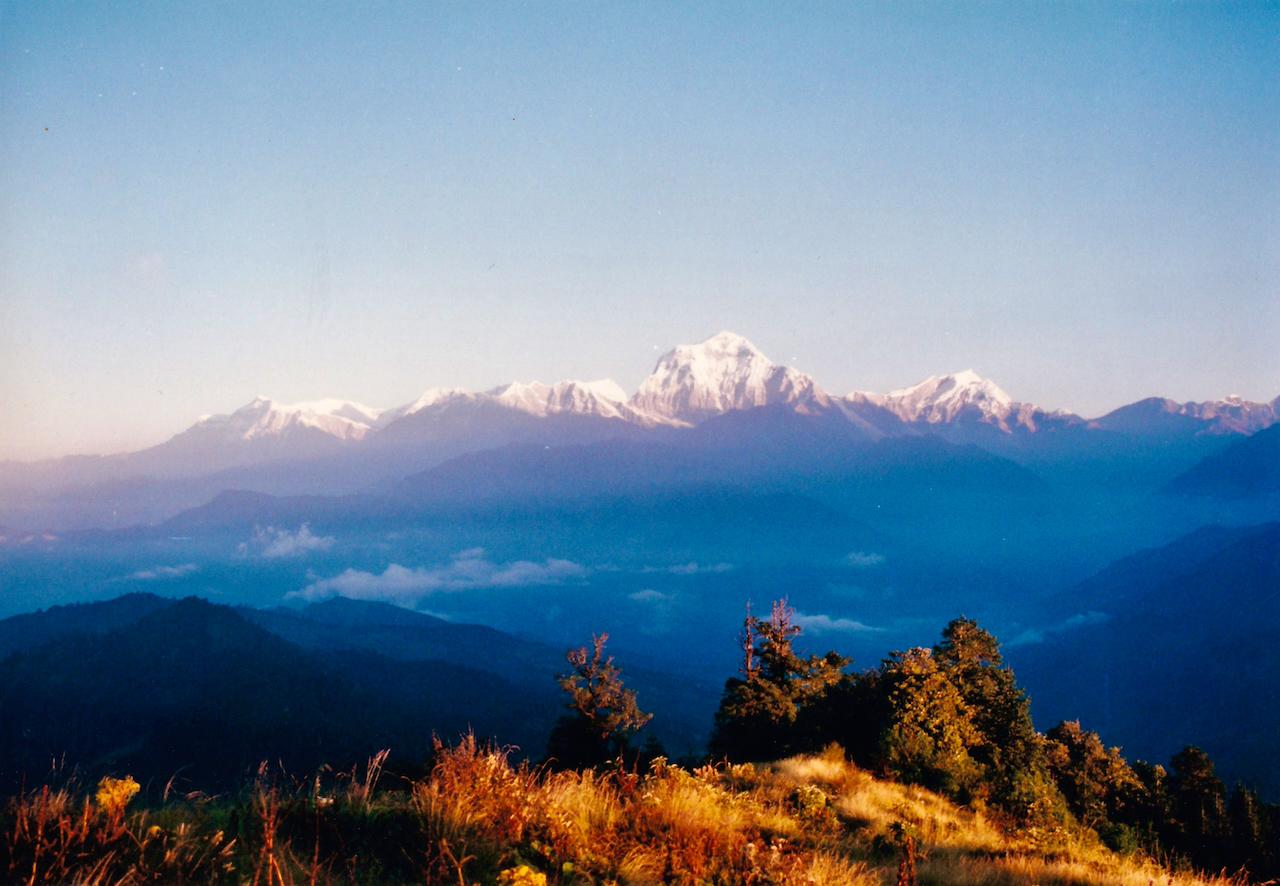
I cannot believe this! It is clear and the mountains are out, greeting us in the dim pre-dawn light! But the trail is so steep – two thousand feet straight up for an hour of continuous climbing. My lungs feel like they will burst at any moment and there a times when I feel I cannot go on. Only Marcia’s presence and smile pushes me onward. Up – up – up until at last we reach the summit. There must be forty or more other trekkers already there – even a guy selling coffee! The view is just extraordinary – all of the mountains are there for us to lay our eyes on; so close and so high!
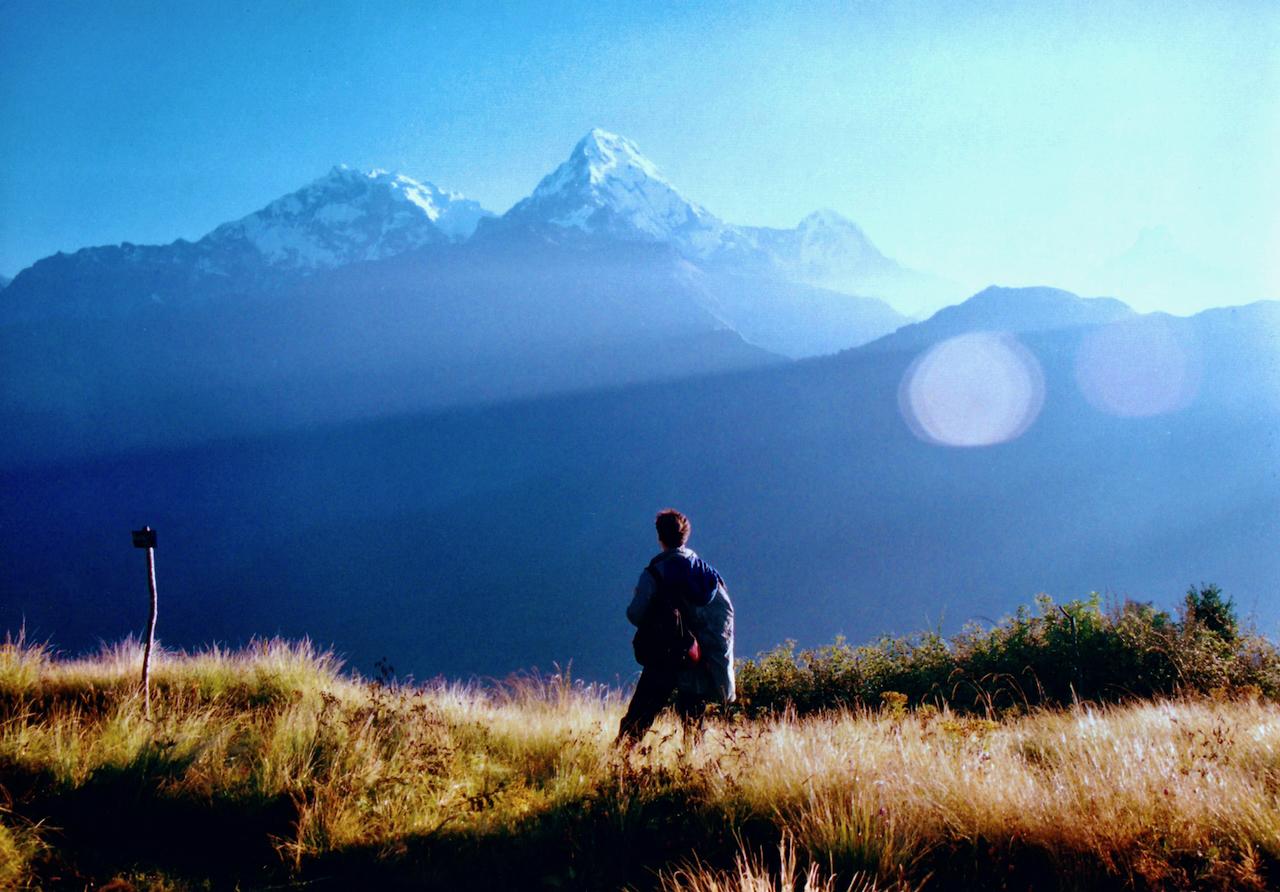
The trail leads straight down – well, almost straight. Eight hours of bone-jarring descent – over terraced steps – around boulders and several berms created from massive landslides. One false step in the loose limestone shale and one could plunge thousands of feet into the gorge.
Everywhere there are signs of de-forestation – some of it planned. There are projects in the works to run electricity from Tatopani down to Ghorepani as well as up to Jomosom using telephone poles fashioned from galvanized metal – all portaged up and down the mountainsides by sherpas lugging 10 foot sections at a time [see photo of the Ulleri steps above] for the paltry sum of just five rupees per day.
The constant jarring on ankles and knees forces a trekker to use one’s thighs and achilles tendons to the extreme. There is a point where my legs feel like they will no longer function so we’ll have to rest soon. Marcia doesn’t complain but I know she is hurting as well. Even our porter Tatsu is eager for a rest.
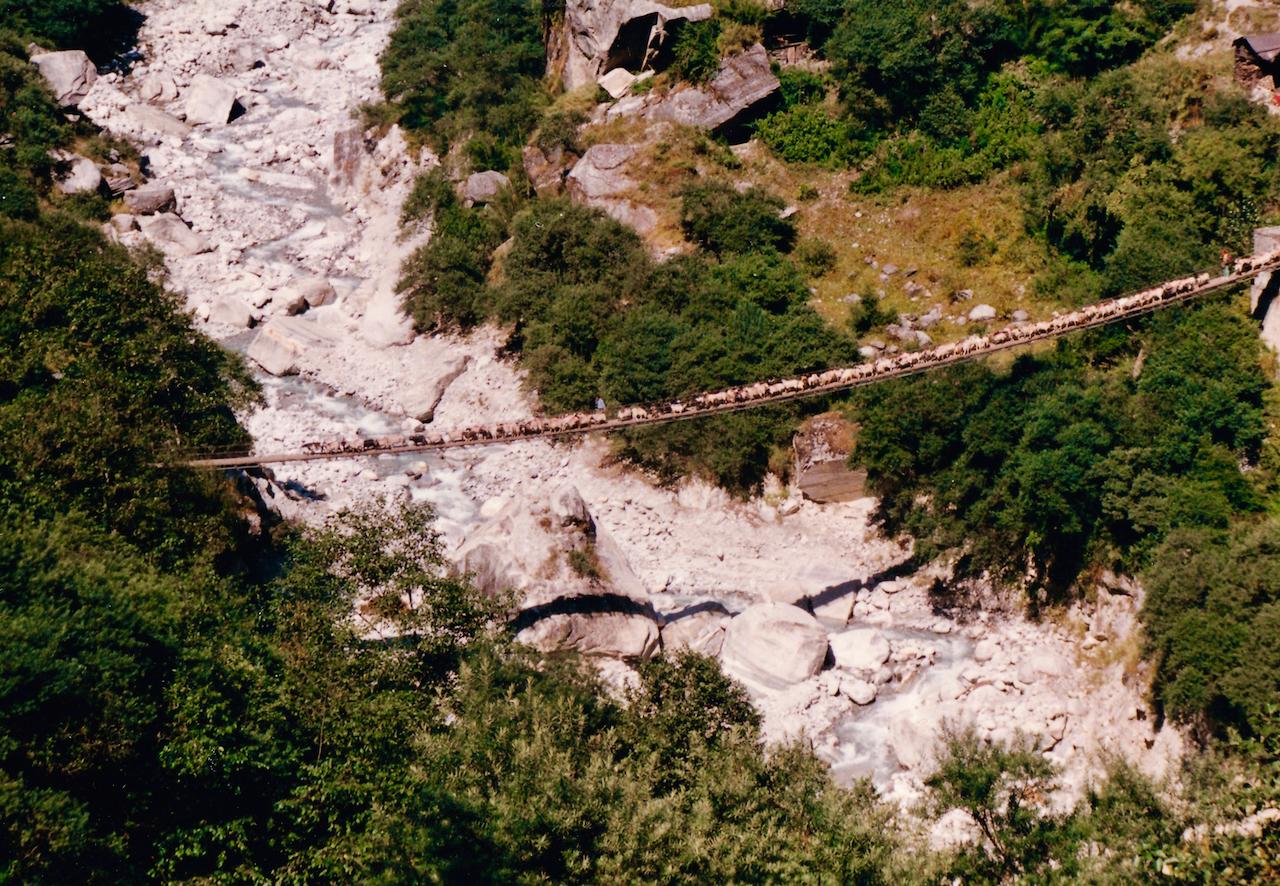 We stop for a snack of dried apples and iodine water [all drinking water has to be filtered and/or laced with iodine in order to prevent diarrhea], then push off once more until we finally reach the river and cross over two bridges each suspended high over the torrent [there were reports that a British woman had fallen from one of them ten days earlier] and stumble into a police checkpoint. Then on to Tatopani [“Hot Springs”] where our guide Madu has secured us a room at the Dhaulagiri Lodge.
We have a few lemon sodas to quench our thirst and hobble down to the spring heated pools where we blissfully soak for an hour while the pain and exhaustion of the trail is gradually eased by the warm and wet heat from the springs. Marcia agrees that we’ll take a day of rest here at this oasis along the trail. Later we collapse into bed, sleeping like the dead until morning.
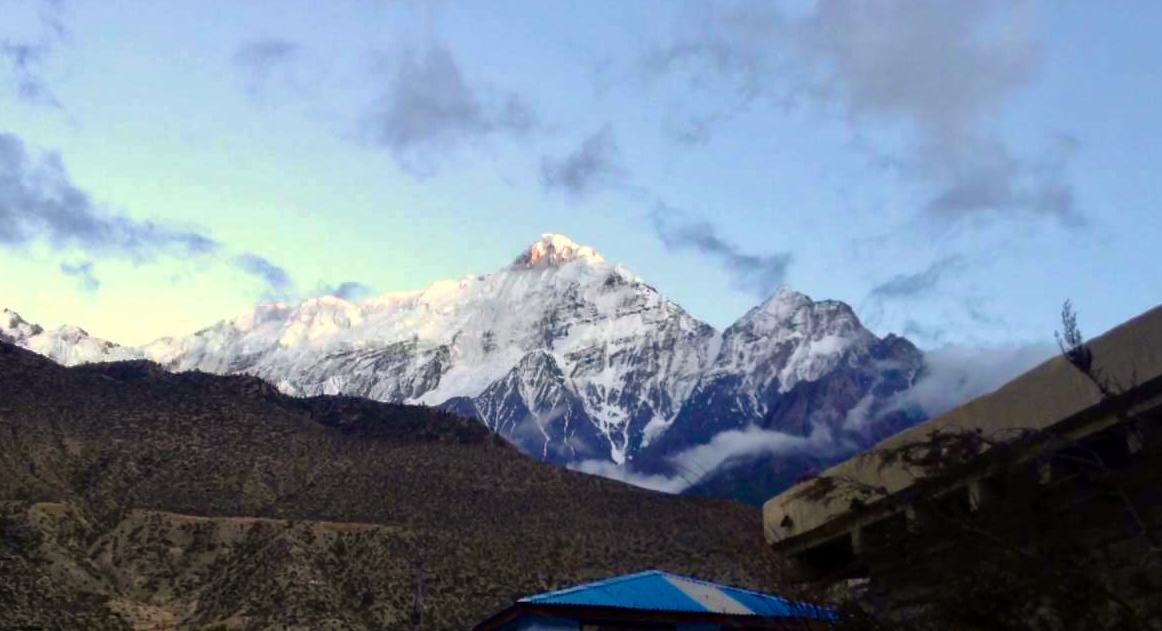
Morning. I push open the window and there above the town is Nilgiri beckoning. We’ll have to trek halfway around this mountain eventually so that from Muktinath we’ll see it from its back side. But not today. We’ll spend a leisurely period eating, drinking, and bathing in the hot springs, hoping we’ll be able to walk again come Tuesday.
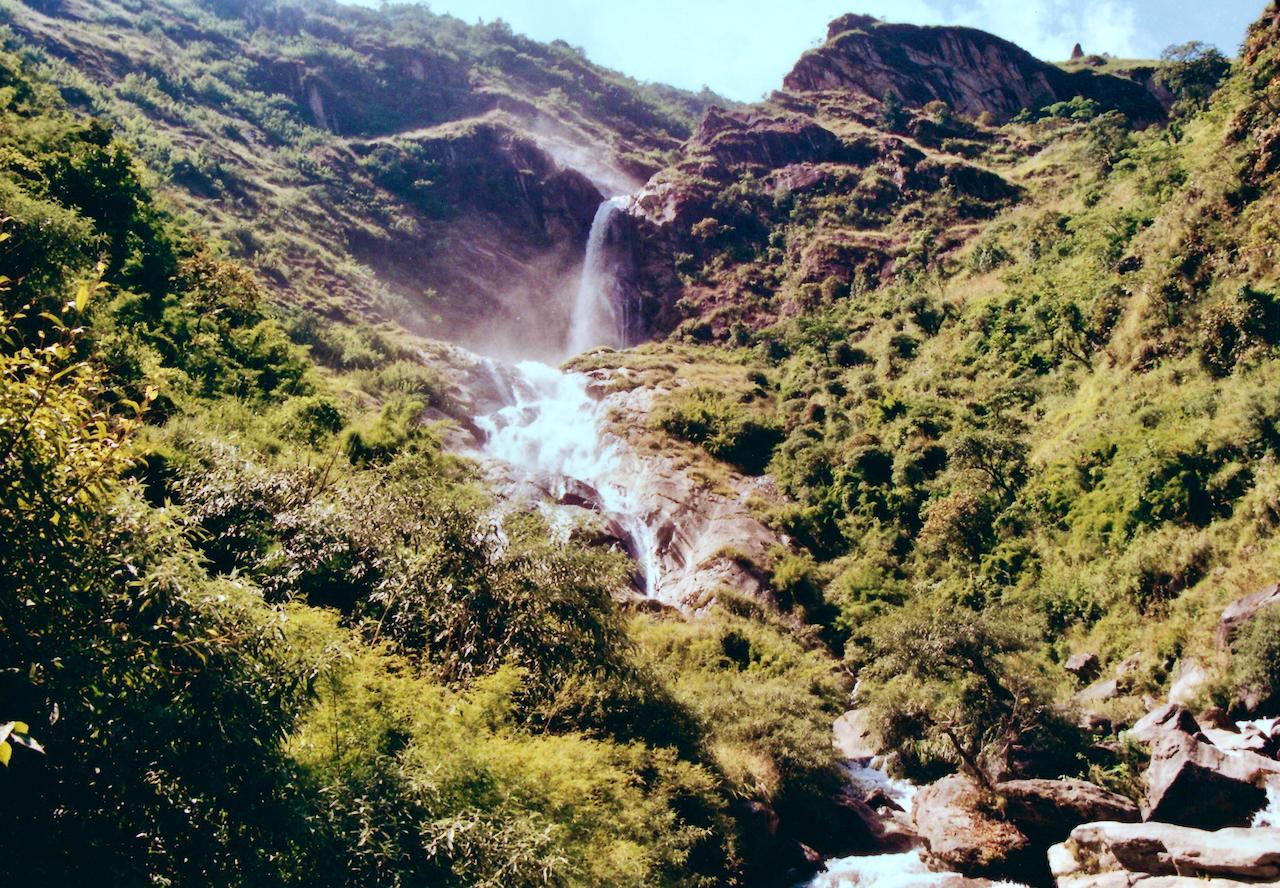
Two hours out, with Nilgiri at our shoulder we come upon Rupse Falls – spectacular ribbon of water cascading down from Dhaulagiri’s flank into the Kali Gandaki. Along our path just before the river crossing, Marcia stumbles, loses her balance and tumbles over the edge of the precipice. Even though I am only a few paces away, it happens so fast I can’t grab for her and can only watch helplessly. As Madu and I reach her side, she is clinging to the roots of a trailside bush and has one leg caught up in its foliage which has likely prevented her from tumbling into the river 100 feet below. I’m worried that she’s broken a limb as her leg is in an awkward position but she claims she’s fine, so we remove her backpack and pull her up to safety. She seems okay except for an extensive abrasion on her right side and leg to which she applies some topical ointment, dons her backpack and we continue on, fording the river to walk along its Eastern shore for a few kilometers.
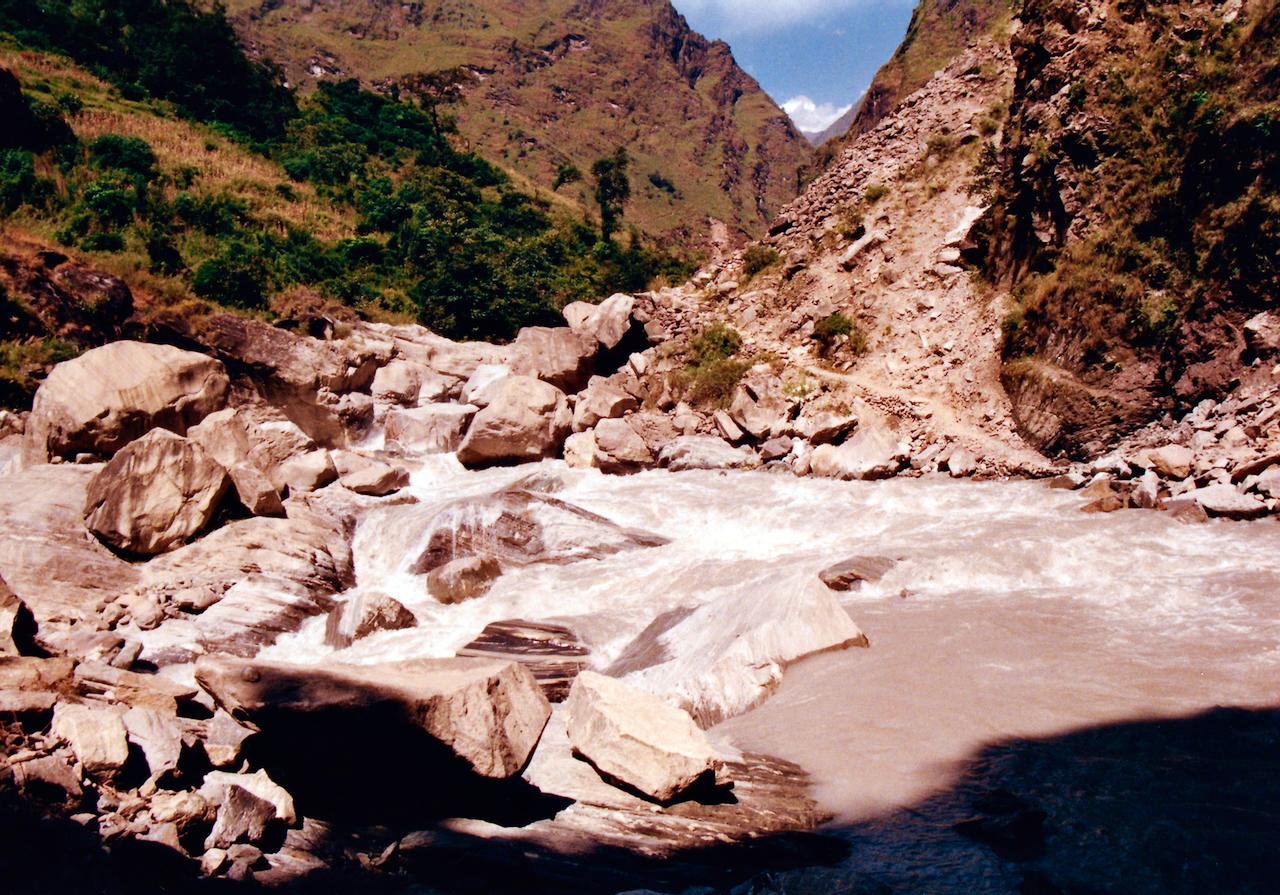
As the river cascades through a series of huge rocks on down towards Pokhara we come upon a basin which we must skirt around in order to ascend above these river falls. At times we must place one foot carefully in front of the other as our path along the soft limestone path is only a foot wide as it wends its way along the river’s edge. One false step and we could tumble into the torrent and we are reminded of the Nepali warning for those who go trekking along these canyons: “Bistarai, Bistarai” – slowly, slowly.
Slowly we make our way around the basin and climb higher and higher through pine forests until we are high above the Kali Gandaki. On the other side of the river we can view the trails that contour the opposing cliffs. It is a very steep, impressive, and dangerous gorge that cuts between Dhaulagiri and Nilgiri. This trip is long and the ascent – though not as steep as the one from Tikhedhunga to Ghorepani – it is still arduous. With our goal in site – the small town of Ghansha situated on a bluff above the West side of the river we come to an impasse.
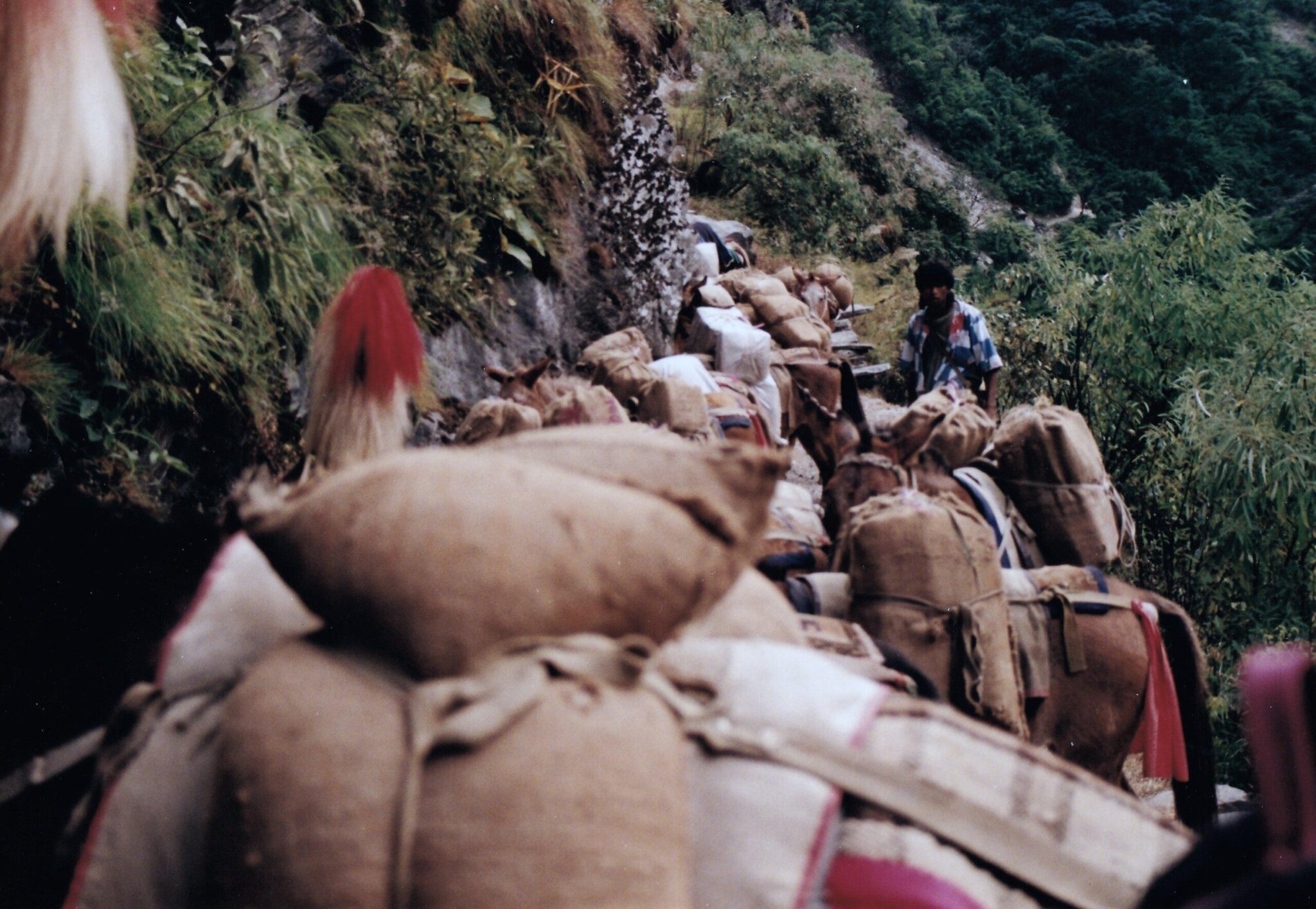
We are on a narrow path – perhaps ten feet wide on the East side of the gorge. The river roars along some 100 feet below – the color of wet cement. Before us, queued up along the trail is a herd of perhaps 500 goats blocking both the trail and the bridge to Gansha beyond.
Behind us is a caravan of donkeys headed up the Thak Khola laden with trade goods. The lead shepherd is shouting at the caravan leader to move his animals back along the path to a wider area. The donkey herder insists there is plenty of room and won’t budge.
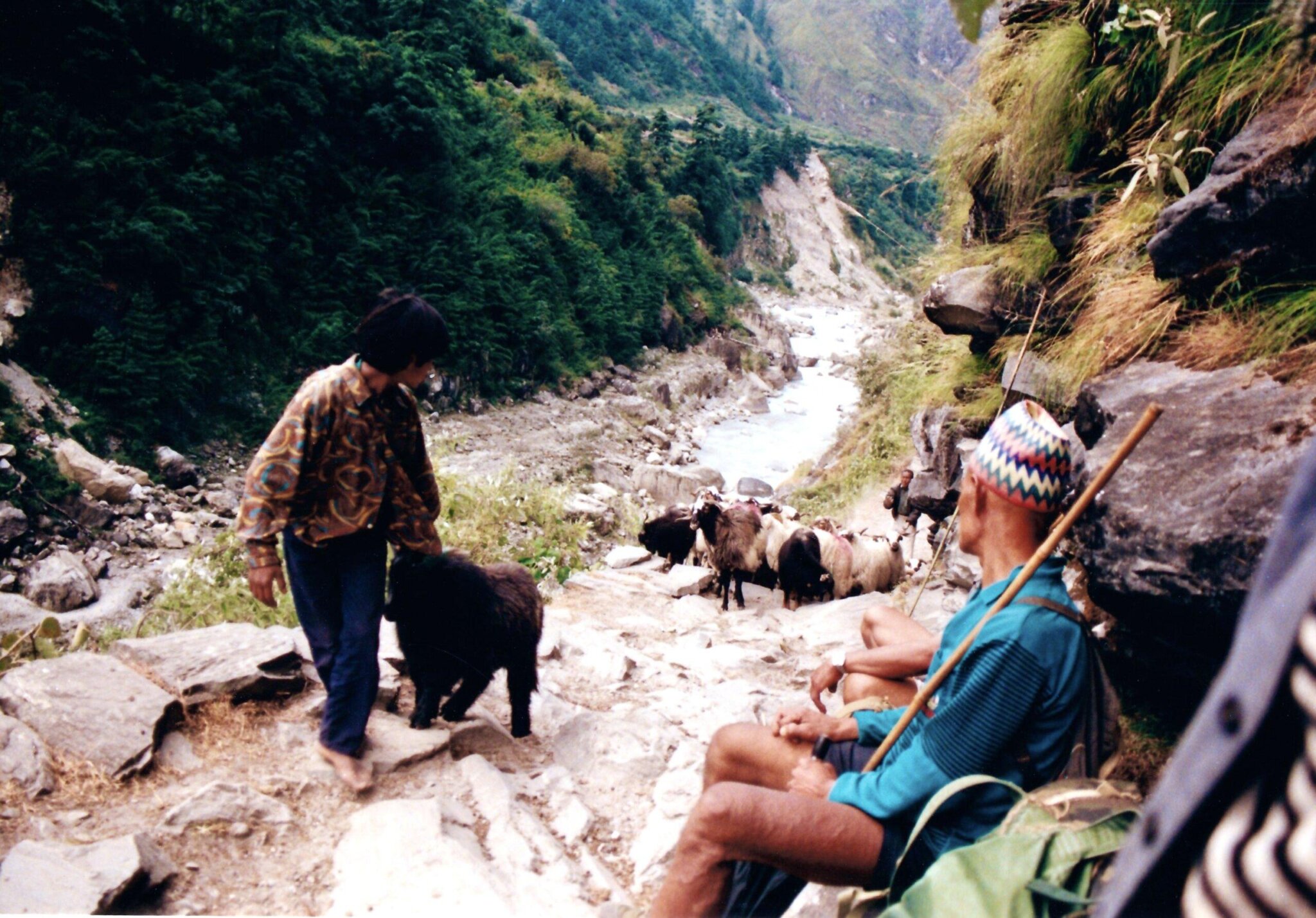
We’re caught in between – tired, hungry, and bemused at the scene unfolding before us. After much haggling in which we trekkers – including myself in complete frustration over the delay and a camera glitch – pitch in our two cents worth, we’ve moved back up the trail 100 yards or more so they can start the goats. Slowly the goats edge forward – a small boy in the forefront pulling a “lead” goat along by the horns, and by 10 minutes or so the goats have cleared the bottleneck and we’re free to move on. Marcia handles me with complete aplomb and I feel pretty much like a jerk for losing my cool and vow to do better.
Evening is spent at dinner visiting with fellow trekkers from L.A. – two hard drinking belchers away from their wives for a few weeks named Ed and Tom – the latter it turns out is an Ultramarathoner – who runs up to a hundred miles per day. We wonder how his porter or anyone can keep up with him. Many good laughs before bedtime.
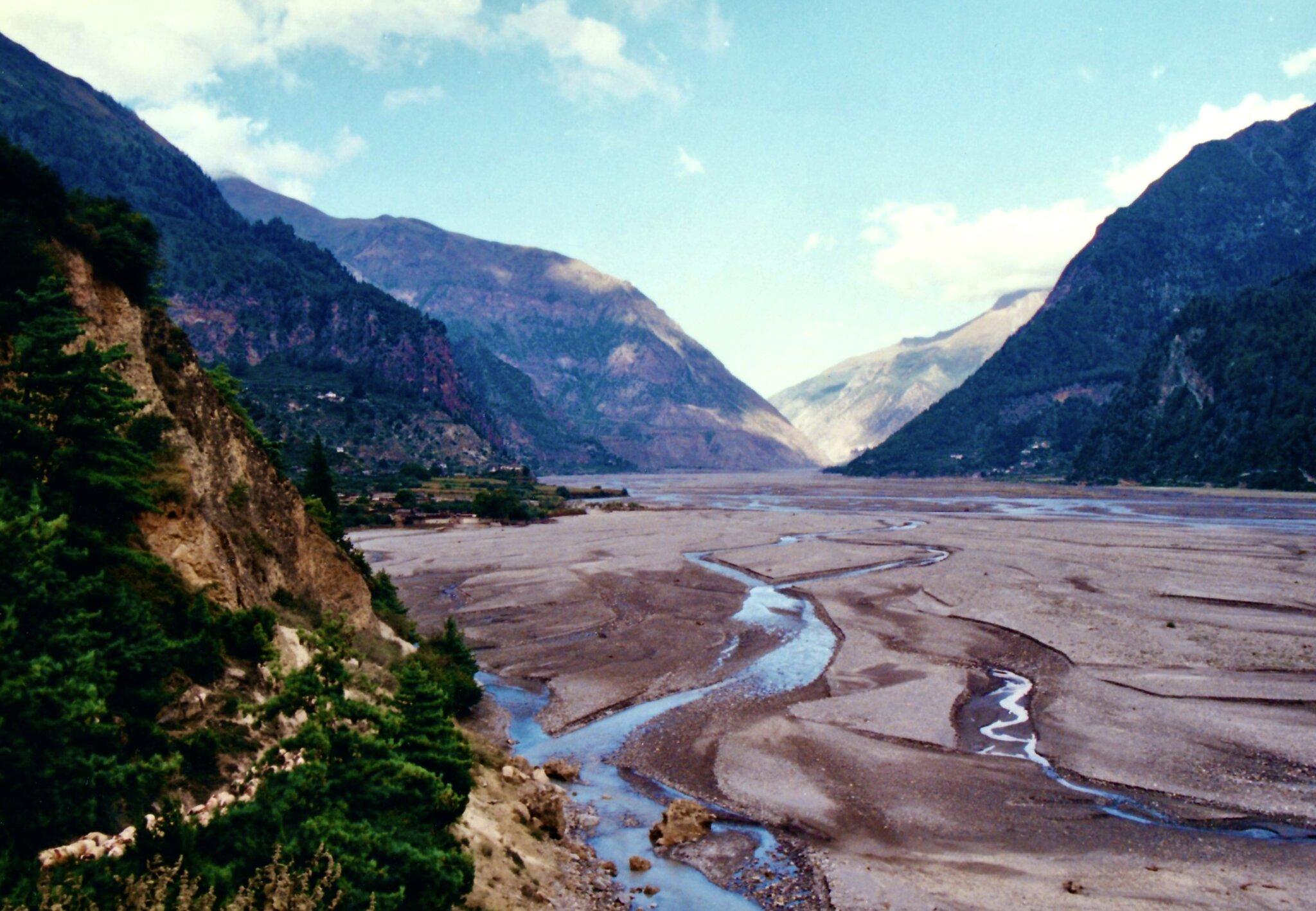
A gradual climb through the day through pine forests and changing topography. The mountains – Dhaulagiri & Nilgiri Himal – are hidden most of the time by clouds and there is a definite bite to the air as if we’re being chased by a beast with a cold breath. We stop for lunch in Kalopani, a small village in the apple district, to have a piece of an apple crumble pie with custard that is out of this world. We are tempted to stay but our goal is the Muktinath Temple plus we need to secure tickets in Jomsom for our flight back to Pokhara as well so we push on towards Tukuche.
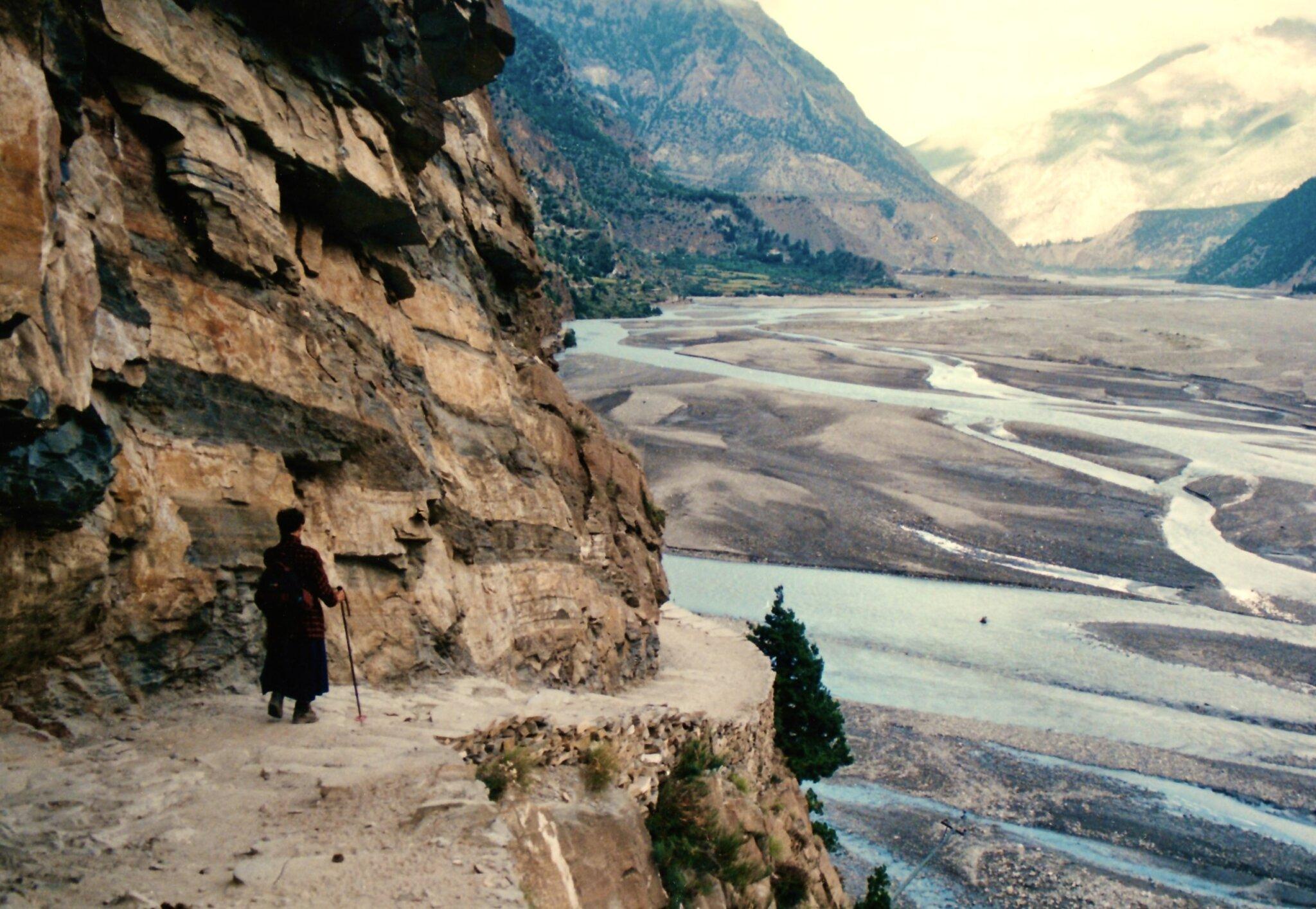
The weather begins to turn much cooler as we descend to the Kali Gandaki river bed. Just before Larjung, we cross a small bay formed by the main river and a tributary. Suddenly we realize that we’ll have to shed our boots and roll up our trousers to wade across several streamlets. I’m a bit squeamish about wading barefoot into sandy bottomed Lake Huron let alone a mountain stream but I finally succumb to the inevitability of getting my feet wet in glacial waters – and they indeed turn out to be just that.
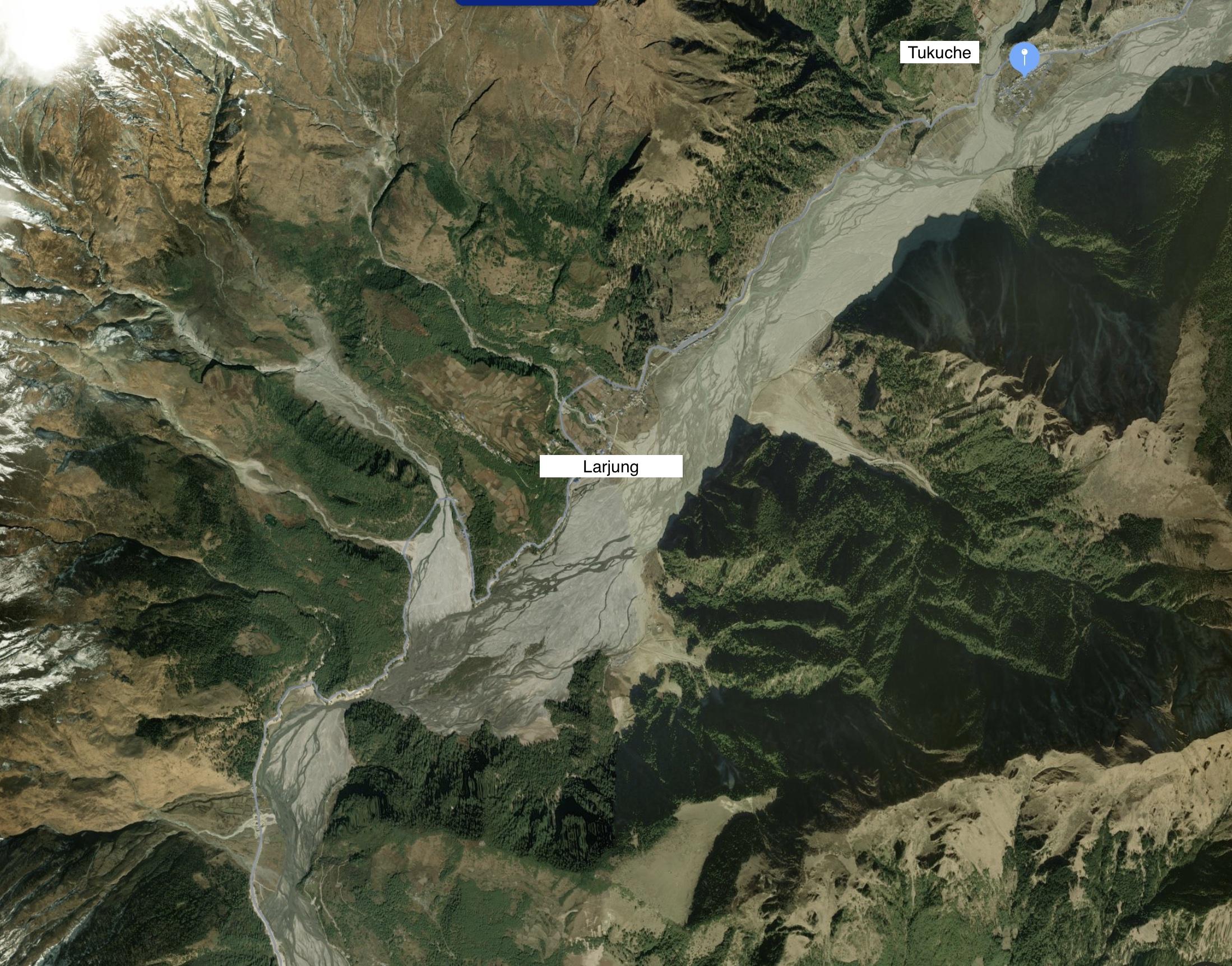 But that wasn’t the worst part. The ghastly part was the sharp rocks that you kept stubbing toes and pinching the soles of your feet on. Once again Marcia seems very entertained handling my duress with great humor and joy. I, on the other hand, proceed on, grimacing, screaming, and clawing my way through the stream. At one point the current is very swift and Madhu – my porter – has to grab my hand to steady me. Finally I am able to beach myself – with an expletive of course – again to Marcia’s amusement – and am rewarded with a a series of hugs and kisses – all for the little boy who tends to throw tantrums to get around Life’s obstacles. After a few seconds I too am laughing at the top of my lungs. A small crowd which had gathered to watch the theatrics shouts its delight as well. “Should I go out again so you can all get a picture?”, I ask. But I really don’t want to do an encore since my feet are red with cold and sore to boot. Maybe if there were fewer rocks.
We don our boots and set off for Tukuche where we find an excellent inn with great food and hot showers.
We wake early to a warm breakfast of porridge and milk tea [pronounced “milik” by the local innkeeper – a woman of Tibetan-Thakali descent with five children]. “I don’t advertise my lodge,” she says. “My customers tell others how good it is.” Although the trekking season is still a few week away, it seems clear that she’s worried about the lack of trekkers staying at her lodge. This morning there are only Marcia and I and a Frenchman who intends on ascending Thorong La Pass from the “hard” side and alone! And he claimed to be a seasoned Pyrenees climber – so who were we to give him advice.
There is a decided bite to the air as we step out onto the street and stretch our aching muscles. We meet a group of German trekkers exiting the lodge across the lane and one of them exclaims: ” They’ve a yak in the stable here!” Now this is one of Marcia’s fondest wishes – to be photographed next to a living yak. The innkeeper then leads our excited group through several doors and into a stable. We peer around and at first glance see only a cock and a few chickens but no yak. Then lurking against the dark back wall we can barely make out a shaggy black shape – resembling more a large flea-bitten dog than a yak and appearing to be a little the worse for wear – is what the landlady loudly claims to be the only stuffed yak in Tukuche. We all break our in laughter. A good joke is a great way to start the day’s journey.
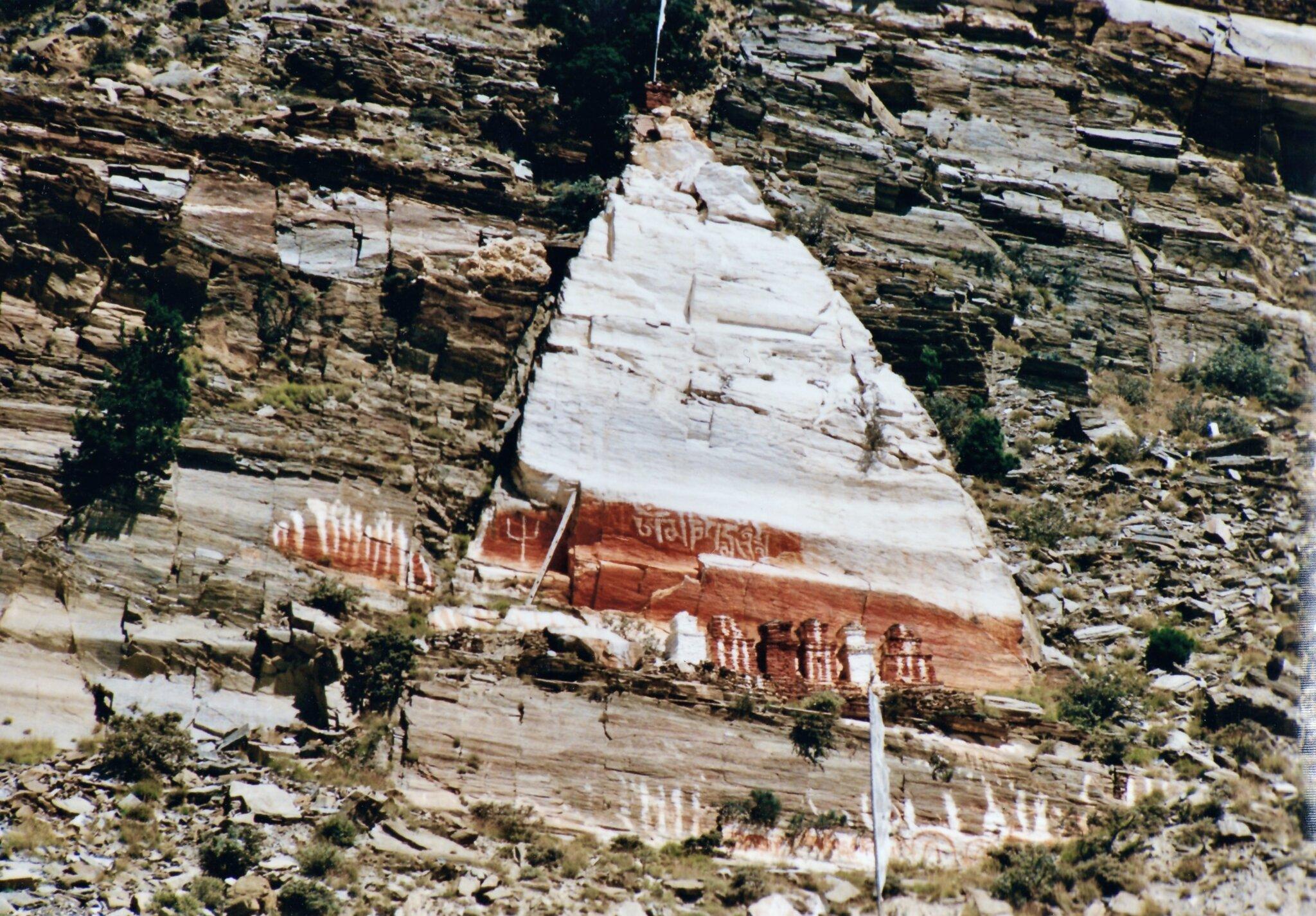
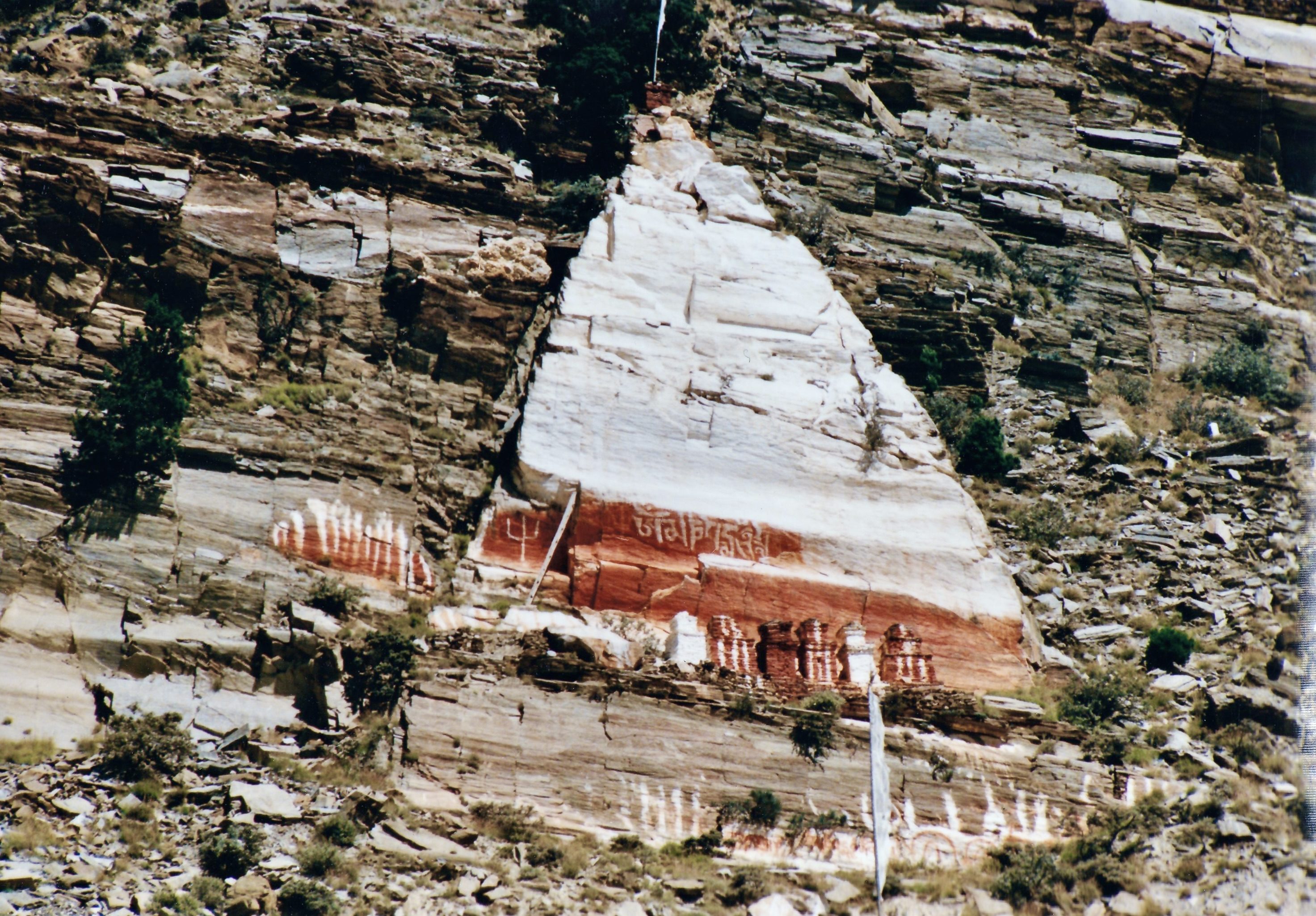 Leaving Tukuche we closely parallel the Kali Gandaki wending our way North through several small villages including one with narrow main streets and buildings built close to each other with a series of tunnels. It is here we huddle, shielding ourselves agains the howling afternoon winds. Then it’s on to Marpha with its painted Buddhist chorten situated high on a hill above town. We stop to sample more milk tea and apple pie.
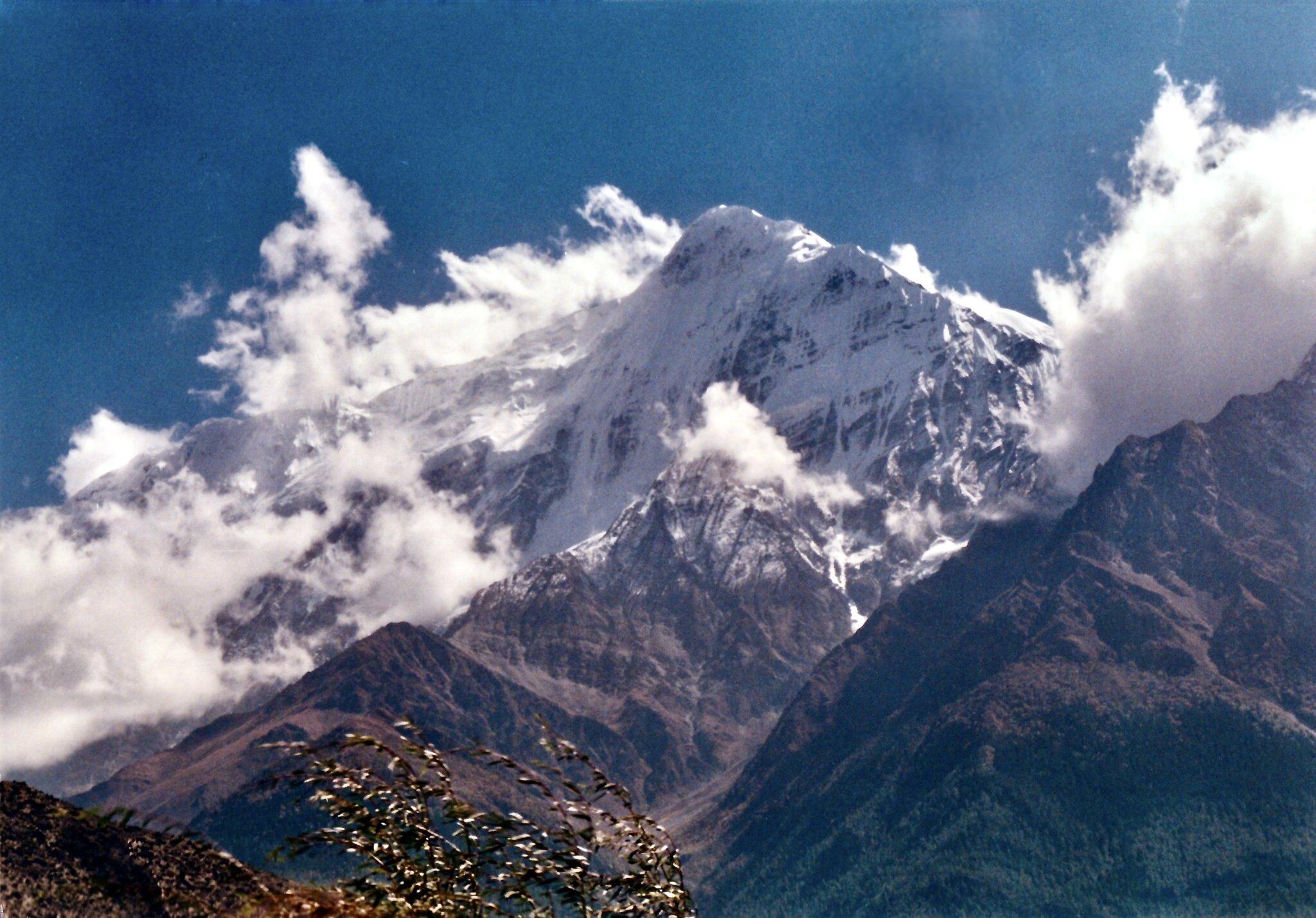
We leave Marpha and again venture out onto the river bed where the wind picks up – howling at our backs. The sky is clear and on our right as we head North, above the clouds looms Nilgiri, a three-pronged crown of white.
Entering Jomosom we find it a wind-blown assembly of hotels and lodges that border one side of the runway to the STOL airport. We book into the Moonlight Lodge for some more tea and potato curry. Marcia opts to hang out in the main dining area while I make ready to turn in. Then an old man accompanied by a young girl enters and begins singing Hindu folk songs – accompanying himself on a stringed instrument, the young girl’s voice lifting high above his. Such sweet music. But my body is tired and I re-tire.
Later Marcia enters our room very excited. It seems a Japanese expedition to summit of Dhaulagiri has just arrived, in fact earlier we’d seen a man who seemed either drugged or asleep on his feet. By accounts that very man together with two sherpas had summited two days before. But one sherpa had fallen two thousand feet and was in serious condition and had been helicoptered out of danger to a Kathmandu hospital. She’d also talked with to liaison officer [a Nepali] for an American expedition to the same peak. Half the party of four had made it to the summit and the other half was still waiting to try. I knew she’d get to the bottom of all of this. Brava!
Next morning after a “hardy” breakfast of potato pancakes and milk tea [Nepali tea in some circles – usually prepared with ginger and cardamon seed with suitable sweeteners] we set off in the direction of Kagbeni, a windswept village that is the stepping off location for expeditions to Mustang a district of Gandaki Province bordering on Tibet that was once known as the Kingdom of Lo Manthang and is still a restricted area today. According the the Wiki, the name “Mustang” is derived from the Tibetan word meaning, “Plain of Aspiration.”
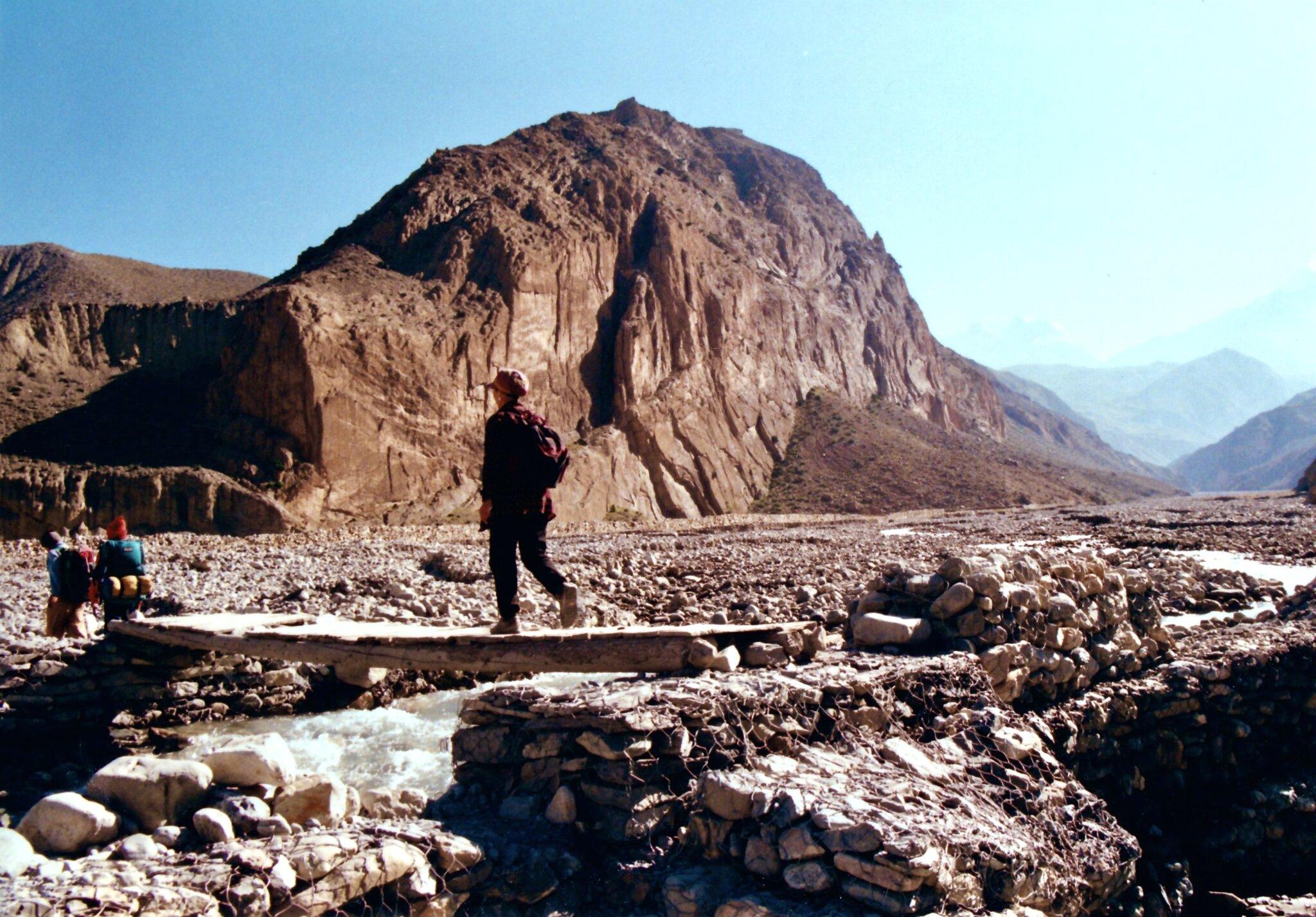 Leaving the outskirts of Jomosom we traverse down to the gravel river bed of the Kali Gandaki once more only this time it is only us and our guides Madhu and Tatsu with the river bed and the mountains on either side – stark in their beauty exhibiting subtle shades of brown, beige, black, and green. The only sounds are our footfalls on the loose gravel, our labored breathing, and the rush of the nearby river.
Soon Marcia spies a flock of birds overhead – big birds, swirling and swarming – calling to each other. They sound like geese or cranes. They are gone before we can even get a picture – besides they’e too high up for us even at nine thousand feet. A half hour later, Marcia stands transfixed – in a trance or mesmerized by some vision – immobilized by an external power. I look around.
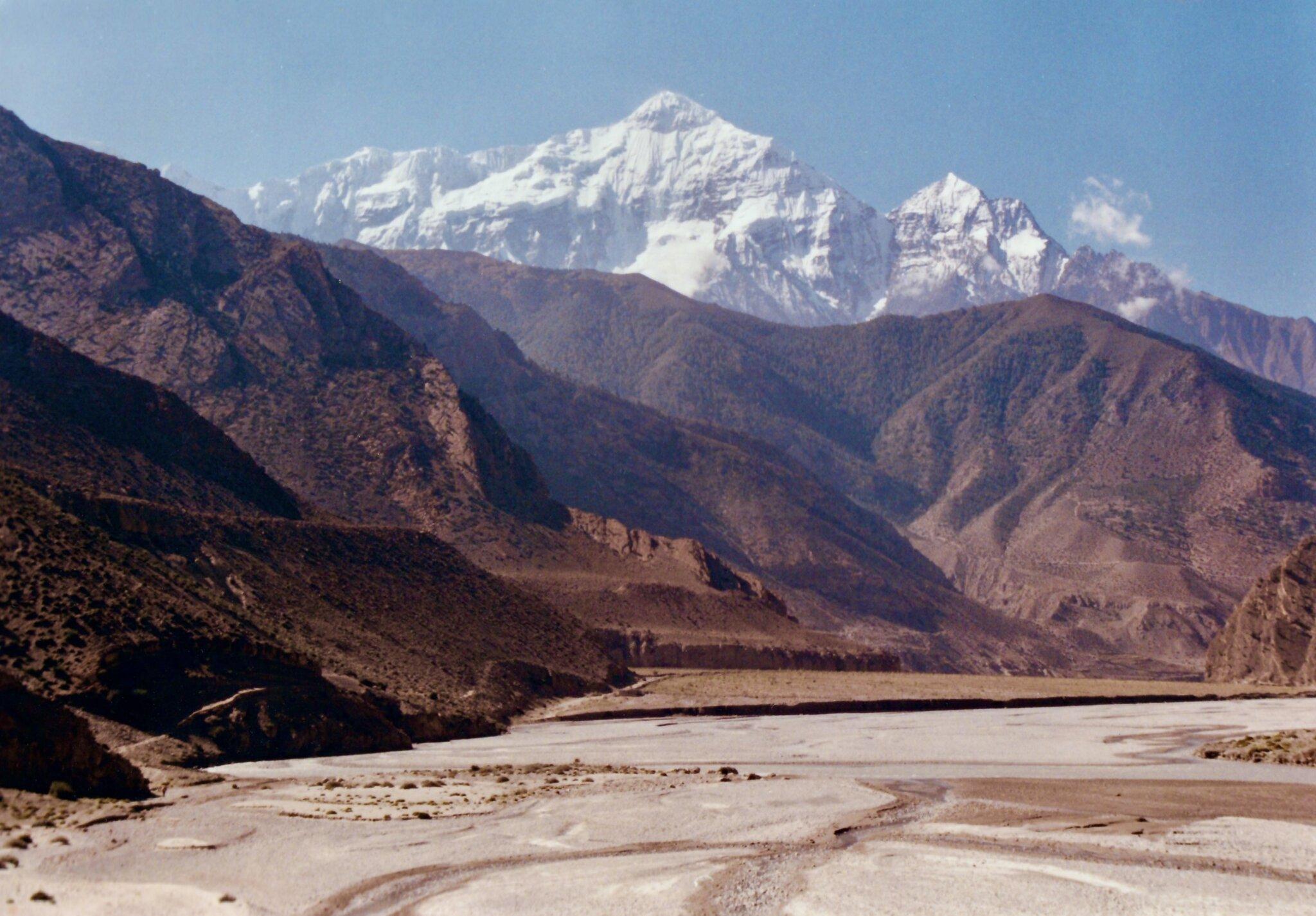 To the Southeast, the tip of Nilgiri shimmers in the morning light, skirted by dark hills. To the Southwest, Dhaulagiri and Thapa Peak loom translucent. To the West are hills brown and beige skirted by whorls of sedimentary layers of earth. To the North the river snarls down from Tibet interweaving its many silvery tentacles along its stony bed. What is it about this place?
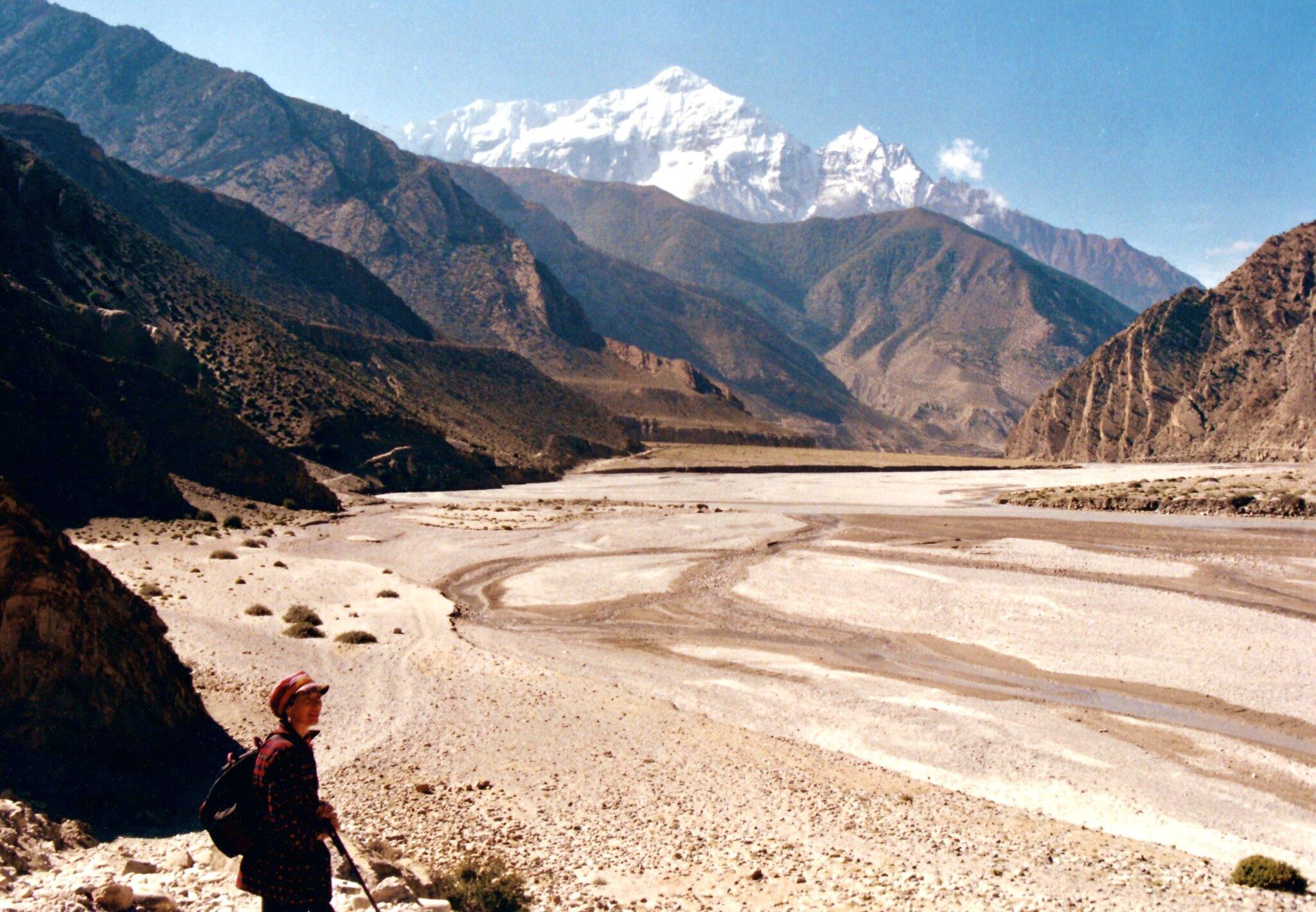 To my left I see a Buddhist chorten – two supplicants prostrating themselves in devoted prayer. My eyes shift back to Marcia. She is like a statue. I point to the chorten and call out to her. She turns her head – sees the shrine and utters an exclamation. Slowly she makes her way over to me and with each step a penumbra radiates from her – more vivid and vibrant with each step. It is her aura – white tinged with cerise – her favorite color [at least the color she wears and mentions the most]. Closer and closer she comes – her aura growing in size until it becomes a part of the landscape itself. “This is a place of great power”, she exclaims. I tell her what I had just seen and we both stand in silent wonder – then embrace.
An hour later we are at the trail head to Kagbeni. The plan had been to spend the night there, then proceed to Muktinath in the morning because of my knee and a nasty blister that has developed on my little toe. But I feel good and the day is young so we decide to bypass Kagbeni in favor of Jharkhot – the old fortress portal to the holy shrine of Muktinath situated just below Thorong La Pass to Manang.
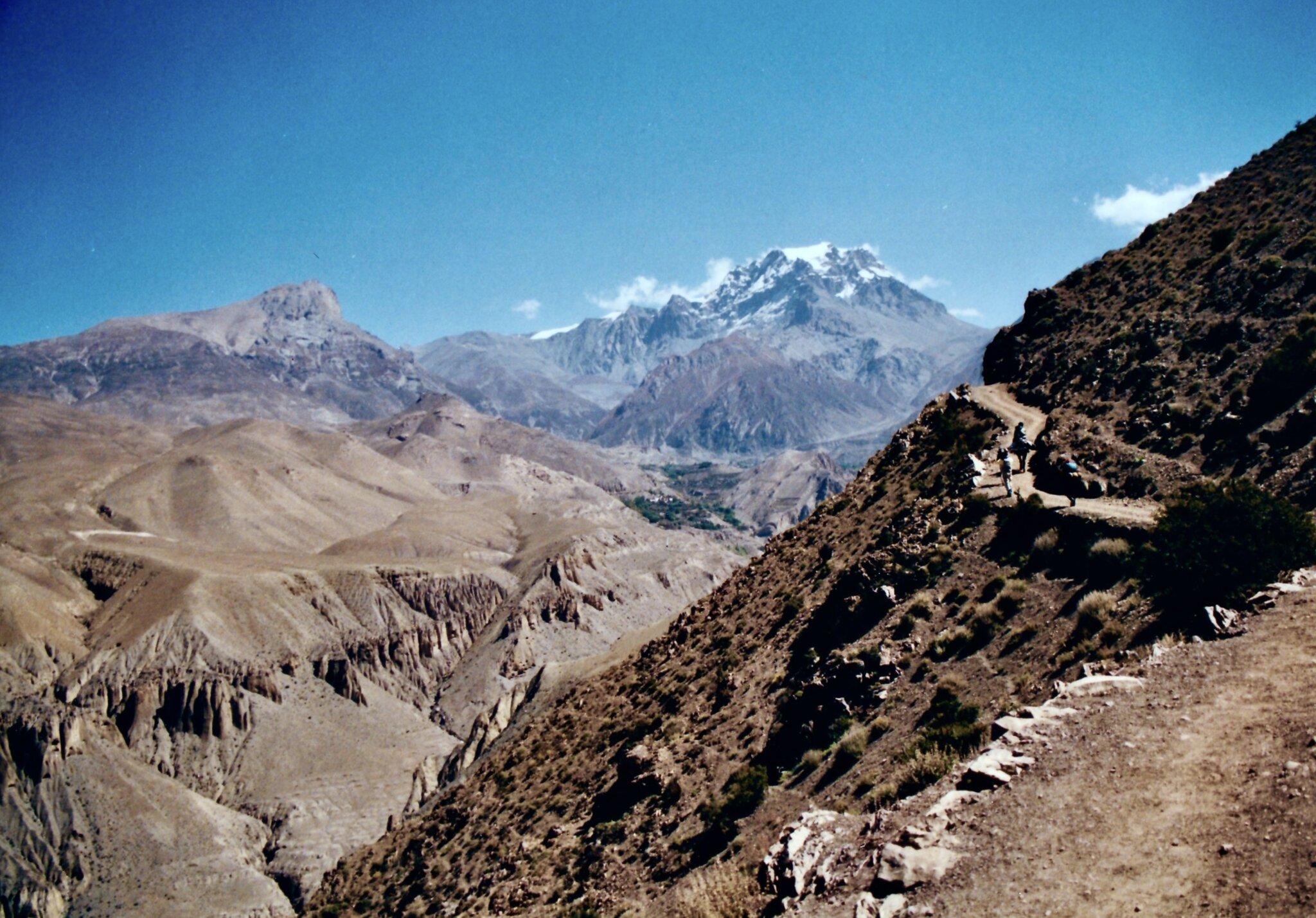 After more “Nepali Tea” we set off – up, up, and up. First through scree strewn from cliff rockslides, then a winding trail offering breath-taking vistas of deep ravines slicing through arid mountain passes. In the distance we can still hear the river, relentless in its descent . Breathing is getting harder even though our ascent has been gradual. We’re at Twelve Thousand feet and climbing and our legs are getting tired. Even Tatsu and Madhu are feeling the altitude.
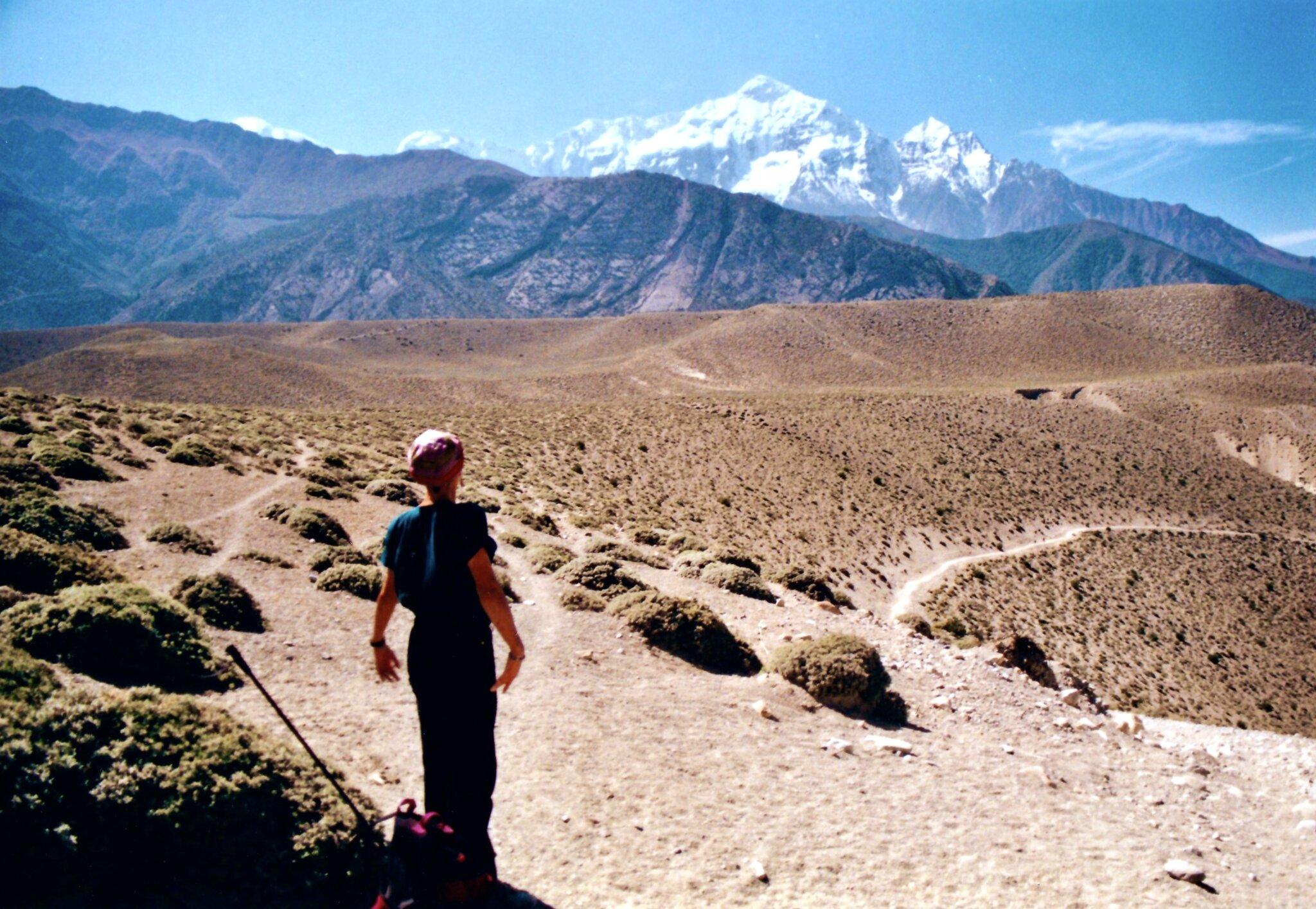 We top a hill and ahead we get a glimpse of Jharkhot – close, or so it seems. Marcia celebrates by performing a few Continuum dance moves – much to the delight of several Nepali women – pilgrims descending past us from Muktinath. But the trail is deceptively steep and the ascent long and arduous. Jharkhot seems no closer and we are nearing exhaustion.
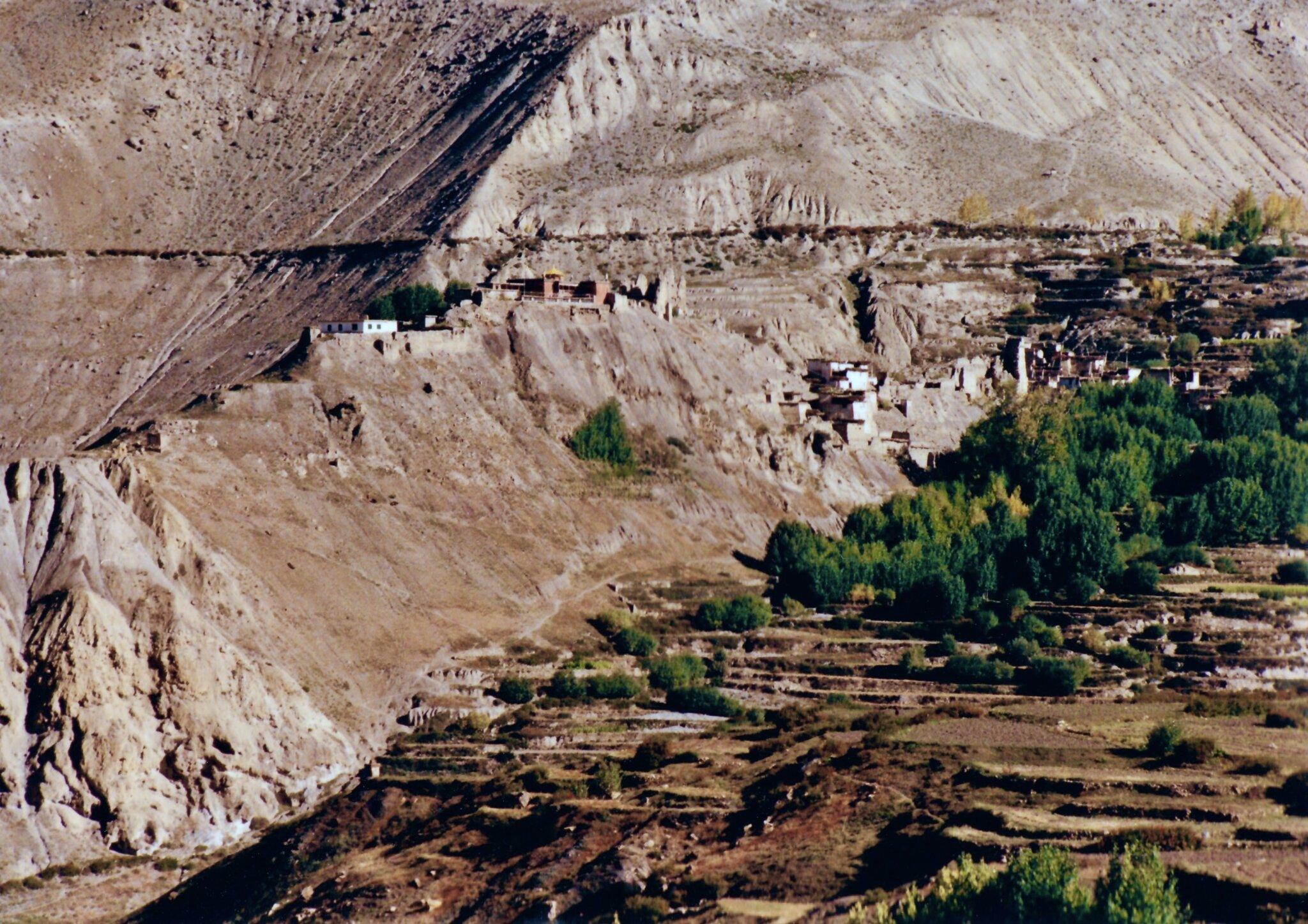
The village is situated on a mesa – at the highest point of which stands a Buddhist temple painted a dark red which appears to have a tower circumscribed by the ruins of what appears to be an ancient fortress. Surrounding the village are farmlands, terraced up nearby hillsides and mountain slopes where millet and rice grow. To the East we observe what seems to be a sprawling monastery (abandoned we later learn) and to the Northeast Thorong Peak hovers over Muktinath, our sacred destination.
Exhausted, we stop at the first inn we come across. I can’t even make it up the stairs to inspect the accommodations so Marcia obliges. She finds them likable largely because of the sunny exposure, the large double windows, and because they have a solar powered shower [Yes! In Nepal in 1994], the first since Tikhedhunga. We take our ablutions then have tea on the roof overlooking a portion of the trail we’d just ascended.
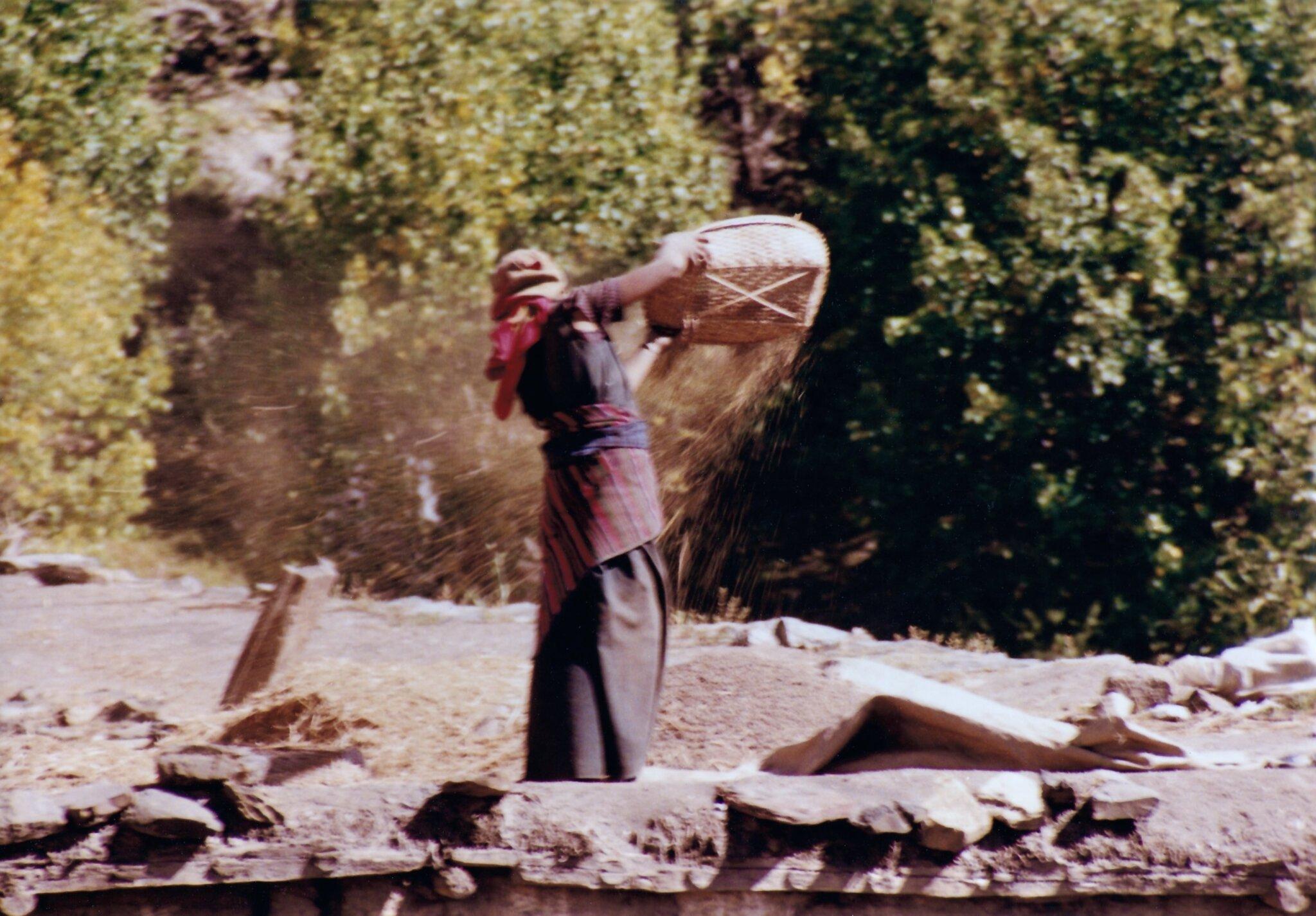
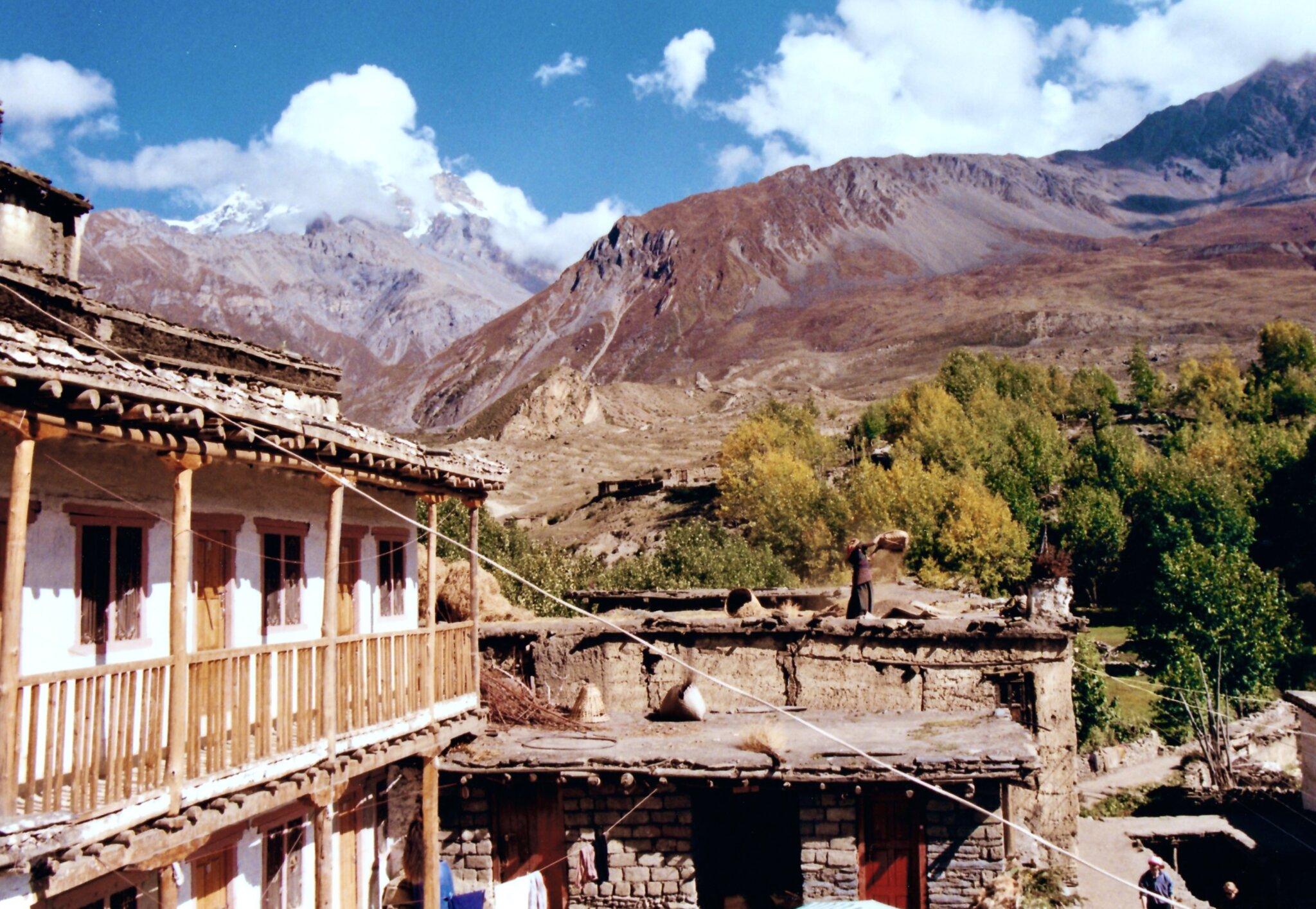
On adjoining rooftops – women thrash millet and work with hand looms. Much of the everyday life here appears to be what it always was – right out of antiquity. We plan a tour of Jharkhot tomorrow after visiting Muktinath. The inn fills up rapidly and we spend some time with a German couple who will be scaling Thorong La in the morning.
Also, a young woman whom we met in Ghansa with the two “boys” from L.A. is also at the hotel. Evidently her “partner” decided to turn back at Jomosom – leaving her to go it alone to Muktinath. She plans to dash up to the temples then trek all day back to Tukuche to catch him – a LOT of walking in one day even if all downhill. Marcia and I marvel at how adversity seems to bring out the “real” side of people – maybe not “real” but perhaps “inner” or “complete”. We wonder what this portends for future of this couple. Her male friend doesn’t seem to be committed – at least to the same things as she.
However, the evening does turn out to be a jolly one, shared with fellow trekkers as we recount our stories and experiences from along the trail. The Ulleri Steps with porters toting telephone poles; Poon Hill; Tatopani’s hot springs; some brushes with disaster; The Great Stuffed Yak of Tukuche; the winds of Jomosom – all tales of Himalayan Trekkers – a “club” which we’ve all become recent members of [some 20 thousand adventurers trek the Thak Khola each year we come to learn].
Sleep comes fitfully, as with the altitude [13 thousand feet] breathing becomes increasingly more difficult for me – sometimes taking all of my strength.
We start out this morning determined to take our time and enjoy the experience. An exploration of Muktinath – a Vishnu temple sacred to both Hindus and Buddhists – is one of Marcia’s personal as well as spiritual goals for this trip and I am acutely aware of how motivated she is to reach the temple. So I am just as determined that sore toe, gamey knee, altitude, and shortness of breath not withstanding, we will make it happen.
On the way up we run into Tom, our erstwhile UltraMarathoner whom we had met earlier along the trail. Single handedly he has run through at least two porters, one friend [Ed], and perhaps even one wife on this trek alone, and is still burning the soles of his sneakers on the barren Thorong La terrain. It seems he started this morning in Kagbeni, rocketed up to Muktinath and part way up the Thorong La Pass and is on his way back down to Jomosom then ultimately back to Pokhara by STOL aircraft.
We’d bought our tickets to Pokhara back in Jomosom as well but are unsure whether we’ll be able to get seats on the small STOL airplanes that fly in and out at limited times. Those limits are set by the topography – a narrow wind-blown pass located on the skirts of Nilgiri Himal which overshadows the airstrip; the high winds – over 25 knots by 10 AM; and the weather – all three of which tend to limit the frequency of flights each day. Plus there are no facilities [in 1994] for night landings.
So our discussion with Tom centers around how and if we’ll all be able to get out of Jomosom [including our porters Madhu and Tatsu] plus any news we’ve had of Ed – Tom’s estranged “partner” [we’d left him back in Kalopani eating his apple crumb pie]. Continuing to gripe about everything, including the terrain, Ed, his porters, and his wife, Tom gives us a wave and he’s off down the hill. “Obsessive” is Marcia’s only remark. Being a marathoner herself she recognizes an addictive personality when she sees one.
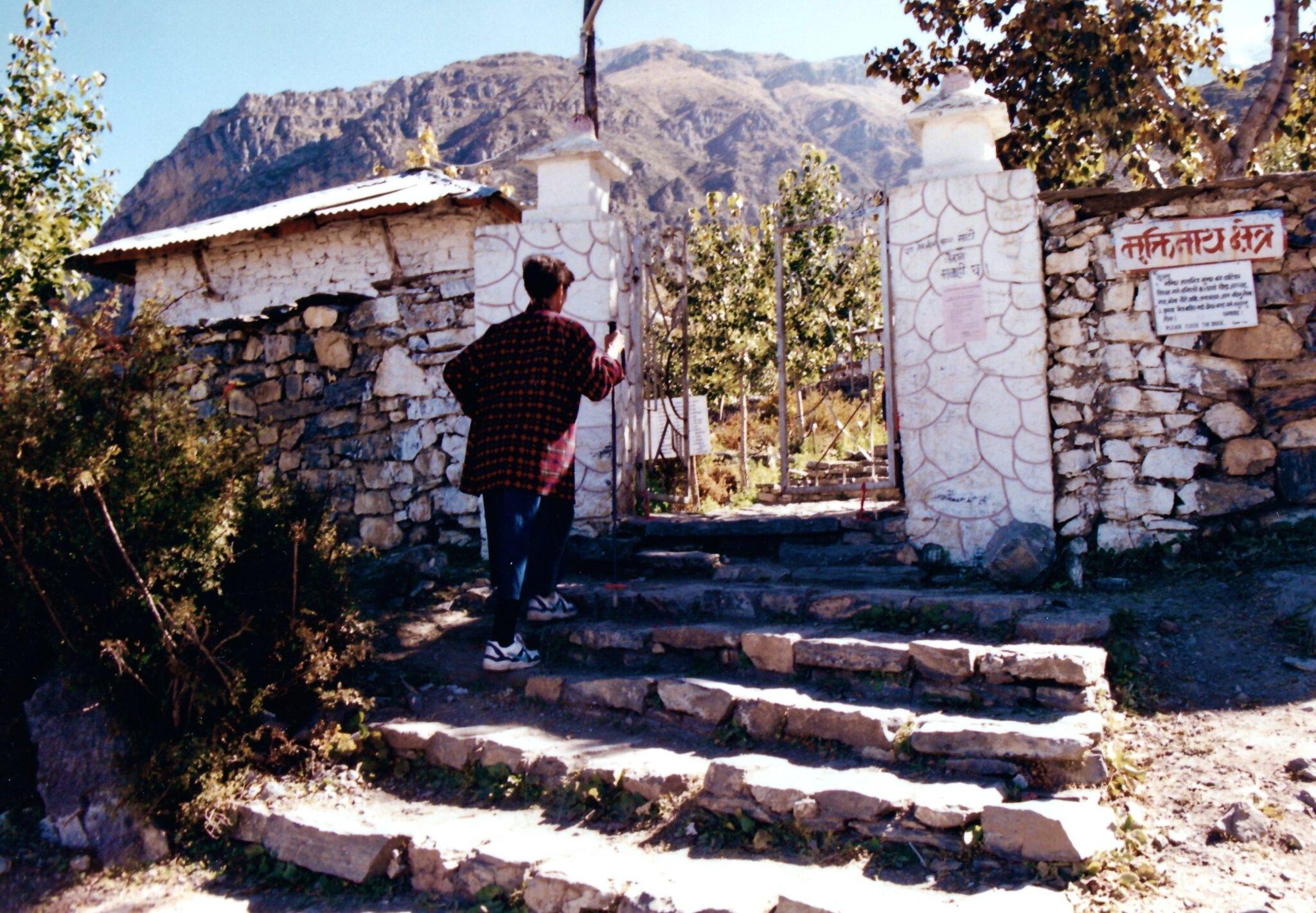
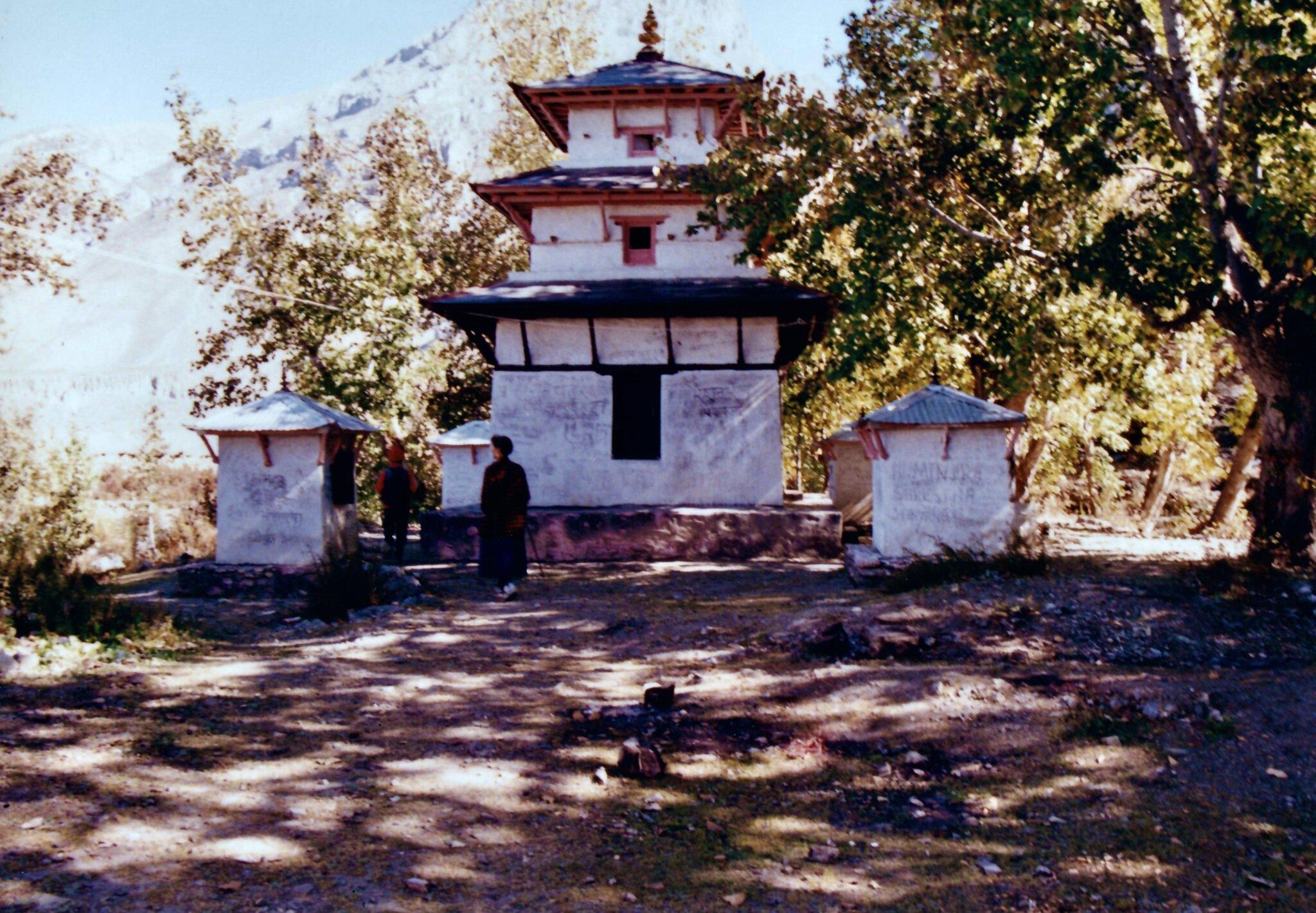
Slowly we wend our way up to the main gate of the Holy Shrine. I am amazed at the complete simplicity of the space. In the West a shrine or temple of this import would take up at least a city block and be festooned with towers and a huge parking lot. But this is Mustang in the Himalayas and there are no vehicles here – none at all. We enter a cool plateau shrouded by junipers stepping along next to a small spring that ripples though its center.
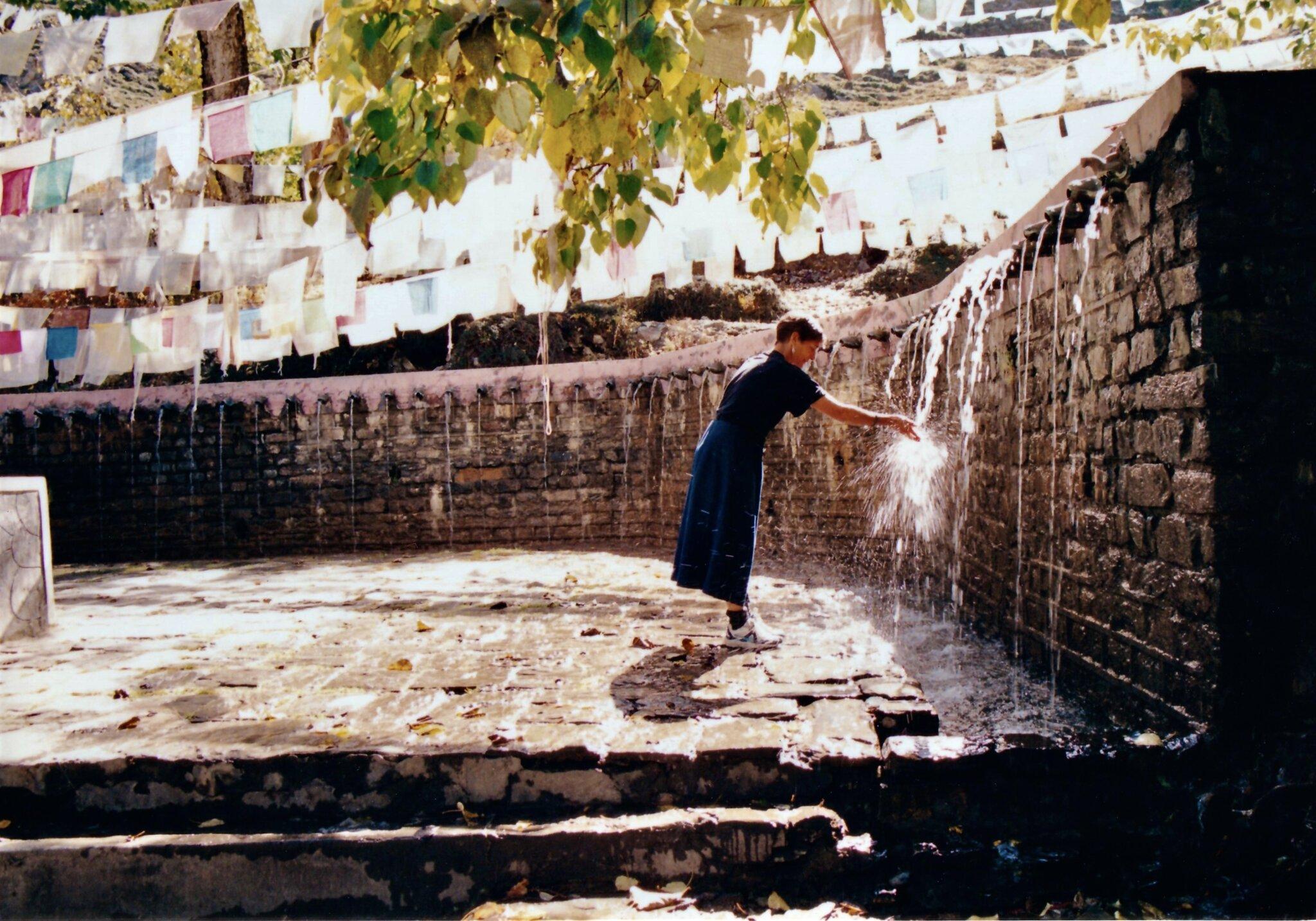
Next to the brook stands a temple, part Vishnu part Buddhist. Surrounding this temple is an eight foot wall featuring 108 sacred fountains each spout shaped like a boar’s head from which water spills onto stone flooring. Going left to right [some heretics or improvisors do the opposite], you utter prayers before each one then dip your fingers in the spout of water and spray it over your head. You do this 108 times [a sacred number] and complete the circuit while bathing off bad kharma in the process. Marcia goes first while I take pictures. Then it’s my turn. The sound of the water cascading from 108 spouts helps the mind focus on the now. Above, the prayer flags flutter in the morning breeze as one by one you utter your prayer or blessing, dip your fingers into the pouring water and spray it over your head. It is very refreshing to both body and soul. I finish feeling cleansed in both spirit and in mind.
Next we visit Jwala Mai Temple – the Shrine of Fire and Water. Legend has it that this shrine once had three “eternal” flames fed by natural gases that appeared to burn right out of flowing water. In order to witness this miracle, devotees must fork over 10 rupees to an attendant who pushes aside a small curtain so that the supplicant – on bended knee – can peer into a murky recess situated under an altar-like display of sacred icons – and yes – see a flame suspended over a small stream of water. However the lighting is so shadowy the skeptic in me can place little faith in this miracle. And next we step up to spin prayer wheels – a long line of them constructed from used Carnation powdered milk cans. What ever works.
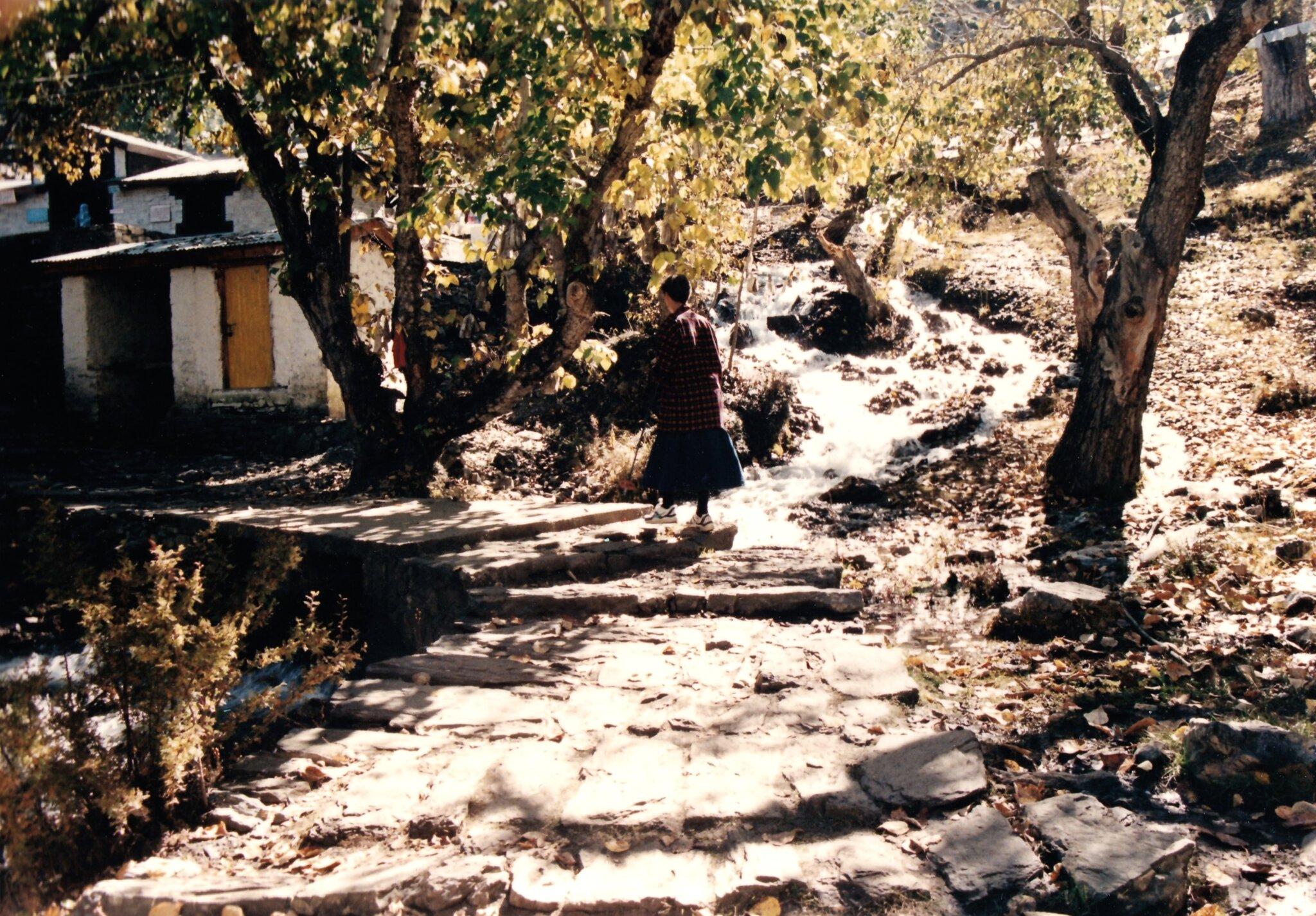
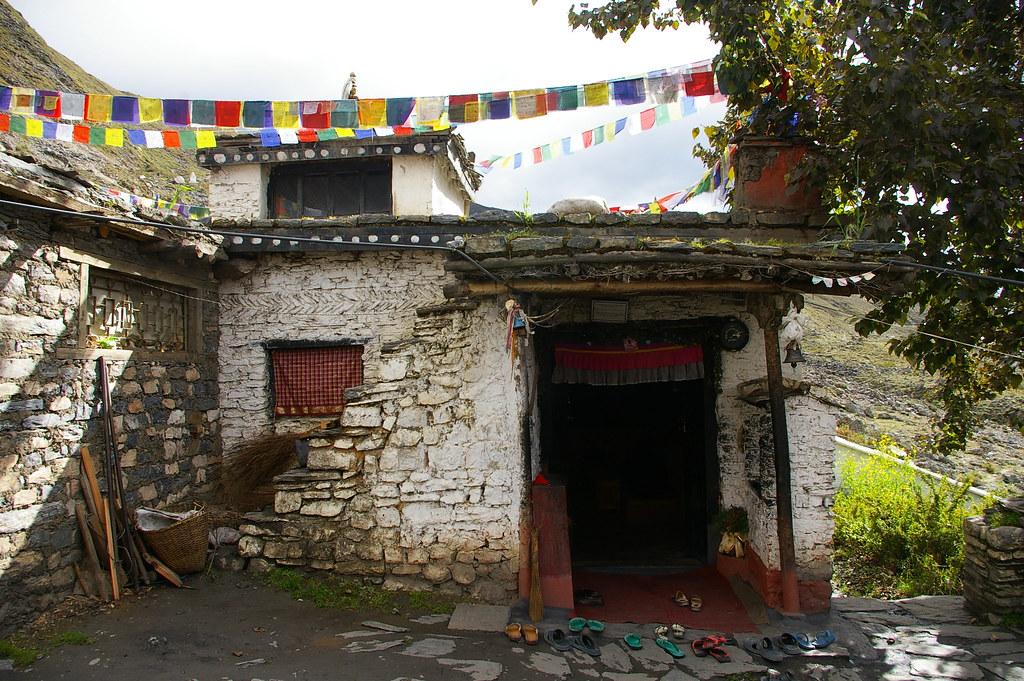
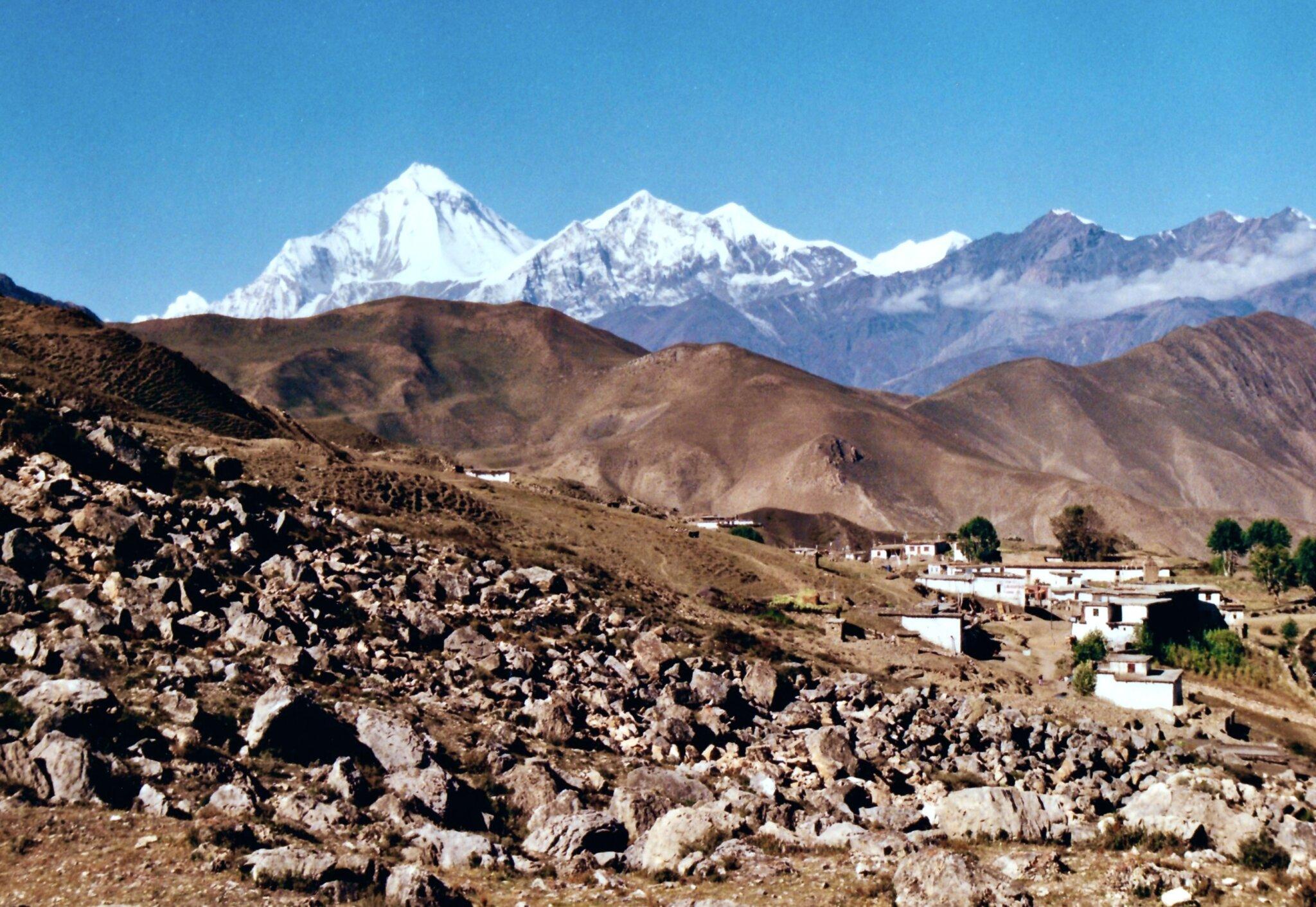
On the way back down towards Jharkhot we stop to sit on a bench – sending the porters ahead while we view the setting – Throrong La Pass above us with Throrong Peak; Nilgiri and the tip of Dhaulagiri to the South. We are surrounded by these wondrous peaks literally at the top of the world.
And who should happen by at this serene moment but Ed – the other half of the L.A. duo. He’s had a great time hiking up the Thak Khola with a newly-hired porter – at half of what we’re paying ours. We fill him in about Tom the Ultramarathoner but he just shrugs and says he’ll catch up with him in Pokhara or he won’t and will just go on to Thailand and Vietnam – if his wife okays it. I just marvel at these seemingly “open” relationships in which you take separate vacations etc. Maybe it’s just a “Me” generation thing. What ever happened to sharing? I’d rather spend my free time with someone else besides myself. Call me romantic. We bade each other farewell and slowly descend to Jharkhot where, after a casual lunch, I re-load the camera for a sight-see of the village.
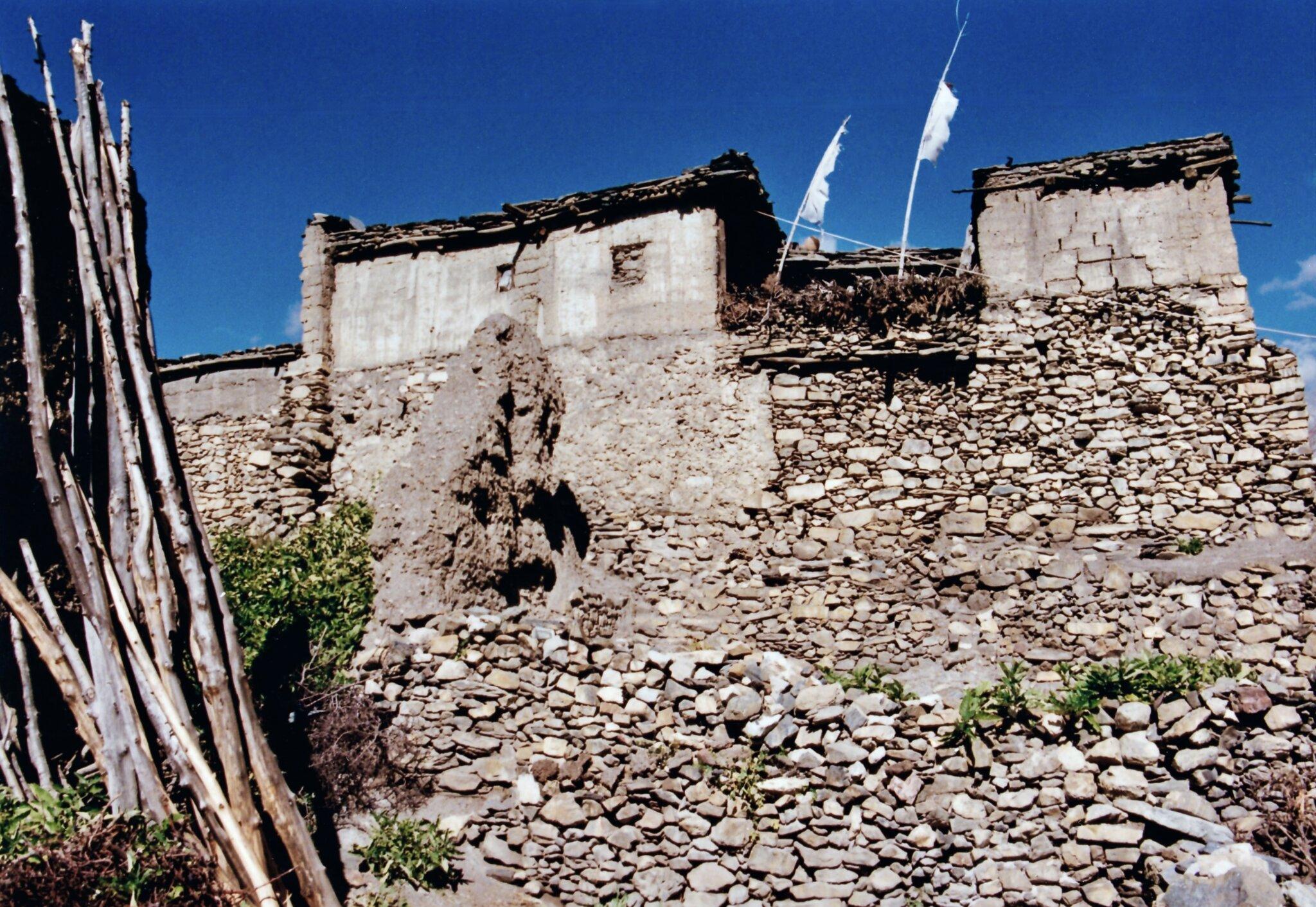 On a flat area – probably used for drying millet and rice we can view the entire valley extending up past Muktinath along Thorong La Khola. Above us are the decaying walls of Jharkhot made mostly of un-mortared brick. There seems to be no one around. In the background we can hear a dog barking and there is the latent smell of domestic farm animals – probably out to pasture this time of day. We hike up some decrepit stone steps and into the narrow streets of the village. There is still no one. The doors we encounter are all well-worn – but locked. Over the transoms of many are placed animistic symbols for good luck or protection. No one seems to be at home this time of day.
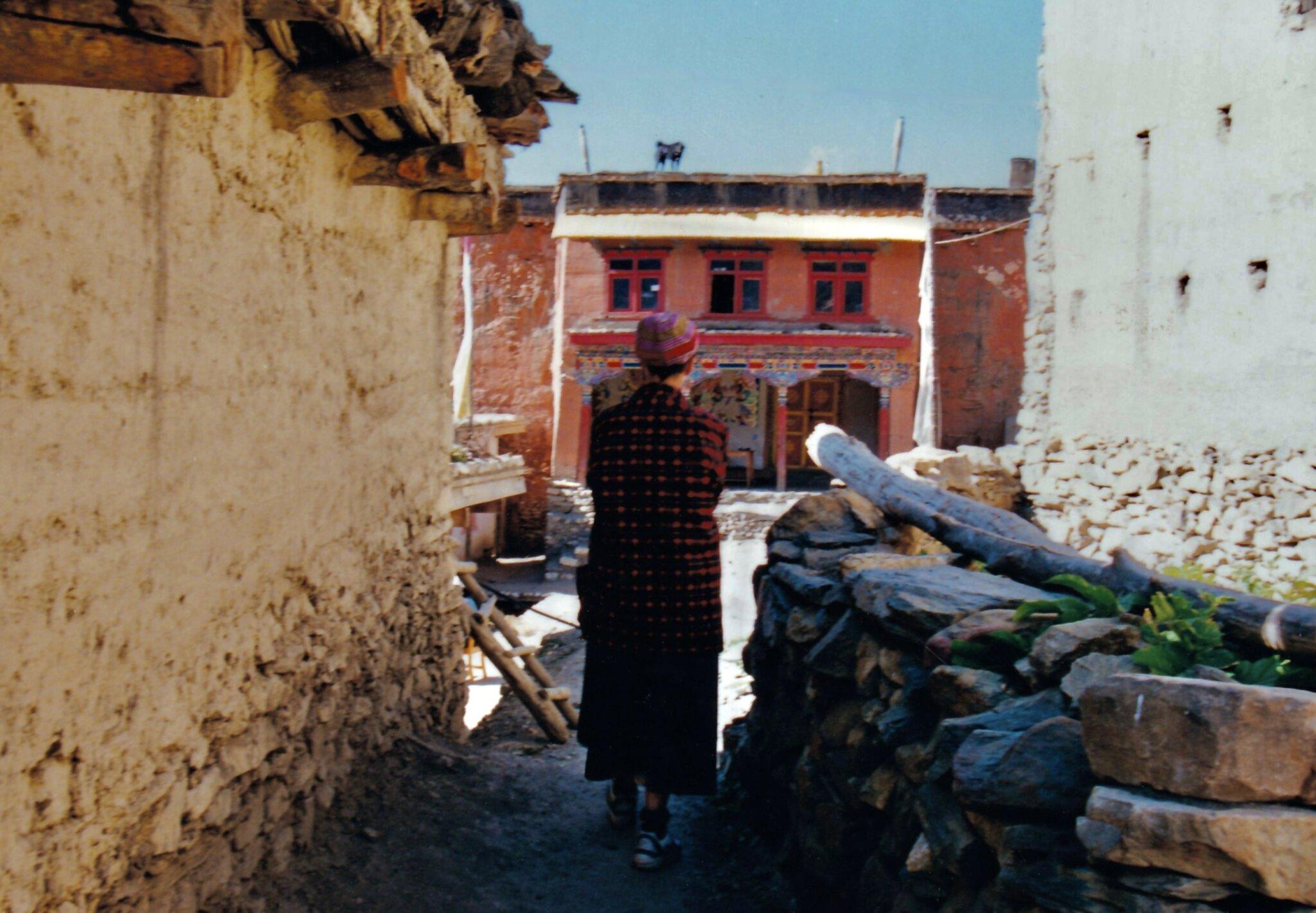
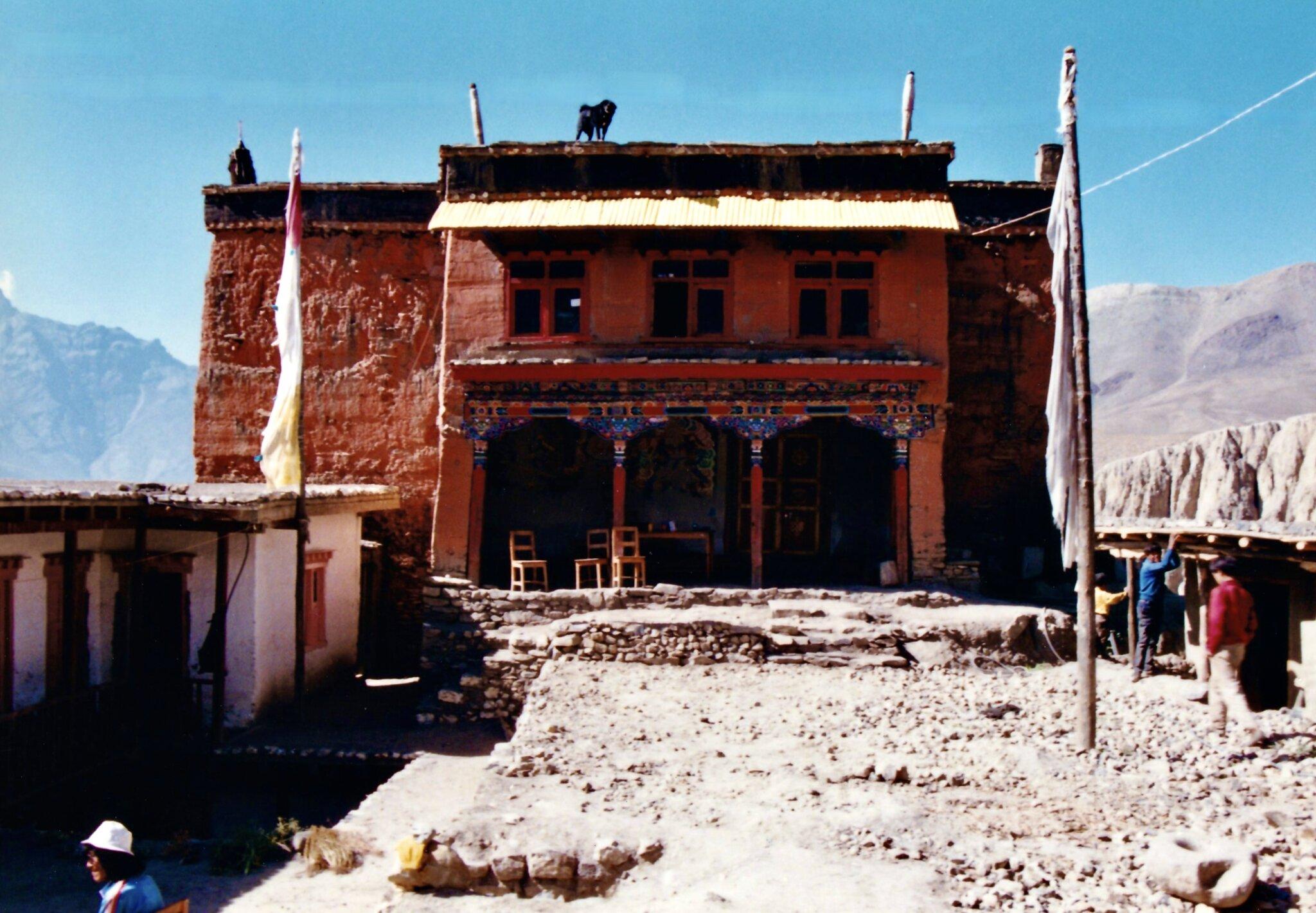
Wending in towadr the end of the promontory we approach the red-painted Tibetan monastery, the dog we heard before – is on the roof – a large black mastiff like many we have encountered along the trail – only this one seems quite Ill-tempered probably because it wants to get off the roof.
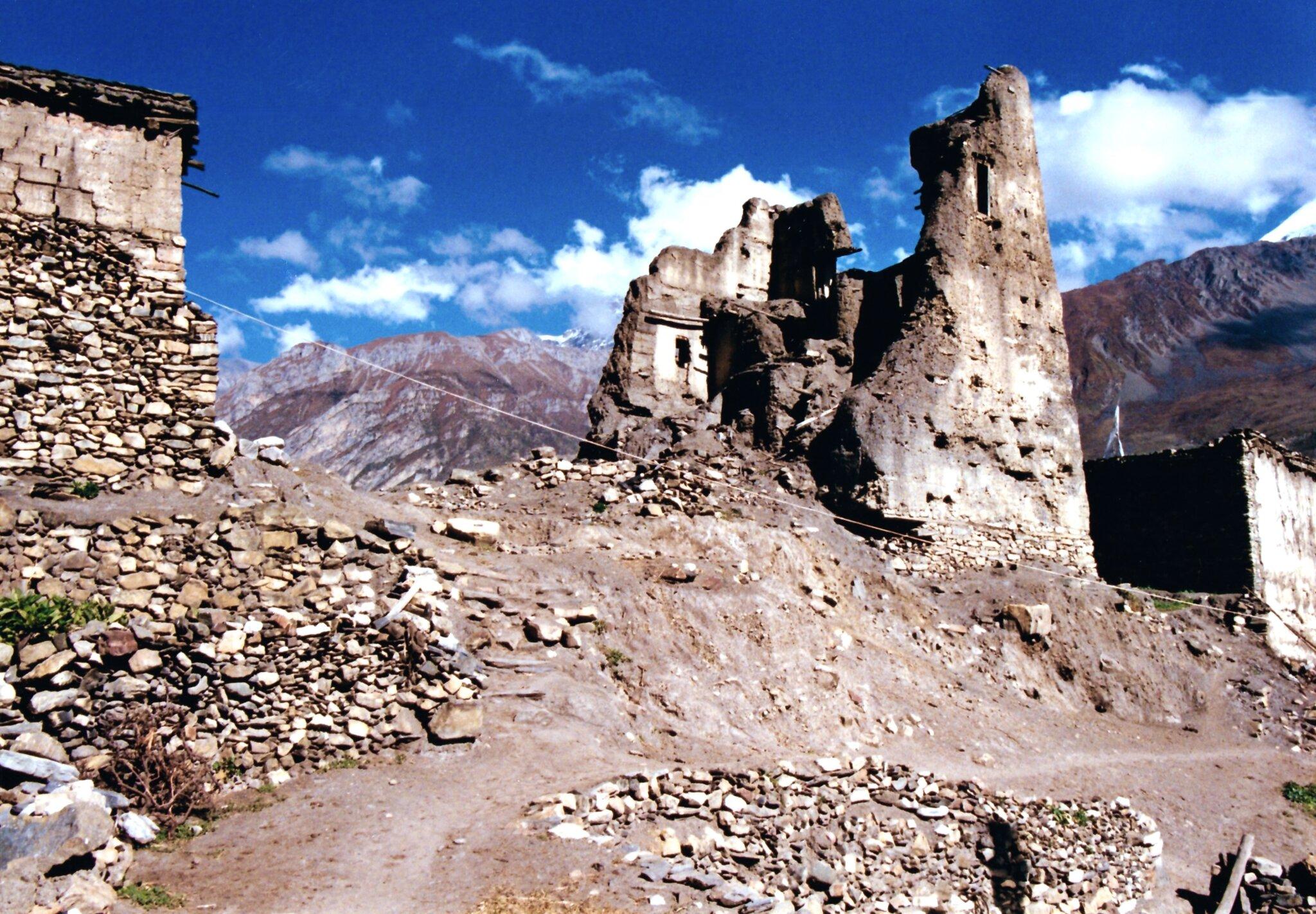 There doesn’t seem to be any monks around so we turn back to begin climbing the decaying pile of rubble to what was once the Citadel of Jharkhot – now with only two of its four walls left and those are only partially standing. It still presents an impressive image, however.
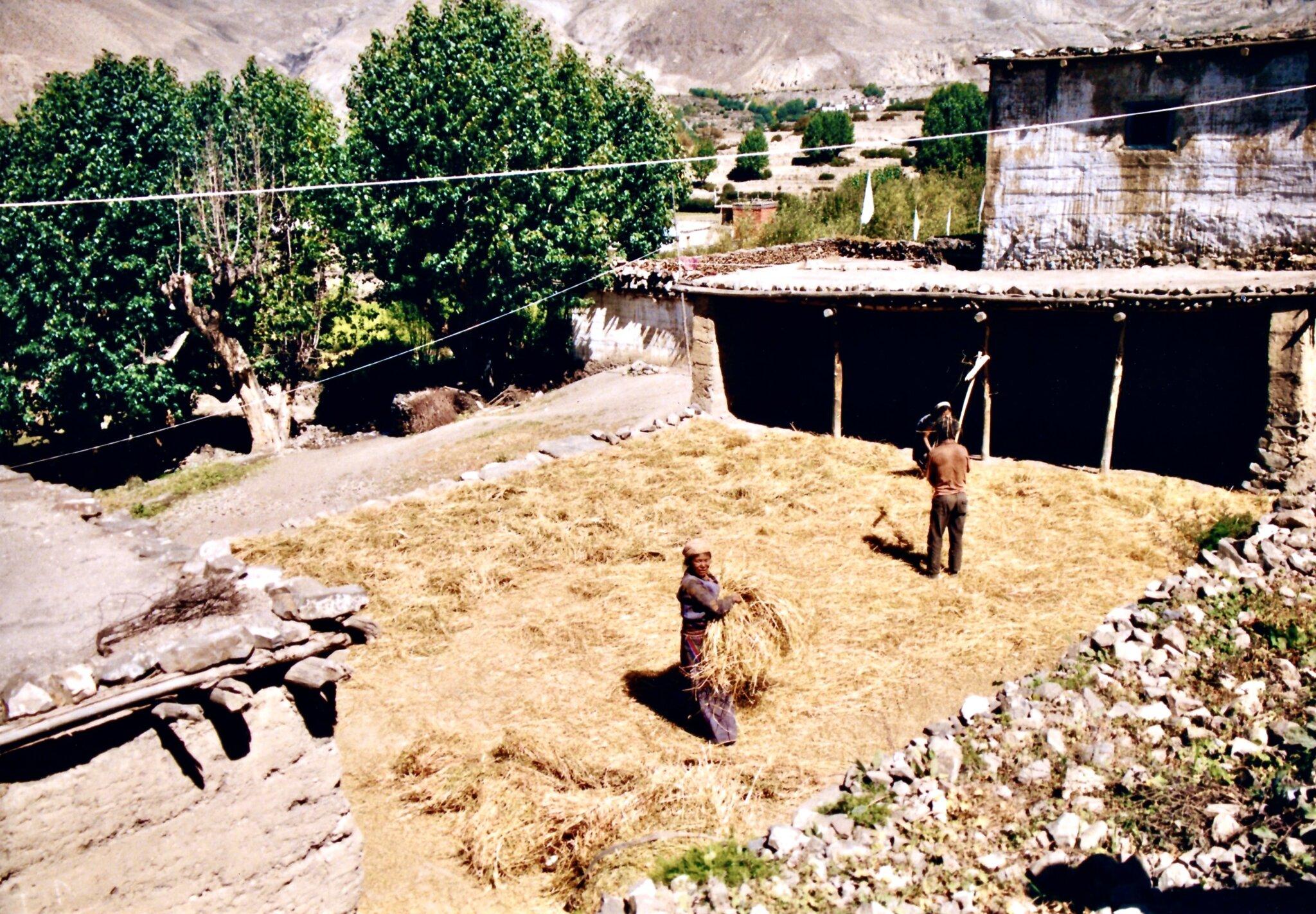 Further along the narrow pathway we encounter two women in a large courtyard busily winnowing millet using a large basket, likely the same task having been done in a similar fashion for generations, and one cannot but wonder what this citadel would have been like in its heyday. Off to the South we can see a sprawling building and are told it used to be a monastery and indeed there are prayer flags strung from its towers and the surrounding fields seem well-tended but the building itself has been long abandoned.
We have a meal and turn in for the night after dark. We seem to be setting aside enough hours for acclimatizing our bodies, but actually falling asleep is the hardest part as the altitude really affects breathing which I find difficult enough under normal circumstances given my crooked nose. There seems to be dust everywhere and the ceiling insulation appears to be yak dung – though truth be told we’ve seen little evidence of yaks on our trek so far save for the stuffed one. We have to get some sleep because tomorrow we face the wind.
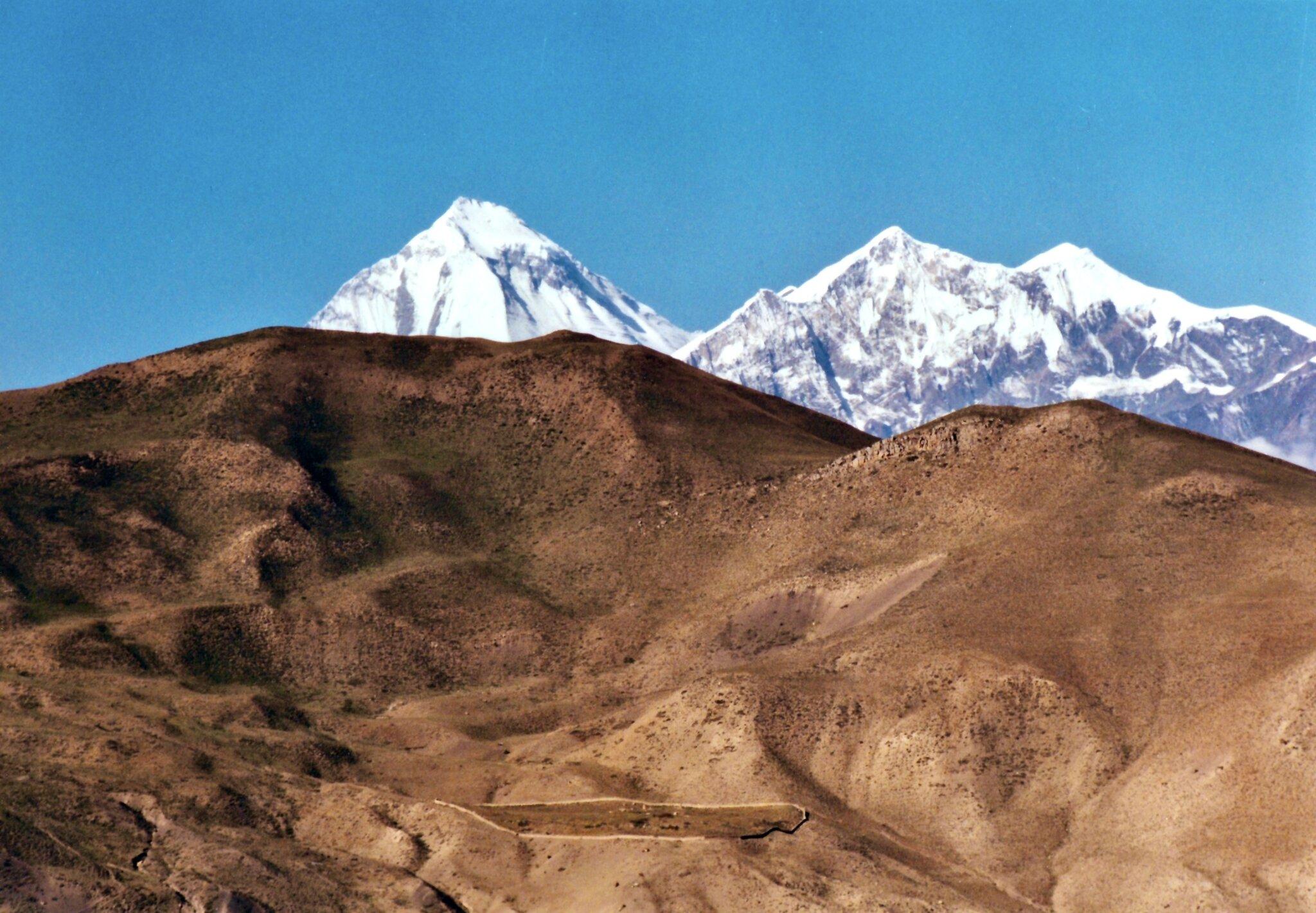
We set out after a breakfast of milk tea and porridge – with apples of course. The weather is brisk – yet fairly warm in the Sun and the trail is sparsely populated. Marcia sends the guides on ahead to the trail junction. We plan to stop there for a snack before heading on to Jomosom. She and I take our time, savoring the panorama of mountains, valleys, and farmlands; glancing back at Thorong La Peak then ahead to the white pinnacles of Nilgiri and Dhaulagiri, marveling again at the subtle variations just in the color of brown!
An hour out and the wind has started already! We hug the cliffside to keep out of the stiff breeze as much as possible. The weather is still pretty mild but we know what we are in for. We stop for more milk tea served on this occasion in a pot large enough for the entire army so we invite our guides to share. As we finish two horses pull up loaded with provisions from Jomosom – the local UPS.
We set off along the river bed toward Jomosom and upon rounding a bend in the Thak Khola we hit the full force of the draft – possibly 25 knots. Quickly we don our sunglasses and scarves so we can see and breathe. From then on the mood of the journey takes on a completely different character – a determination sets in to finish our trek as quickly and safely as possible. Gone are the moments of quiet contemplation, speculative wonder, and spontaneous improvisation. We’re just trying to get off that gravel river bed in one piece!
Finally Jomosom – a quiet room with a hot shower. Of course Marcia wants to do some shopping for souvenirs and I want to track down the air line agent for Royal Nepal to re-confirm our flight to Pokhara tomorrow morning. We visit several shops, two of which seem to have wonderful carpets and horse blankets that Marcia is enamored of. They do seem to grow on you, once you know what to look for. We negotiate to buy one – and afterwards Marcia thinks we paid too much but time will tell.
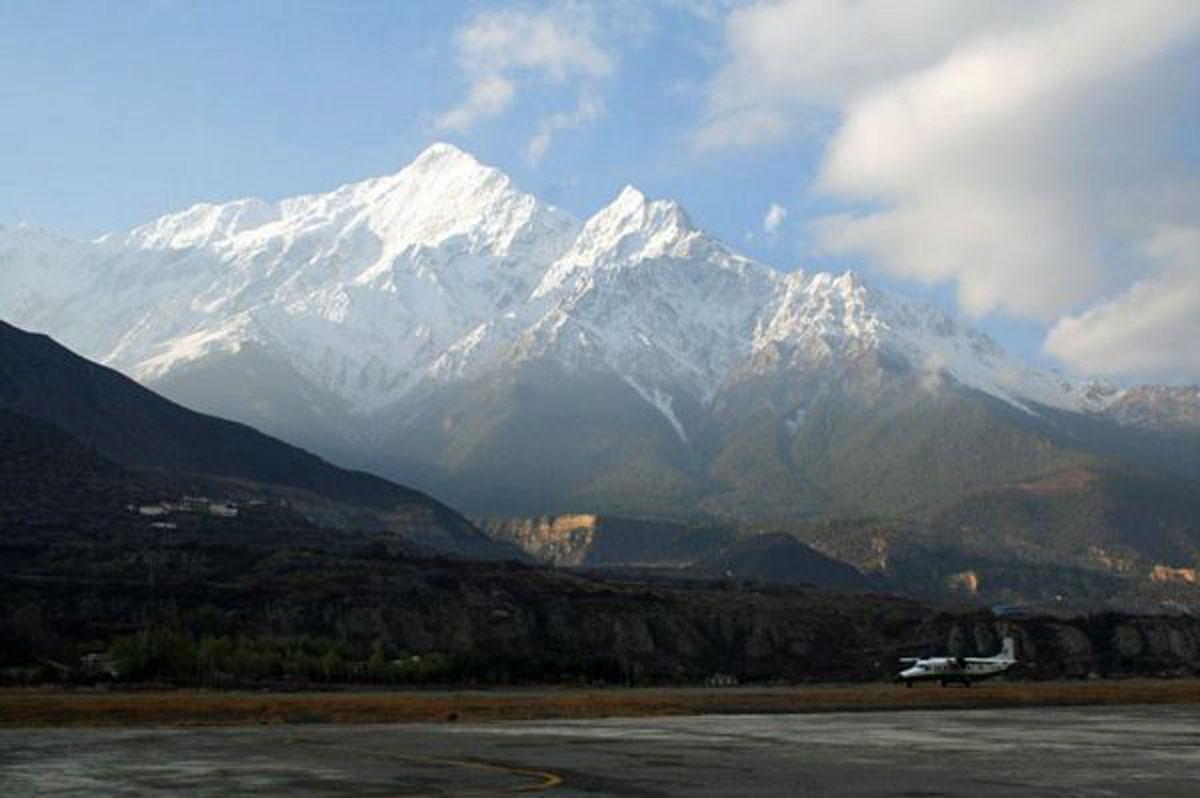
The plane is late and at the airport we see Ed again. He’s taking a later flight on another airline. His plans – as he’d related to us before – are to go on to Thailand & Vietnam evidently with or without his spouse’s approval. We look up to see Nilgiri as it greets the dawn with us. Majestic!
The flight is a little bumpy but cozy, bringing back memories of those I took in Puerto Rico 25 years ago between San Juan and Ponce riding aboard Commanders and Herons.
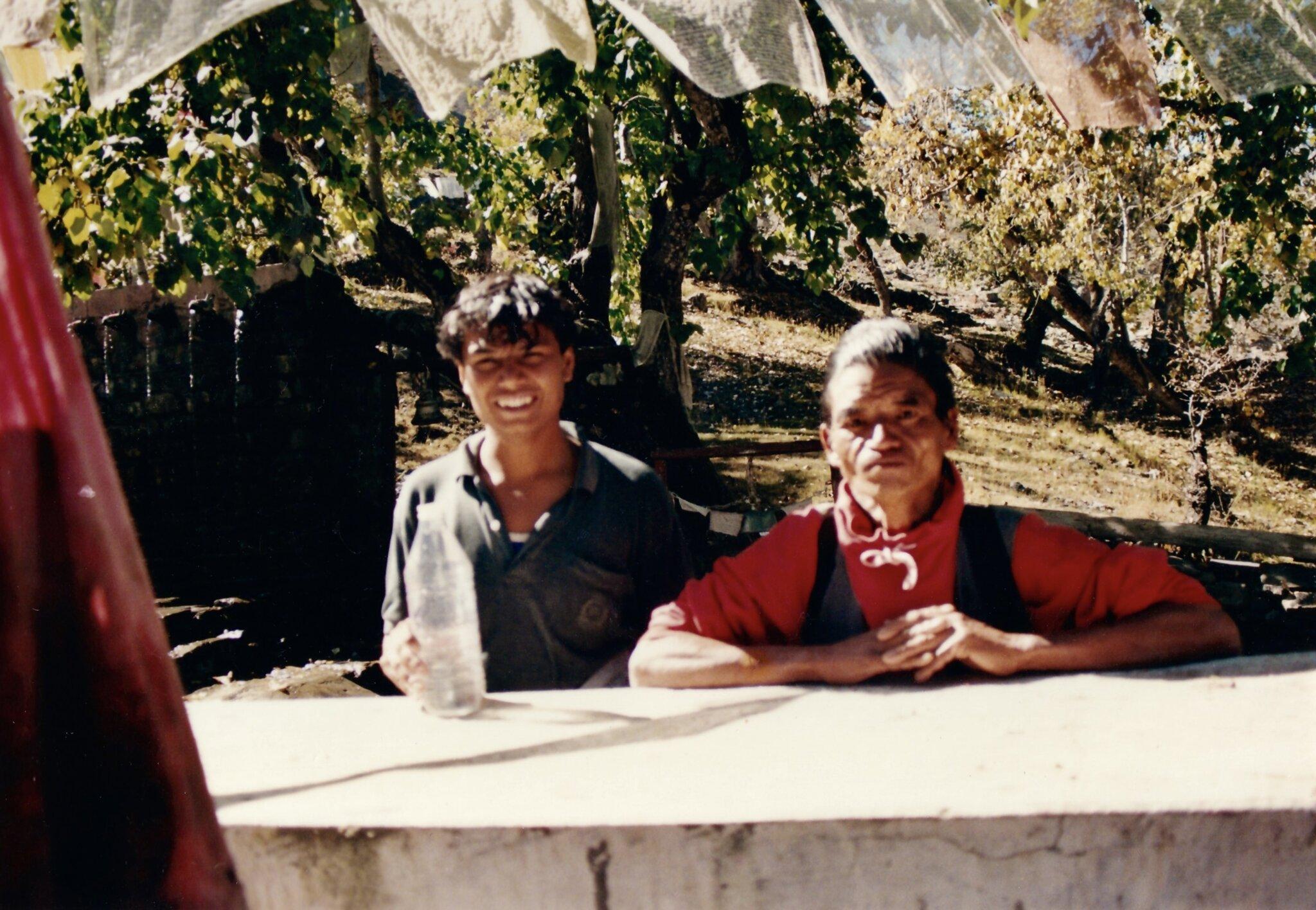
These Nepali pilots seem to know what they’re doing and what took us ten days to walk – we cover in fifteen minutes – touching down on the gravel runway in Pokhara back in the sub-tropics. From the air it seemed that it had recently rained and indeed the ground is wet in spots. We have a few hours before the flight back to Kathmandu so Marcia suggests a taxi back to Phewa Lake for breakfast. We drop off our guides Tatsu and Madhu bidding both fond farewells, then barter with the taxi driver to take us to the “right” German bakery – the one along the lake – for a sumptuous breakfast with a view and neither the food nor the view disappoint.
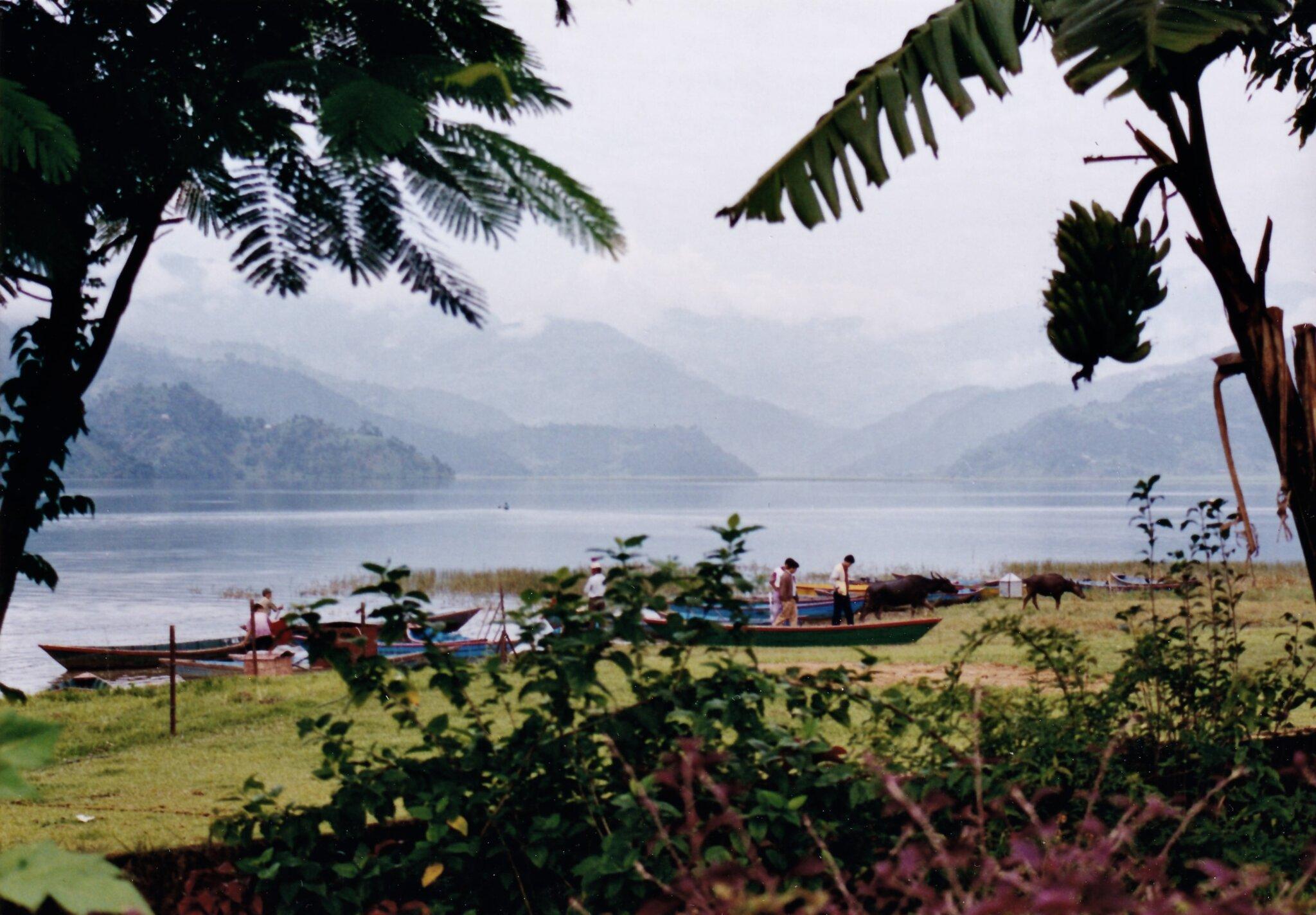
Finally – we feel a sense of accomplishment – of a journey completed. We’ve done it! Marcia and I embrace. We’d trekked the Kali Gandaki Gorge all the way to the legendary Holy Shrine of Muktinath. Before us stretches our lives – full of great promise with much to decide.
The last days in Kathmandu were spent frenetically buying last minute collectibles as keepsakes or to sell at swap meets back home; some sight-seeing and as well as taking a couple of “side-trips”.
The first was to a Devi’s house in Kathmandu for a traditional Nepali wedding ceremony for a non-traditional couple; he an Italian American and she a Chinese American. They had been married several weeks before at the Renaissance Pleasure Faire in Marin County near San Francisco and for a honeymoon they decided to do a trek in Nepal. When they got to Kathmandu where they met author Ian Baker, who evidently suggested to them it might be great to get married in Nepal as well. They then spent the whole day before the ceremony running about town buying all the clothing and traditional offerings required by the Devi in order to perform the ritual.
The next evening we all gathered at a small home near the Bagmati River making sure we deposited our shoes in a dim hallway at its front door. There was no headroom to stand, so we all knelt or sat cross-legged – a problem for me since my knee was still swollen from the trek. What followed were a series of rituals presided over by the Devi who spoke to the celebrants in a low voice directing them through the ceremony with an occasional aside which drew laughs from the Nepalis in attendance. Every so often she would recite an incantation and throw flower petals or rice over the seated couple. Then a thin veil was dropped separating the audience from the celebrants – more prayers and offerings – and money exchanged [or so we were told]. Then the veil was lifted. The bride walked around the groom – he walked around her – kissed her feet – and voila! They were married.
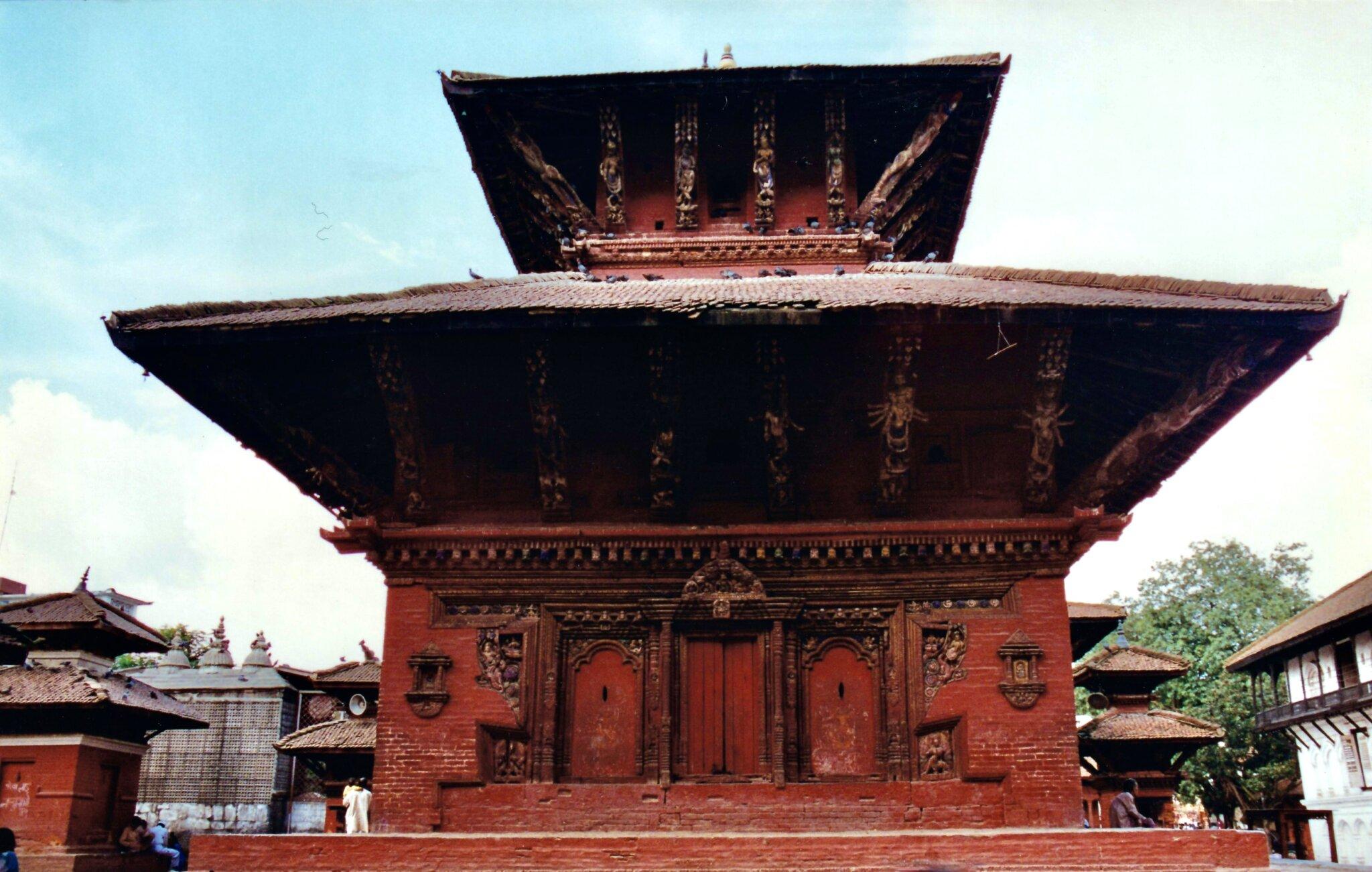
The second and last outing was to Bhaktapur, a small city with 12th Century origins known for metal work and its huge temples. There was to be a festival for Dashain which goes on for nine nights involving young men wearing ceremonial masks which represented seven or eight of the major Hindu gods. The men will don the masks and after several rounds of raksi, they would set off through the streets – preceded by bands [literally] of others clanging chimes, beating drums and playing flutes.
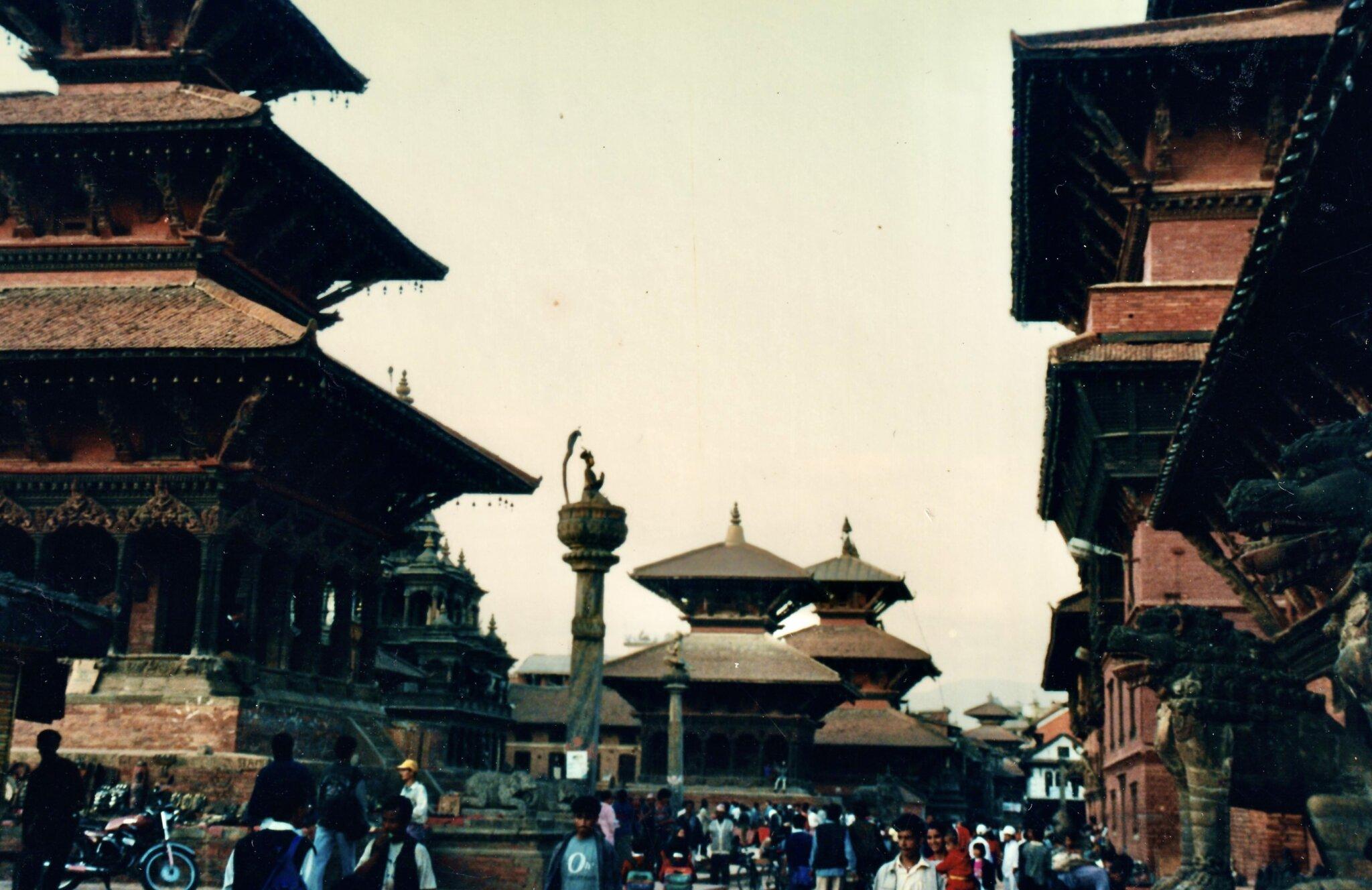
It was late afternoon when we arrived together with the writer China Galland who along with myself was taking photos of the area’s temples, decaying sculptures, and iconography. Apparently at the time there was little or no program for maintaining or preserving these national treasures – besides most of them had been stolen by art thieves. The light was failing rapidly as we found our way down to the Bagmati River where the ceremony was to begin. Along the way we passed under banners in red and white strung from buildings on either side od the road, met many street musicians roving in small groups proceeded by men doing a kind of shuffle to the music. It seems women were not allowed to participate in these festivities other than to prepare the food offerings and even these offerings are carried to the “gods” by men.
Finally the procession got underway under the glare of several butane lamps – glowing blue/white in the darkness. The chanting and the rhythmic drumming; here and there small groups of dancers whirling and lunging; and everywhere people were grinning ear to ear. It was obvious this was going to continue on well into the night so It was time to go back to the main Durbar – grab a choice spot in the restaurant there, sip some hot lemon, visit the WC, say our fond farewells, and then head back to Kathmandu feeling grateful and blessed by a fortuitous nexus in time and space.
Be sue to check out our Nepal Galleries page [see blue button link below} where we’ve posted tons of photos showcasing our 1994 trek of the Kali Gandaki Gorge and visit to Kathmandu which we’re currently updating frequently with pictures from different segments of the trek.
And stay tuned! We’re working on another post about our 1996 trek to Solukhumbu in Nepal which will contain text from a journal we kept along with some video clips as well as photos documenting the trek. You won’t want to miss it!
Originally published as a hand written Diary by James Babij AKA Kazkar Babiy or The Daily Llama from September/October 1994.
All Content unless otherwise notated © 1994-2023 Ruthenians.net. All rights reserved.
Shared via Creative Commons
Views: 0
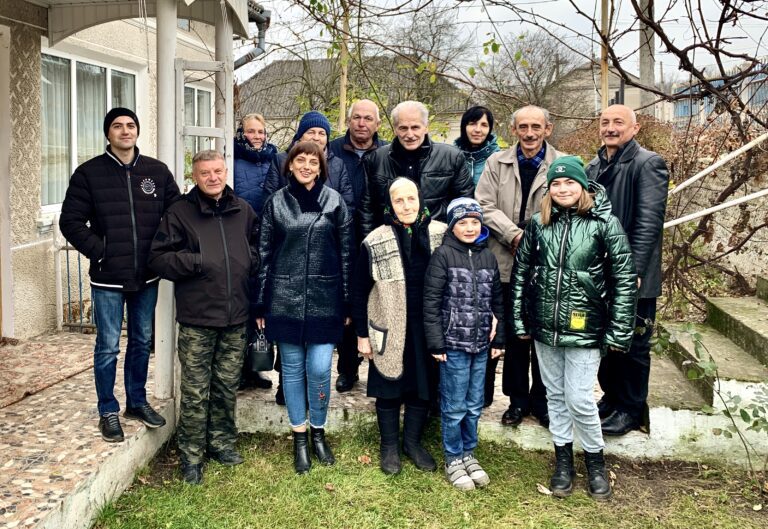
Originally we wanted to present the pictures for this narrative on Our Slavic Roots and Heritage in slideshow format which usually also dictates some form of aural background like music, sound effects, or narration. But unfortunately, unless sub-titles or captions are added to the video track, an oral history of what these slides themselves represent – the story being told by the pictures themselves – can be muddled or incomplete. For this reason we’ve instead opted for a blog presentation – during which we can wax ad infinitum on the tales, myths, and legends associated with each slide. After all, isn’t that what a self-styled казкар is supposed to do?
Our initial decision to explore our Ukrainian ancestry back in 2017 has enabled us, thanks to our guide, translator, and driver Diana Borysenko, to not only find the legendary Babijowa Gora [Babij Mountain – yes, it’s an actual place] but also visit the ancestral villages of our paternal [or maternal] grandparents, meet some local inhabitants, and find Grandfather Ivan’s birth record in the regional State Archives all of which we have documented in our previous Old Country blogs for that tour [see links below].

We returned in 2018 – again with Diana’s expert assistance – to tour the historic sites of Kamianets-Podylskyi, Khotyn, Olesko,and Pidhirtsi castles, plus search for ancestral plots in the cemeteries of Burkaniv and Zolotnyky as well as peruse archival records in the State Archives for any ancestral links where, at the bottom of a page in a folio from 1863, we found an entry that revealed the names of our Third Great Grandparents – Thomas Babiy and Anastasia Baczynska.
Then there was the incredibly emotional trip in 2019 with brothers Daniel and David – again conducted by Diana and eloquently documented by Brother David – during which we not only met actual living relatives from both the Babij and Chuda clans – including cousins Stefaniya Barszka, Magdalena Chuda. and Sofia and Nadia Vernyhora-Chuda – but were guided by local relatives to the obelisk grave marker of our Second Great Grandfather Ignat Babiy. Even writing this today still brings me to tears.
And lastly our August and November 2021 tours when – again thanks to the talents of Diana Borysenko – we met Stefania’s extended family including her sons Bohdan & Vasyl, daughter Olha Hoy plus niece Oksana Perig and her family. And we have the pictures to prove it so set yourself down and pucker up.

Let’s start off this narrative which we’ve dubbed “The Old Country: Our Slavic Roots” with a photo that is – as the saying goes – worth a thousand words: Ignat Babiy’s Obelisk. As we detailed in our previous post “The Old Country: Between The Forceps and The Stone“, this is how it appeared when we first discovered it in 2019. There are several key factors to point out about our Slavic ancestry, just from this obelisk and its current location:
“Neither crop failure nor bad weather caused the famine in Ukraine. Although the chaos of collectivization helped create the conditions that led to famine, the high numbers of deaths in Ukraine between 1932 and 1934, and especially the spike in the spring of 1933, were not caused directly by collectivization either. Starvation was the result, rather, of the forcible removal of food from people’s homes; the roadblocks that prevented peasants from seeking work or food; the harsh rules of the blacklists imposed on farms and villages; the restrictions on barter and trade; and the vicious propaganda campaign designed to persuade Ukrainians to watch, unmoved, as their neighbours died of hunger“.
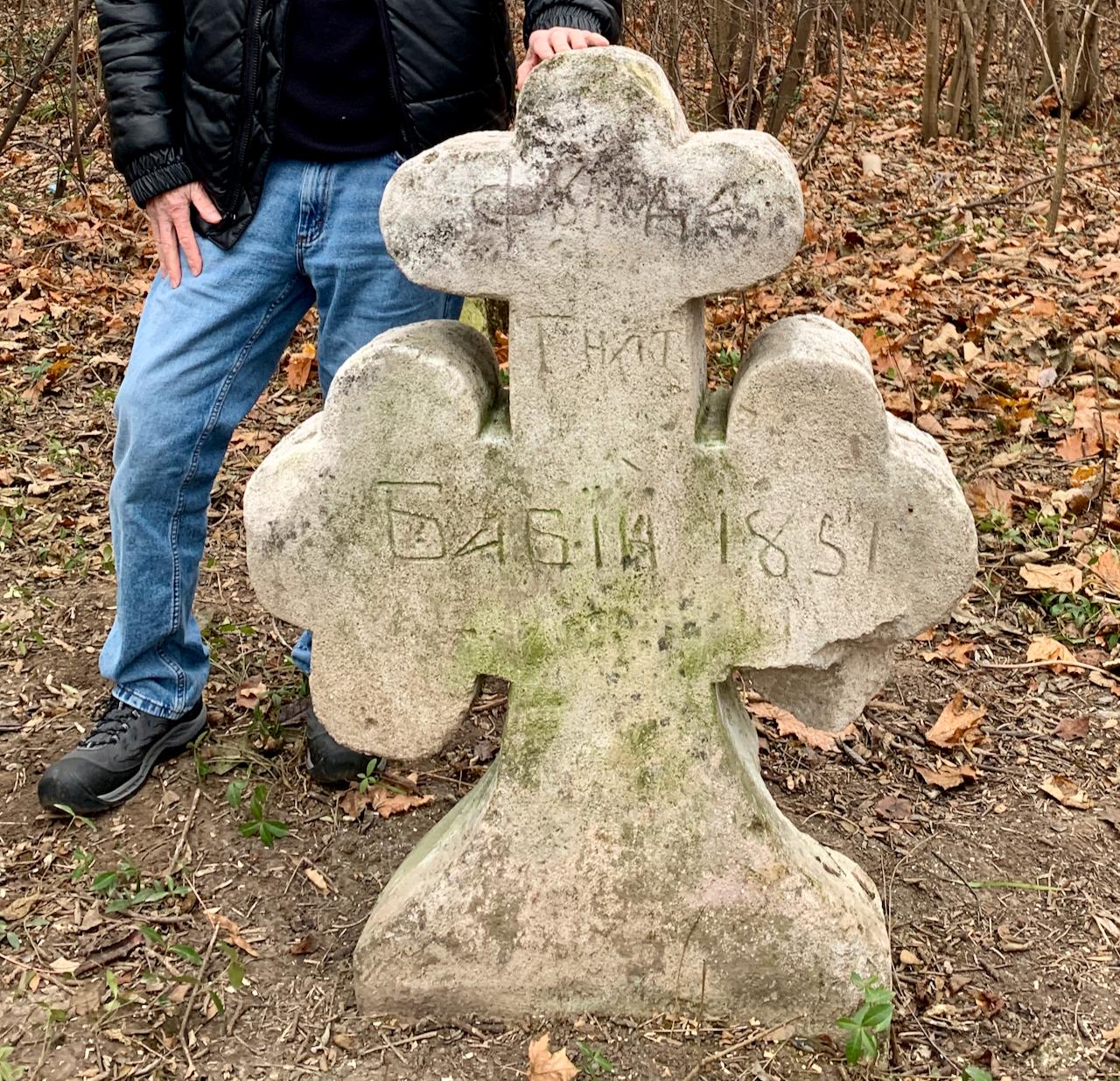
Next, on our second tour in November 2021 we again visited with Stefaniya and family in Burkaniv during which Diana and I were fortunate to attend a memorial dinner for Stefaniya’s husband Roman whom had passed away the year before. Previously that year we had asked Stefaniya’s son Bohdan – who is a local farmer – if he might be able to clear away the undergrowth around Ignat’s obelisk so that family might more easily access the site. He agreed but felt it wold be better to wait until the Fall when the vegetation would die off before attempting a cleanup.
It was Fall and we were back and upon inspection, Bohdan had done his work so admirably that he had even uncovered another Babiy grave marker in the shape of a Greek Orthodox cross dated 1851. However the Cyrillic inscriptions which decorated both sides of the stone were hand chiseled and hard to decipher; one side clearly marked “Гнат Бабій 1851” – “Ignat Babiy 1851”, likely a reference to a separate Ignat Babiy – possibly related – who had passed away that year.
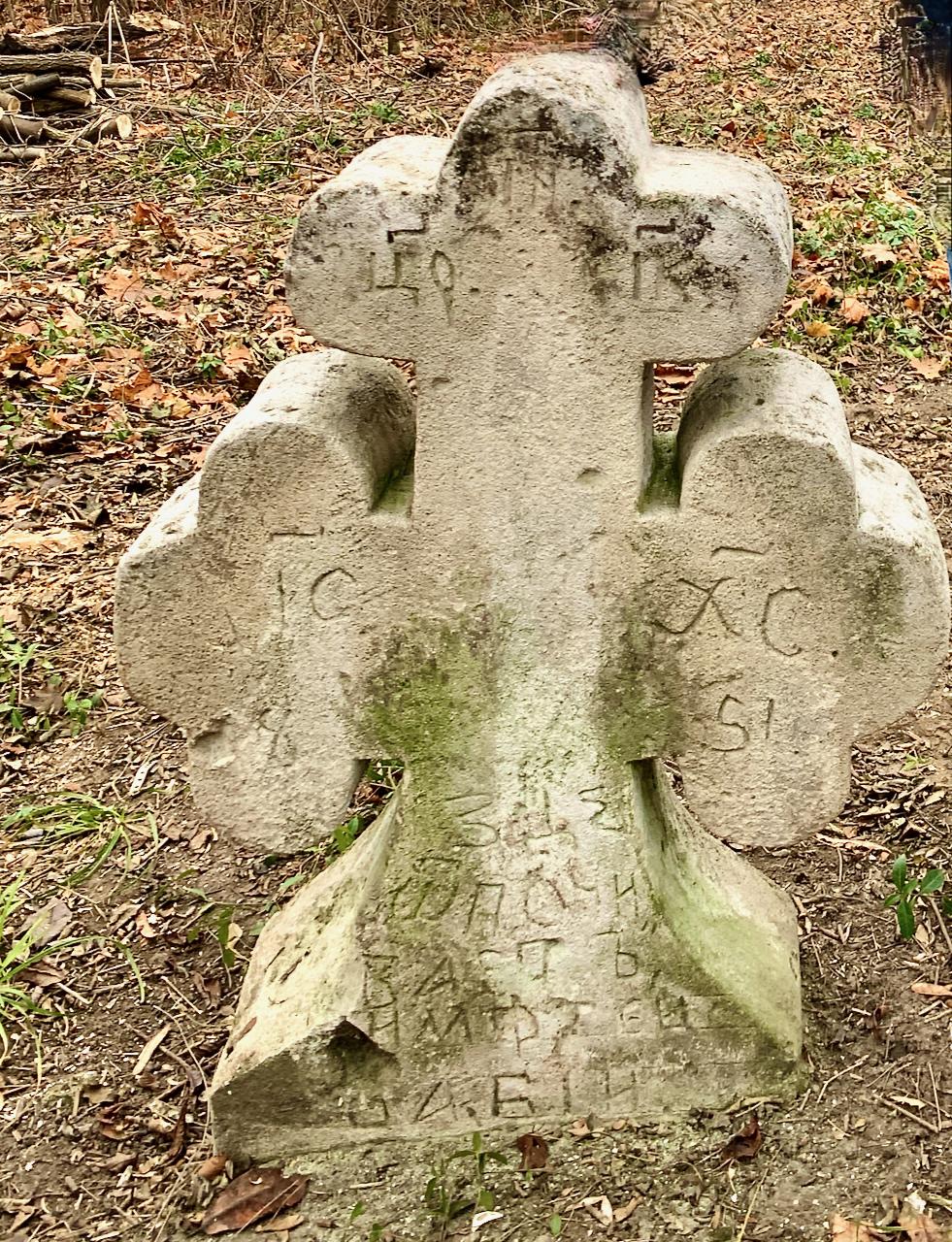
On the obverse side inscriptions were almost completely illegible except for a chiseled etching that appeared to read “Тимофій Бабій” – “Timofy Babiy” – at the bottom of the stone’s face – plus the year “18” and “51” carved on opposing sides of its middle arm. There were other inscription above that one, so obviously this tombstone had been dedicated to more than one Babiy when it was created, but Time and the elements had done their work as well.
More questions. Still, this was yet another emotional moment with family – thanks to Bohdan.
What we do not know of, and more importantly have so far been unable to find, is any physical evidence – other than Ignat’s obelisk – of our Ukrainian ancestors in the cemeteries of the two villages. None. Having said that, we did see quite a few either unmarked or seemingly abandoned burial mounds, especially in the Burkaniv village necropolis, so the graves of Panteleimon Babiy and Maria Palychata; and Prokop Babiy and Maria Durdela; and Paul Chuda and Xenia Lemiszka may still be hidden there waiting to be re-discovered.

We do know from archival cadastral documents found and photographed by Diana that our Chuda and Babiy ancestors did own many plots of land in the Burkaniv and Zolotnyky area including chalupas [cottages] with gardens as well as farmland. As of 1821 Anton Chuda, who lived in the same house Gramma Anna was born in some 70 years later, owned 13 plots of farmland and as of the same year a Tymko Babiy owned 26 lots. In 1879, our Second Great Grandfather Ignat Babiy owned 33 properties. Is it possible that Anton Chuda was Gramma Anna’s grandfather? Were Tymko and Ignat related? Was Tymko the Timofy etched on the Greek cross tombstone above? More questions.
The State Archives had also provided quite a few church metrical records [births, marriages, deaths} hand written in either Latin or Cyrillic for the offspring of Ignat and Magdalena, including the children of sons Prokop, Basilius, Petrus, and of course Panteleimon [each of whom had a wife named “Maria”] but it was not until our second meeting with Stefaniya Barszka and her son Bohdan Barszky in August of 2021 that we were finally able to make a connection back through the several generations between that of Ignat and ours via a living voice.
A family’s oral history is essential to maintaining a sense of belonging to a lineage that stretches through generations. We give this lineage a name – by tradition a male surname and we know that all names mean something as we’ve already pointed out in previous blogs. These oral histories contain stories, myths and legends passed down as being factual and most are, but you know the Old Saw:
“Trust no man, nor call him brother, with hair one color and beard another”.
Nevertheless, family elders must be believed because they’ve lived through life’s struggles, passions, deceits, and losses. Elders have a tale to tell. We just have to listen and decide what to believe or not. What follows is Stefaniya’s tale as transliterated by our guide Diana.
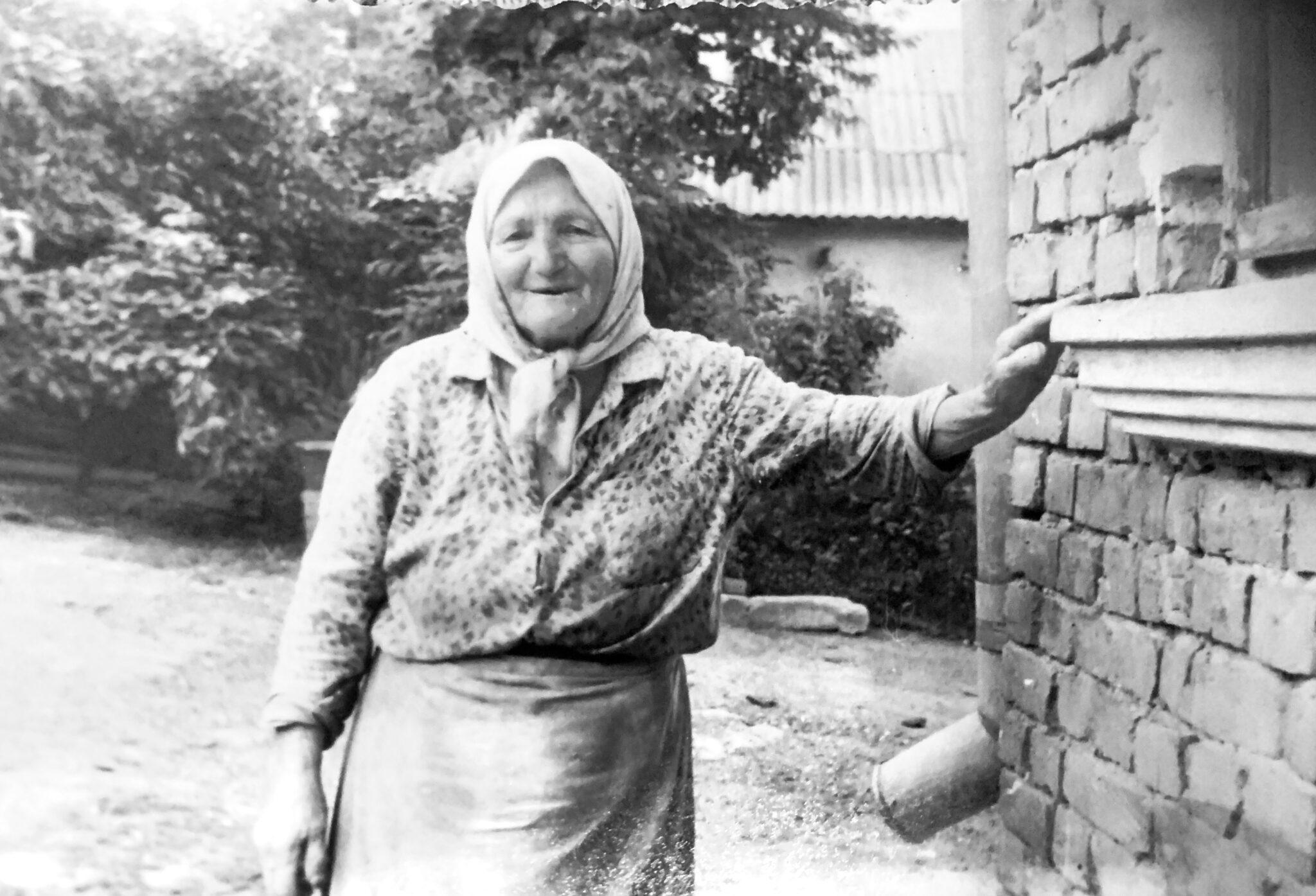
This is her mother, born Thecla Babiy [1910-1989], daughter of Prokop Babiy and Maria Durdela. Since Prokop and Panteleimon were brothers, that made Thecla and Grampa John first cousins and by inference our Aunt Estelle Spearman her second cousin.
Thecla had many siblings including a brother Mykola who fought and died in The Great War; sisters Magdalena, Eugenia, and Anna; and brothers Pavlo, Stefanius, and Gregory who became a well-known physician in Vienna.
Thecla married Gregorii Biskup [Bishop] and had three daughters: Stefaniya, Sophia [1929-2002], and Maria [1935-2019] – whose daughter Oksana we had met earlier in Lviv, and whose son Yuriy Vlasov, we discovered via email, lives in Ontario Canada not far from Lake St. Clair. Yuriy kindly sent us this photo taken outside the family home in Burkaniv that shows Thecla with Stefaniya and infant Yuriy Vlasov ca. 1967

Stefaniya married Roman Barszky who sadly passed away after a long illness in 2020. They had three children: sons Vasyli and Bohdan, and daughter Olha who is a school teacher and lives nearby in Zolotnyky. [She must know the school’s headmaster Volodymyr Boyko whom we met on our first trip to Ukraine in 2017].
Subsequent to these events we returned home and by February 2022 everything changed for Ukraine and the rest of our world. We’ve published several video clips by Diana Borysenko – including her views about the ongoing fight of Ukrainians for their independence and how Ukrainians are responding to that challenge – that we’ve dubbed Diana’s Diary. Please watch. Слава Україні!
![Grandpa Ivan [John] Babiy](https://www.ruthenians.net/kArpatia/wp-content/uploads/media-from-ftp/2021/12/Grandpa-Cropped-restore.jpeg)
As you can no doubt see it was in bad shape, the original having been damaged by a flood some years ago along with other archival papers that had been stored by her Mom Olga Babij Balboni with a cover note scrawled in Cyrillic and signed “Gregorii” with the date “1922”.
The back story was that this photo and associated papers had origins from The Old Country via Gregorii Babiy, Prokop Babiy’s son who according to Stefaniya eventually became a prominent physician in Vienna.
So what is going on in this photo? What do we see in it? Four men and two women. The women appear to be dressed in white. A man in the background is holding an accordion so he’s most likely a musician. The guy standing is wearing some kind of costume so he’s probably a performer, and the two seated men are in formal attire with boutonnieres on their lapels and are jointly holding what appears to be a bottle of spirits so they most likely knew each other quite well. A wedding?
Well we also know that the man standing “stage left” is none other than our grandfather Ivan Babiy. Plus, according to family lore, among his many talents he also could really “cut a rug” – Cossack style. [Allegedly he could pick up a table with his teeth as well]. In this photo he is posing for the camera with his right hand on the left shoulder of the older gentleman seated next to him – another sign of intimacy. They probably knew each other as well.
Now we have been told that this photo came in a package that originated with Gregorii Babiy who was Ivan’s first cousin and Thecla Babiy’s older brother, so likely he’s probably in this photo. And on top of that quite possibly he’s the groom – the younger man to the left seated in front of the two women in white. So in this scenario, if Gregorii is the groom then the older man seated to his left whom he obviously knows intimately – along with Cossack dancer Ivan – could be his father Prokop Babiy. The only tidbit that doesn’t fit in this tale is the year 1922.
By 1922, John Babij would have been married for six years and living in Detroit with three young kids and a wife to feed and shelter. According to his daughter Aunt Olga – Ivan had illegally entered the US in the first place, most likely in the Teens just before or during The Great War, having “jumped ship” from some kind of naval vessel he was a crew member of while it was docked in Tampa Bay, Florida, abandoning it for a new life in the New World.
The ship itself was likely from a neutral nation, maybe even Italian since Italy was straddling the fence between opposing sides of the conflict at the time, or even Austria, who did have a navy at the time but was of course aligned with Germany so its vessels would not likely be welcome in a US port, although the US was technically a neutral party until 1917. Yet somehow, as both a deserter and an illegal alien, Ivan made his way up the East Coast of the U.S. to New York City by hook or by crook or good fortune or all three combined. And as both fortune and fate would seemingly ordain, he eventually met and married Anna Chuda there in 1916, herself having grown up just across the Strypa River from Ivan in The Old Country region of Podhajce, Austria-Hungary. Quite a tale indeed.
But life was not easy for Ivan and Anna as they gradually migrated Westward with their children in search of work and a safe place to stay. During that time – the Twenties and Depression era Thirties – the United States was still a country whose population was predominately rural and agrarian. But that was changing. Anna and Ivan were raised as farmers, so it is likely their hopes for a new life centered on having a farm to raise their family and live on. But in the meantime there were mouths to feed and rent to pay so they had to go where the jobs were – industrial centers like Cleveland and Detroit.
For more narratives on what life was like for an immigrant family of itinerant farmers eking out a living in rural America during these times check out these posts:
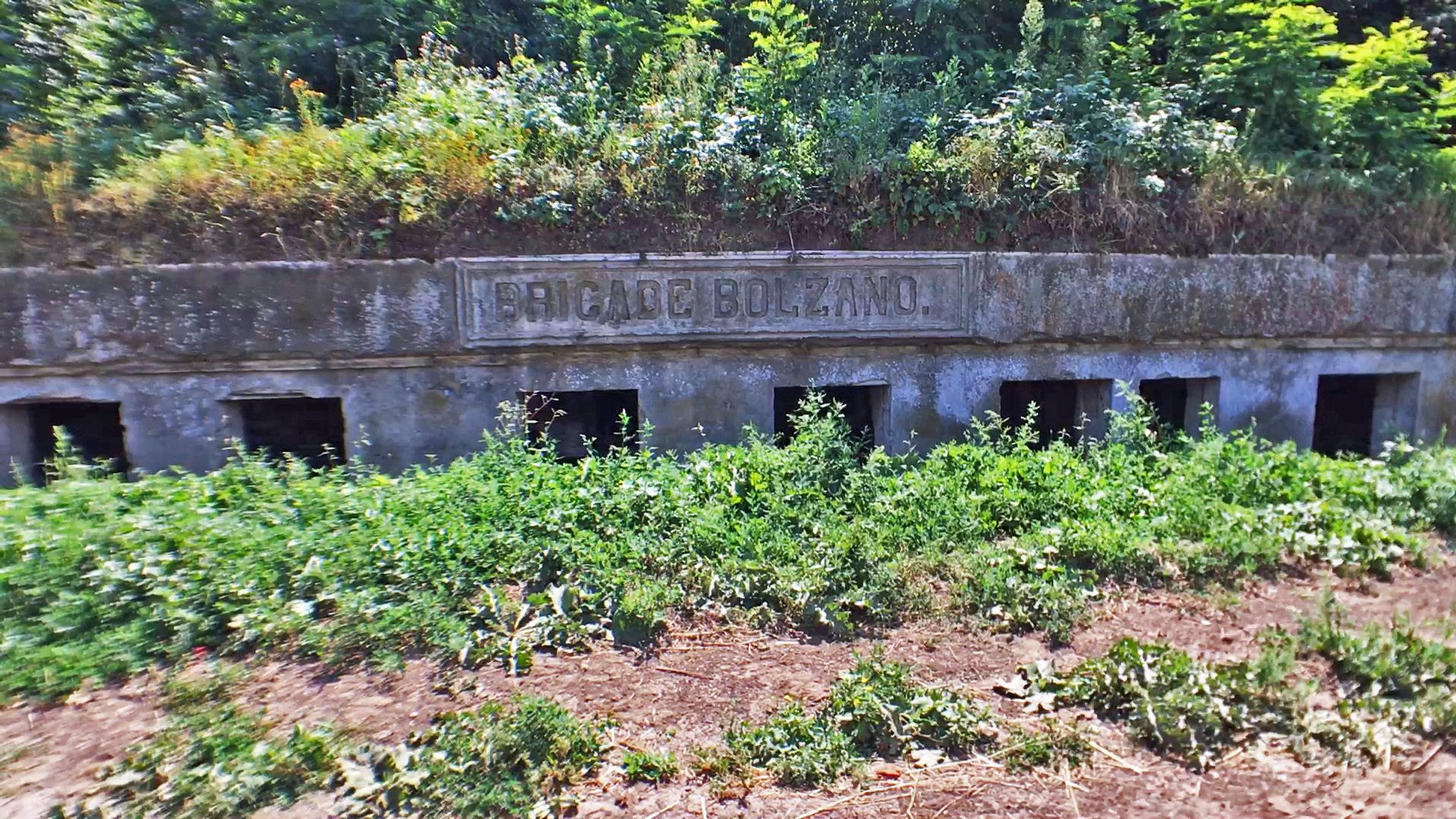
And let us not forget the events that caused both Ivan and Anna, their families, and tens millions of other Slavs who called themselves Ukrainians – a “people without a country” – both then and now – to flee their homeland because of the threat of war. In the case of Ivan and Anna and fellow Galicians it was the advent of World War I [aka The Great War] during which Eastern Galicia was overrun by troops from the Russian Empire in the Battle of Galicia in 1914. At least a year earlier the run-up to this decisive battle had seen troops from the Austria-Hungarian Army augmented by recruits from the pro-independence Ukrainian Sich Sharpshooters move into the Podhajce region as well as in other areas of Galicia causing great alarm for the safety of the indigenous population including the children in these rural communities. Estimates for the lives lost from the Battle of Galicia total nearly 600,000 in combatants alone. There seem to be no estimates for the loss of civilian lives, however.
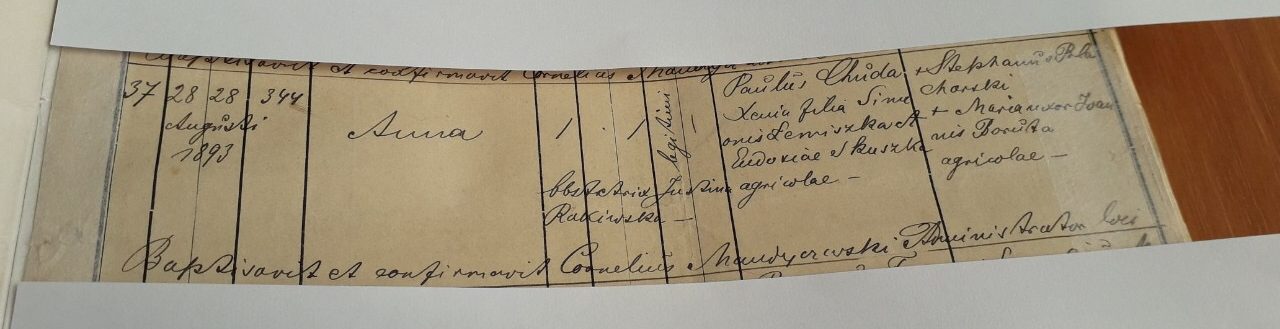
But we know there were, not only in the war but also the sectarian pogroms between Poles, pro-independence Ukrainians, Russians and Russian-speaking Ukrainians, and of course Jews. In her post “Hard Not Happy Times“, cousin Sue Roth makes mention of Grandma Anna’s mother whom she calls “Lenka Leninskaya” – a Russian appellation. This was either a pseudonym or a nickname, possibly used to mask her Polish origins either out of necessity or affiliation because according to the church archives unearthed by our guide Diana Borysenko her actual name was Xenia Lemiszka – “Xenia” being the Greek form of the Ukrainian name “Oksana” or the Russian name “Kseniya”.
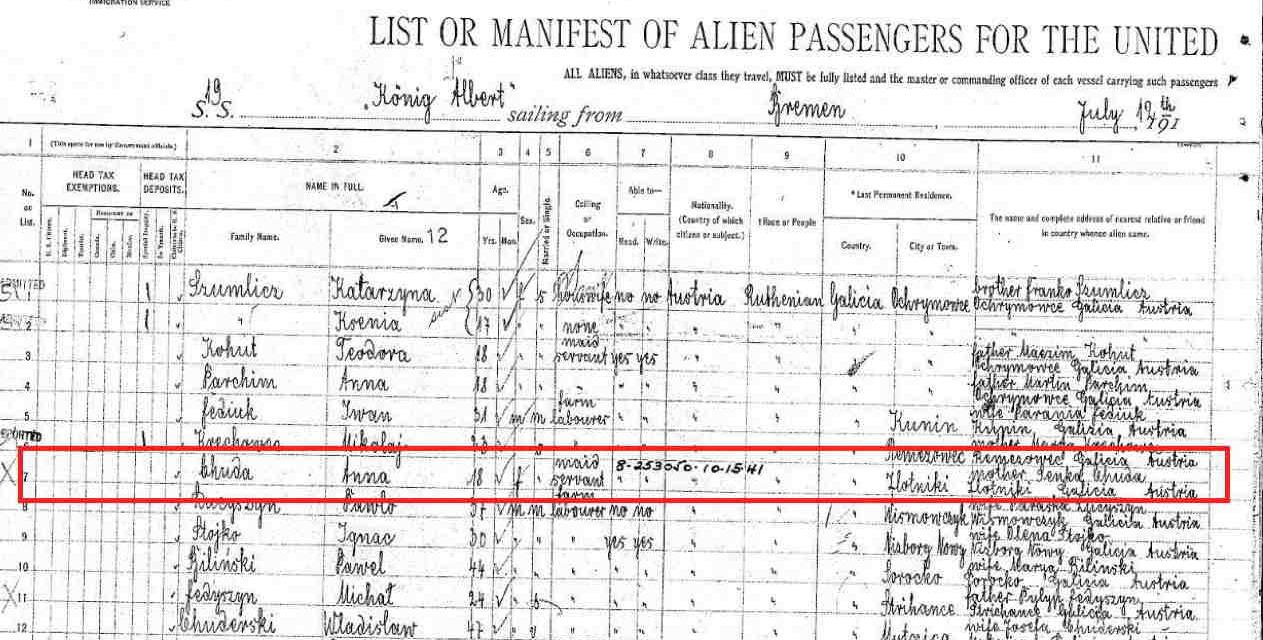
On the Ellis Island passenger manifest of Xenia’s daughter Anna Chuda dated 19 June 1913, Anna’s mother is listed as “Lenka Chuda”. Yet on the marriage license of Ivan and Anna dated 14 May 1916 her mother is listed as “Kseniya Chuda” – a Russian given name. Obviously the Chudas, like many Ukrainians were multi-lingual and spoke both Ukrainian and Russian – perhaps even Polish as well. Was Xenia Chuda a Russian sympathizer or given the anti-Polish political climate in Galicia at the time did she adopt a Russophile personage out of necessity – having been alone after her husband Paul passed away some time previously, with four children to raise and provide for?
The Great War ended resulting in the collapse of the Austro-Hungarian empire along with a dramatically weakened Russian monarchy which would soon fall to the Bolsheviks. On top of that Eastern Galicia which included the region Anna and Ivan were born in subsequently reverted to Polish rule which would continue throughout the Interwar period until the outbreak of World War II bringing with it renewed reprisals by Poles against both Ukrainian nationalists and Russian/Soviet sympathizers. And this economic and political atmosphere of oppression and repression based solely on ethnic prejudices of the Past would continue under the Soviets albeit exacerbated by the West’s obsession with the painting of socialism as an enemy of democracy.
What we as descendants are left with are more questions.
 But there is “one more thing” – as tech bros like to say. After sharing this above photo on social media with Oksana Perig – Stefaniya’s niece – I received a text forwarded by Oksana originating from Stefaniya’s daughter Olha Hoy that contained an image of Gregorii Babiy, his wife and that of a daughter and her spouse, reportedly taken in 1959 at their wedding.
Compare the image of a sixty-ish Gregorii in this photo to that of the younger twenty-ish man in the image obtained from cousin Sue. A possible resemblance? We just do not know since Olha’s mother Stefaniya was not yet born when Prokop died.
This blog’s feature image above was taken by Diana in November 2021 during a gathering of her family members at Stefaniya’s house in Burkaniv in memory for her late husband Roman who had passed away the previous year. Family. Just look at the faces. You can view more coverage of the gathering in our previous blog The Old Country: Blue Over Gold.
A quick note about the photos in this blog and others on this site: to view an expanded Lightbox view of a particular photo, just click on it and it will fill your screen. To close, click the small “x” located in its upper right-hand corner. Enjoy.
For an alternative POV of our 2019 tour of Ukraine check out Brother David’s day by day account titled “The Phenomenal Babij Brother Ukraine Trip“. You will be as amazed as we were so don’t miss it.
Be sure to view our most recent blog from our 2021 trips to Ukraine titled “The Old Country – Blue Over Gold” – documenting meetings with extended relatives and a lengthy discussion about the ongoing war with Russia and don’t forget 2019’s “The Old Country — Between The Forceps And The Stone” in which we expound upon our innate mortality, the pandemic of fake news, alternative realities, and “unknown unknowns” – [our spin on Donald Rumsfeld’s paranoia about “things we don’t know we don’t know”], then present even more ancestral links to actual living relatives that we’ve found.
And remember, you can read the complete saga of our 2017 trip to Ukraine published earlier in our blogs “The Old Country — Ternopil Oblast“, “The Old Country — Ivano-Frankivsk Oblast“, “The Old Country — Lviv Oblast”, plus more from our travels in 2018 found at “The Old Country — Salt of The Earth” and The Old Country – In Nomine Patris [AKA “Father Knows Best”]. Just follow the appropriate links.
Add to that travelogues documenting our tours of Galicia: “The Old Country – Galicia “; “The Old Country – Echoes In Time“; plus “The Old Country – A Slideshow” – a visual tour of the sites and sounds of the ancestral villages and historical places we’ve visited in our trips to Ukraine.
P.S. In case you missed it be sure to catch both of our videos on the Pysanky MasterClasses we took from Master Folk Artist Halyna Syrotyuk. You’ll want some pysanky as gifts too!
Of course, don’t forget to share these links with your friends and family.
And if all of this doesn’t whet your whistle for a visit to our ancestral homeland, check out Diana Borysenko‘s website DianaTours-WesternUkraine.com for links to all of the tours, masterclasses, activities, and ancestral heritage services she provides.
Plus you can keep abreast of the ongoing battle for Free Ukraine here and keep watching Diana’s Diary – Ukrainians At War updated periodically via her posts on social media .
These posts are journeys from the Present into the Past, opening portals opaque with age or forgotten or long closed and hidden by Time’s passage. We make our own history and in the end, history is about the journey not the destination.
Content and images © Ruthenians.net MMXXIII all rights reserved.
Views: 0
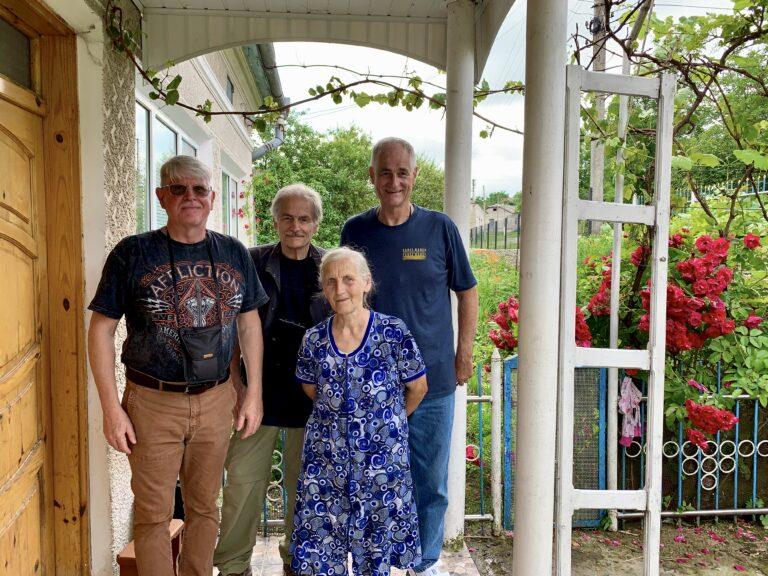
By David Babij
30 July 2019
First, Brother James, the elder Babij, decided to make a 3rd trip to the “homeland”. In conversation with Brother Dan in early 2019, James encourages Dan to consider going “home”. Dan…who has never been farther away from MI than Cozumel or California, and has no passport or any clue as to what is involved. Dan buys in to the plan, shops flight plans, applies for his passport. In an email from James, the plan for the 2 brothers to go “home” is revealed to the rest of the clan. David, the baby Babij, reads the email…the immediate reaction is “Oh hell no, if Dan is going then I am going too!!”Read more
Views: 0
Views: 0
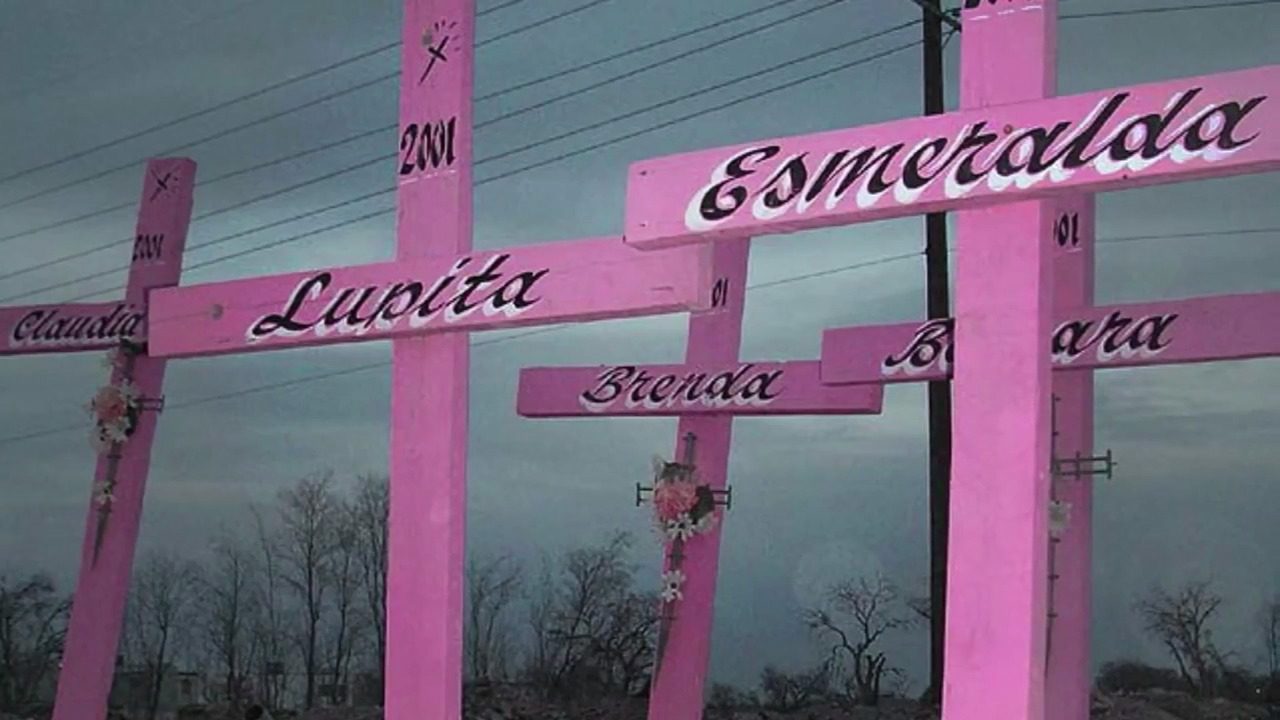
Views: 0
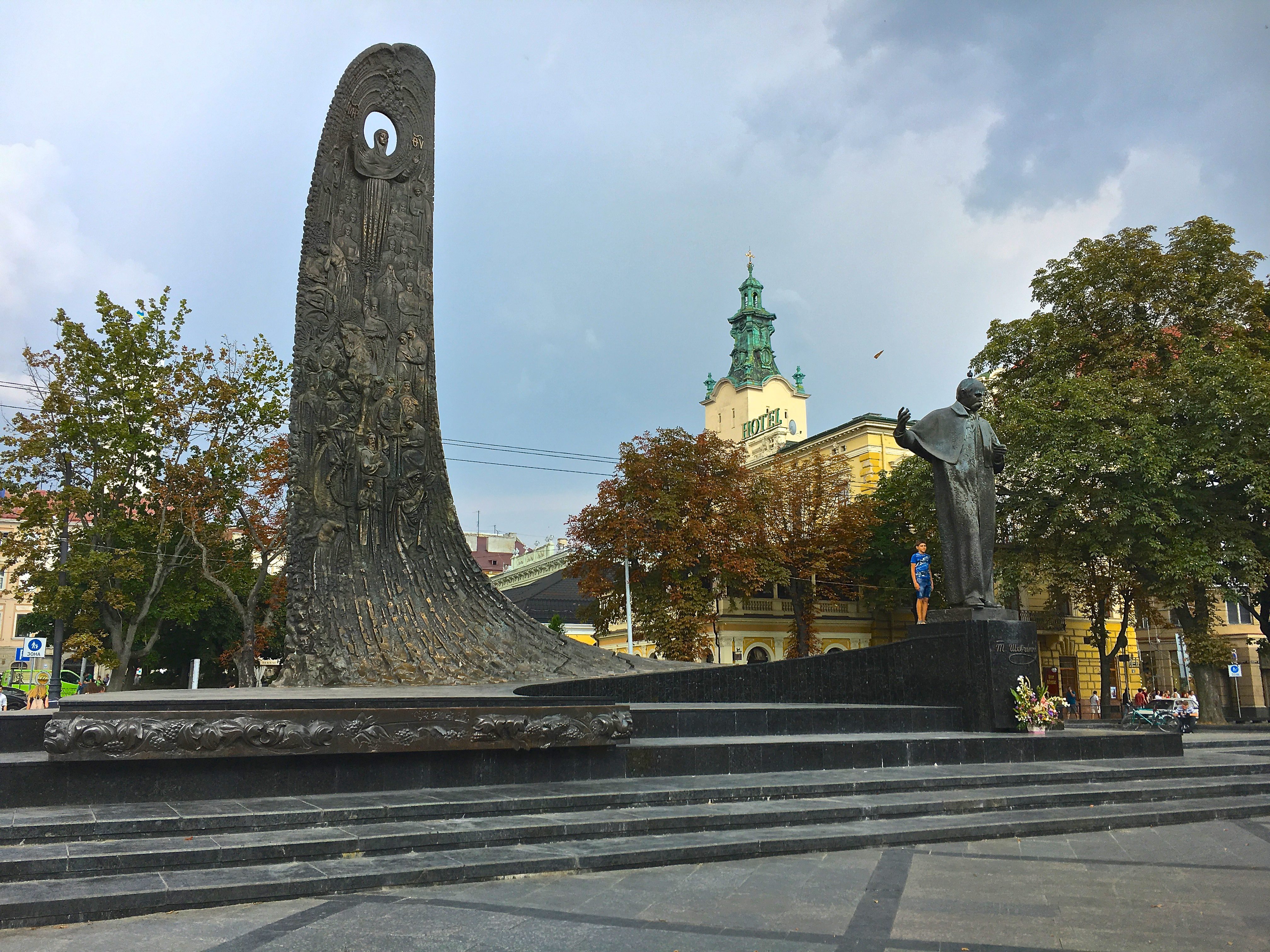 The Old Country: Lviv (16,779)
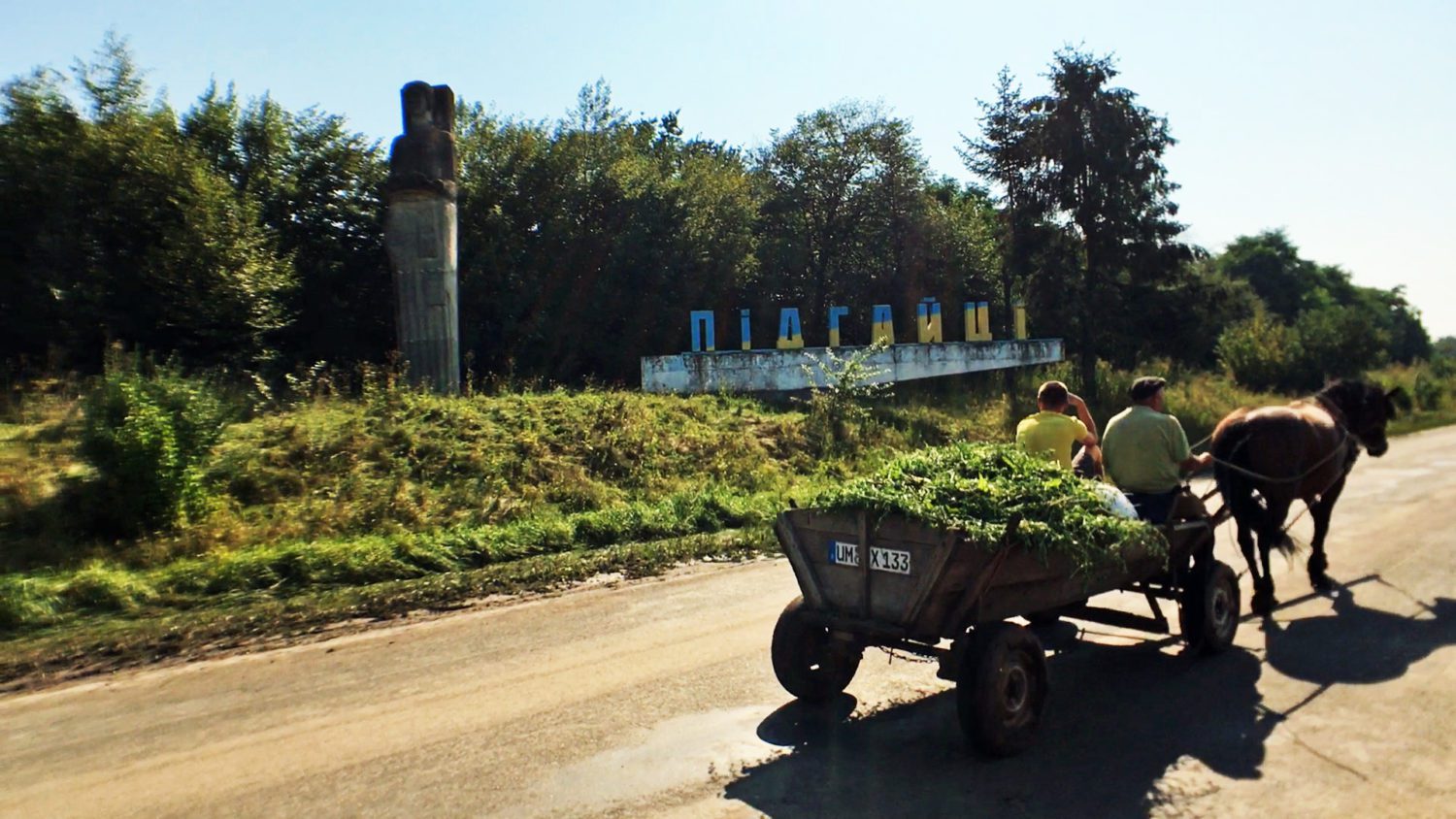 The Old Country: Ternopil Oblast (16,709)
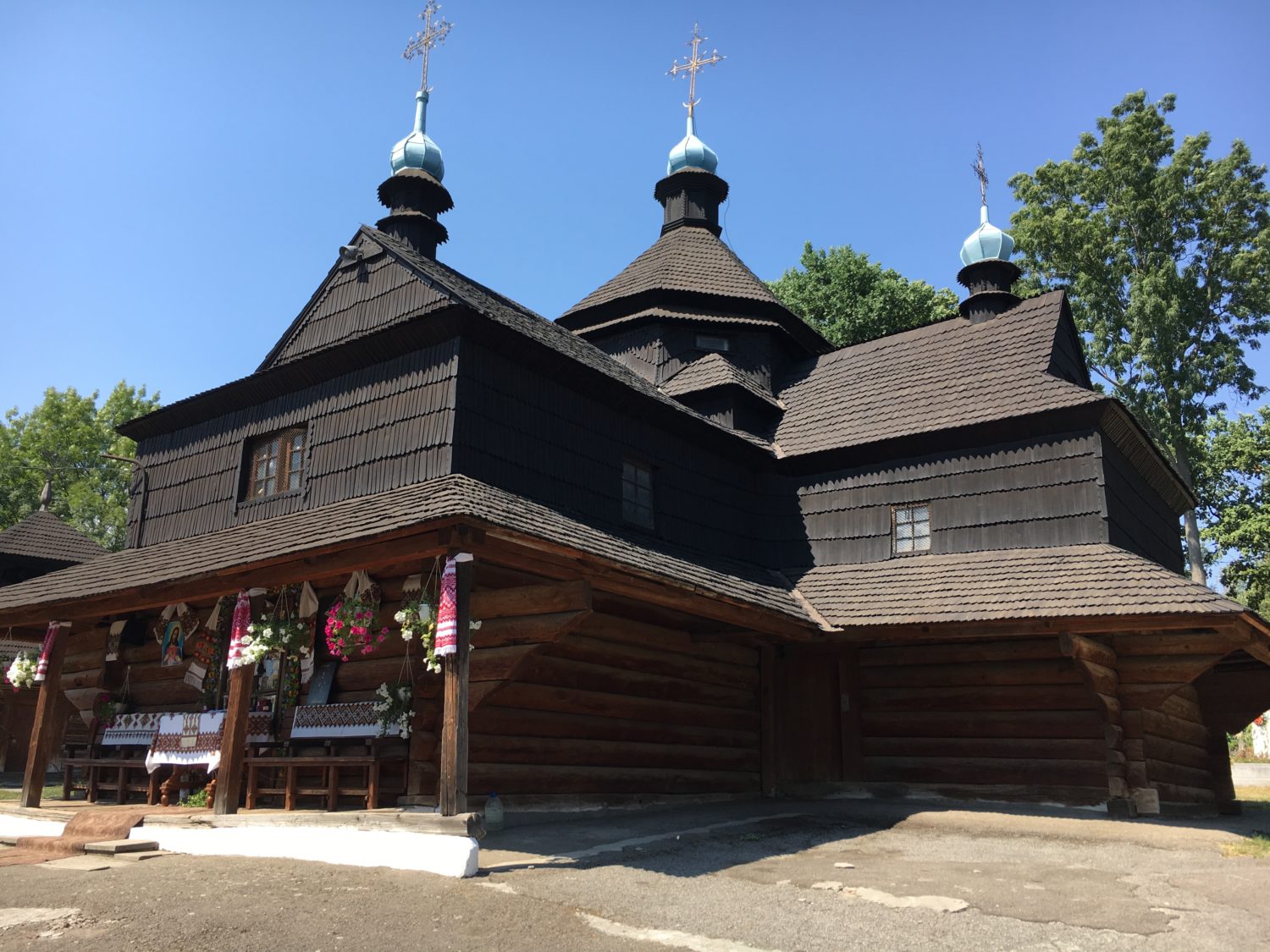 The Old Country: Ivano-Frankivsk Oblast (16,113)
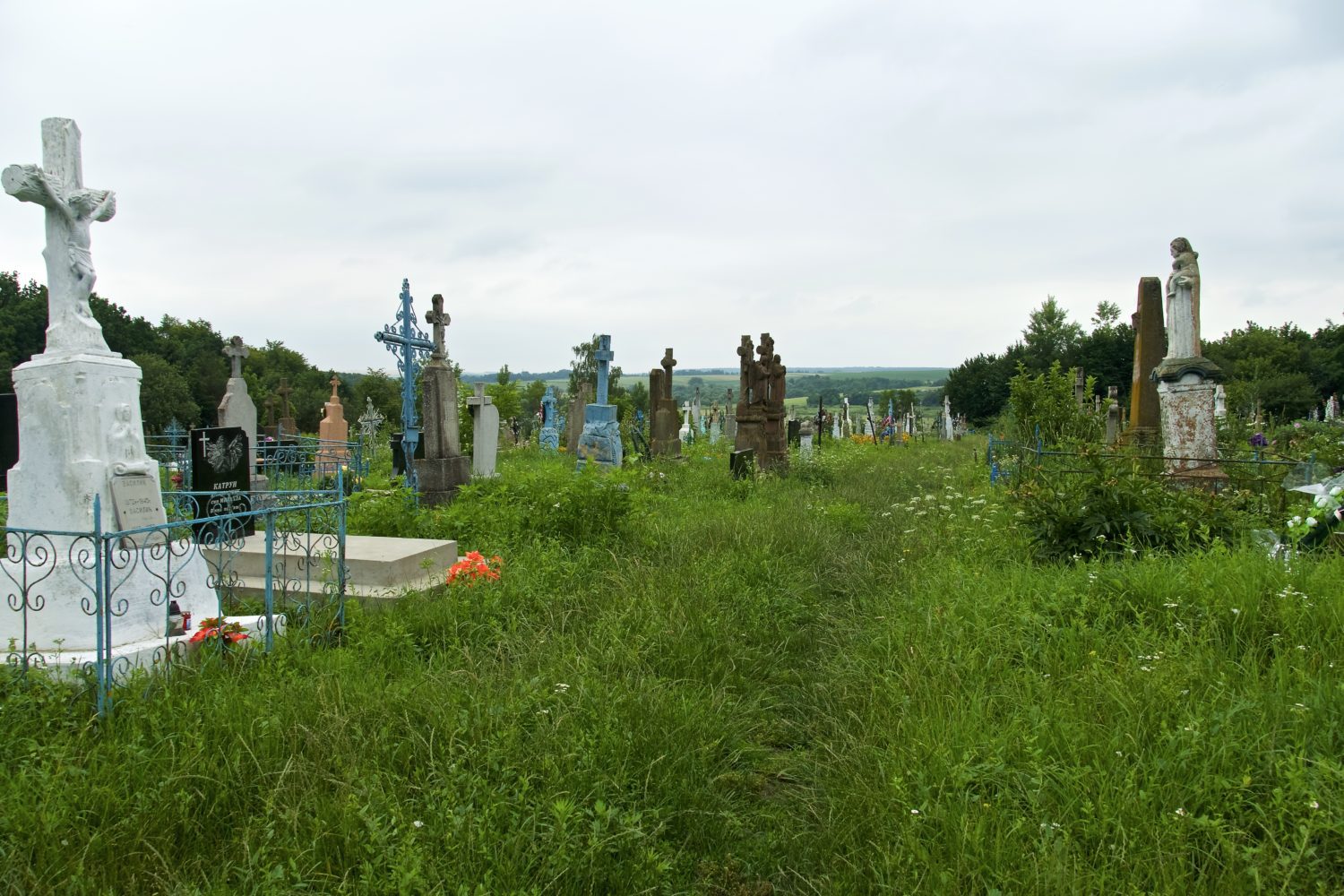 The Old Country: Salt Of The Earth (15,213)
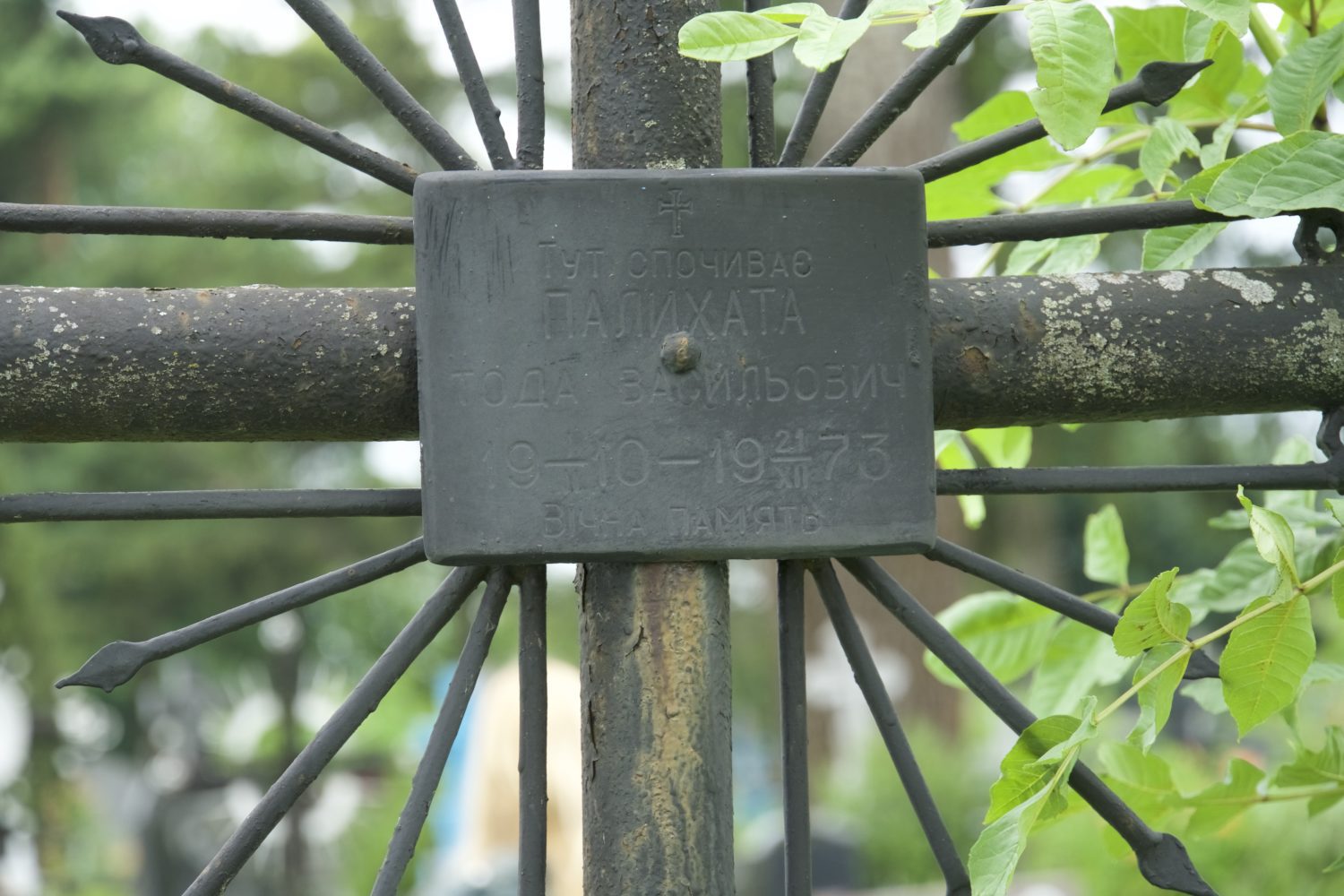 The Old Country: In Nomine Patris (12,020)