
Originally we wanted to present the pictures for this narrative on Our Slavic Roots and Heritage in slideshow format which usually also dictates some form of aural background like music, sound effects, or narration. But unfortunately, unless sub-titles or captions are added to the video track, an oral history of what these slides themselves represent – the story being told by the pictures themselves – can be muddled or incomplete. For this reason we’ve instead opted for a blog presentation – during which we can wax ad infinitum on the tales, myths, and legends associated with each slide. After all, isn’t that what a self-styled казкар is supposed to do?
Our initial decision to explore our Ukrainian ancestry back in 2017 has enabled us, thanks to our guide, translator, and driver Diana Borysenko, to not only find the legendary Babijowa Gora [Babij Mountain – yes, it’s an actual place] but also visit the ancestral villages of our paternal [or maternal] grandparents, meet some local inhabitants, and find Grandfather Ivan’s birth record in the regional State Archives all of which we have documented in our previous Old Country blogs for that tour [see links below].

We returned in 2018 – again with Diana’s expert assistance – to tour the historic sites of Kamianets-Podylskyi, Khotyn, Olesko,and Pidhirtsi castles, plus search for ancestral plots in the cemeteries of Burkaniv and Zolotnyky as well as peruse archival records in the State Archives for any ancestral links where, at the bottom of a page in a folio from 1863, we found an entry that revealed the names of our Third Great Grandparents – Thomas Babiy and Anastasia Baczynska.
Then there was the incredibly emotional trip in 2019 with brothers Daniel and David – again conducted by Diana and eloquently documented by Brother David – during which we not only met actual living relatives from both the Babij and Chuda clans – including cousins Stefaniya Barszka, Magdalena Chuda. and Sofia and Nadia Vernyhora-Chuda – but were guided by local relatives to the obelisk grave marker of our Second Great Grandfather Ignat Babiy. Even writing this today still brings me to tears.
And lastly our August and November 2021 tours when – again thanks to the talents of Diana Borysenko – we met Stefania’s extended family including her sons Bohdan & Vasyl, daughter Olha Hoy plus niece Oksana Perig and her family. And we have the pictures to prove it so set yourself down and pucker up.
Ignat Babiy.

Let’s start off this narrative which we’ve dubbed “The Old Country: Our Slavic Roots” with a photo that is – as the saying goes – worth a thousand words: Ignat Babiy’s Obelisk. As we detailed in our previous post “The Old Country: Between The Forceps and The Stone“, this is how it appeared when we first discovered it in 2019. There are several key factors to point out about our Slavic ancestry, just from this obelisk and its current location:
- Its inscription that documents both his date of birth [22 Dec 1825] and death [23 Sep 1898]; and an honorific “Gospodar” [Master or Lord] acknowledging that he owned a lot of farmland in the area at that time.
- Its location – along with a number of other tombstones, many defaced or in pieces – having been deposited in or at some time moved to a copse of trees overgrown with vines and ground cover that is adjacent to the Tserkva Pravoslavna [Orthodox Church] in Burkaniv.
- There were no existing grave sites in this forest, at least there were none that we found, just the grave markers. Which begs the question: what happened to the actual graves of our ancestors – and those of other Slavic families?
- And by inference, did some or all of the above have anything to do with the political, social, and economic upheavals in Ukraine during the 20th century which prompted several mass emigrations from The Old Country to the West, such as the one our grandparents were a party to just prior to The Great War, as well as the compulsory collectivization of farmlands during the Interwar Soviet era? These Soviet era neofeudal Five Year Plans effectively turned landowning Ukrainian farmers [kurkuli or kulaks] back into peasant serfs who owned nothing, not even the crops that they grew. In fact, according to Pulitzer Prize winning author Anne Applebaum in her book Red Famine: Stalin’s War On Ukraine, that was Stalin’s plan all along because he was alarmed by the threat posed by Ukrainian nationalism post WW I enough to use these de-kurkulization practices to rid the Soviet Union of a “persistent political problem”. Just take away their land and their livelihood. Applebaum writes:
“Neither crop failure nor bad weather caused the famine in Ukraine. Although the chaos of collectivization helped create the conditions that led to famine, the high numbers of deaths in Ukraine between 1932 and 1934, and especially the spike in the spring of 1933, were not caused directly by collectivization either. Starvation was the result, rather, of the forcible removal of food from people’s homes; the roadblocks that prevented peasants from seeking work or food; the harsh rules of the blacklists imposed on farms and villages; the restrictions on barter and trade; and the vicious propaganda campaign designed to persuade Ukrainians to watch, unmoved, as their neighbours died of hunger“.
- This was the mass genocide known as “Holodomor“, the death of millions of Ukrainians by forced starvation; a mass extermination never acknowledged by the Soviets and dismissed as маленький рус [Little Russian] propaganda by Russia to this day.
- Plus as we write this post, Putin has re-launched an attempt to throttle Ukraine’s grain exports and create another Holodomor by targeting its grain silos in Odesa with missile attacks on top of backing out of the Black Sea Grain Initiative brokered by Türkiye to begin once again blockading Ukrainian cargo ships from entering or leaving the Black Sea. Do we see a pattern here?
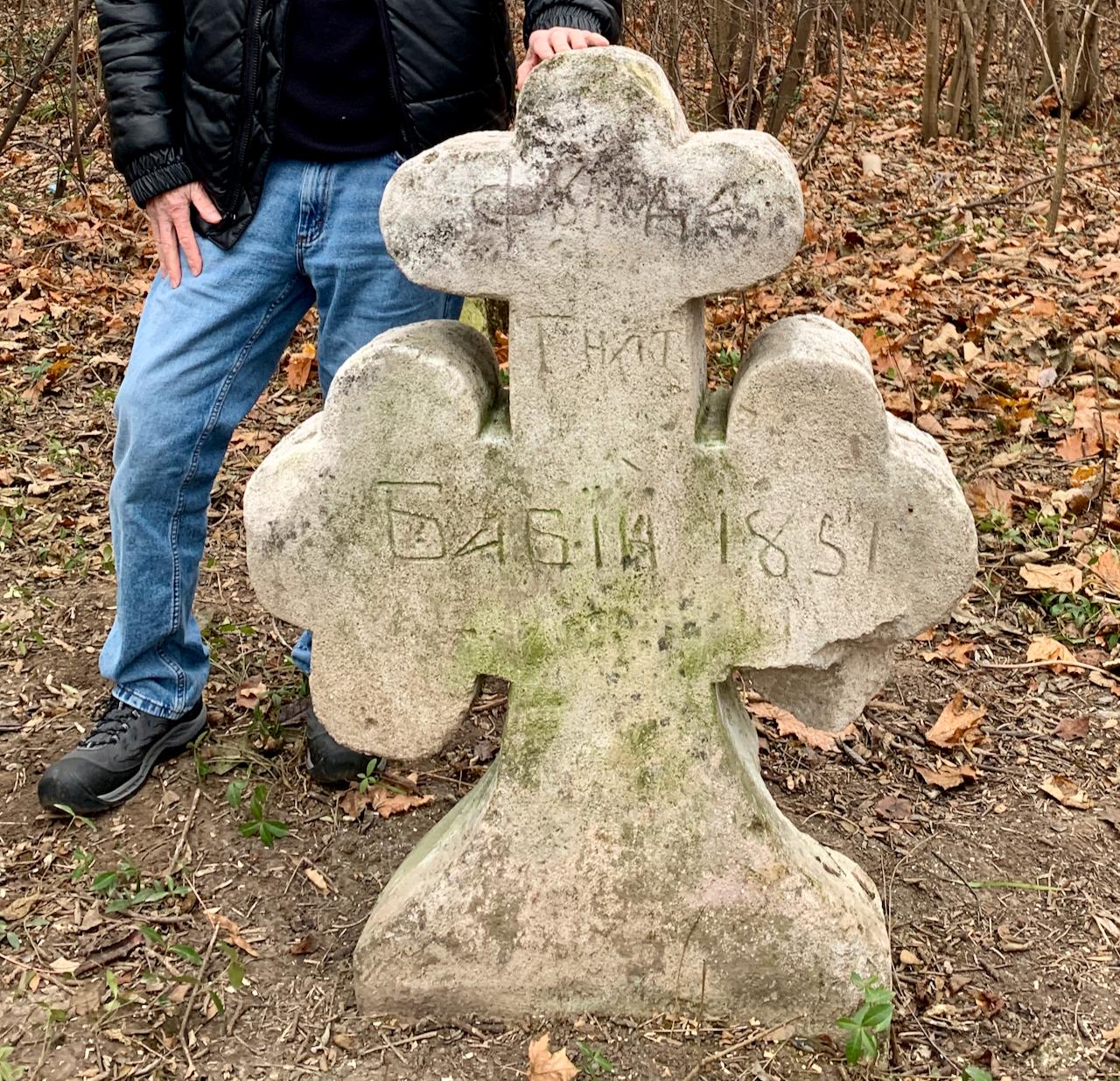
Next, on our second tour in November 2021 we again visited with Stefaniya and family in Burkaniv during which Diana and I were fortunate to attend a memorial dinner for Stefaniya’s husband Roman whom had passed away the year before. Previously that year we had asked Stefaniya’s son Bohdan – who is a local farmer – if he might be able to clear away the undergrowth around Ignat’s obelisk so that family might more easily access the site. He agreed but felt it wold be better to wait until the Fall when the vegetation would die off before attempting a cleanup.
It was Fall and we were back and upon inspection, Bohdan had done his work so admirably that he had even uncovered another Babiy grave marker in the shape of a Greek Orthodox cross dated 1851. However the Cyrillic inscriptions which decorated both sides of the stone were hand chiseled and hard to decipher; one side clearly marked “Гнат Бабій 1851” – “Ignat Babiy 1851”, likely a reference to a separate Ignat Babiy – possibly related – who had passed away that year.
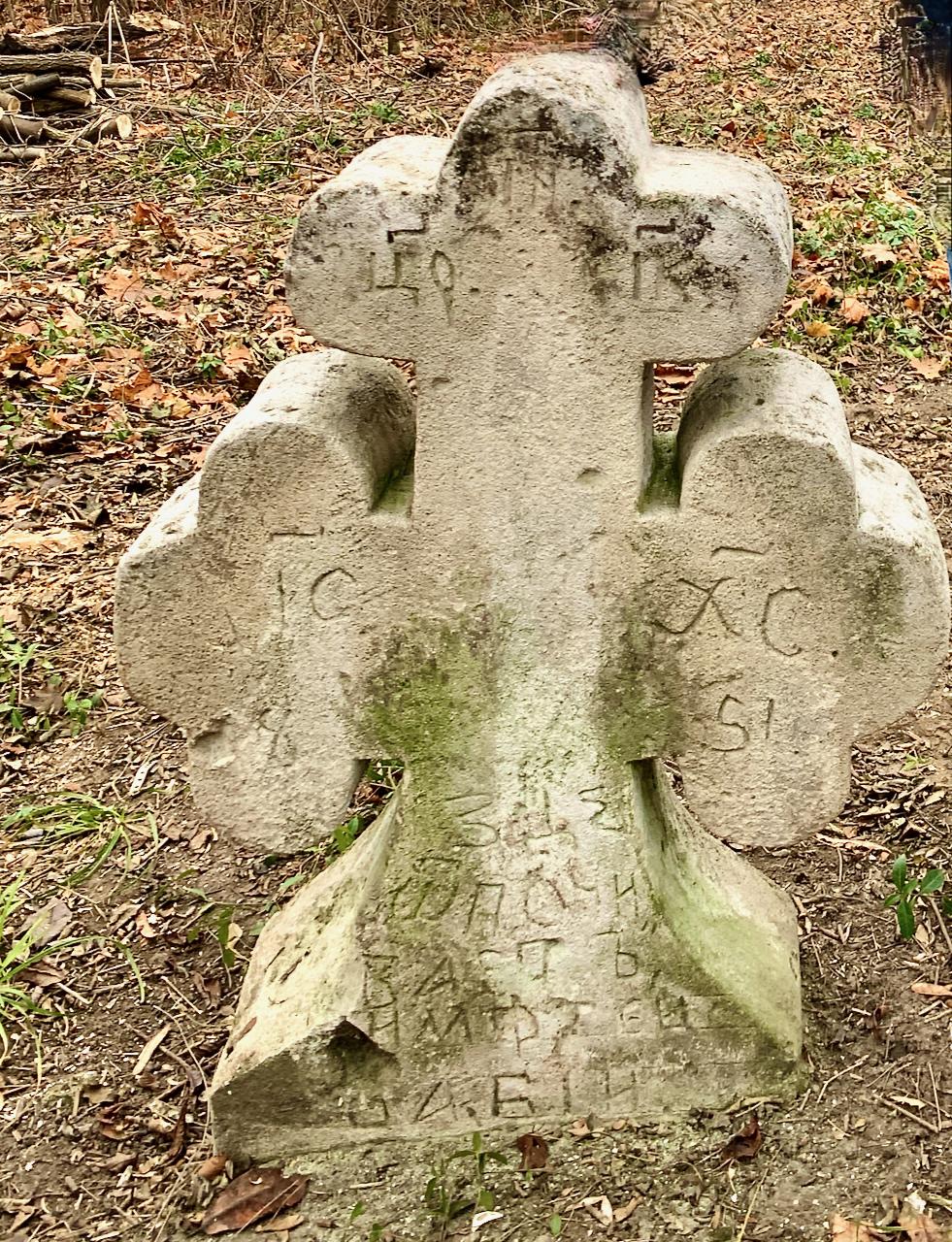
On the obverse side inscriptions were almost completely illegible except for a chiseled etching that appeared to read “Тимофій Бабій” – “Timofy Babiy” – at the bottom of the stone’s face – plus the year “18” and “51” carved on opposing sides of its middle arm. There were other inscription above that one, so obviously this tombstone had been dedicated to more than one Babiy when it was created, but Time and the elements had done their work as well.
More questions. Still, this was yet another emotional moment with family – thanks to Bohdan.
What we do not know of, and more importantly have so far been unable to find, is any physical evidence – other than Ignat’s obelisk – of our Ukrainian ancestors in the cemeteries of the two villages. None. Having said that, we did see quite a few either unmarked or seemingly abandoned burial mounds, especially in the Burkaniv village necropolis, so the graves of Panteleimon Babiy and Maria Palychata; and Prokop Babiy and Maria Durdela; and Paul Chuda and Xenia Lemiszka may still be hidden there waiting to be re-discovered.
The Archives.

We do know from archival cadastral documents found and photographed by Diana that our Chuda and Babiy ancestors did own many plots of land in the Burkaniv and Zolotnyky area including chalupas [cottages] with gardens as well as farmland. As of 1821 Anton Chuda, who lived in the same house Gramma Anna was born in some 70 years later, owned 13 plots of farmland and as of the same year a Tymko Babiy owned 26 lots. In 1879, our Second Great Grandfather Ignat Babiy owned 33 properties. Is it possible that Anton Chuda was Gramma Anna’s grandfather? Were Tymko and Ignat related? Was Tymko the Timofy etched on the Greek cross tombstone above? More questions.
The State Archives had also provided quite a few church metrical records [births, marriages, deaths} hand written in either Latin or Cyrillic for the offspring of Ignat and Magdalena, including the children of sons Prokop, Basilius, Petrus, and of course Panteleimon [each of whom had a wife named “Maria”] but it was not until our second meeting with Stefaniya Barszka and her son Bohdan Barszky in August of 2021 that we were finally able to make a connection back through the several generations between that of Ignat and ours via a living voice.
Verbal History.
A family’s oral history is essential to maintaining a sense of belonging to a lineage that stretches through generations. We give this lineage a name – by tradition a male surname and we know that all names mean something as we’ve already pointed out in previous blogs. These oral histories contain stories, myths and legends passed down as being factual and most are, but you know the Old Saw:
“Trust no man, nor call him brother, with hair one color and beard another”.
Nevertheless, family elders must be believed because they’ve lived through life’s struggles, passions, deceits, and losses. Elders have a tale to tell. We just have to listen and decide what to believe or not. What follows is Stefaniya’s tale as transliterated by our guide Diana.
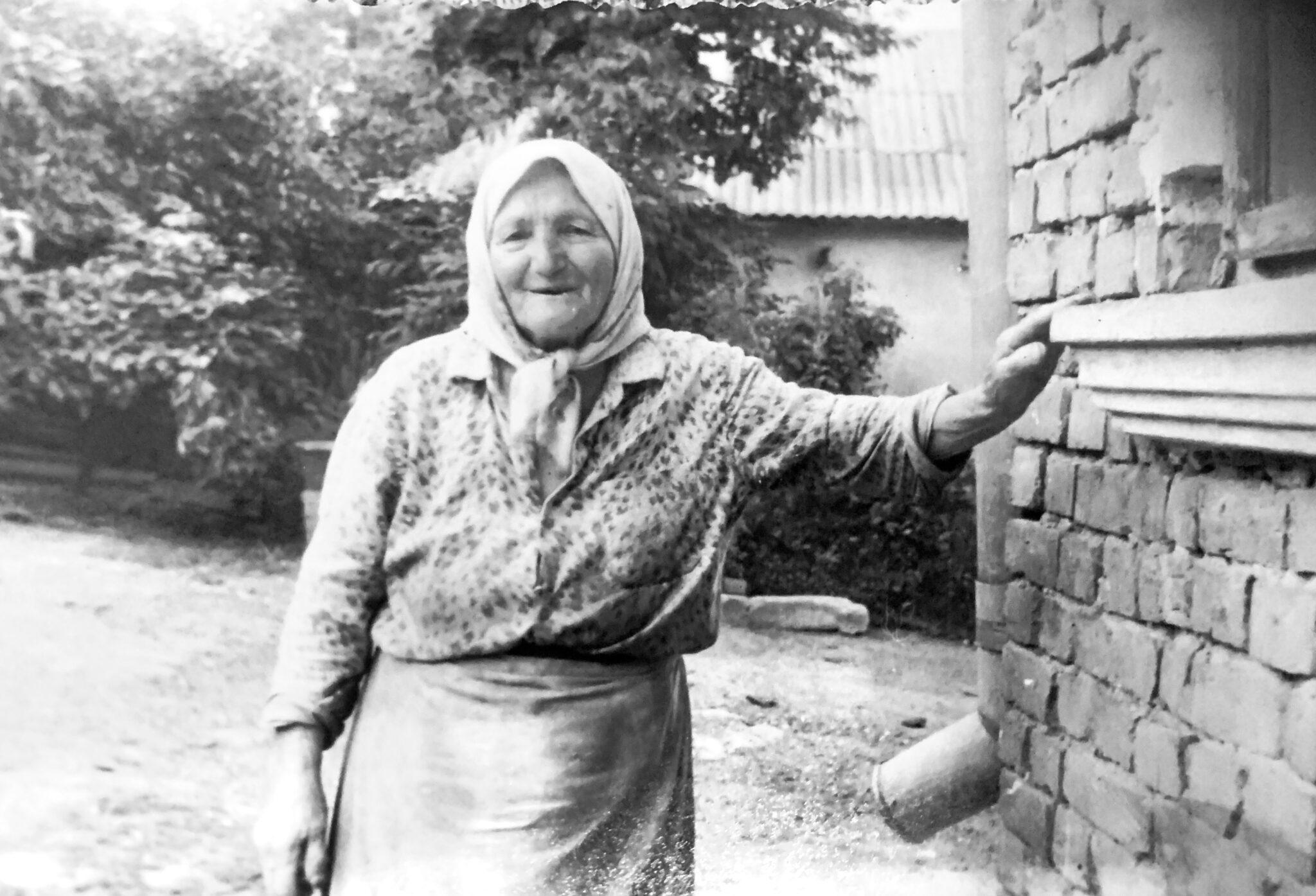
This is her mother, born Thecla Babiy [1910-1989], daughter of Prokop Babiy and Maria Durdela. Since Prokop and Panteleimon were brothers, that made Thecla and Grampa John first cousins and by inference our Aunt Estelle Spearman her second cousin.
Thecla had many siblings including a brother Mykola who fought and died in The Great War; sisters Magdalena, Eugenia, and Anna; and brothers Pavlo, Stefanius, and Gregory who became a well-known physician in Vienna.
Thecla married Gregorii Biskup [Bishop] and had three daughters: Stefaniya, Sophia [1929-2002], and Maria [1935-2019] – whose daughter Oksana we had met earlier in Lviv, and whose son Yuriy Vlasov, we discovered via email, lives in Ontario Canada not far from Lake St. Clair. Yuriy kindly sent us this photo taken outside the family home in Burkaniv that shows Thecla with Stefaniya and infant Yuriy Vlasov ca. 1967

Stefaniya married Roman Barszky who sadly passed away after a long illness in 2020. They had three children: sons Vasyli and Bohdan, and daughter Olha who is a school teacher and lives nearby in Zolotnyky. [She must know the school’s headmaster Volodymyr Boyko whom we met on our first trip to Ukraine in 2017].
Every Picture Tells A Story.
Subsequent to these events we returned home and by February 2022 everything changed for Ukraine and the rest of our world. We’ve published several video clips by Diana Borysenko – including her views about the ongoing fight of Ukrainians for their independence and how Ukrainians are responding to that challenge – that we’ve dubbed Diana’s Diary. Please watch. Слава Україні!
![Grandpa Ivan [John] Babiy](https://www.ruthenians.net/kArpatia/wp-content/uploads/media-from-ftp/2021/12/Grandpa-Cropped-restore.jpeg)
As you can no doubt see it was in bad shape, the original having been damaged by a flood some years ago along with other archival papers that had been stored by her Mom Olga Babij Balboni with a cover note scrawled in Cyrillic and signed “Gregorii” with the date “1922”.
The back story was that this photo and associated papers had origins from The Old Country via Gregorii Babiy, Prokop Babiy’s son who according to Stefaniya eventually became a prominent physician in Vienna.
So what is going on in this photo? What do we see in it? Four men and two women. The women appear to be dressed in white. A man in the background is holding an accordion so he’s most likely a musician. The guy standing is wearing some kind of costume so he’s probably a performer, and the two seated men are in formal attire with boutonnieres on their lapels and are jointly holding what appears to be a bottle of spirits so they most likely knew each other quite well. A wedding?
Well we also know that the man standing “stage left” is none other than our grandfather Ivan Babiy. Plus, according to family lore, among his many talents he also could really “cut a rug” – Cossack style. [Allegedly he could pick up a table with his teeth as well]. In this photo he is posing for the camera with his right hand on the left shoulder of the older gentleman seated next to him – another sign of intimacy. They probably knew each other as well.
Now we have been told that this photo came in a package that originated with Gregorii Babiy who was Ivan’s first cousin and Thecla Babiy’s older brother, so likely he’s probably in this photo. And on top of that quite possibly he’s the groom – the younger man to the left seated in front of the two women in white. So in this scenario, if Gregorii is the groom then the older man seated to his left whom he obviously knows intimately – along with Cossack dancer Ivan – could be his father Prokop Babiy. The only tidbit that doesn’t fit in this tale is the year 1922.
By 1922, John Babij would have been married for six years and living in Detroit with three young kids and a wife to feed and shelter. According to his daughter Aunt Olga – Ivan had illegally entered the US in the first place, most likely in the Teens just before or during The Great War, having “jumped ship” from some kind of naval vessel he was a crew member of while it was docked in Tampa Bay, Florida, abandoning it for a new life in the New World.
The ship itself was likely from a neutral nation, maybe even Italian since Italy was straddling the fence between opposing sides of the conflict at the time, or even Austria, who did have a navy at the time but was of course aligned with Germany so its vessels would not likely be welcome in a US port, although the US was technically a neutral party until 1917. Yet somehow, as both a deserter and an illegal alien, Ivan made his way up the East Coast of the U.S. to New York City by hook or by crook or good fortune or all three combined. And as both fortune and fate would seemingly ordain, he eventually met and married Anna Chuda there in 1916, herself having grown up just across the Strypa River from Ivan in The Old Country region of Podhajce, Austria-Hungary. Quite a tale indeed.
Desperate Times Creates Desperate People.
But life was not easy for Ivan and Anna as they gradually migrated Westward with their children in search of work and a safe place to stay. During that time – the Twenties and Depression era Thirties – the United States was still a country whose population was predominately rural and agrarian. But that was changing. Anna and Ivan were raised as farmers, so it is likely their hopes for a new life centered on having a farm to raise their family and live on. But in the meantime there were mouths to feed and rent to pay so they had to go where the jobs were – industrial centers like Cleveland and Detroit.
For more narratives on what life was like for an immigrant family of itinerant farmers eking out a living in rural America during these times check out these posts:
- from cousin Anne Chavez – “All The Farms” in which she details her mother Estelle’s childhood memories of moving from farm to farm in the Thumb District of Michigan during the late Twenties to early Forties.
- and from cousin Sue Roth – “Hard Not Happy Times” – a commentary based upon her mother Olga’s accounts of the personal sacrifices the struggling Babij family had to make in order to survive.
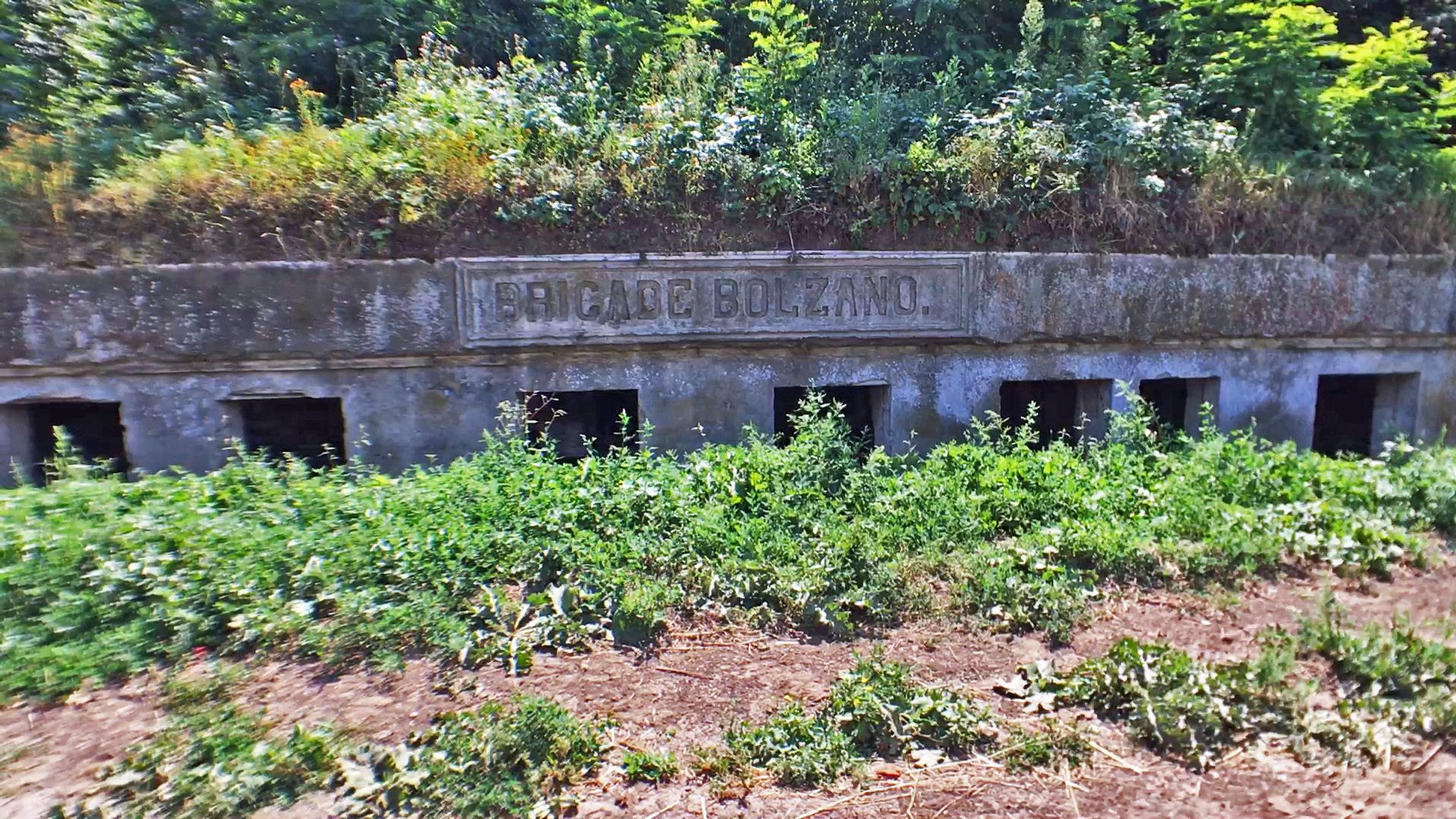
And let us not forget the events that caused both Ivan and Anna, their families, and tens millions of other Slavs who called themselves Ukrainians – a “people without a country” – both then and now – to flee their homeland because of the threat of war. In the case of Ivan and Anna and fellow Galicians it was the advent of World War I [aka The Great War] during which Eastern Galicia was overrun by troops from the Russian Empire in the Battle of Galicia in 1914. At least a year earlier the run-up to this decisive battle had seen troops from the Austria-Hungarian Army augmented by recruits from the pro-independence Ukrainian Sich Sharpshooters move into the Podhajce region as well as in other areas of Galicia causing great alarm for the safety of the indigenous population including the children in these rural communities. Estimates for the lives lost from the Battle of Galicia total nearly 600,000 in combatants alone. There seem to be no estimates for the loss of civilian lives, however.
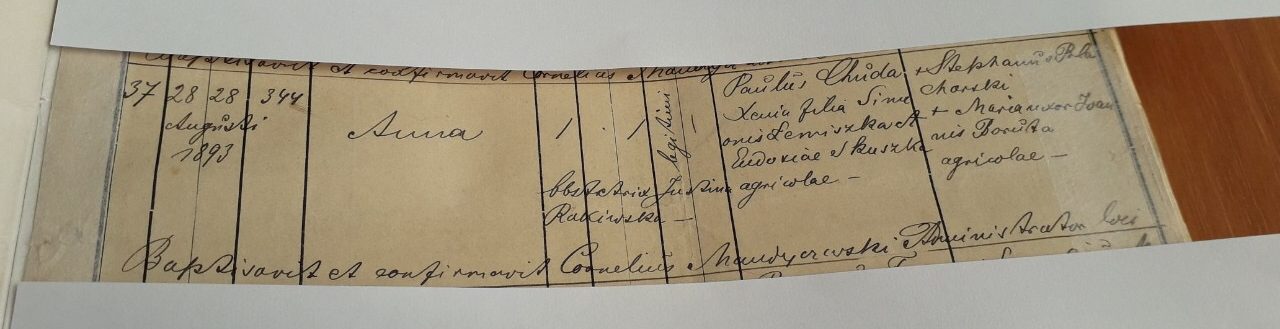
But we know there were, not only in the war but also the sectarian pogroms between Poles, pro-independence Ukrainians, Russians and Russian-speaking Ukrainians, and of course Jews. In her post “Hard Not Happy Times“, cousin Sue Roth makes mention of Grandma Anna’s mother whom she calls “Lenka Leninskaya” – a Russian appellation. This was either a pseudonym or a nickname, possibly used to mask her Polish origins either out of necessity or affiliation because according to the church archives unearthed by our guide Diana Borysenko her actual name was Xenia Lemiszka – “Xenia” being the Greek form of the Ukrainian name “Oksana” or the Russian name “Kseniya”.
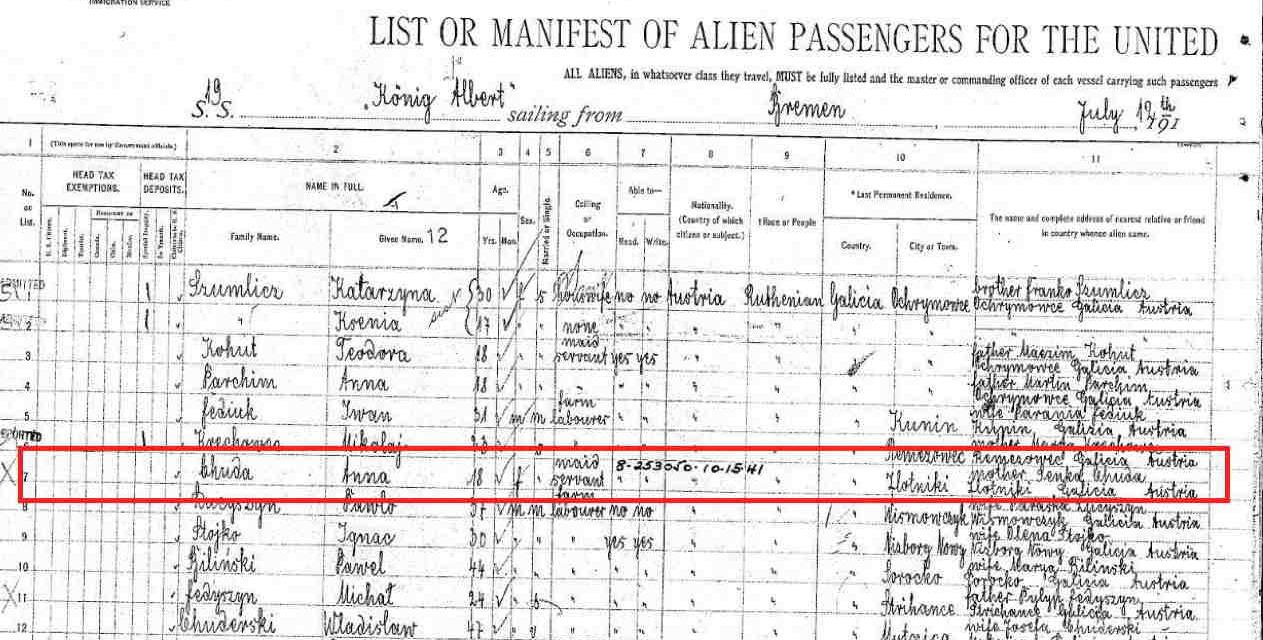
On the Ellis Island passenger manifest of Xenia’s daughter Anna Chuda dated 19 June 1913, Anna’s mother is listed as “Lenka Chuda”. Yet on the marriage license of Ivan and Anna dated 14 May 1916 her mother is listed as “Kseniya Chuda” – a Russian given name. Obviously the Chudas, like many Ukrainians were multi-lingual and spoke both Ukrainian and Russian – perhaps even Polish as well. Was Xenia Chuda a Russian sympathizer or given the anti-Polish political climate in Galicia at the time did she adopt a Russophile personage out of necessity – having been alone after her husband Paul passed away some time previously, with four children to raise and provide for?
The Great War ended resulting in the collapse of the Austro-Hungarian empire along with a dramatically weakened Russian monarchy which would soon fall to the Bolsheviks. On top of that Eastern Galicia which included the region Anna and Ivan were born in subsequently reverted to Polish rule which would continue throughout the Interwar period until the outbreak of World War II bringing with it renewed reprisals by Poles against both Ukrainian nationalists and Russian/Soviet sympathizers. And this economic and political atmosphere of oppression and repression based solely on ethnic prejudices of the Past would continue under the Soviets albeit exacerbated by the West’s obsession with the painting of socialism as an enemy of democracy.
What we as descendants are left with are more questions.
Epilogue.
 But there is “one more thing” – as tech bros like to say. After sharing this above photo on social media with Oksana Perig – Stefaniya’s niece – I received a text forwarded by Oksana originating from Stefaniya’s daughter Olha Hoy that contained an image of Gregorii Babiy, his wife and that of a daughter and her spouse, reportedly taken in 1959 at their wedding.
Compare the image of a sixty-ish Gregorii in this photo to that of the younger twenty-ish man in the image obtained from cousin Sue. A possible resemblance? We just do not know since Olha’s mother Stefaniya was not yet born when Prokop died.
This blog’s feature image above was taken by Diana in November 2021 during a gathering of her family members at Stefaniya’s house in Burkaniv in memory for her late husband Roman who had passed away the previous year. Family. Just look at the faces. You can view more coverage of the gathering in our previous blog The Old Country: Blue Over Gold.
A quick note about the photos in this blog and others on this site: to view an expanded Lightbox view of a particular photo, just click on it and it will fill your screen. To close, click the small “x” located in its upper right-hand corner. Enjoy.
For an alternative POV of our 2019 tour of Ukraine check out Brother David’s day by day account titled “The Phenomenal Babij Brother Ukraine Trip“. You will be as amazed as we were so don’t miss it.
Be sure to view our most recent blog from our 2021 trips to Ukraine titled “The Old Country – Blue Over Gold” – documenting meetings with extended relatives and a lengthy discussion about the ongoing war with Russia and don’t forget 2019’s “The Old Country — Between The Forceps And The Stone” in which we expound upon our innate mortality, the pandemic of fake news, alternative realities, and “unknown unknowns” – [our spin on Donald Rumsfeld’s paranoia about “things we don’t know we don’t know”], then present even more ancestral links to actual living relatives that we’ve found.
And remember, you can read the complete saga of our 2017 trip to Ukraine published earlier in our blogs “The Old Country — Ternopil Oblast“, “The Old Country — Ivano-Frankivsk Oblast“, “The Old Country — Lviv Oblast”, plus more from our travels in 2018 found at “The Old Country — Salt of The Earth” and The Old Country – In Nomine Patris [AKA “Father Knows Best”]. Just follow the appropriate links.
Add to that travelogues documenting our tours of Galicia: “The Old Country – Galicia “; “The Old Country – Echoes In Time“; plus “The Old Country – A Slideshow” – a visual tour of the sites and sounds of the ancestral villages and historical places we’ve visited in our trips to Ukraine.
P.S. In case you missed it be sure to catch both of our videos on the Pysanky MasterClasses we took from Master Folk Artist Halyna Syrotyuk. You’ll want some pysanky as gifts too!
Of course, don’t forget to share these links with your friends and family.
And if all of this doesn’t whet your whistle for a visit to our ancestral homeland, check out Diana Borysenko‘s website DianaTours-WesternUkraine.com for links to all of the tours, masterclasses, activities, and ancestral heritage services she provides.
Plus you can keep abreast of the ongoing battle for Free Ukraine here and keep watching Diana’s Diary – Ukrainians At War updated periodically via her posts on social media .
These posts are journeys from the Present into the Past, opening portals opaque with age or forgotten or long closed and hidden by Time’s passage. We make our own history and in the end, history is about the journey not the destination.
Слава Україні — Слава Героям.
Content and images © Ruthenians.net MMXXIII all rights reserved.


Views: 0