Prologue.
The year 1994 was a tumultuous one for that brought significant changes to my career that included job & residence changes plus the beginnings of a new relationship that would reshape my life going forward. Marcia and I had briefly met at a party given by friends the year before. At this time those friends had gone on vacation and Marcia was staying at their house taking care of their dog while I was tasked to periodically check the mail and see if she needed anything.
Well, we hit it off – went to see some shows; met for dinners; did some local hiking. And then our friends returned and after a brief period of time Marcia was off once more to Nepal where she planned to live for several months – or more! Nepal. Halfway around the world and I just had to go and see her.
TREKKING THE KALI GANDAKI GORGE
September 15, 1994
I cannot go back…..Knowing this I take an 11,000 mile step into an unknown place that is my unrealized and unfulfilled self, throwing off the weight of a mantle of self-doubt, dread and regret . This journey begins in my mind and ends in my heart, a trip fueled by love and bound only by the limits of inner space.
As John Crowley writes:
“To go out you must first go in, and to go in you must first go out.
Here I go!
September 17 1994
Passion. An ocean I travel in a flimsy craft made up only of my capacity for love. A sometimes stormy sea – ascending and descending peaks and troughs – at one with a wave of angst, and yet separate – distinct – riding wherever it may take me. Slowly it builds – increasing with each breath – then overcomes me and I am consumed with love again feeling whole – connected – fulfilled. I hope Marcia knowns how deeply she brings this to focus and hope she feels it too!
I listened – “participated” in a tape on Self-love – a course I took in AA and thought I’d matriculated from – during which the “Ally” directed me to touch my heart with my hand and tell myself that I loved me and was my best friend. I cried – big salty tears of joy – realizing that I felt guilty – so guilty for just “Receiving”. I worked overtime at giving, often confusing “giving” with “communicating” words. I must learn to receive and to feel worthy. I cannot go back over bridges that lead to worth-less-ness.
September 19-23 1994
Kathmandu
The plane descends out of the clouds and touches down at Tribhuvan International Airport taxiing up to awaiting passenger ramps close to a ground-level covered pedestrian walkway leading to the main terminal building. I de-plane and proceed with the other passengers along the walkway a few paces until I happen to glance up at an open air balcony adjacent to the terminal building and catch site of a woman standing apart from the other onlookers. It is Marcia. I step out from beneath the passageway to where I can be seen and wave. Immediately Marcia waves back excitedly. Nepal at last!
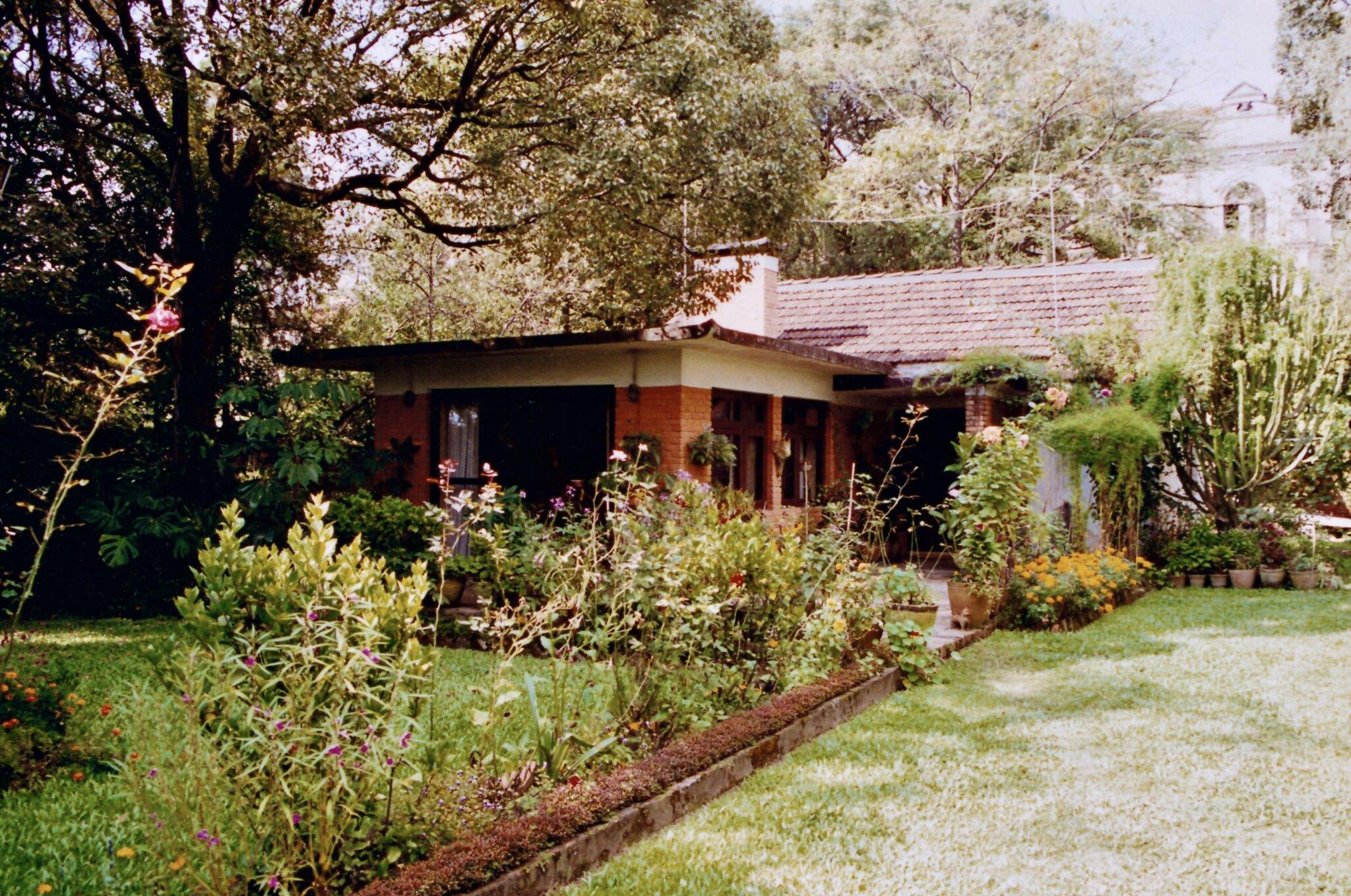 Nervously, I gather myself up physically and emotionally, collect my baggage, and pass through customs to where Marcia stands in a waiting area outside the terminal. We embrace quickly [public displays of affection between the opposite sexes are frowned up in Nepali culture] then board a Tuk Tuk rickshaw taxi for a ride through town to a house Marcia has arranged for us to stay for the duration of our visit.
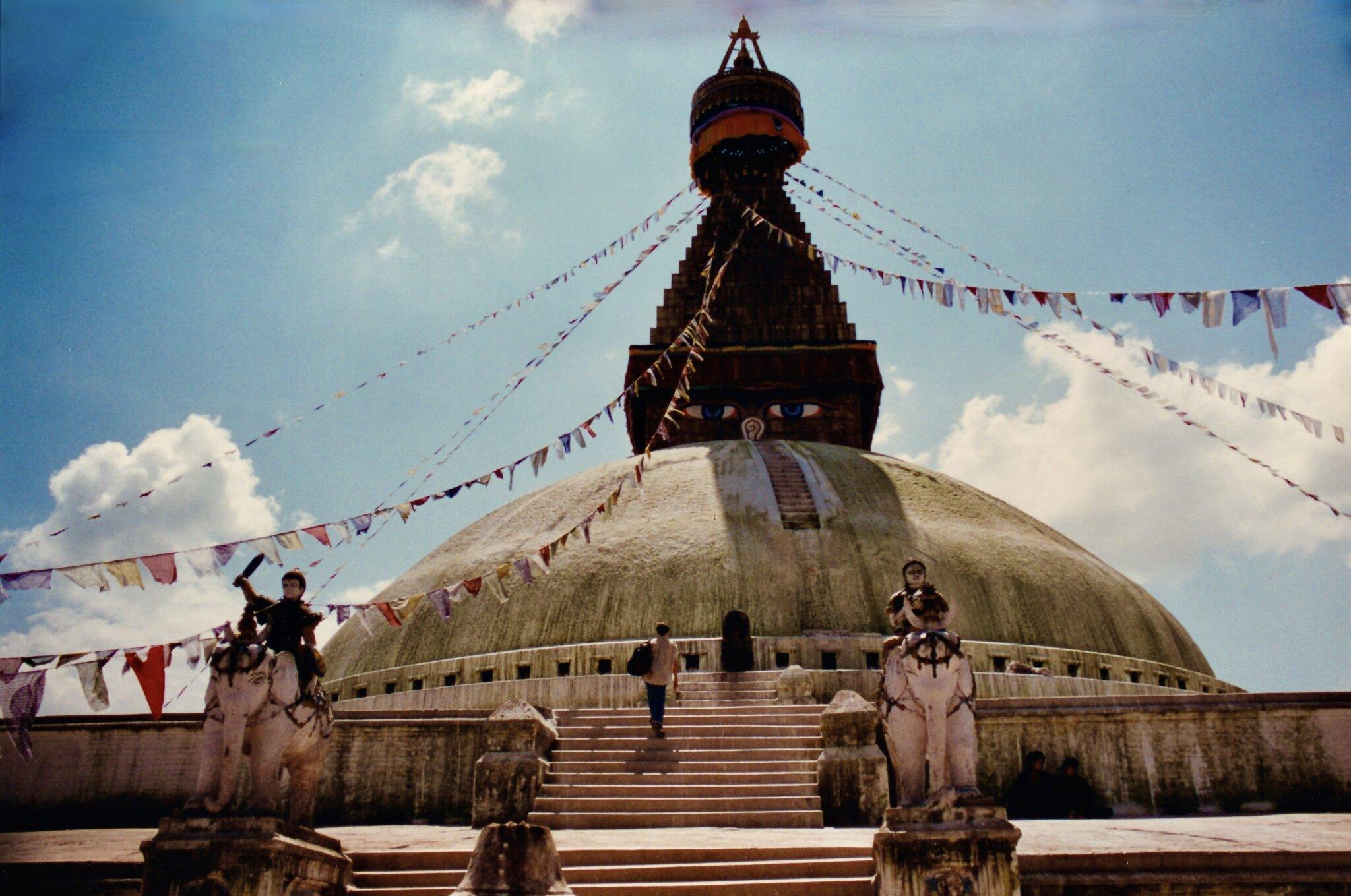
Kathmandu at first sight appear like a village growing rapidly – uncontrolled and un-controllable; muddy, dusty, dirty – teeming with life. People. animals, vehicles of all description; cars, motor scooters, bikes and tuk tuk taxis. Buildings falling down and being re-built back up again. The air is filled with smoke and dust searing my throat and lungs making it difficult to breathe. And yet, on every corner there seems to be a shrine to a Hindu deity of one sort or another, so I am moved by the devotion of the people to enlightenment and joy, even though outwardly they seem to have very little to be thankful for yet, inwardly it would seem they have what I crave the most – peace, serenity, and love.
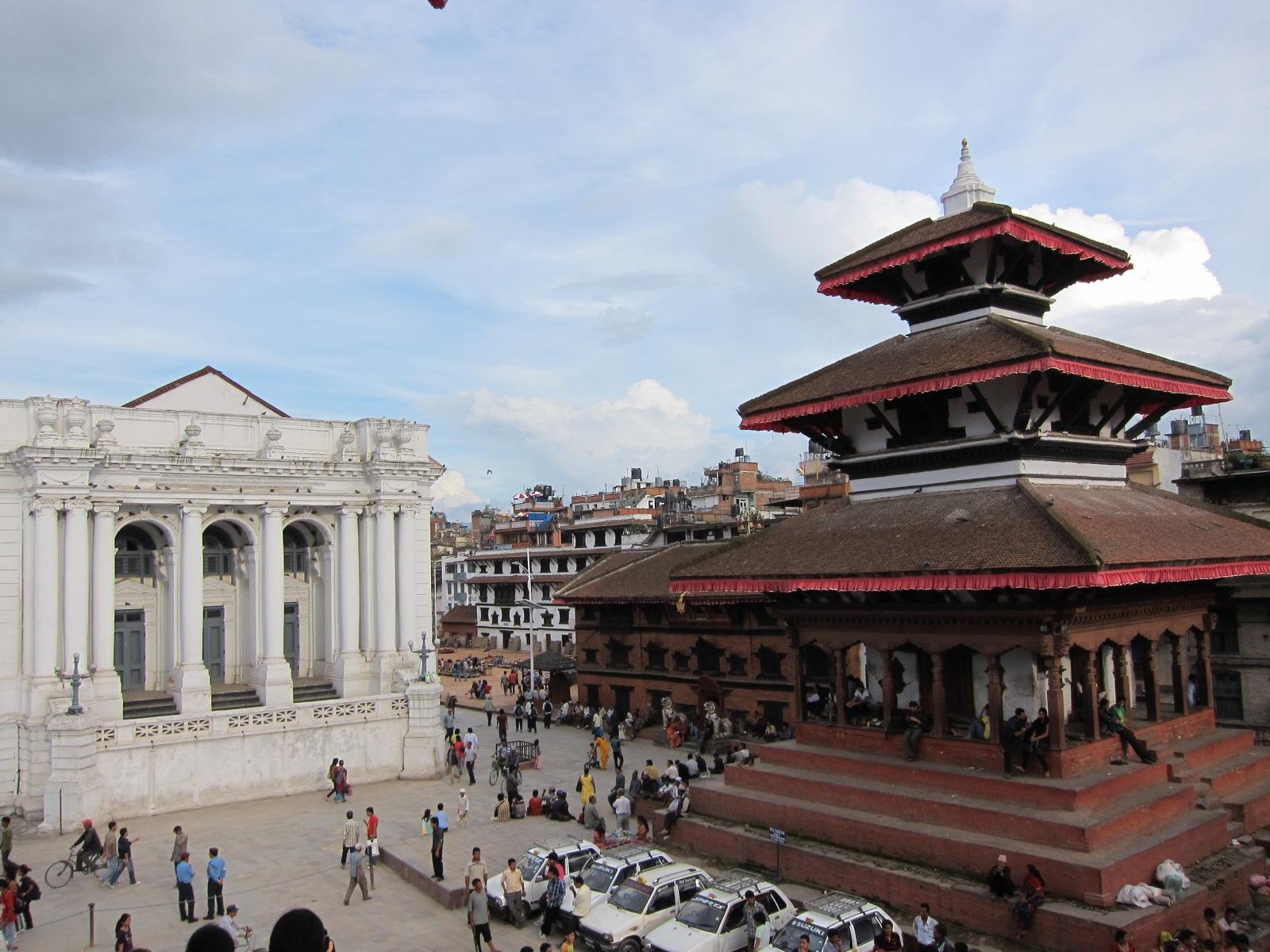 I have arrived during Indra Jatra – a Hindu holy festival celebrating the end of the monsoon season and commemorating the founding of Kathmandu in the 10th Century. Right on cue it started to rain as Marcia and I walked the streets from shrine to temple along with throngs of devoted followers. We stop at the Durbar Square, Kathmandu’s city center dating from the 3rd Century, which is dominated by two towering Hindu shrines standing next to a huge white edifice – a government building seemingly teleported from colonial England and glaringly appearing to be out of place.
It is in front of this building that Marcia suddenly clasps my hands beneath the ponchos we are wearing. My heart flutters. Just then a group of men spin out of the crowd carrying a large float in the shape of a “bull” scattering celebrants in their wake. Suddenly they are right on top of us and ram into me knocking me backwards. I am stunned by the force of the blow.
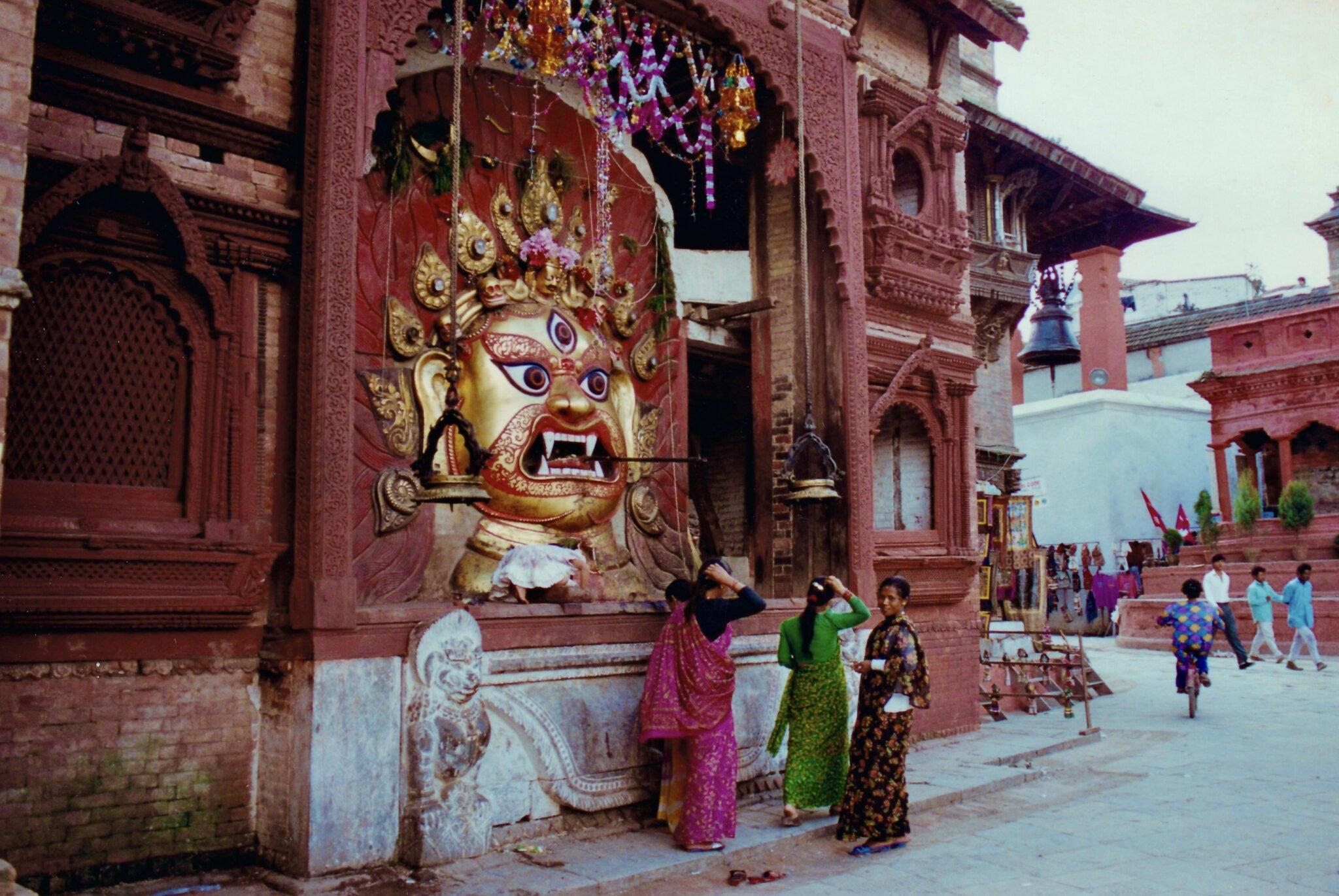
The bull [possibly the Hindu deity Bhairava] then does a half spin, the men beneath it one by one begin to lose their balance causing the entire float to collapse onto the pavement to the groans of the crowd.
Quickly Marcia grabs my hand and we ascend the steps of a nearby temple – a safer place to view the rest of the celebration. Later as part of a large gathering on the square we witness the procession of the Living Goddess Kumari – the virgin bride and her lengthy entourage – as it parades through the streets to much cheering and fanfare.
September 26.
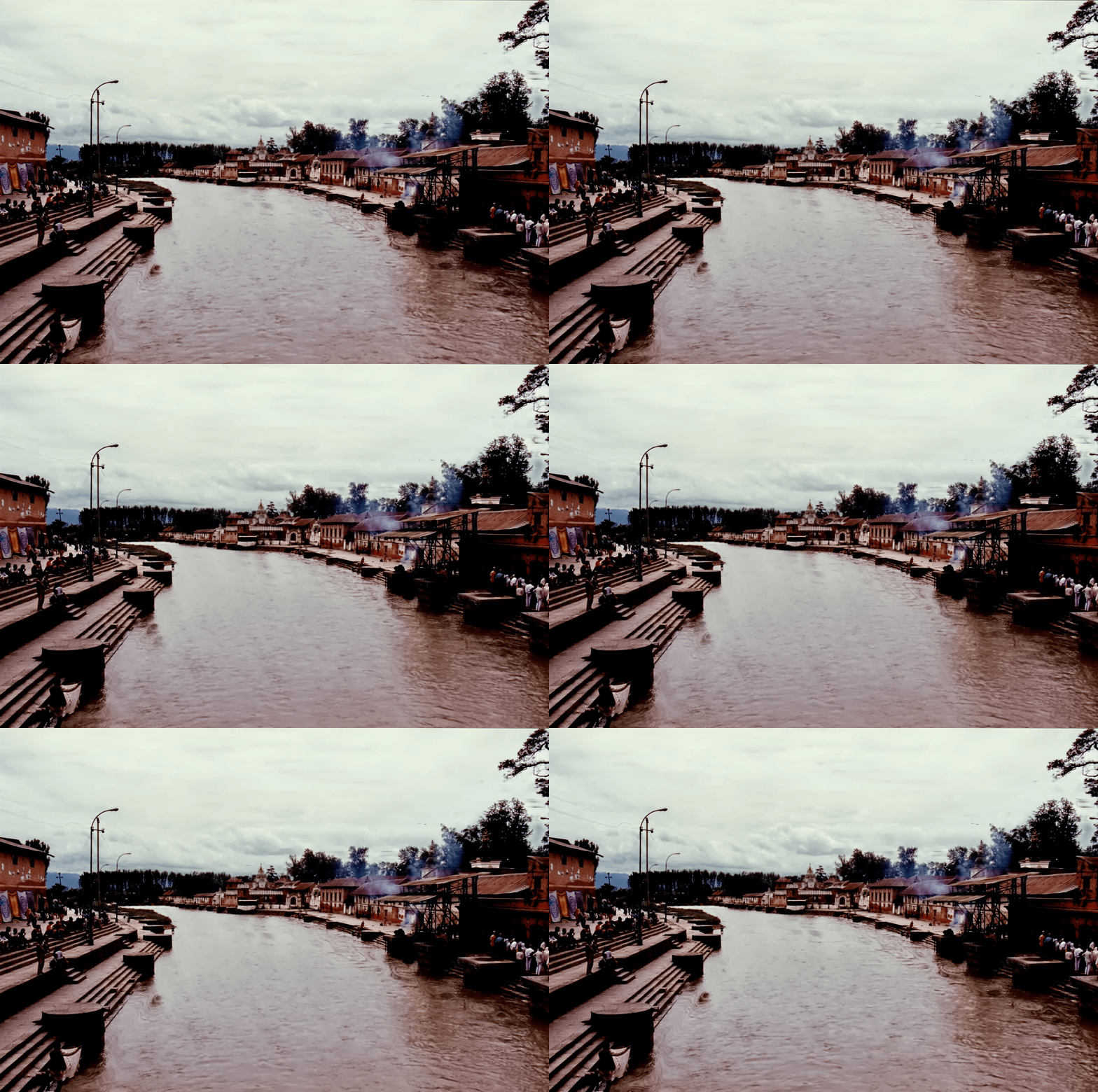
A “kamikaze” bike ride across Thamel dodging motor scooters, tuk tuks, and foot traffic to Durbar Square through the market district. It would make a fascinating video of life in Kathmandu [see our version later in another post]. Talk about having your senses piqued to capacity. Then it’s on to the Bagmati River where we visit Pashupatinath Temple, “a sprawling collection of temples, ashrams, images and icons raised over the centuries” along the banks of the Bagmati, dedicated to Lord Pashupati and subsequently classified as a World Heritage Site in 1979. This temple represents an ancient Hindu concept stating that death should not be feared and sex should not be ridiculed. As a result, there is a ritual cremation ground extremely close to the temple, as well as sensual artworks on the temple’s roof. Many pilgrims to the site want their lives to end here and are cremated at this temple so they may be purified by the sacred waters of the Bagmati.
September 27.
Got a bit of the “Fajardo Quickstep” – a Borinquen slang term for the runs. Probably the result of some rancid cooking oil which is used in practically everything in this town. Not good for the LDL count.
In the A.M. I sat in for a lecture on Buddhism with a group of college kids from Boston. While they nodded off in varying degrees of consciousness, I was rapt. Total attention for an hour mesmerized by the energy of these Nepalis.
September 28.
Feeling much better so we ventured out to do some shopping for the trek. It is still very cloudy and smoggy and there is some concern whether we’ll be able to see anything in the mountains.
September 29.
The Bus Trip From Kathmandu to Pokhara.
Through early morning fog we climb out of Kathmandu Valley. Motoring around a curve we are suddenly bathed in sunlight and below us we see a vast expanse of rice paddies, the road ahead a ribbon winding into the distance far below. The bus makes frequent stops, often to navigate past many landslides caused by the recent monsoons that partially cover the roadway as we follow the Kali Gandaki River heading East toward Pokhara. At one point we even have to disembark from the bus and on foot cross a narrow bridge that was damaged by the same storms.
Re-boarding the bus, we are again jouncing over rough roadway stretches, winding around blind curves – the only other vehicles being other buses – no cars. We do see one cyclist and a couple of land rovers. But the exhaust fumes from the bus are making us both feel nauseous even though we’ve got our face masks on and we can’t wait for the trip to end. Eight hours later it finally does.
We stumble off the bus and collect our belongings only to be confronted by a cacophony of shouts from a crowd of taxi drivers – held at bay by the local constabulary – all begging to take us to their own special hotel. Marcia recognizes one named Krishna so we board his tuk tuk. Along the way to the hotel, Marcia negotiates for a guide and porter and a taxi ride to “New School” – the starting point for our trek next morning.
For dinner we have some Dahl baht (rice and lentil soup) which likely will be our steady diet for the next few days.
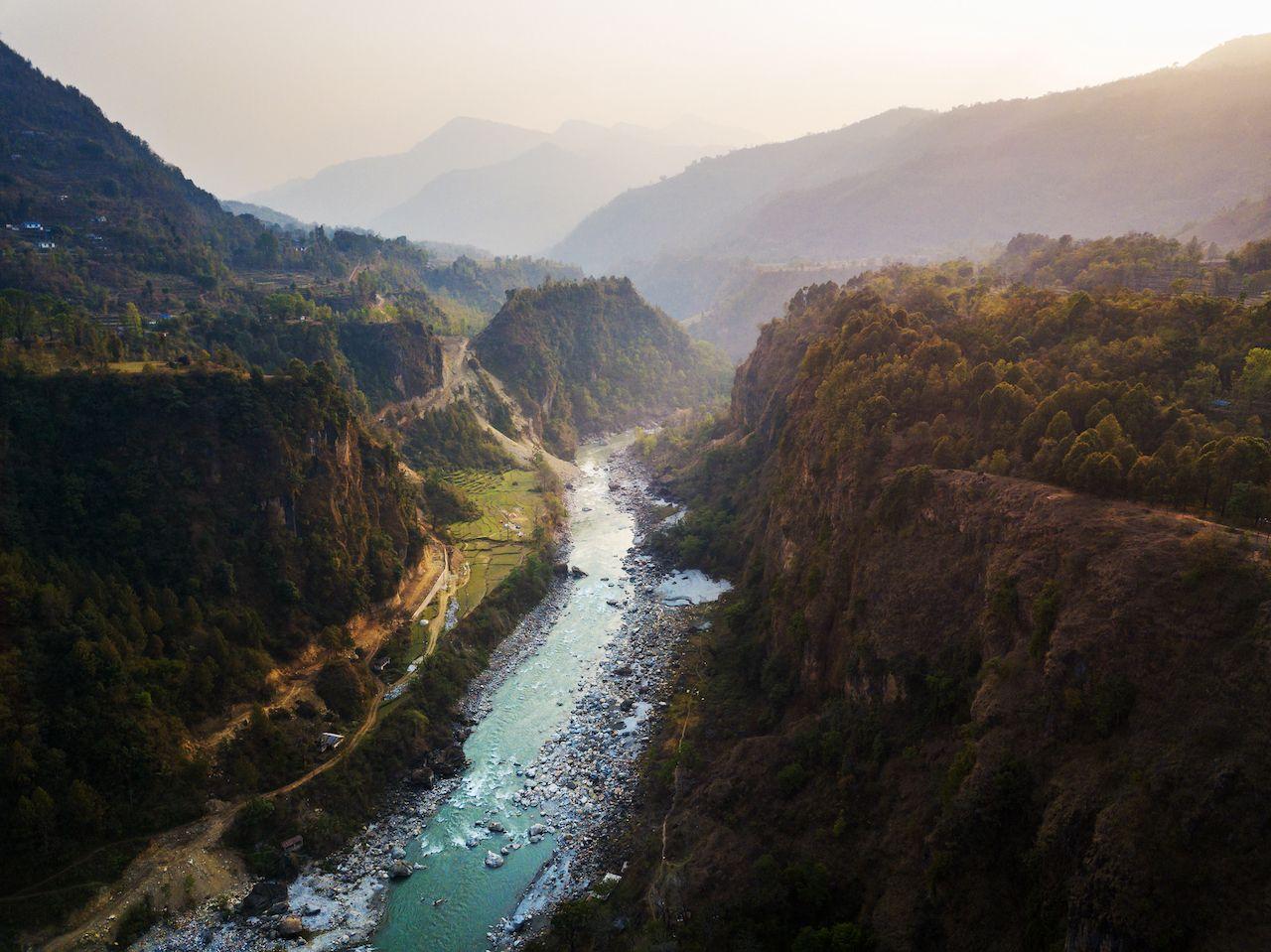
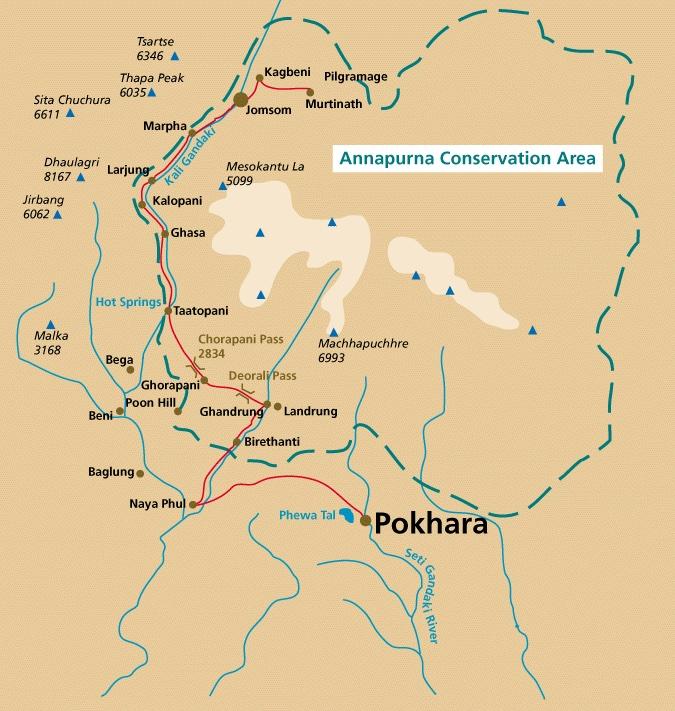 The trekking route – from Pokhara to Jomosom to Muktinath along the Kali Gankaki River Gorge – through the deepest canyons on Earth.
According to the Wiki: The Kali Ghandaki Gorge lies between the mountains Dhaulagiri, elevation 8,167 metres (26,795 ft) to the west and Annapurna I, elevation 8,091 metres (26,545 ft) to the east. If one measures the depth of a canyon by the difference between the river height and the heights of the highest peaks on either side, this gorge is the world’s deepest.
The river is older than the Himalayas. As tectonic activity forces the mountains higher, the river has cut through the uplift. The upper part of the gorge is inhabited by the Thakali people, and is sometimes known as Thak Khola. This region is known for extinct shaligram [ammonite] fossils, revered as one of five non-living forms of Lord Vishnu that date as far back as the Cretaceous Period [more than 60 million years ago].
September 30.
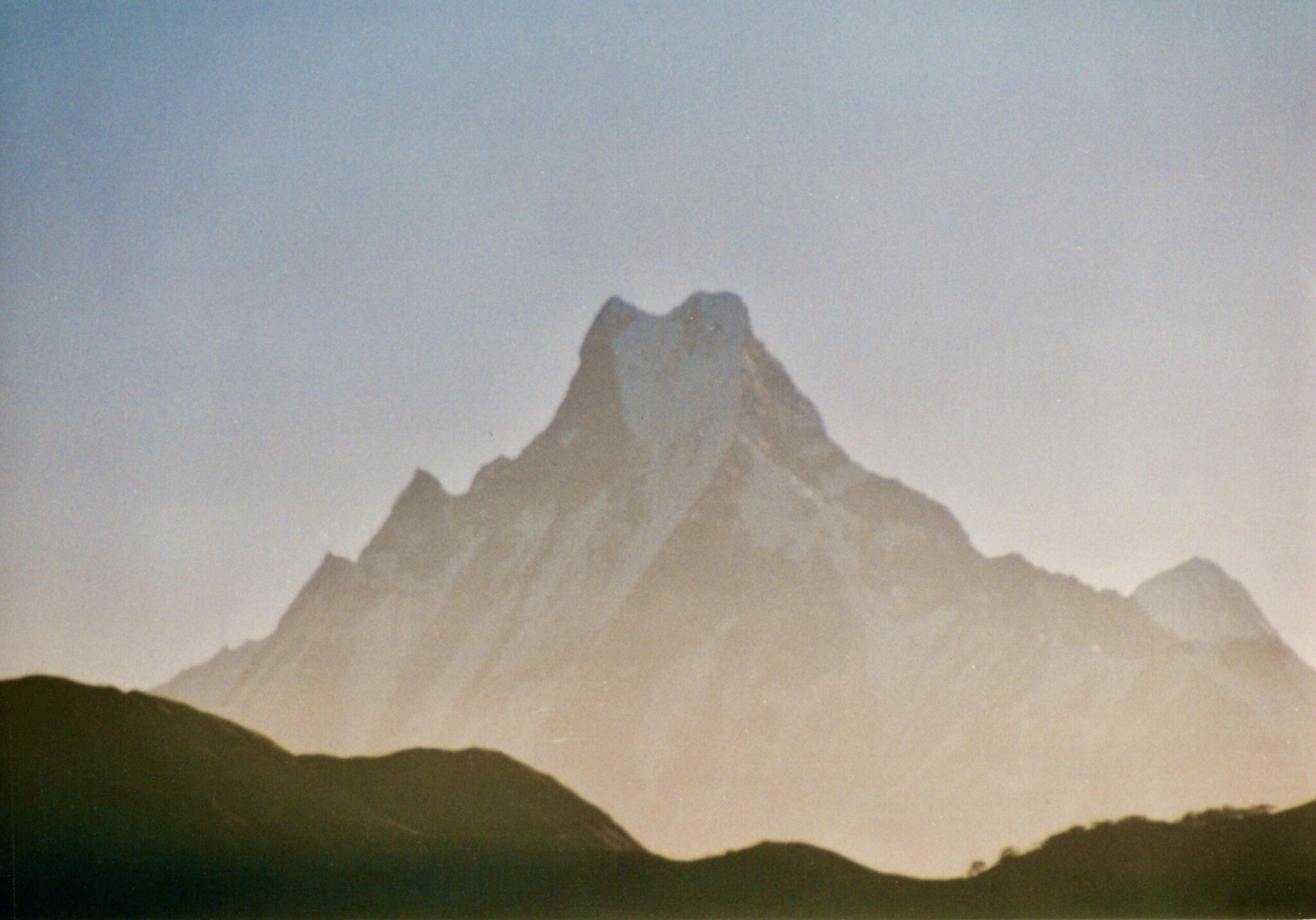
We’re off with our porters Madhu and Tatsu — taking a tuk-tuk taxi which will save us a day’s trek along the trail from Pokhara, On the horizon we view Machapuchare or “fish’s tail” in Nepali – a tall finger of white above the clouds greeting and beckoning us onward. We are ecstatic and beg the driver to pull over so we can take some photos. Machapuchare’s summit has never been “officially” climbed although there are reports of a New Zealand climber, Bill Denz, making a successful yet illegal attempt to reach the summit in the early 1980s.
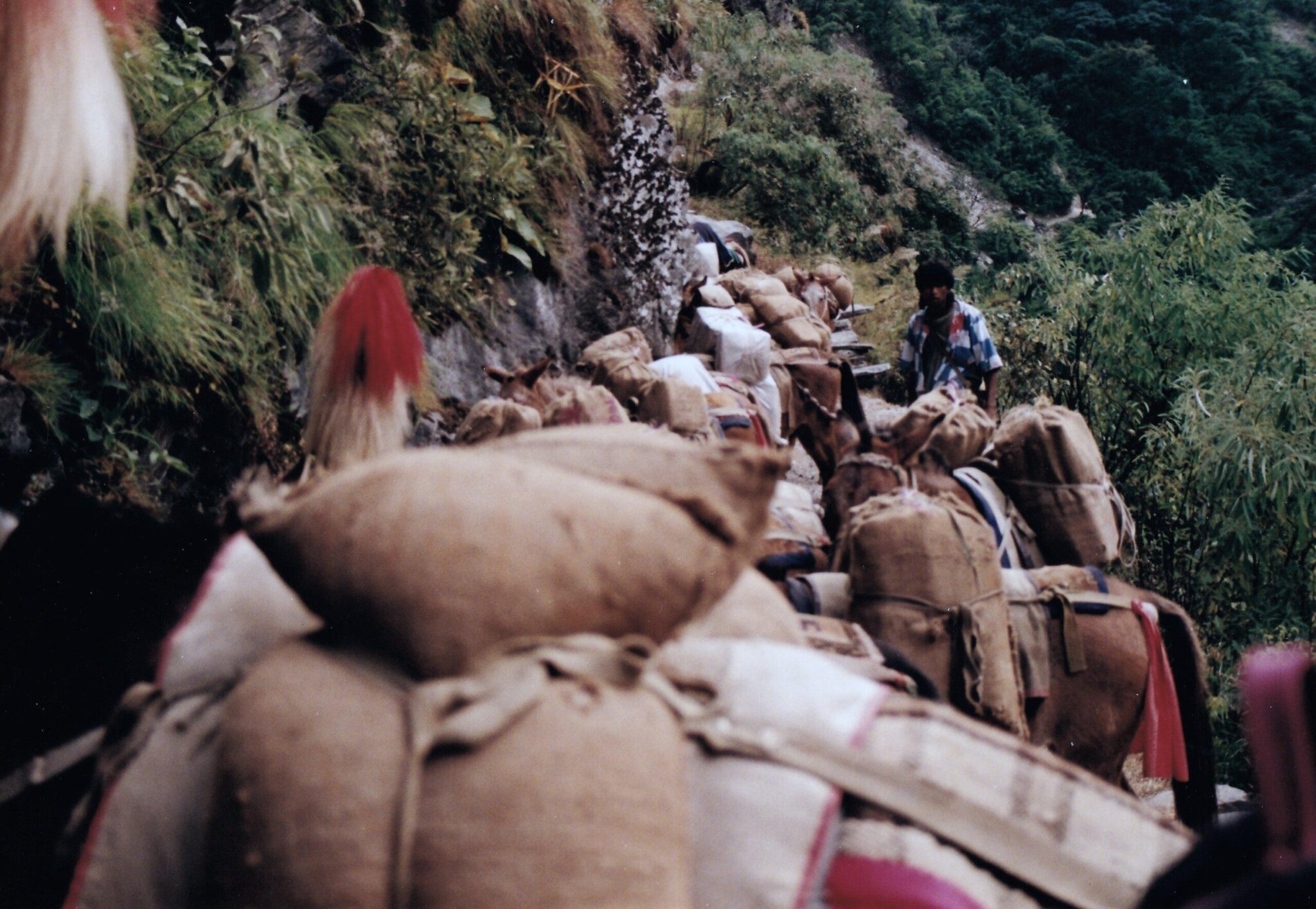
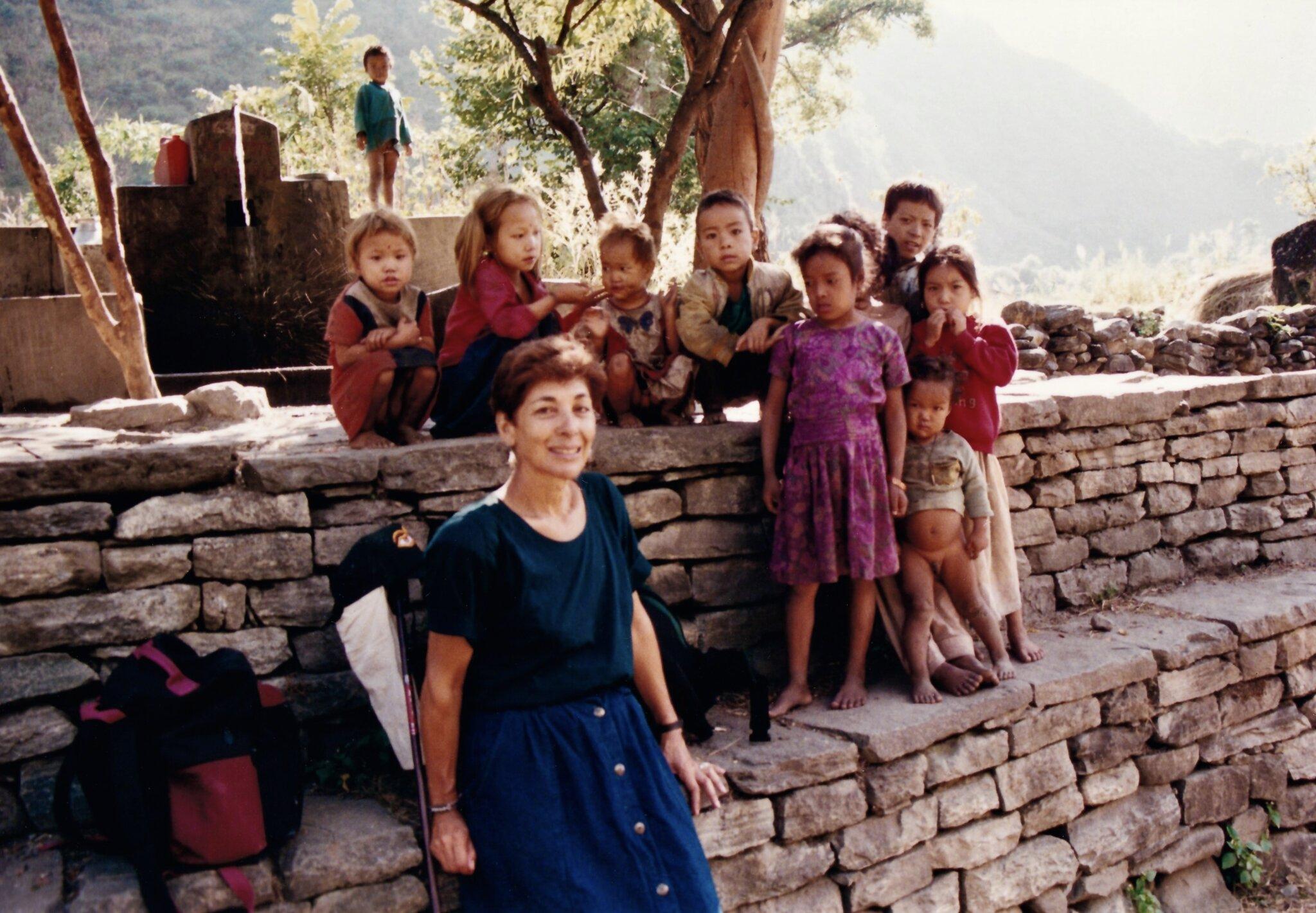 Passing through the morning mist and clouds we begin the trek to our first destination – the “New School” at Tikhedhunga where we’ll stay at a guest house next to a new secondary school. Shouldering our packs, we’re off through meadows and across foot bridges. All along the way we encounter Tibetan porters lugging huge bundles and even galvanized pipes on their backs bound for Ghorepani – the “donkey trains” of the Himalayas ferrying food and provisions [in the early 1990s roads going North did not exist in this part of the Kali Gandaki – only trekking paths]. Along the way we meet a few other trekkers and a group of children on their way to school who agree to pose for a picture or two.
About two hours out we view the trail as it meanders along a small cliff and through a rice paddy with a small hut in the distance. A photo op! Reaching for my camera I take my eyes off of the path for a second and stumble over the cliff. Only Madhu my porter saves me from a bath in the river. With both my pride and knee bruised, we continue on finally reaching Tikhedhunga, near the dreaded Ulleri Steps [an estimated 3300 stone steps reaching an altitude of 6400 ft.] our resting point for the night.
I laid awake that night worrying about my knee and the possibility of encountering leeches [we’d heard stories] and as if to heighten my fears if begins to rain. Marcia’s serene presence calms me.
October 1.

The Ulleri Steps to Ghorepani.
We ascend the Ulleri Steps from Tihkedhundra criss-crossing mountain slopes and terraced rice and millet fields, hiking through oak and rhododendron forests on past Ulleri and several small settlements to Ghorepani [“horse water” in Nepali]. 6 hours of steady climbing – an ascent of over five thousand feet in less than a day. We are exhausted and can barely breathe because of the altitude. This is the hardest bit of physical activity I’ve ever done so we collapse at the local lodge.
The weather has become overcast and windy with fog billowing through the trees and it is much colder since we are at nine thousand feet. Tomorrow morning at 5 AM we will ascend Poon Hill to view the Annapurnas, the whole Western range of the Himalayas including Dhaulagiri and Nilgiri will be at our feet.
October 2.
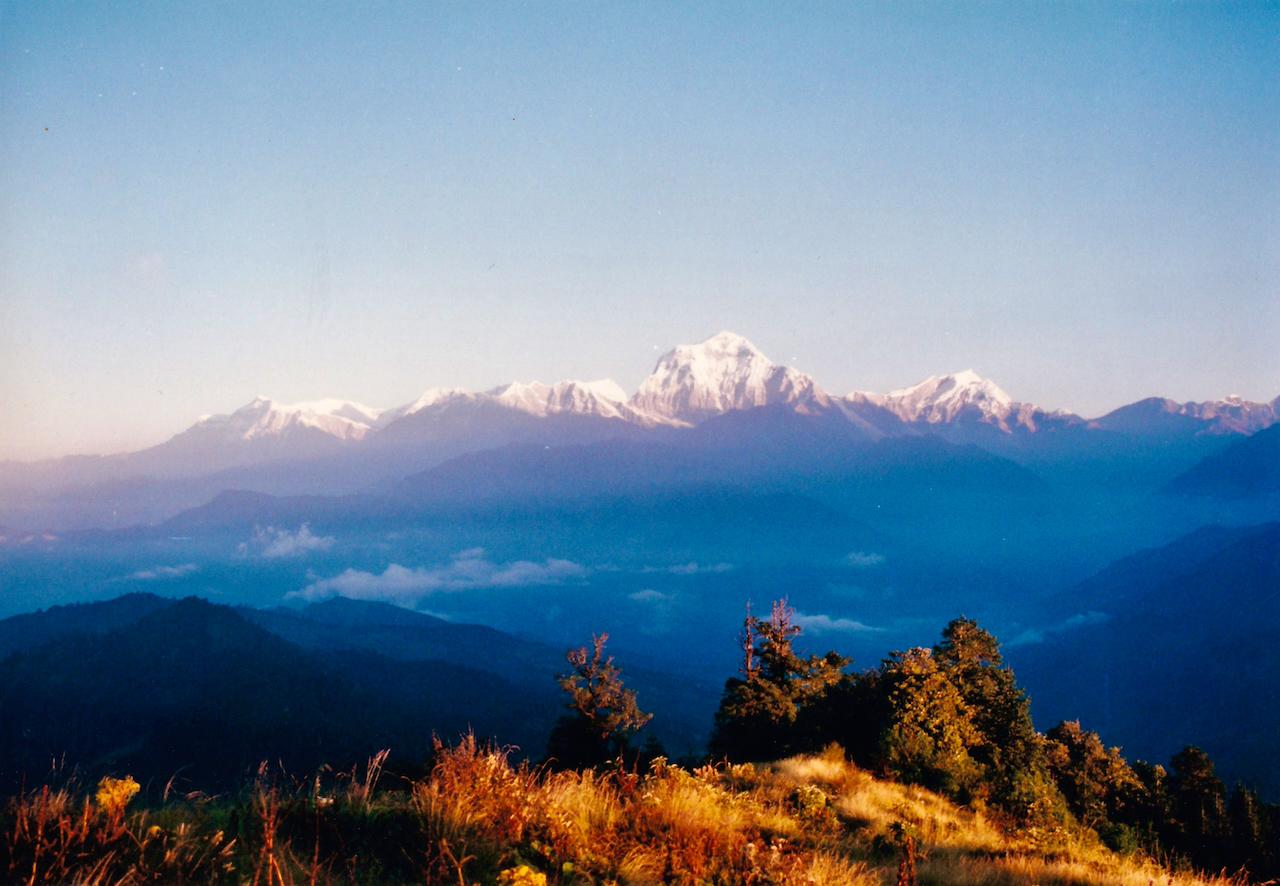
Poon Hill.
I cannot believe this! It is clear and the mountains are out, greeting us in the dim pre-dawn light! But the trail is so steep – two thousand feet straight up for an hour of continuous climbing. My lungs feel like they will burst at any moment and there a times when I feel I cannot go on. Only Marcia’s presence and smile pushes me onward. Up – up – up until at last we reach the summit. There must be forty or more other trekkers already there – even a guy selling coffee! The view is just extraordinary – all of the mountains are there for us to lay our eyes on; so close and so high!
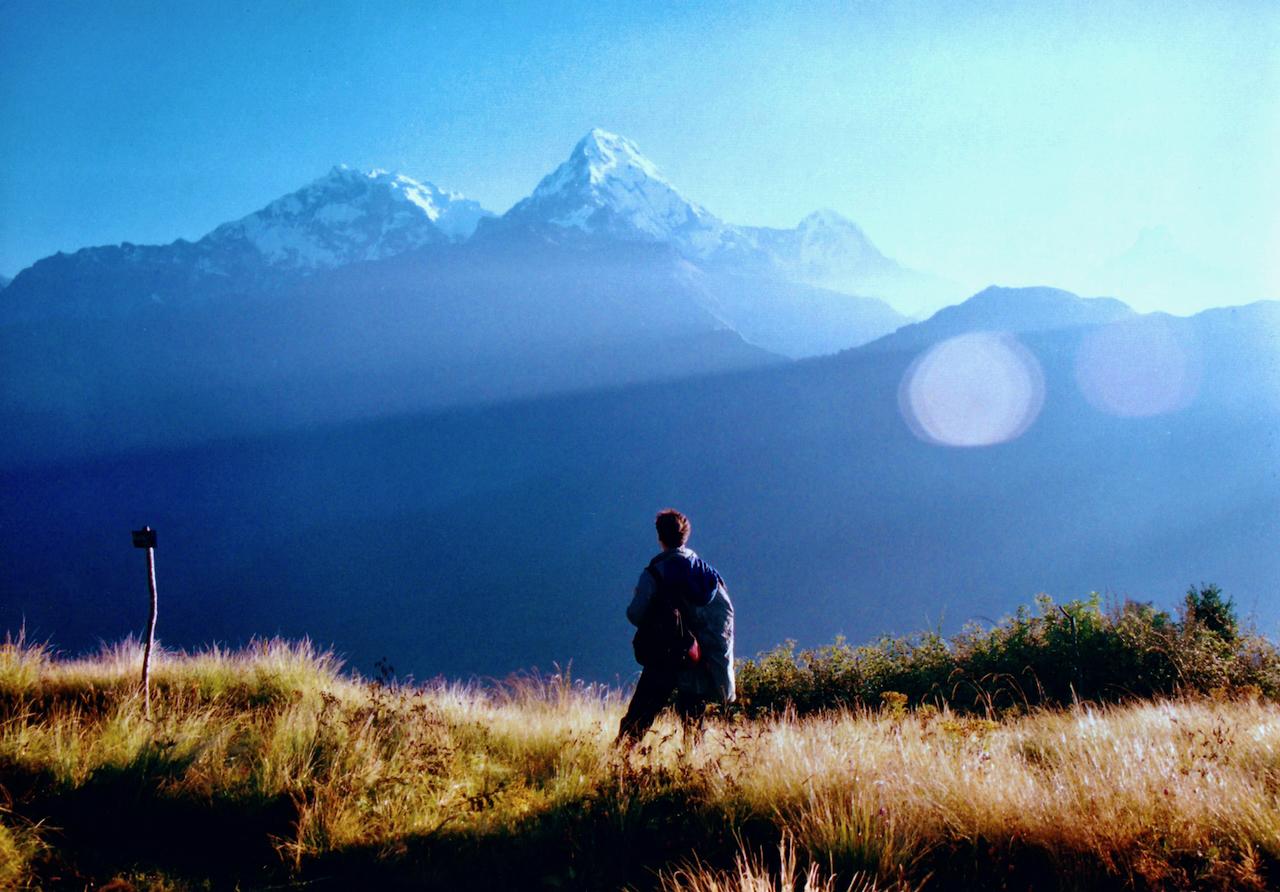
October 2.
Trek to Tatopani.
The trail leads straight down – well, almost straight. Eight hours of bone-jarring descent – over terraced steps – around boulders and several berms created from massive landslides. One false step in the loose limestone shale and one could plunge thousands of feet into the gorge.
Everywhere there are signs of de-forestation – some of it planned. There are projects in the works to run electricity from Tatopani down to Ghorepani as well as up to Jomosom using telephone poles fashioned from galvanized metal – all portaged up and down the mountainsides by sherpas lugging 10 foot sections at a time [see photo of the Ulleri steps above] for the paltry sum of just five rupees per day.
The constant jarring on ankles and knees forces a trekker to use one’s thighs and achilles tendons to the extreme. There is a point where my legs feel like they will no longer function so we’ll have to rest soon. Marcia doesn’t complain but I know she is hurting as well. Even our porter Tatsu is eager for a rest.
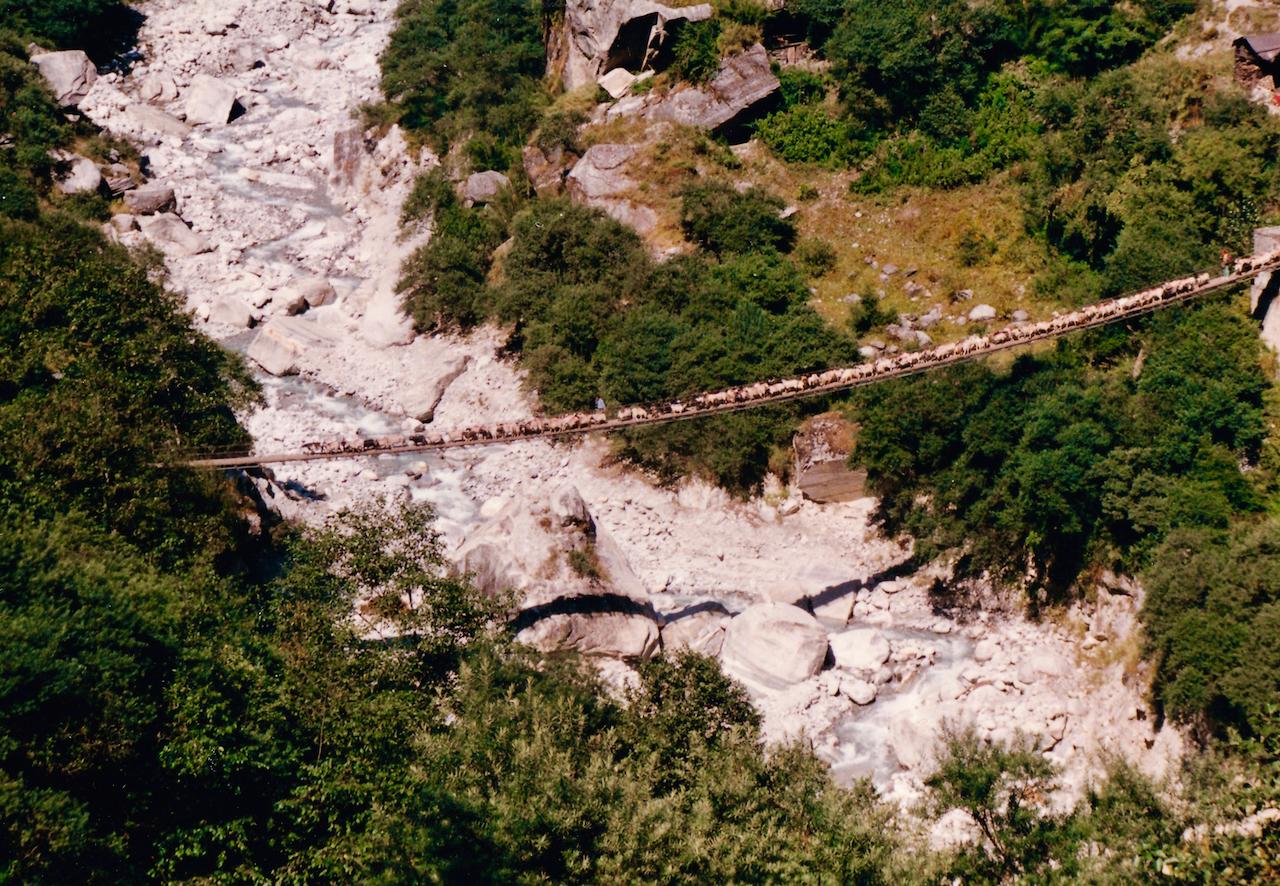 We stop for a snack of dried apples and iodine water [all drinking water has to be filtered and/or laced with iodine in order to prevent diarrhea], then push off once more until we finally reach the river and cross over two bridges each suspended high over the torrent [there were reports that a British woman had fallen from one of them ten days earlier] and stumble into a police checkpoint. Then on to Tatopani [“Hot Springs”] where our guide Madu has secured us a room at the Dhaulagiri Lodge.
We have a few lemon sodas to quench our thirst and hobble down to the spring heated pools where we blissfully soak for an hour while the pain and exhaustion of the trail is gradually eased by the warm and wet heat from the springs. Marcia agrees that we’ll take a day of rest here at this oasis along the trail. Later we collapse into bed, sleeping like the dead until morning.
October 3.
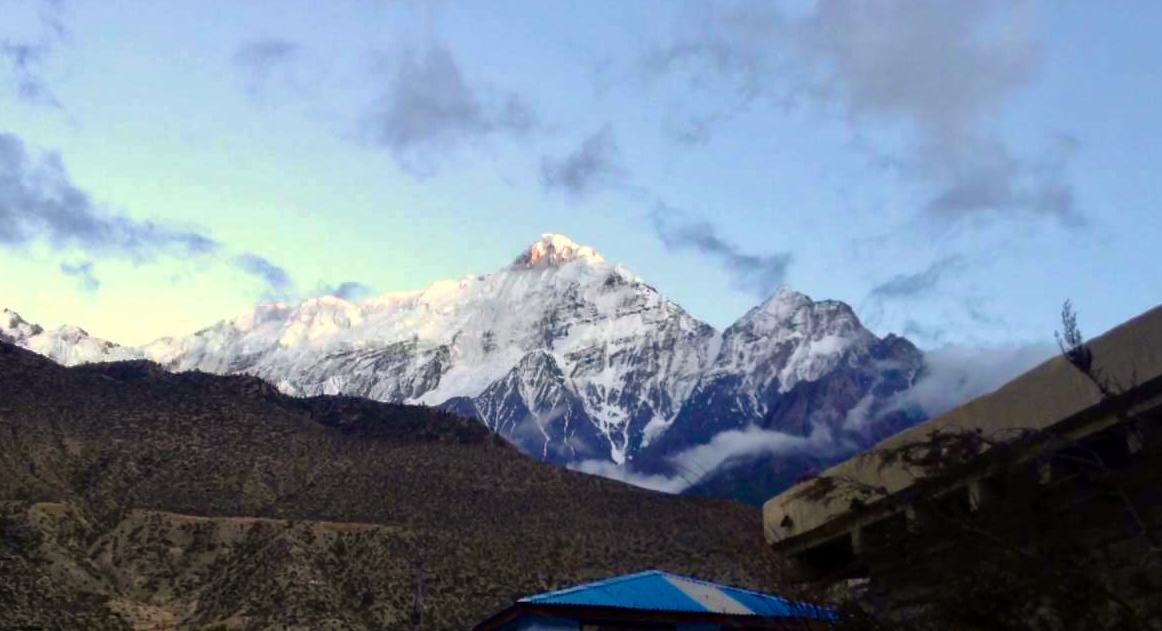
Morning. I push open the window and there above the town is Nilgiri beckoning. We’ll have to trek halfway around this mountain eventually so that from Muktinath we’ll see it from its back side. But not today. We’ll spend a leisurely period eating, drinking, and bathing in the hot springs, hoping we’ll be able to walk again come Tuesday.
October 4.
The Trail To Ghansha.
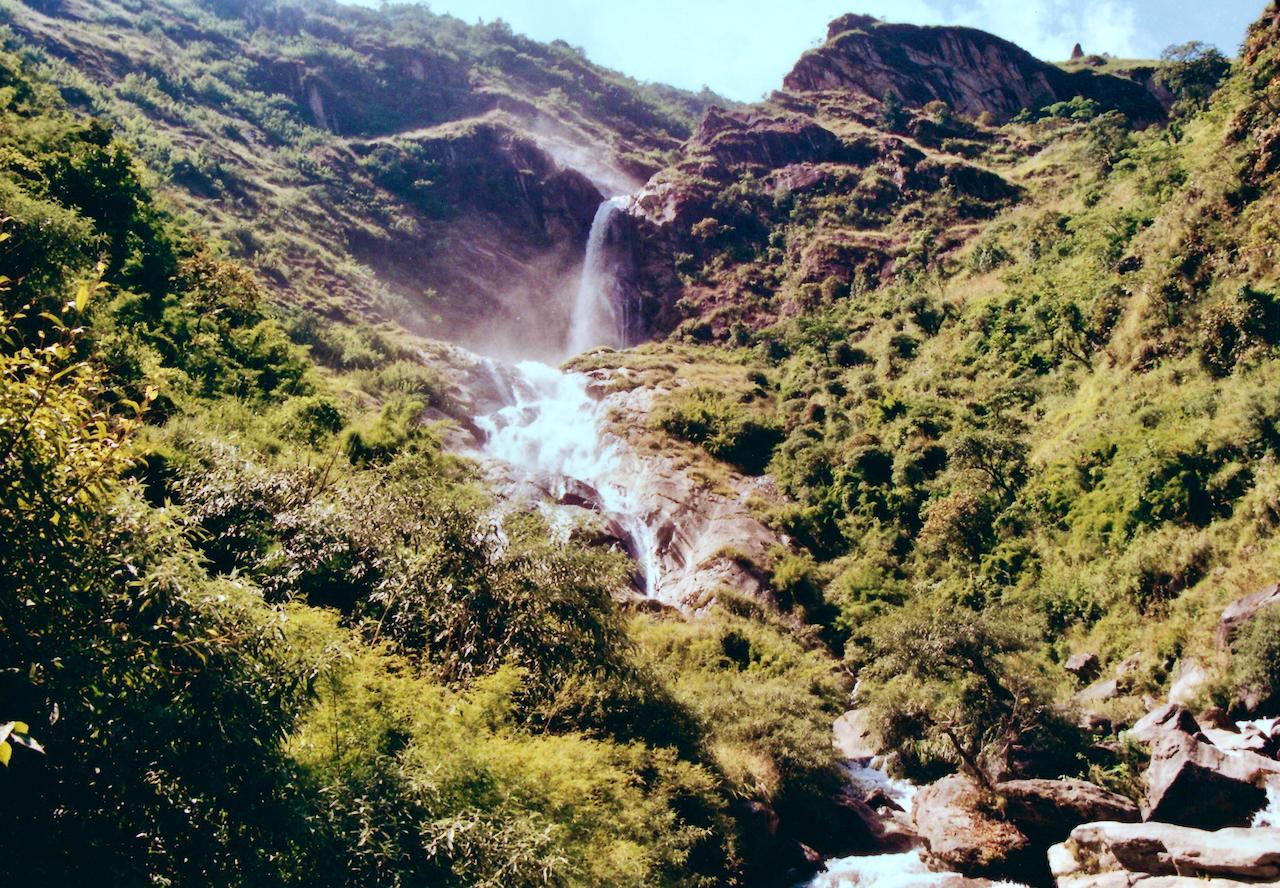
Two hours out, with Nilgiri at our shoulder we come upon Rupse Falls – spectacular ribbon of water cascading down from Dhaulagiri’s flank into the Kali Gandaki. Along our path just before the river crossing, Marcia stumbles, loses her balance and tumbles over the edge of the precipice. Even though I am only a few paces away, it happens so fast I can’t grab for her and can only watch helplessly. As Madu and I reach her side, she is clinging to the roots of a trailside bush and has one leg caught up in its foliage which has likely prevented her from tumbling into the river 100 feet below. I’m worried that she’s broken a limb as her leg is in an awkward position but she claims she’s fine, so we remove her backpack and pull her up to safety. She seems okay except for an extensive abrasion on her right side and leg to which she applies some topical ointment, dons her backpack and we continue on, fording the river to walk along its Eastern shore for a few kilometers.
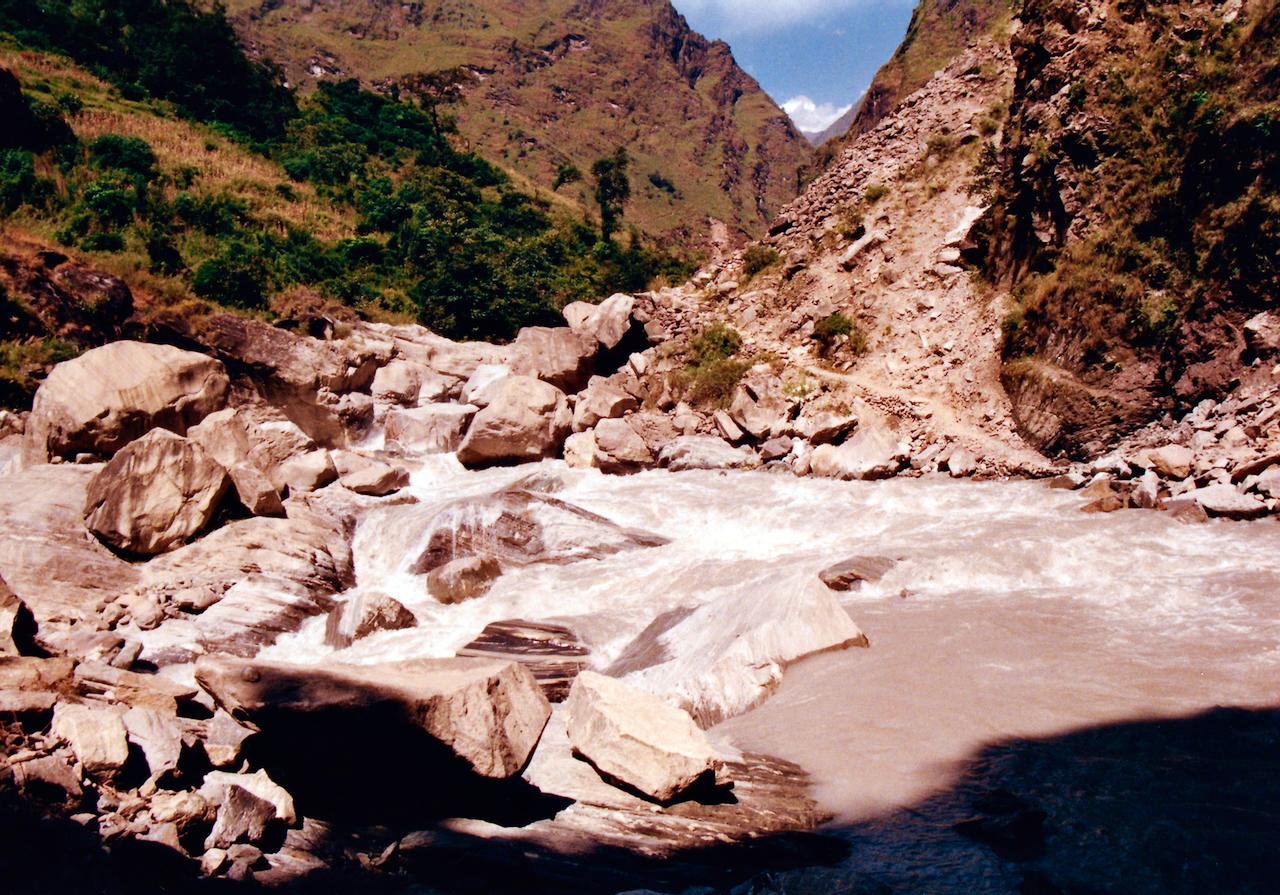
As the river cascades through a series of huge rocks on down towards Pokhara we come upon a basin which we must skirt around in order to ascend above these river falls. At times we must place one foot carefully in front of the other as our path along the soft limestone path is only a foot wide as it wends its way along the river’s edge. One false step and we could tumble into the torrent and we are reminded of the Nepali warning for those who go trekking along these canyons: “Bistarai, Bistarai” – slowly, slowly.
Slowly we make our way around the basin and climb higher and higher through pine forests until we are high above the Kali Gandaki. On the other side of the river we can view the trails that contour the opposing cliffs. It is a very steep, impressive, and dangerous gorge that cuts between Dhaulagiri and Nilgiri. This trip is long and the ascent – though not as steep as the one from Tikhedhunga to Ghorepani – it is still arduous. With our goal in site – the small town of Ghansha situated on a bluff above the West side of the river we come to an impasse.
We are on a narrow path – perhaps ten feet wide on the East side of the gorge. The river roars along some 100 feet below – the color of wet cement. Before us, queued up along the trail is a herd of perhaps 500 goats blocking both the trail and the bridge to Gansha beyond.
Behind us is a caravan of donkeys headed up the Thak Khola laden with trade goods. The lead shepherd is shouting at the caravan leader to move his animals back along the path to a wider area. The donkey herder insists there is plenty of room and won’t budge.
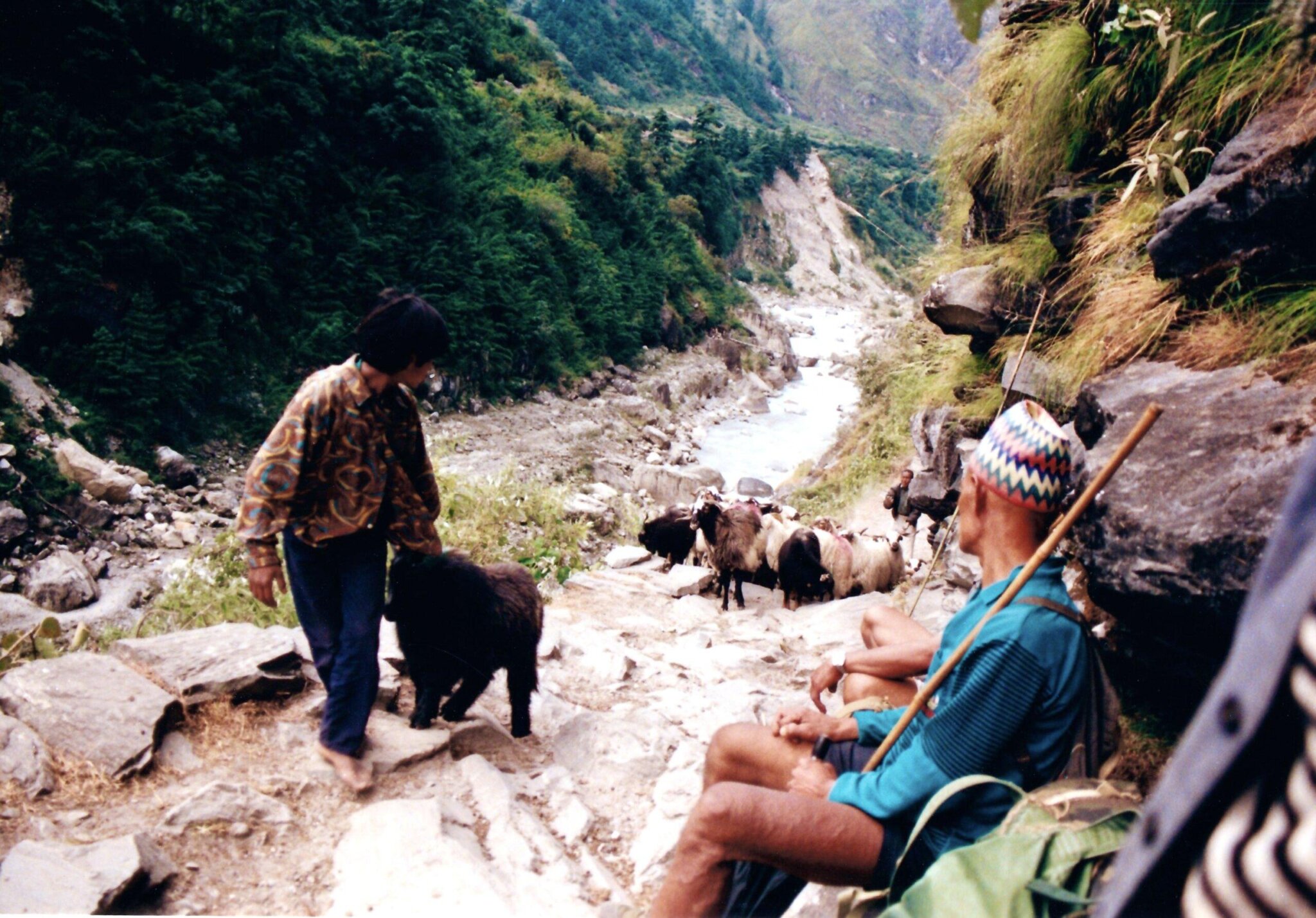
We’re caught in between – tired, hungry, and bemused at the scene unfolding before us. After much haggling in which we trekkers – including myself in complete frustration over the delay and a camera glitch – pitch in our two cents worth, we’ve moved back up the trail 100 yards or more so they can start the goats. Slowly the goats edge forward – a small boy in the forefront pulling a “lead” goat along by the horns, and by 10 minutes or so the goats have cleared the bottleneck and we’re free to move on. Marcia handles me with complete aplomb and I feel pretty much like a jerk for losing my cool and vow to do better.
Evening is spent at dinner visiting with fellow trekkers from L.A. – two hard drinking belchers away from their wives for a few weeks named Ed and Tom – the latter it turns out is an Ultramarathoner – who runs up to a hundred miles per day. We wonder how his porter or anyone can keep up with him. Many good laughs before bedtime.
October 5.
Tukuche.
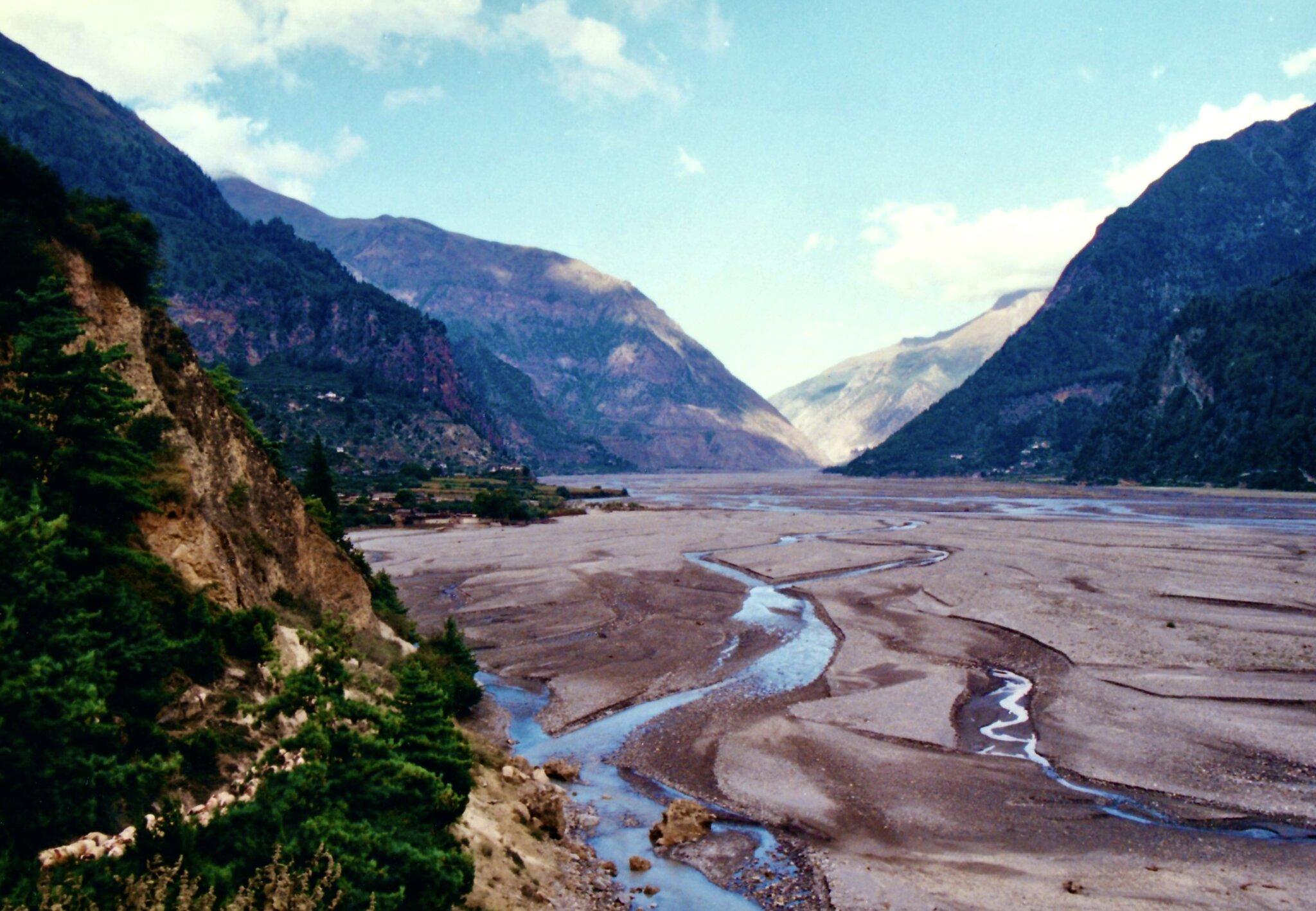
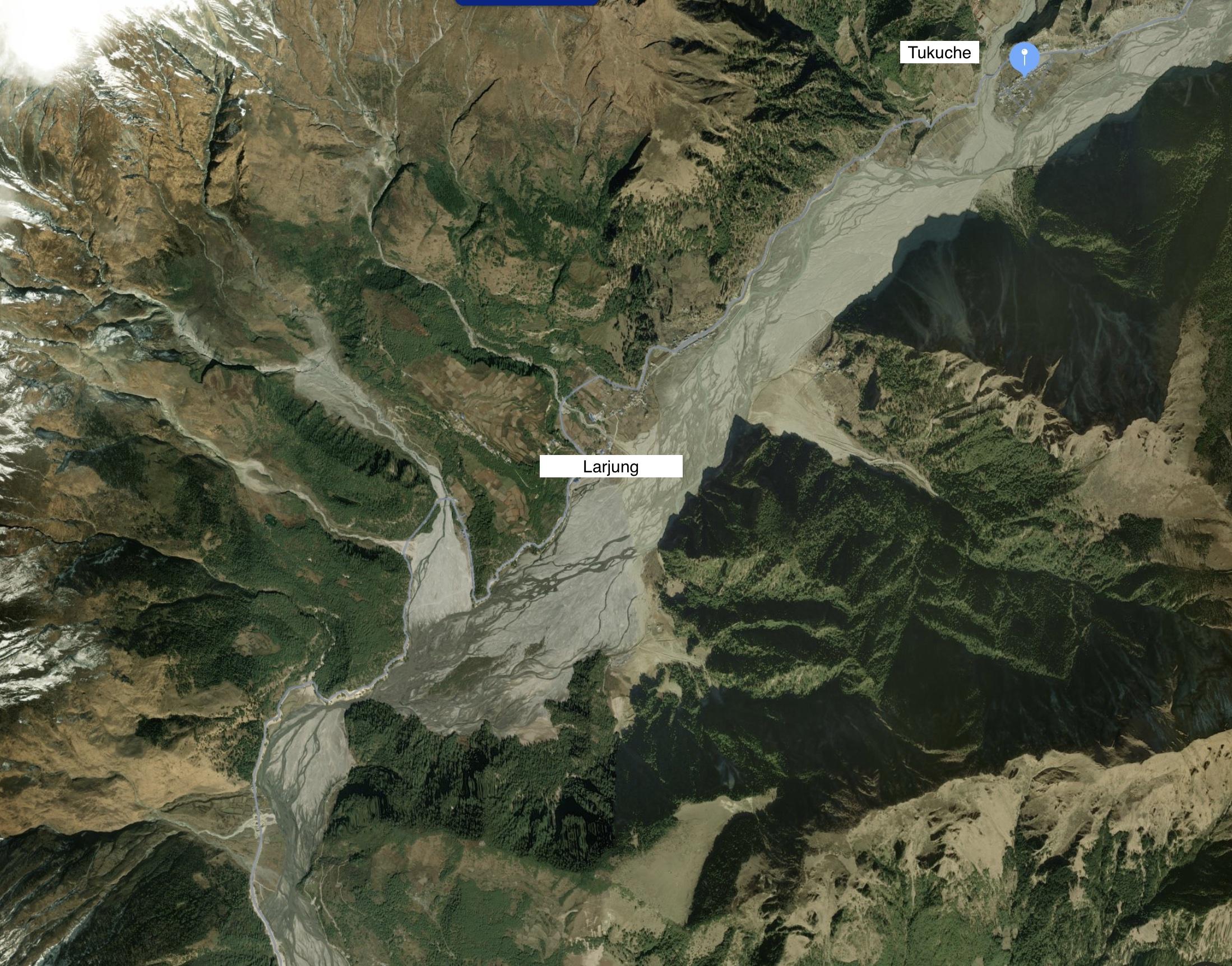
A gradual climb through the day through pine forests and changing topography. The mountains – Dhaulagiri & Nilgiri Himal – are hidden most of the time by clouds and there is a definite bite to the air as if we’re being chased by a beast with a cold breath. We stop for lunch in Kalopani, a small village in the apple district, to have a piece of an apple crumble pie with custard that is out of this world. We are tempted to stay but our goal is the Muktinath Temple plus we need to secure tickets in Jomsom for our flight back to Pokhara as well so we push on towards Tukuche.
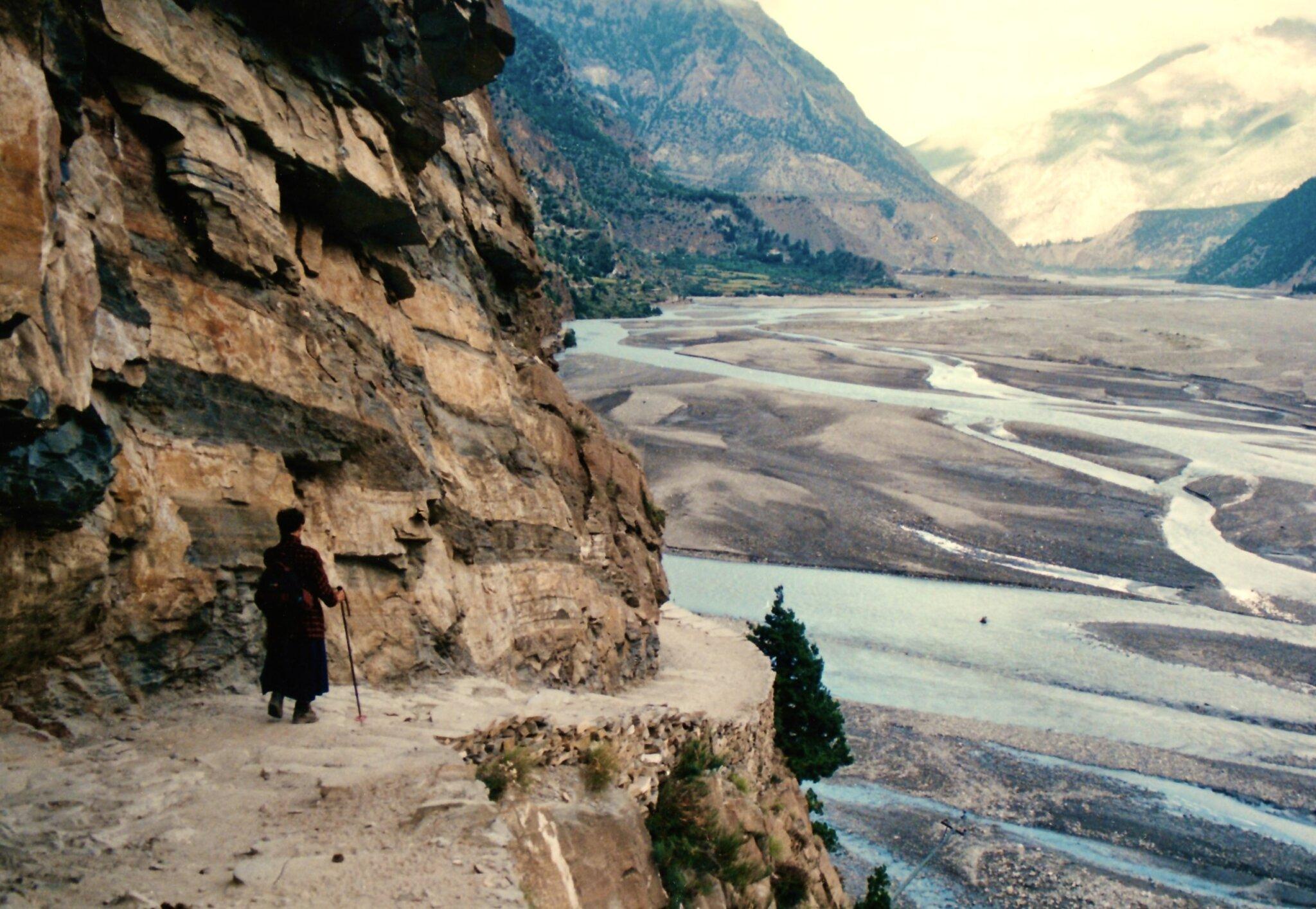
The weather begins to turn much cooler as we descend to the Kali Gandaki river bed. Just before Larjung, we cross a small bay formed by the main river and a tributary. Suddenly we realize that we’ll have to shed our boots and roll up our trousers to wade across several streamlets. I’m a bit squeamish about wading barefoot into sandy bottomed Lake Huron let alone a mountain stream but I finally succumb to the inevitability of getting my feet wet in glacial waters – and they indeed turn out to be just that.
 But that wasn’t the worst part. The ghastly part was the sharp rocks that you kept stubbing toes and pinching the soles of your feet on. Once again Marcia seems very entertained handling my duress with great humor and joy. I, on the other hand, proceed on, grimacing, screaming, and clawing my way through the stream. At one point the current is very swift and Madhu – my porter – has to grab my hand to steady me. Finally I am able to beach myself – with an expletive of course – again to Marcia’s amusement – and am rewarded with a a series of hugs and kisses – all for the little boy who tends to throw tantrums to get around Life’s obstacles. After a few seconds I too am laughing at the top of my lungs. A small crowd which had gathered to watch the theatrics shouts its delight as well. “Should I go out again so you can all get a picture?”, I ask. But I really don’t want to do an encore since my feet are red with cold and sore to boot. Maybe if there were fewer rocks.
We don our boots and set off for Tukuche where we find an excellent inn with great food and hot showers.
October 6.
On to Jomosom.
We wake early to a warm breakfast of porridge and milk tea [pronounced “milik” by the local innkeeper – a woman of Tibetan-Thakali descent with five children]. “I don’t advertise my lodge,” she says. “My customers tell others how good it is.” Although the trekking season is still a few week away, it seems clear that she’s worried about the lack of trekkers staying at her lodge. This morning there are only Marcia and I and a Frenchman who intends on ascending Thorong La Pass from the “hard” side and alone! And he claimed to be a seasoned Pyrenees climber – so who were we to give him advice.
There is a decided bite to the air as we step out onto the street and stretch our aching muscles. We meet a group of German trekkers exiting the lodge across the lane and one of them exclaims: ” They’ve a yak in the stable here!” Now this is one of Marcia’s fondest wishes – to be photographed next to a living yak. The innkeeper then leads our excited group through several doors and into a stable. We peer around and at first glance see only a cock and a few chickens but no yak. Then lurking against the dark back wall we can barely make out a shaggy black shape – resembling more a large flea-bitten dog than a yak and appearing to be a little the worse for wear – is what the landlady loudly claims to be the only stuffed yak in Tukuche. We all break our in laughter. A good joke is a great way to start the day’s journey.
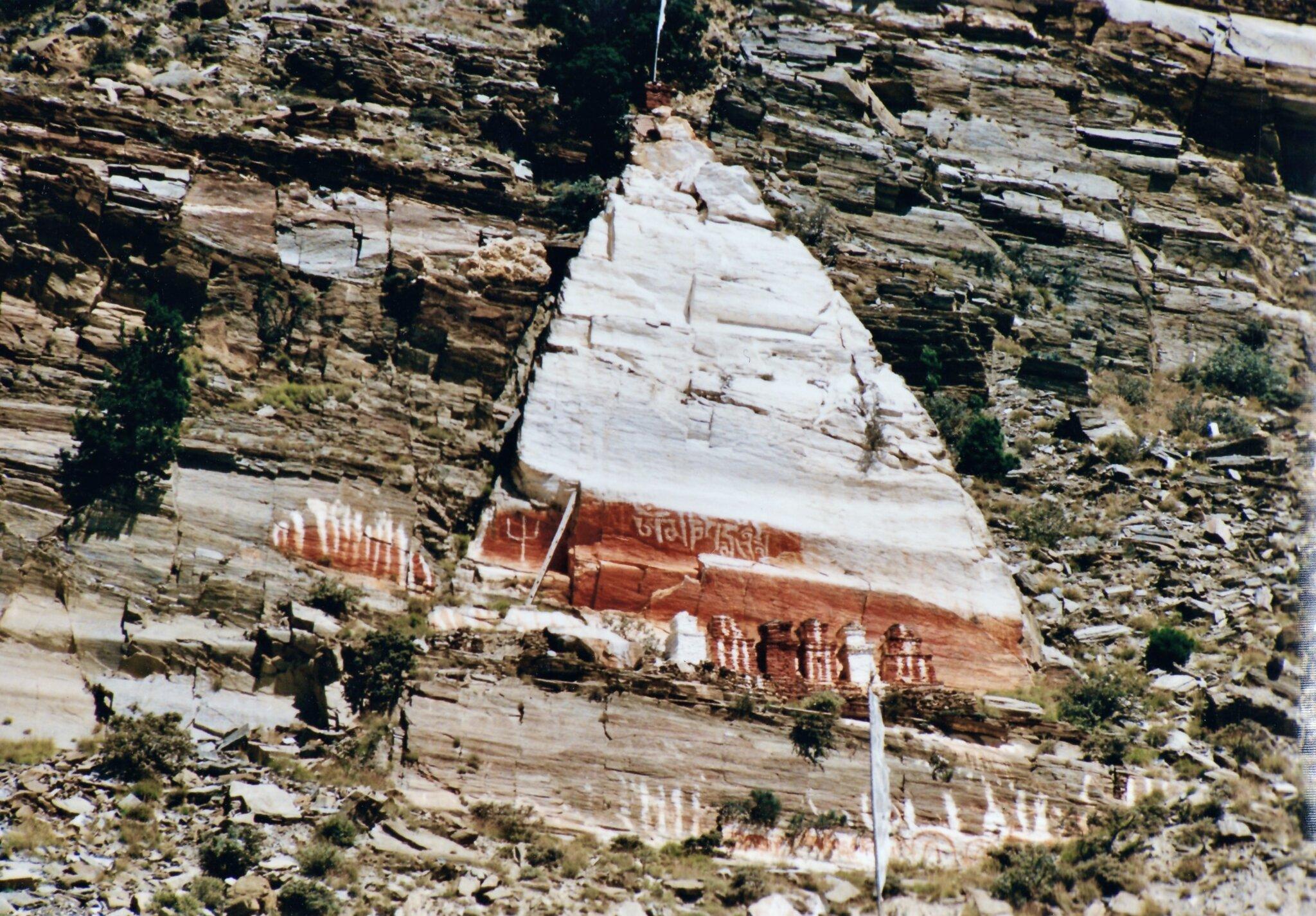
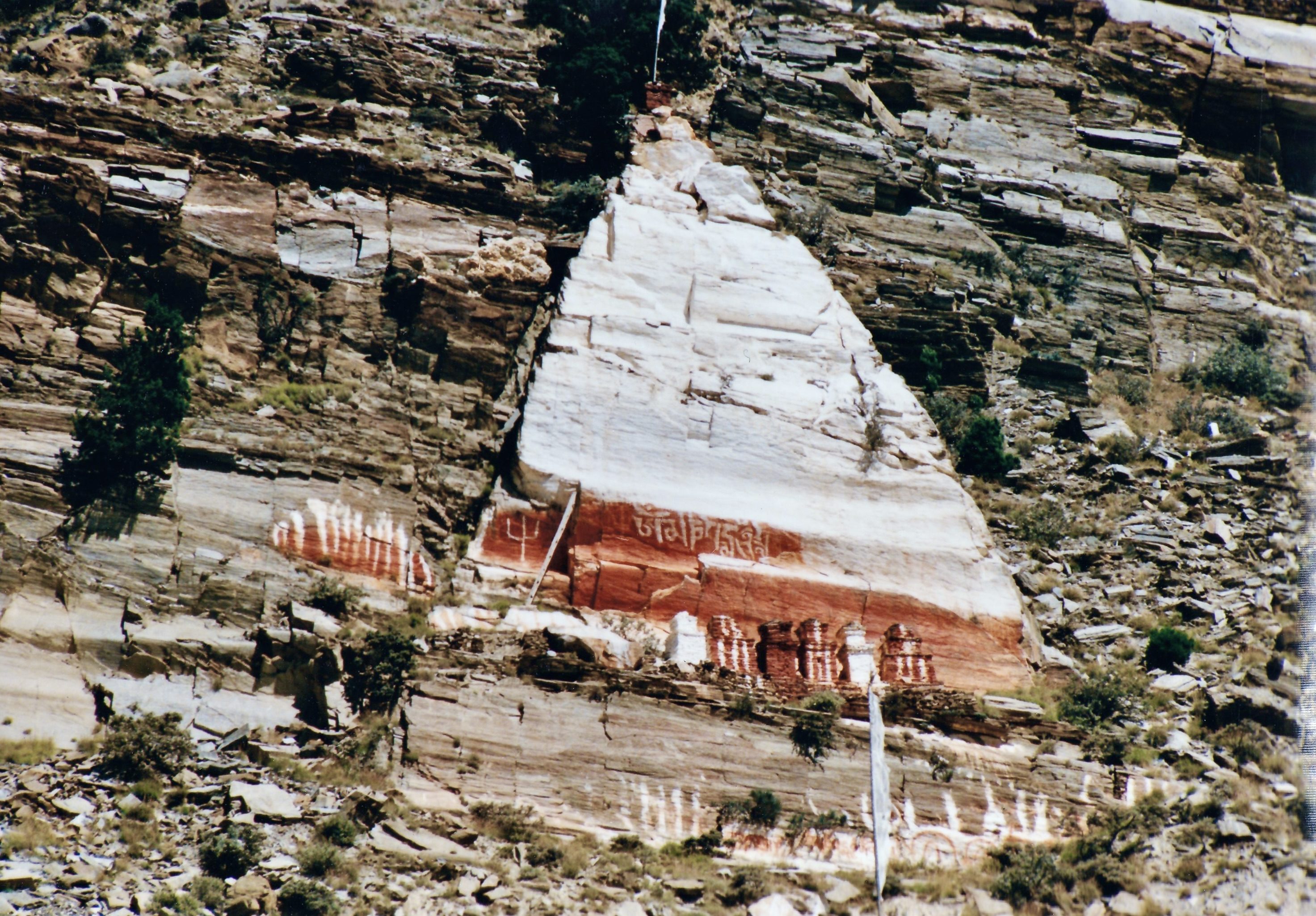 Leaving Tukuche we closely parallel the Kali Gandaki wending our way North through several small villages including one with narrow main streets and buildings built close to each other with a series of tunnels. It is here we huddle, shielding ourselves agains the howling afternoon winds. Then it’s on to Marpha with its painted Buddhist chorten situated high on a hill above town. We stop to sample more milk tea and apple pie.
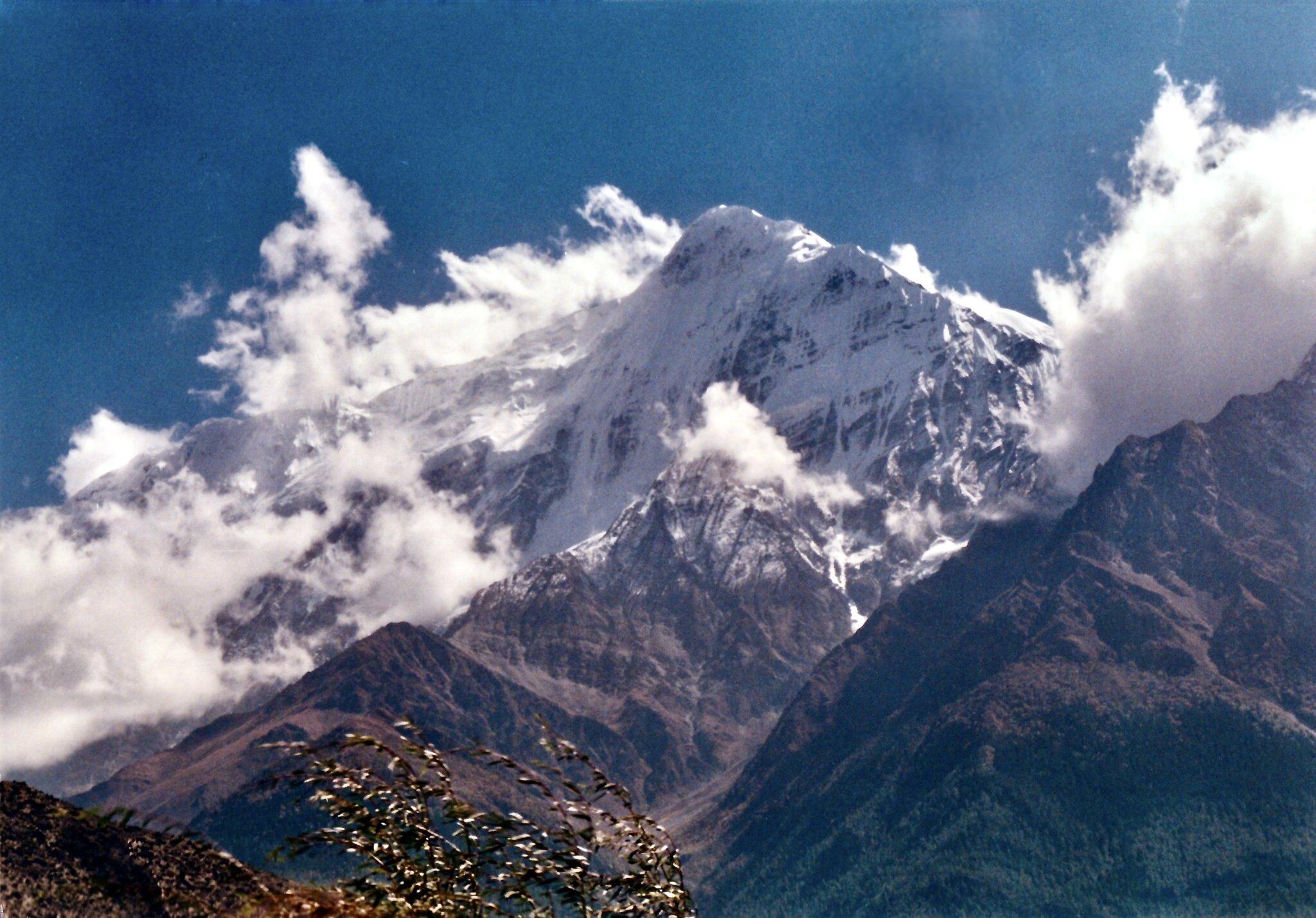
We leave Marpha and again venture out onto the river bed where the wind picks up – howling at our backs. The sky is clear and on our right as we head North, above the clouds looms Nilgiri, a three-pronged crown of white.
Entering Jomosom we find it a wind-blown assembly of hotels and lodges that border one side of the runway to the STOL airport. We book into the Moonlight Lodge for some more tea and potato curry. Marcia opts to hang out in the main dining area while I make ready to turn in. Then an old man accompanied by a young girl enters and begins singing Hindu folk songs – accompanying himself on a stringed instrument, the young girl’s voice lifting high above his. Such sweet music. But my body is tired and I re-tire.
Later Marcia enters our room very excited. It seems a Japanese expedition to summit of Dhaulagiri has just arrived, in fact earlier we’d seen a man who seemed either drugged or asleep on his feet. By accounts that very man together with two sherpas had summited two days before. But one sherpa had fallen two thousand feet and was in serious condition and had been helicoptered out of danger to a Kathmandu hospital. She’d also talked with to liaison officer [a Nepali] for an American expedition to the same peak. Half the party of four had made it to the summit and the other half was still waiting to try. I knew she’d get to the bottom of all of this. Brava!
October 7.
Jharkhot.
Next morning after a “hardy” breakfast of potato pancakes and milk tea [Nepali tea in some circles – usually prepared with ginger and cardamon seed with suitable sweeteners] we set off in the direction of Kagbeni, a windswept village that is the stepping off location for expeditions to Mustang a district of Gandaki Province bordering on Tibet that was once known as the Kingdom of Lo Manthang and is still a restricted area today. According the the Wiki, the name “Mustang” is derived from the Tibetan word meaning, “Plain of Aspiration.”
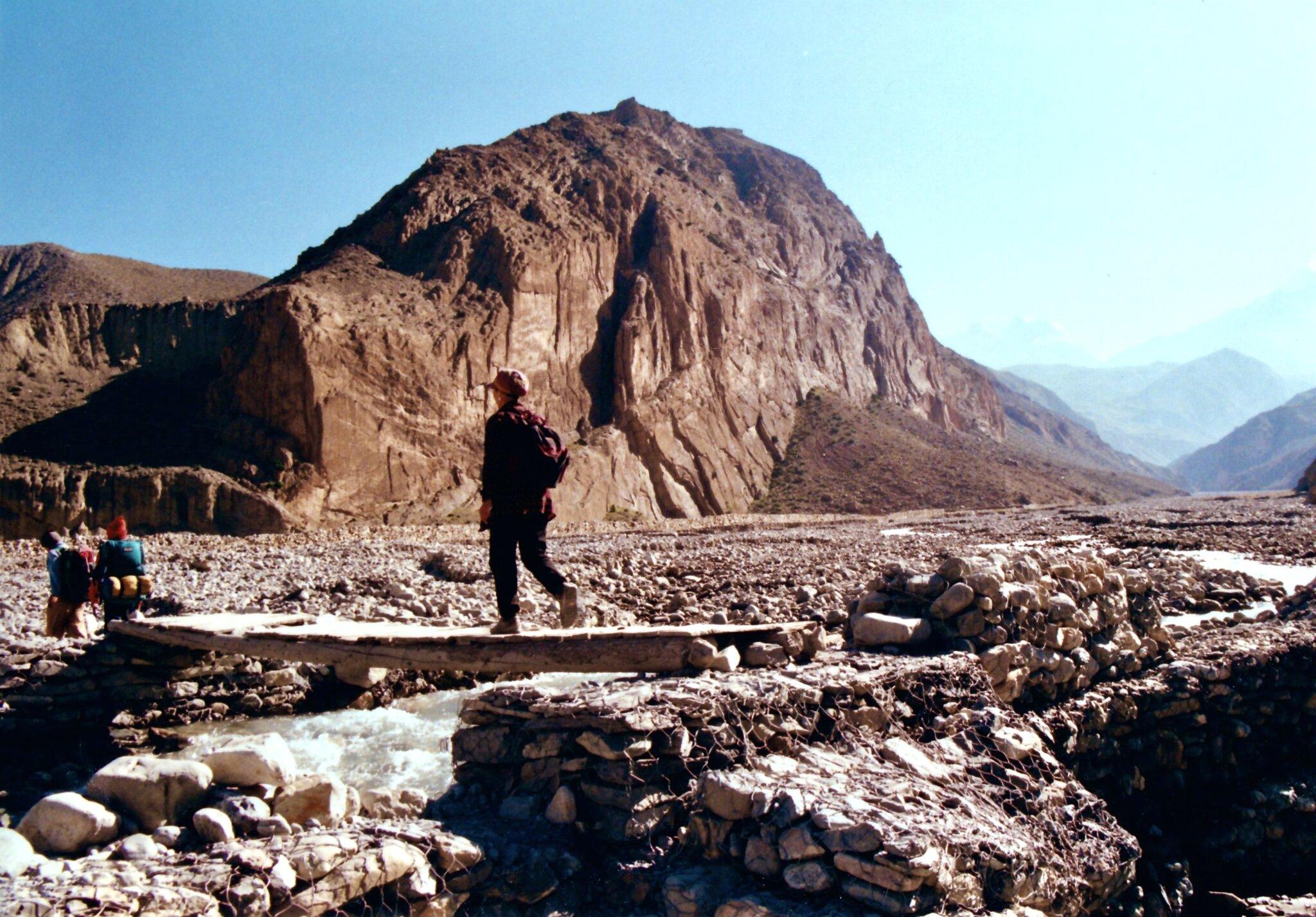 Leaving the outskirts of Jomosom we traverse down to the gravel river bed of the Kali Gandaki once more only this time it is only us and our guides Madhu and Tatsu with the river bed and the mountains on either side – stark in their beauty exhibiting subtle shades of brown, beige, black, and green. The only sounds are our footfalls on the loose gravel, our labored breathing, and the rush of the nearby river.
Soon Marcia spies a flock of birds overhead – big birds, swirling and swarming – calling to each other. They sound like geese or cranes. They are gone before we can even get a picture – besides they’e too high up for us even at nine thousand feet. A half hour later, Marcia stands transfixed – in a trance or mesmerized by some vision – immobilized by an external power. I look around.
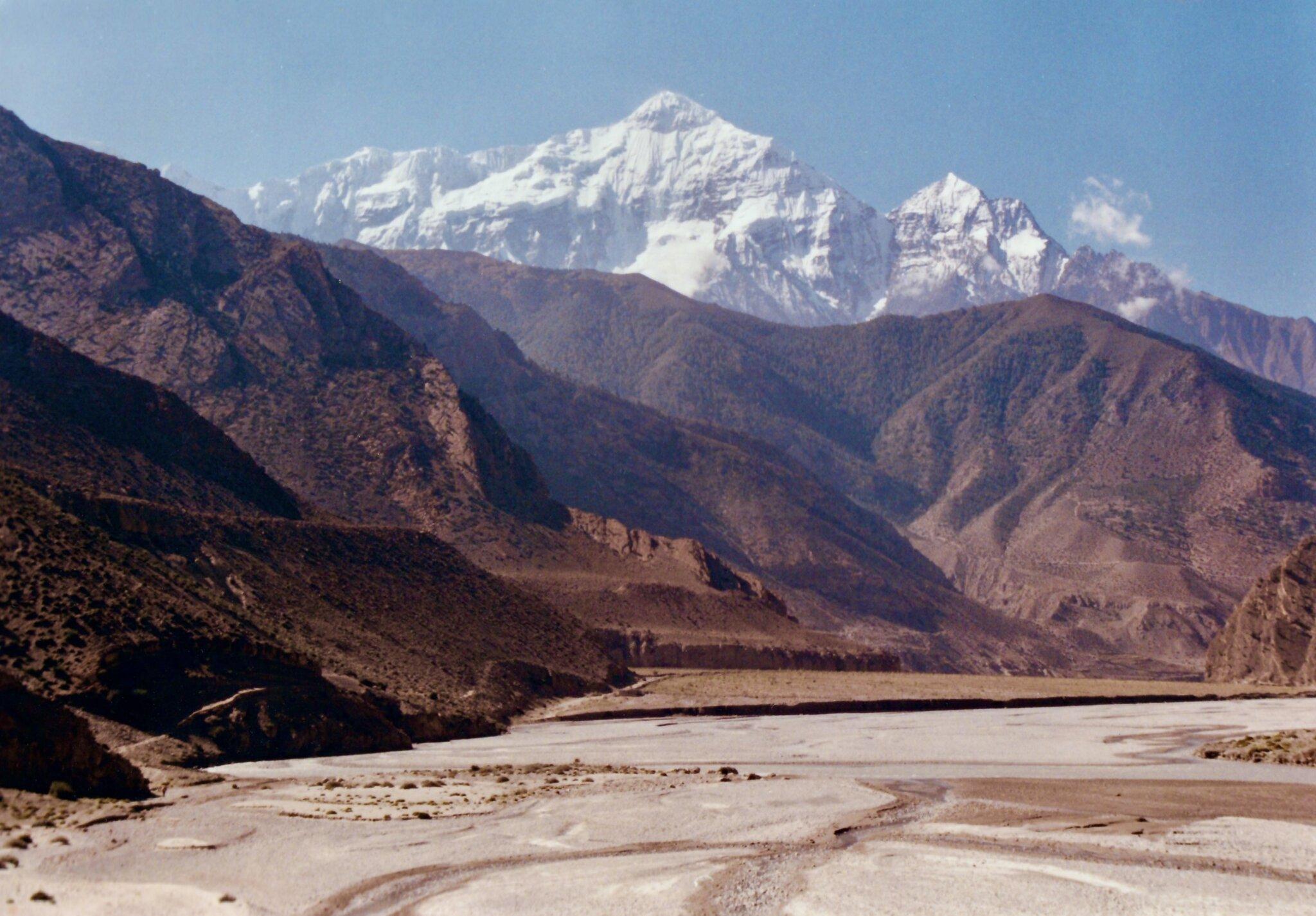 To the Southeast, the tip of Nilgiri shimmers in the morning light, skirted by dark hills. To the Southwest, Dhaulagiri and Thapa Peak loom translucent. To the West are hills brown and beige skirted by whorls of sedimentary layers of earth. To the North the river snarls down from Tibet interweaving its many silvery tentacles along its stony bed. What is it about this place?
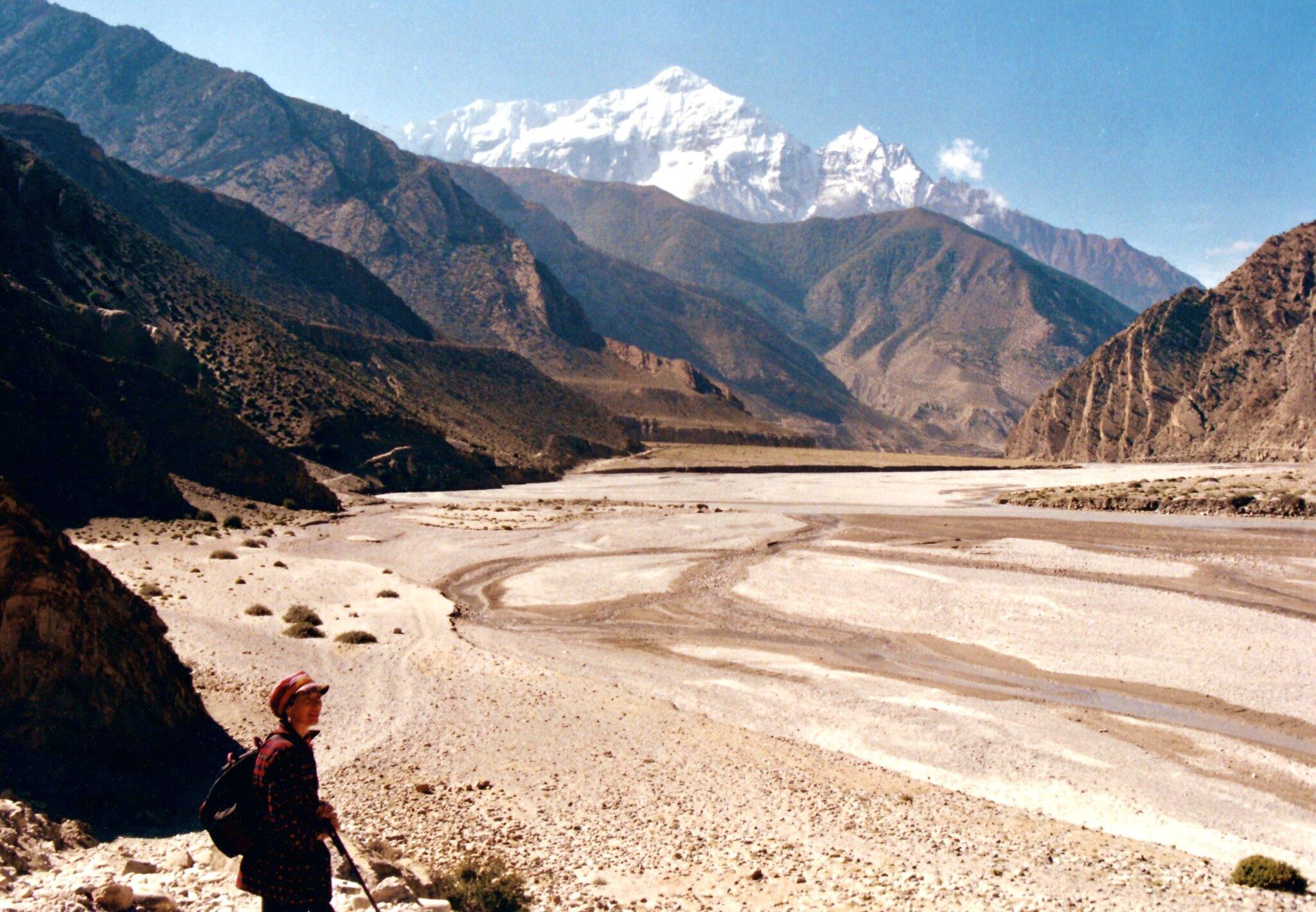 To my left I see a Buddhist chorten – two supplicants prostrating themselves in devoted prayer. My eyes shift back to Marcia. She is like a statue. I point to the chorten and call out to her. She turns her head – sees the shrine and utters an exclamation. Slowly she makes her way over to me and with each step a penumbra radiates from her – more vivid and vibrant with each step. It is her aura – white tinged with cerise – her favorite color [at least the color she wears and mentions the most]. Closer and closer she comes – her aura growing in size until it becomes a part of the landscape itself. “This is a place of great power”, she exclaims. I tell her what I had just seen and we both stand in silent wonder – then embrace.
An hour later we are at the trail head to Kagbeni. The plan had been to spend the night there, then proceed to Muktinath in the morning because of my knee and a nasty blister that has developed on my little toe. But I feel good and the day is young so we decide to bypass Kagbeni in favor of Jharkhot – the old fortress portal to the holy shrine of Muktinath situated just below Thorong La Pass to Manang.
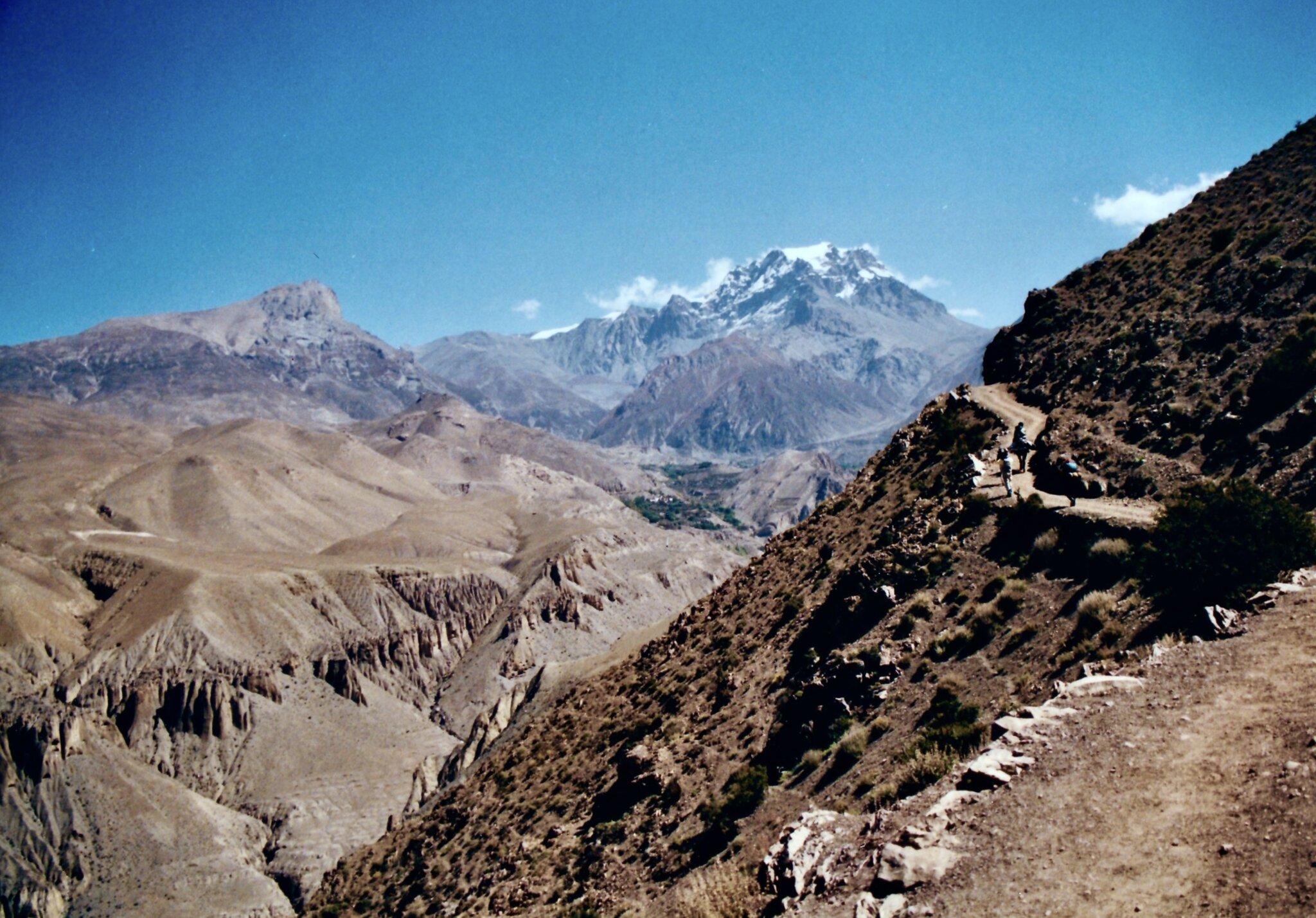 After more “Nepali Tea” we set off – up, up, and up. First through scree strewn from cliff rockslides, then a winding trail offering breath-taking vistas of deep ravines slicing through arid mountain passes. In the distance we can still hear the river, relentless in its descent . Breathing is getting harder even though our ascent has been gradual. We’re at Twelve Thousand feet and climbing and our legs are getting tired. Even Tatsu and Madhu are feeling the altitude.
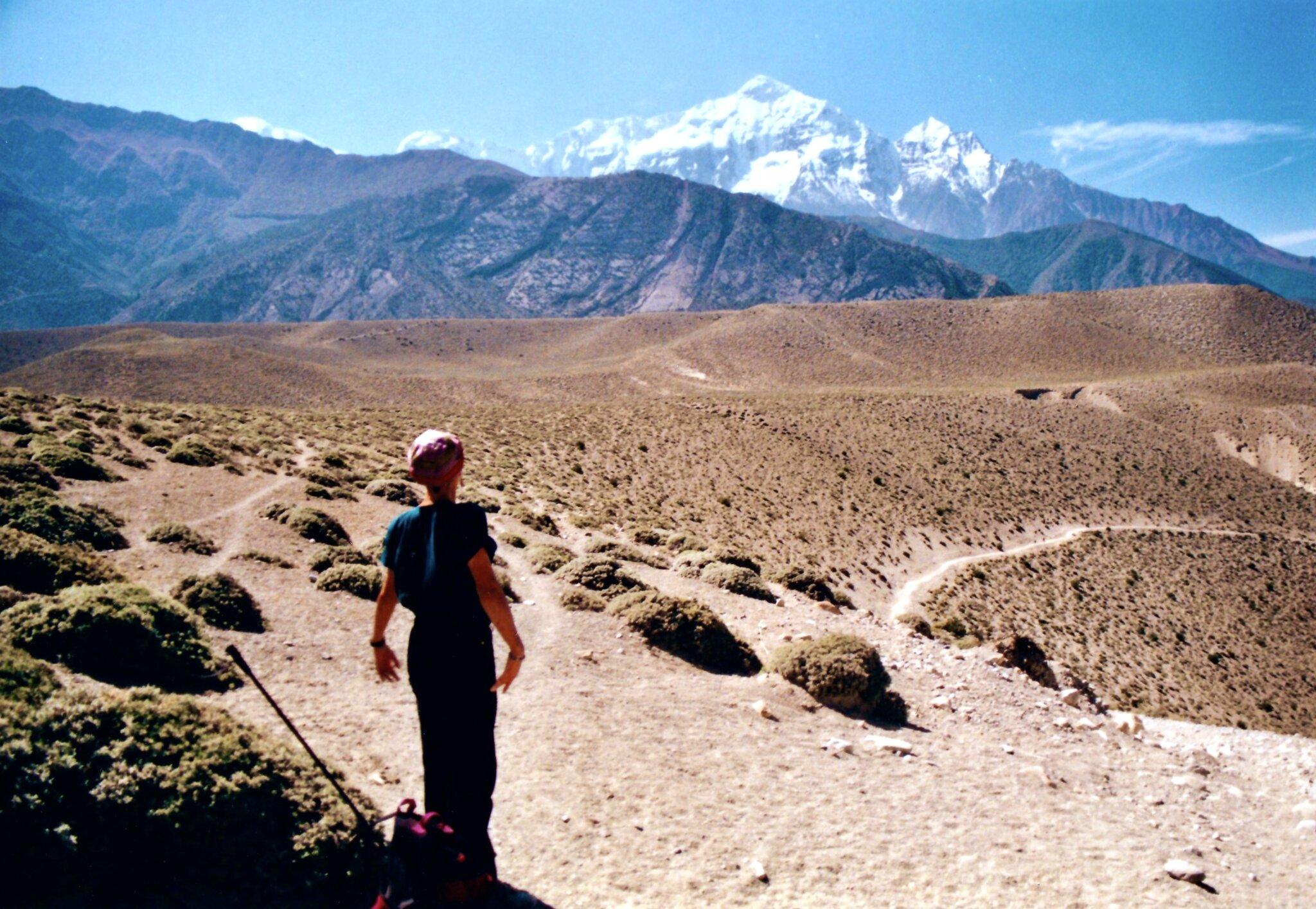 We top a hill and ahead we get a glimpse of Jharkhot – close, or so it seems. Marcia celebrates by performing a few Continuum dance moves – much to the delight of several Nepali women – pilgrims descending past us from Muktinath. But the trail is deceptively steep and the ascent long and arduous. Jharkhot seems no closer and we are nearing exhaustion.
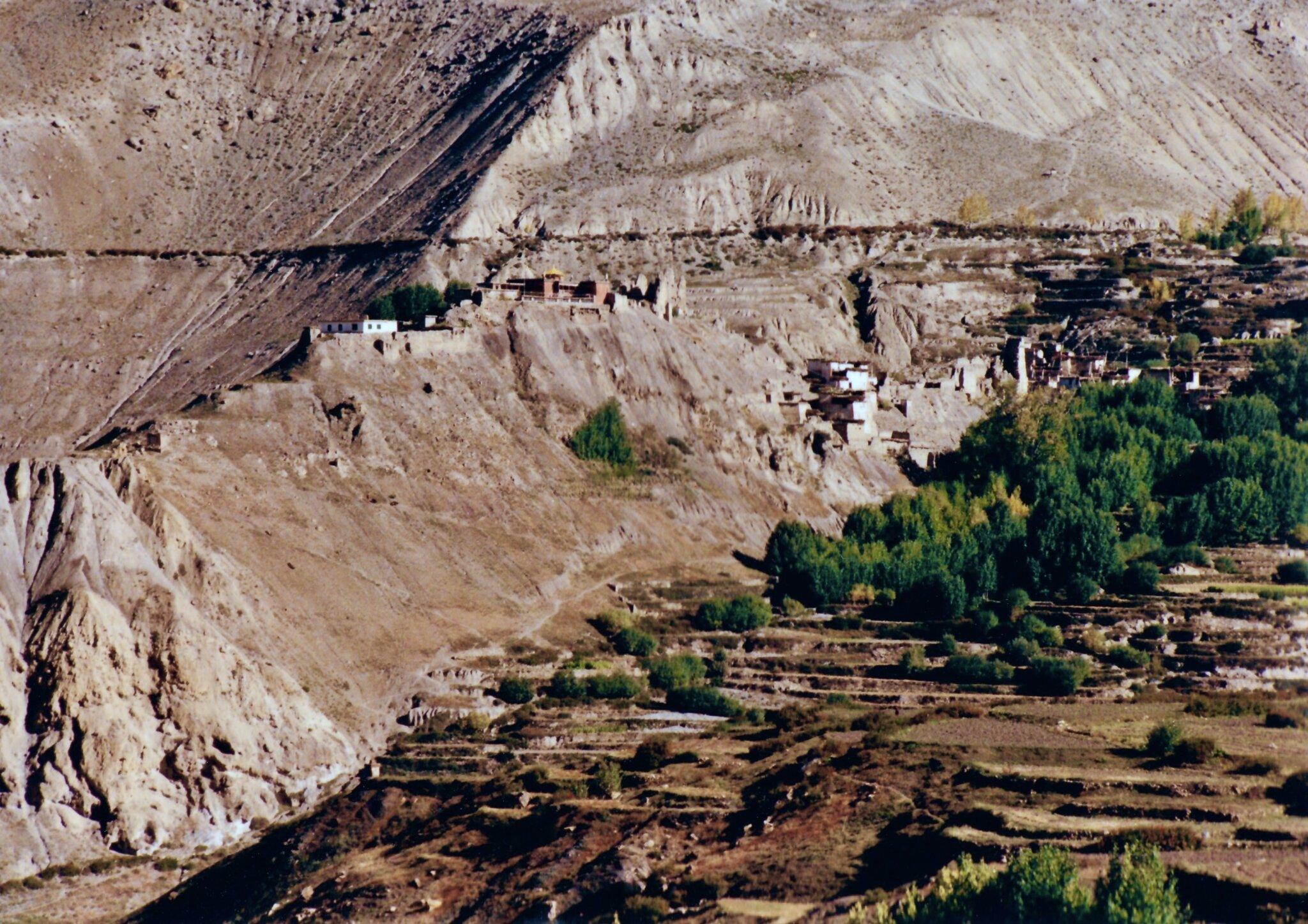
The village is situated on a mesa – at the highest point of which stands a Buddhist temple painted a dark red which appears to have a tower circumscribed by the ruins of what appears to be an ancient fortress. Surrounding the village are farmlands, terraced up nearby hillsides and mountain slopes where millet and rice grow. To the East we observe what seems to be a sprawling monastery (abandoned we later learn) and to the Northeast Thorong Peak hovers over Muktinath, our sacred destination.
Exhausted, we stop at the first inn we come across. I can’t even make it up the stairs to inspect the accommodations so Marcia obliges. She finds them likable largely because of the sunny exposure, the large double windows, and because they have a solar powered shower [Yes! In Nepal in 1994], the first since Tikhedhunga. We take our ablutions then have tea on the roof overlooking a portion of the trail we’d just ascended.
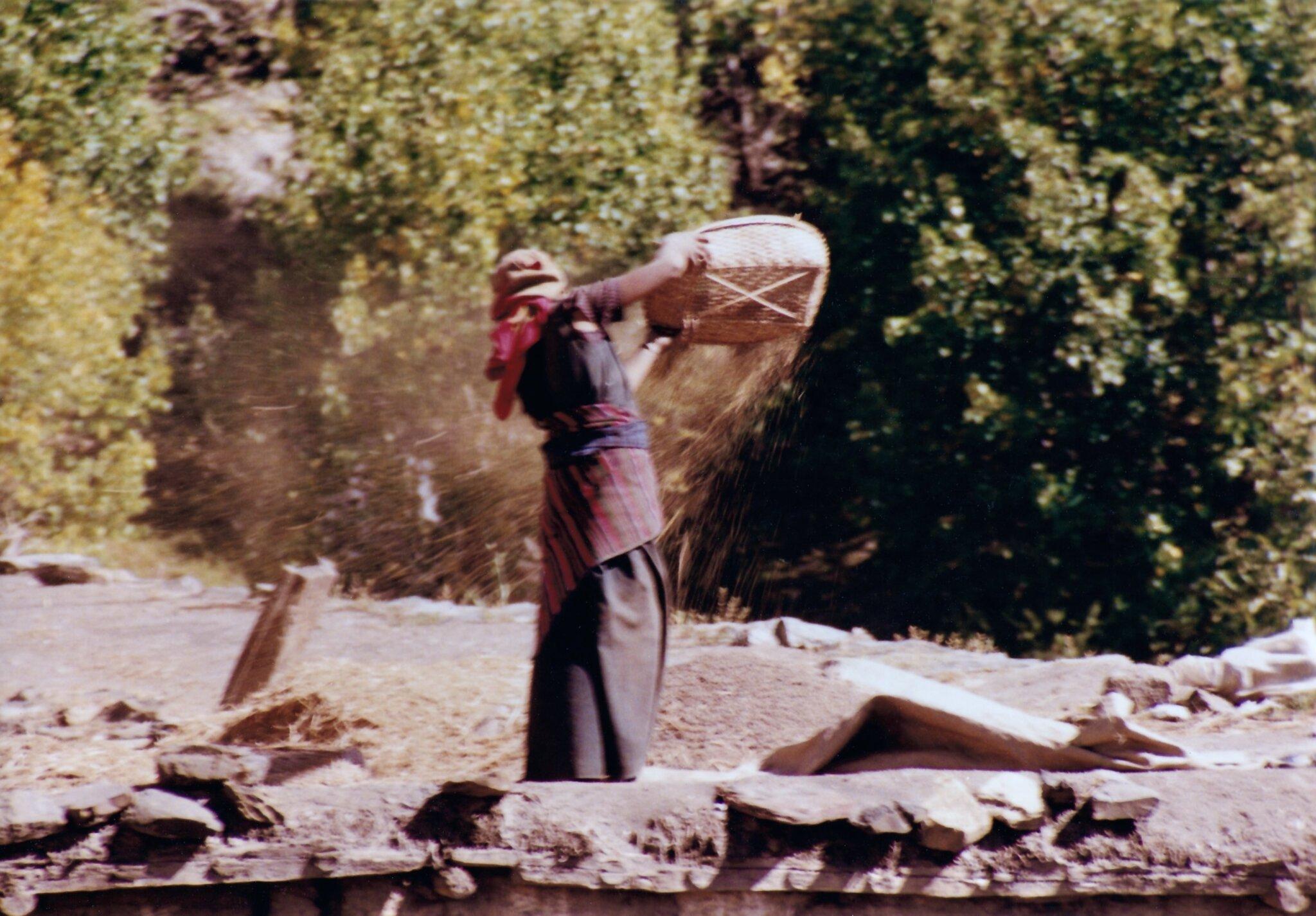
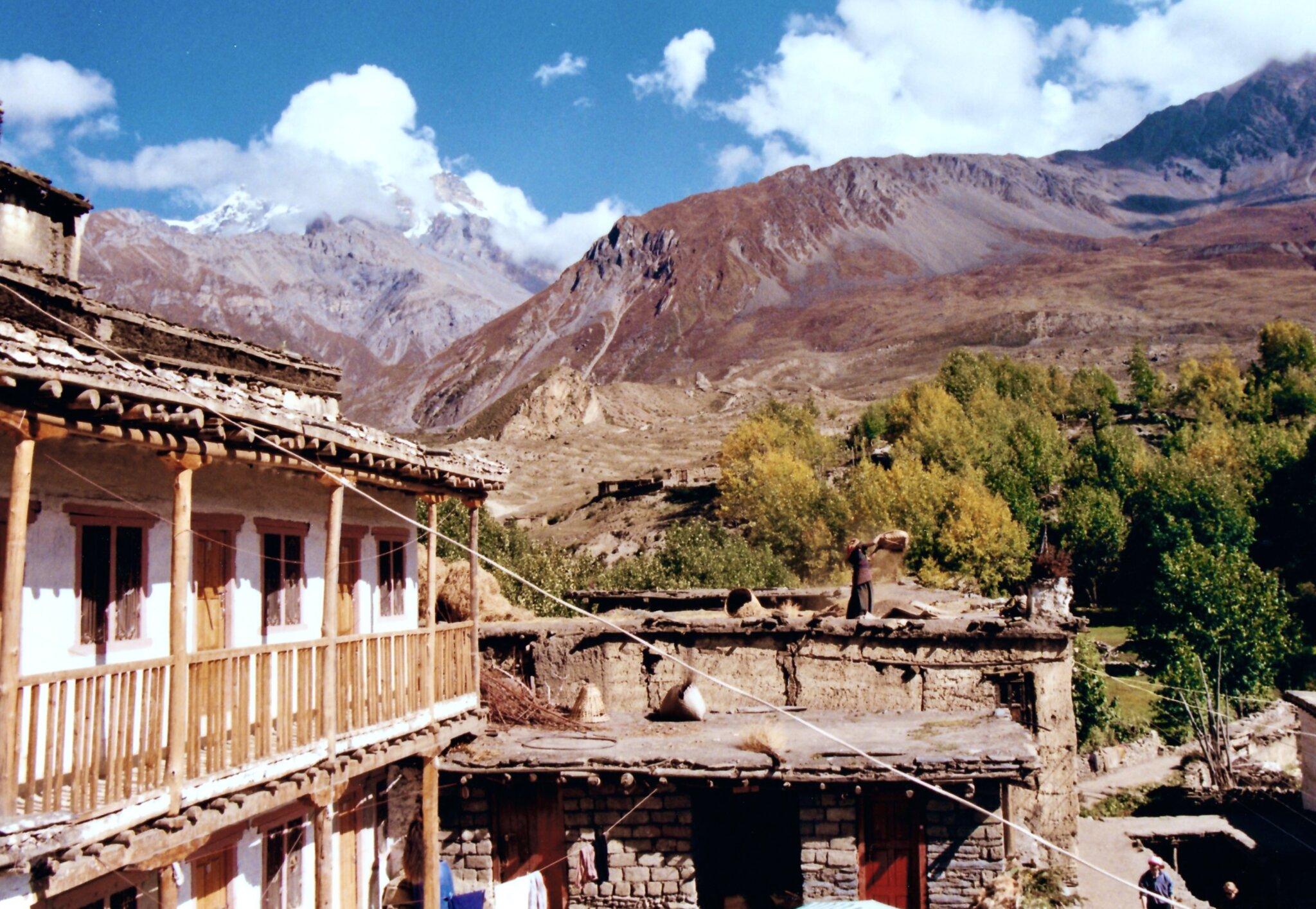
On adjoining rooftops – women thrash millet and work with hand looms. Much of the everyday life here appears to be what it always was – right out of antiquity. We plan a tour of Jharkhot tomorrow after visiting Muktinath. The inn fills up rapidly and we spend some time with a German couple who will be scaling Thorong La in the morning.
Also, a young woman whom we met in Ghansa with the two “boys” from L.A. is also at the hotel. Evidently her “partner” decided to turn back at Jomosom – leaving her to go it alone to Muktinath. She plans to dash up to the temples then trek all day back to Tukuche to catch him – a LOT of walking in one day even if all downhill. Marcia and I marvel at how adversity seems to bring out the “real” side of people – maybe not “real” but perhaps “inner” or “complete”. We wonder what this portends for future of this couple. Her male friend doesn’t seem to be committed – at least to the same things as she.
However, the evening does turn out to be a jolly one, shared with fellow trekkers as we recount our stories and experiences from along the trail. The Ulleri Steps with porters toting telephone poles; Poon Hill; Tatopani’s hot springs; some brushes with disaster; The Great Stuffed Yak of Tukuche; the winds of Jomosom – all tales of Himalayan Trekkers – a “club” which we’ve all become recent members of [some 20 thousand adventurers trek the Thak Khola each year we come to learn].
Sleep comes fitfully, as with the altitude [13 thousand feet] breathing becomes increasingly more difficult for me – sometimes taking all of my strength.
October 8.
Muktinath.
We start out this morning determined to take our time and enjoy the experience. An exploration of Muktinath – a Vishnu temple sacred to both Hindus and Buddhists – is one of Marcia’s personal as well as spiritual goals for this trip and I am acutely aware of how motivated she is to reach the temple. So I am just as determined that sore toe, gamey knee, altitude, and shortness of breath not withstanding, we will make it happen.
On the way up we run into Tom, our erstwhile UltraMarathoner whom we had met earlier along the trail. Single handedly he has run through at least two porters, one friend [Ed], and perhaps even one wife on this trek alone, and is still burning the soles of his sneakers on the barren Thorong La terrain. It seems he started this morning in Kagbeni, rocketed up to Muktinath and part way up the Thorong La Pass and is on his way back down to Jomosom then ultimately back to Pokhara by STOL aircraft.
We’d bought our tickets to Pokhara back in Jomosom as well but are unsure whether we’ll be able to get seats on the small STOL airplanes that fly in and out at limited times. Those limits are set by the topography – a narrow wind-blown pass located on the skirts of Nilgiri Himal which overshadows the airstrip; the high winds – over 25 knots by 10 AM; and the weather – all three of which tend to limit the frequency of flights each day. Plus there are no facilities [in 1994] for night landings.
So our discussion with Tom centers around how and if we’ll all be able to get out of Jomosom [including our porters Madhu and Tatsu] plus any news we’ve had of Ed – Tom’s estranged “partner” [we’d left him back in Kalopani eating his apple crumb pie]. Continuing to gripe about everything, including the terrain, Ed, his porters, and his wife, Tom gives us a wave and he’s off down the hill. “Obsessive” is Marcia’s only remark. Being a marathoner herself she recognizes an addictive personality when she sees one.
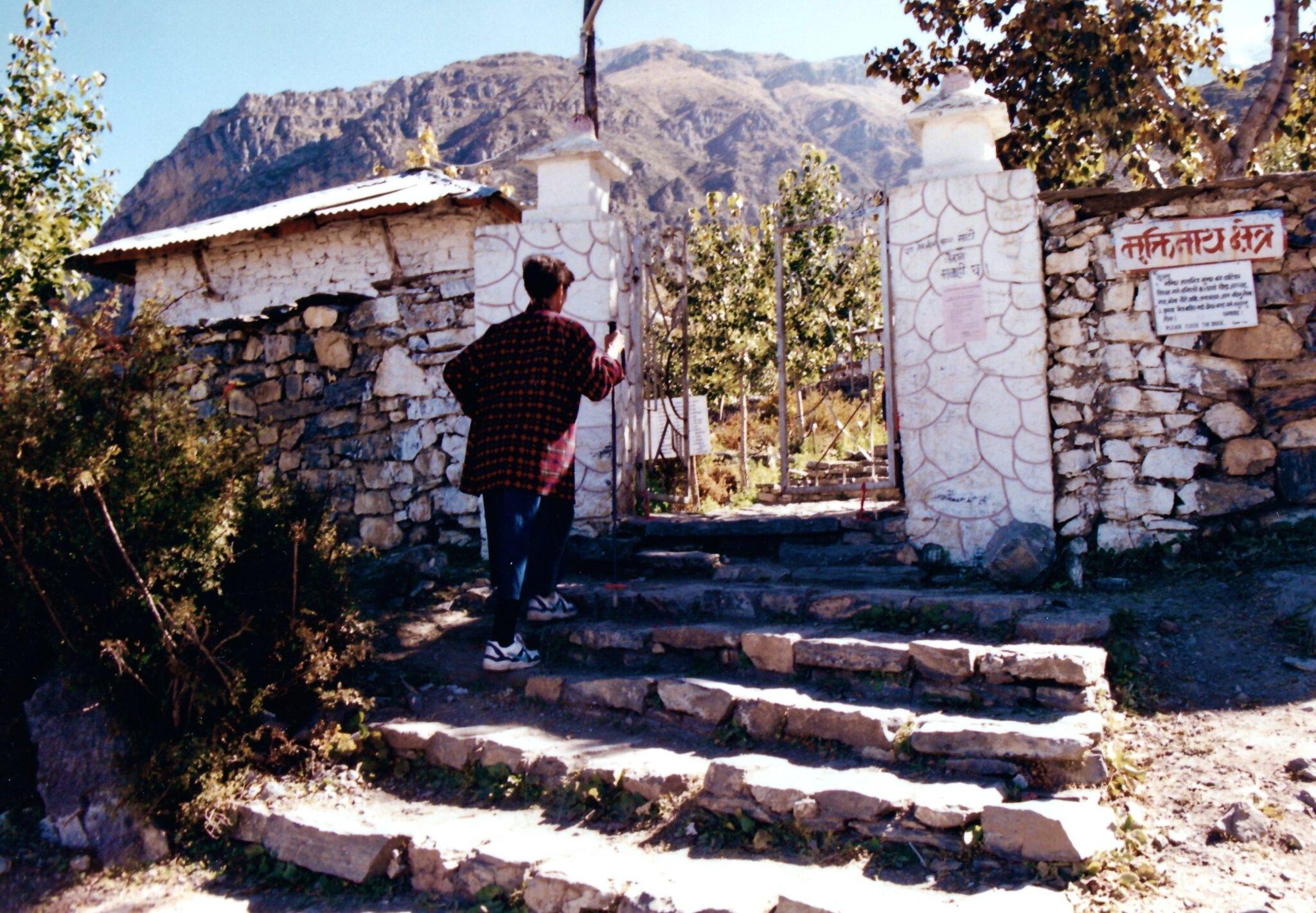
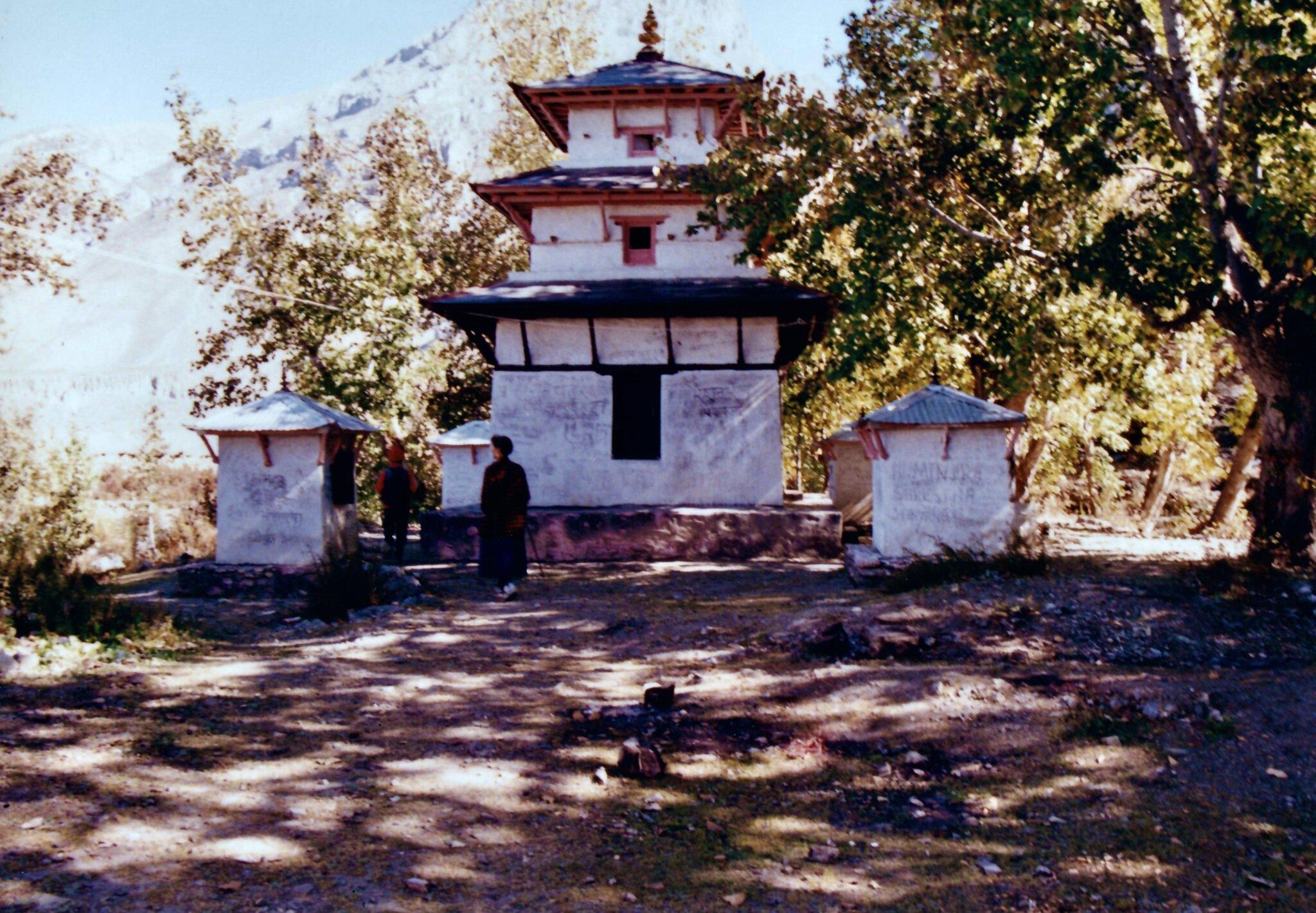
Slowly we wend our way up to the main gate of the Holy Shrine. I am amazed at the complete simplicity of the space. In the West a shrine or temple of this import would take up at least a city block and be festooned with towers and a huge parking lot. But this is Mustang in the Himalayas and there are no vehicles here – none at all. We enter a cool plateau shrouded by junipers stepping along next to a small spring that ripples though its center.
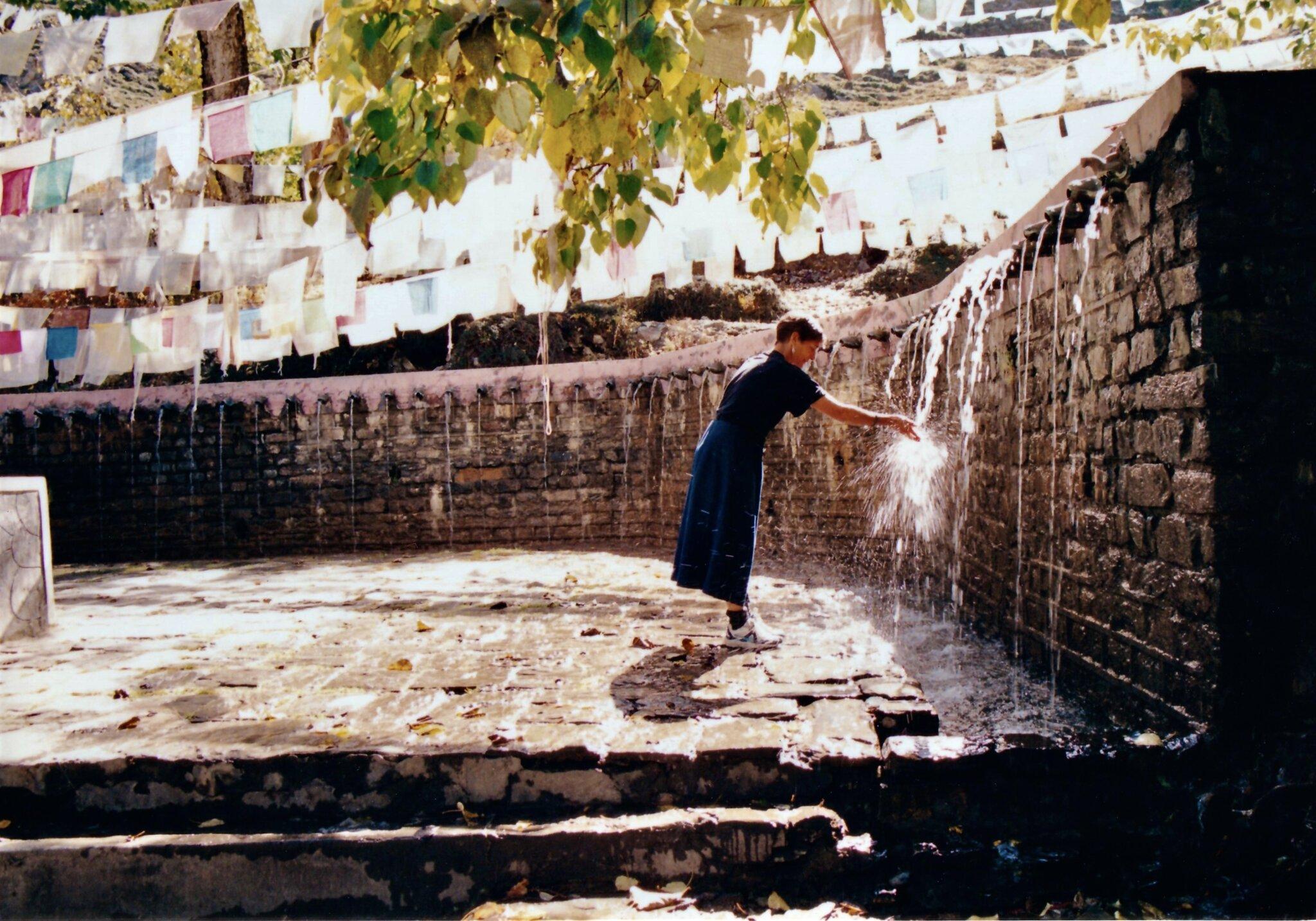
Next to the brook stands a temple, part Vishnu part Buddhist. Surrounding this temple is an eight foot wall featuring 108 sacred fountains each spout shaped like a boar’s head from which water spills onto stone flooring. Going left to right [some heretics or improvisors do the opposite], you utter prayers before each one then dip your fingers in the spout of water and spray it over your head. You do this 108 times [a sacred number] and complete the circuit while bathing off bad kharma in the process. Marcia goes first while I take pictures. Then it’s my turn. The sound of the water cascading from 108 spouts helps the mind focus on the now. Above, the prayer flags flutter in the morning breeze as one by one you utter your prayer or blessing, dip your fingers into the pouring water and spray it over your head. It is very refreshing to both body and soul. I finish feeling cleansed in both spirit and in mind.
Next we visit Jwala Mai Temple – the Shrine of Fire and Water. Legend has it that this shrine once had three “eternal” flames fed by natural gases that appeared to burn right out of flowing water. In order to witness this miracle, devotees must fork over 10 rupees to an attendant who pushes aside a small curtain so that the supplicant – on bended knee – can peer into a murky recess situated under an altar-like display of sacred icons – and yes – see a flame suspended over a small stream of water. However the lighting is so shadowy the skeptic in me can place little faith in this miracle. And next we step up to spin prayer wheels – a long line of them constructed from used Carnation powdered milk cans. What ever works.
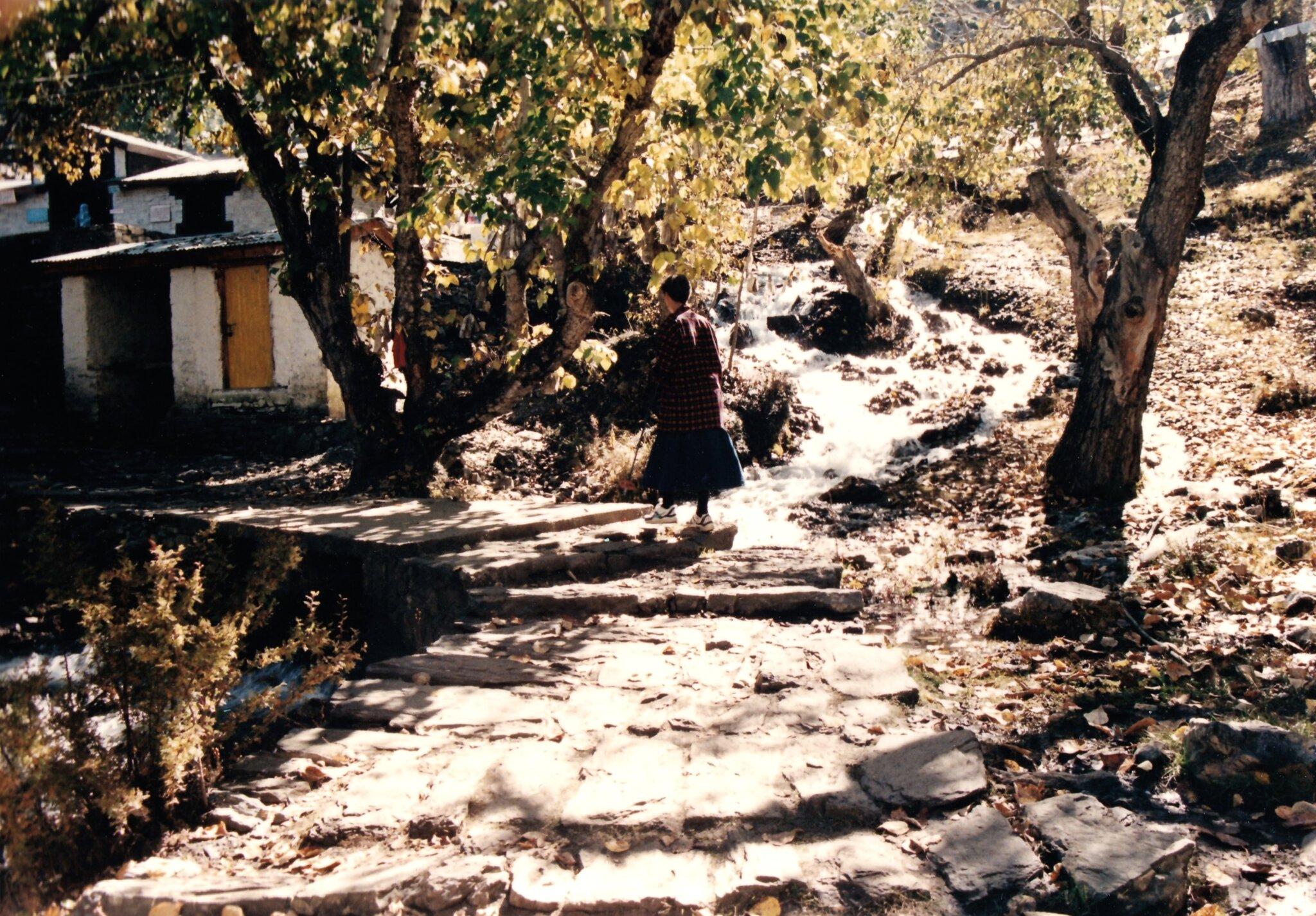
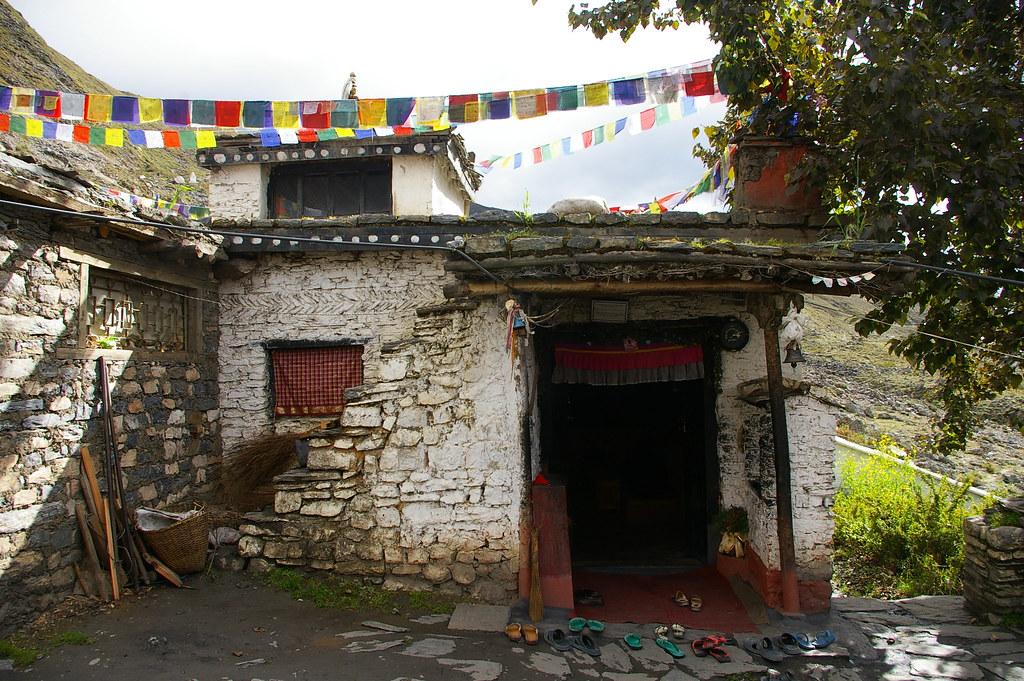
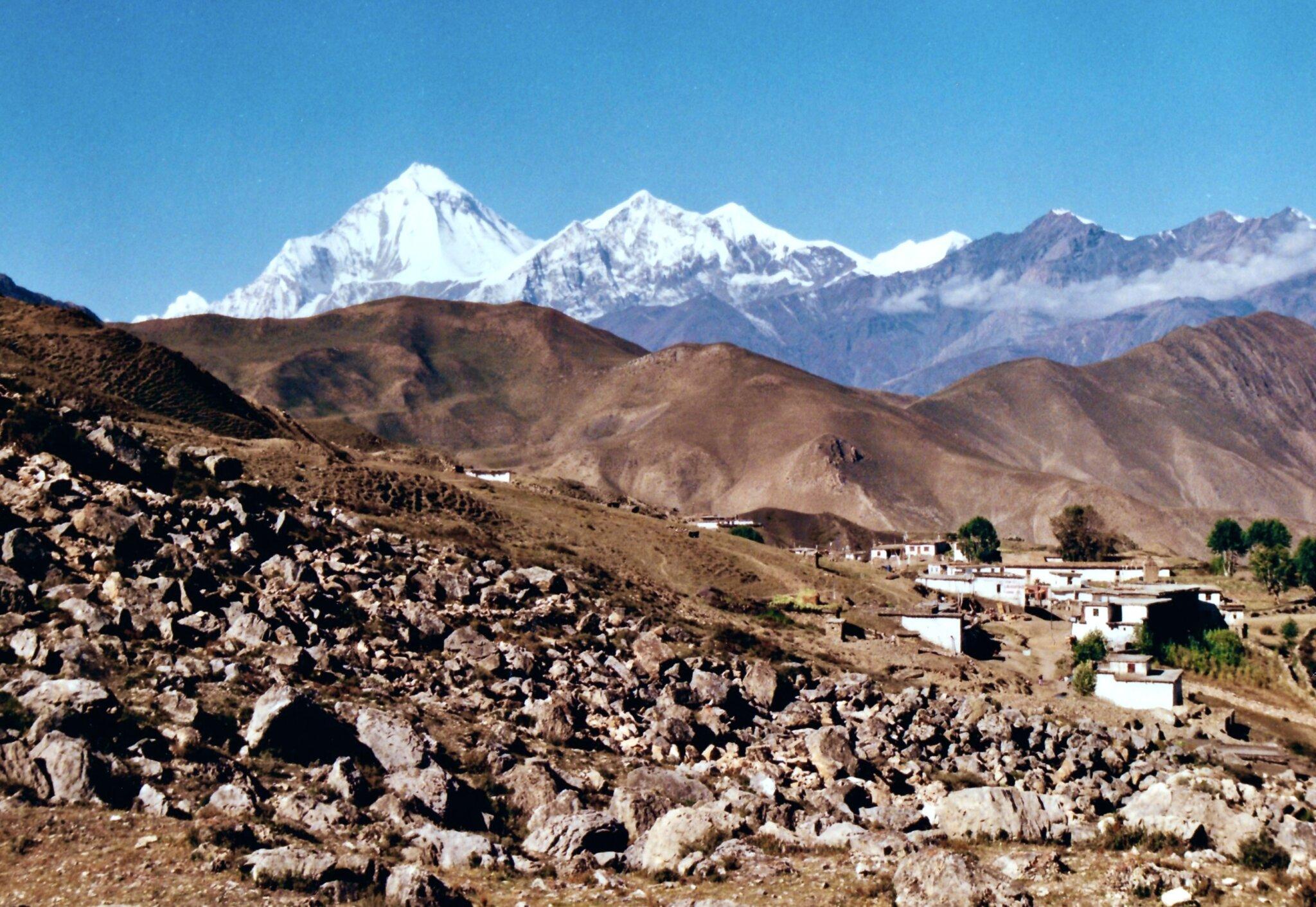
On the way back down towards Jharkhot we stop to sit on a bench – sending the porters ahead while we view the setting – Throrong La Pass above us with Throrong Peak; Nilgiri and the tip of Dhaulagiri to the South. We are surrounded by these wondrous peaks literally at the top of the world.
And who should happen by at this serene moment but Ed – the other half of the L.A. duo. He’s had a great time hiking up the Thak Khola with a newly-hired porter – at half of what we’re paying ours. We fill him in about Tom the Ultramarathoner but he just shrugs and says he’ll catch up with him in Pokhara or he won’t and will just go on to Thailand and Vietnam – if his wife okays it. I just marvel at these seemingly “open” relationships in which you take separate vacations etc. Maybe it’s just a “Me” generation thing. What ever happened to sharing? I’d rather spend my free time with someone else besides myself. Call me romantic. We bade each other farewell and slowly descend to Jharkhot where, after a casual lunch, I re-load the camera for a sight-see of the village.
Jharkhot.
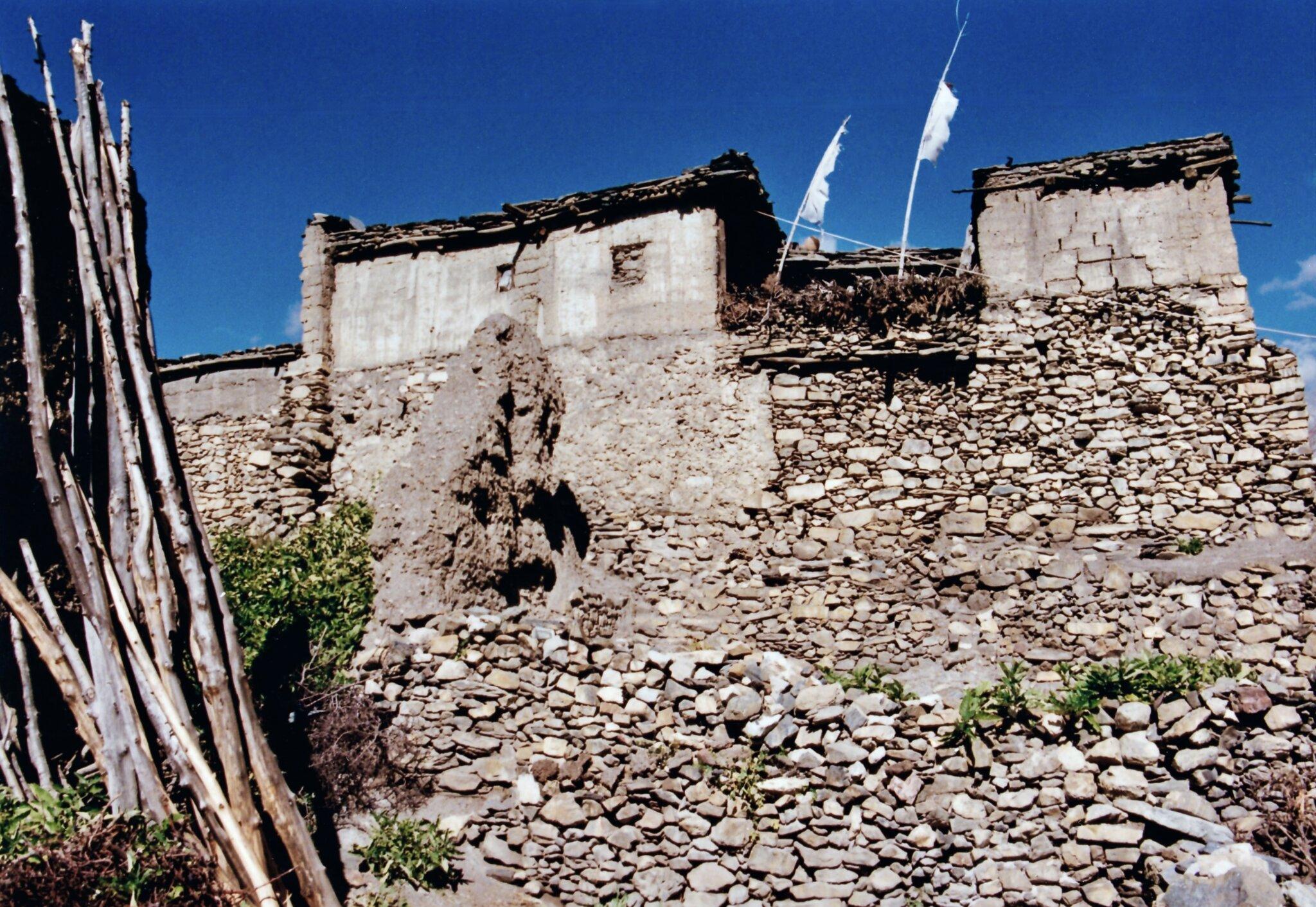 On a flat area – probably used for drying millet and rice we can view the entire valley extending up past Muktinath along Thorong La Khola. Above us are the decaying walls of Jharkhot made mostly of un-mortared brick. There seems to be no one around. In the background we can hear a dog barking and there is the latent smell of domestic farm animals – probably out to pasture this time of day. We hike up some decrepit stone steps and into the narrow streets of the village. There is still no one. The doors we encounter are all well-worn – but locked. Over the transoms of many are placed animistic symbols for good luck or protection. No one seems to be at home this time of day.
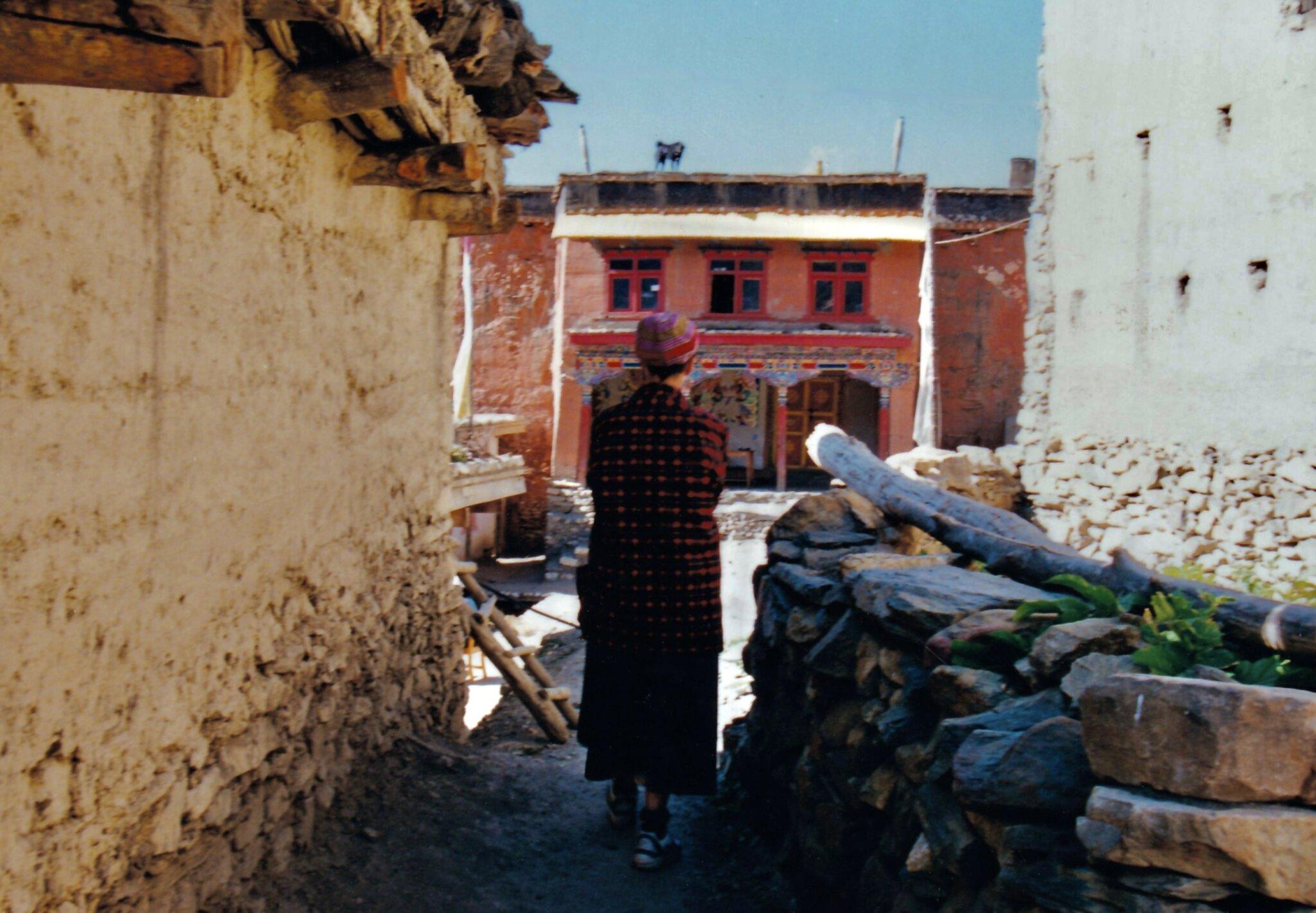
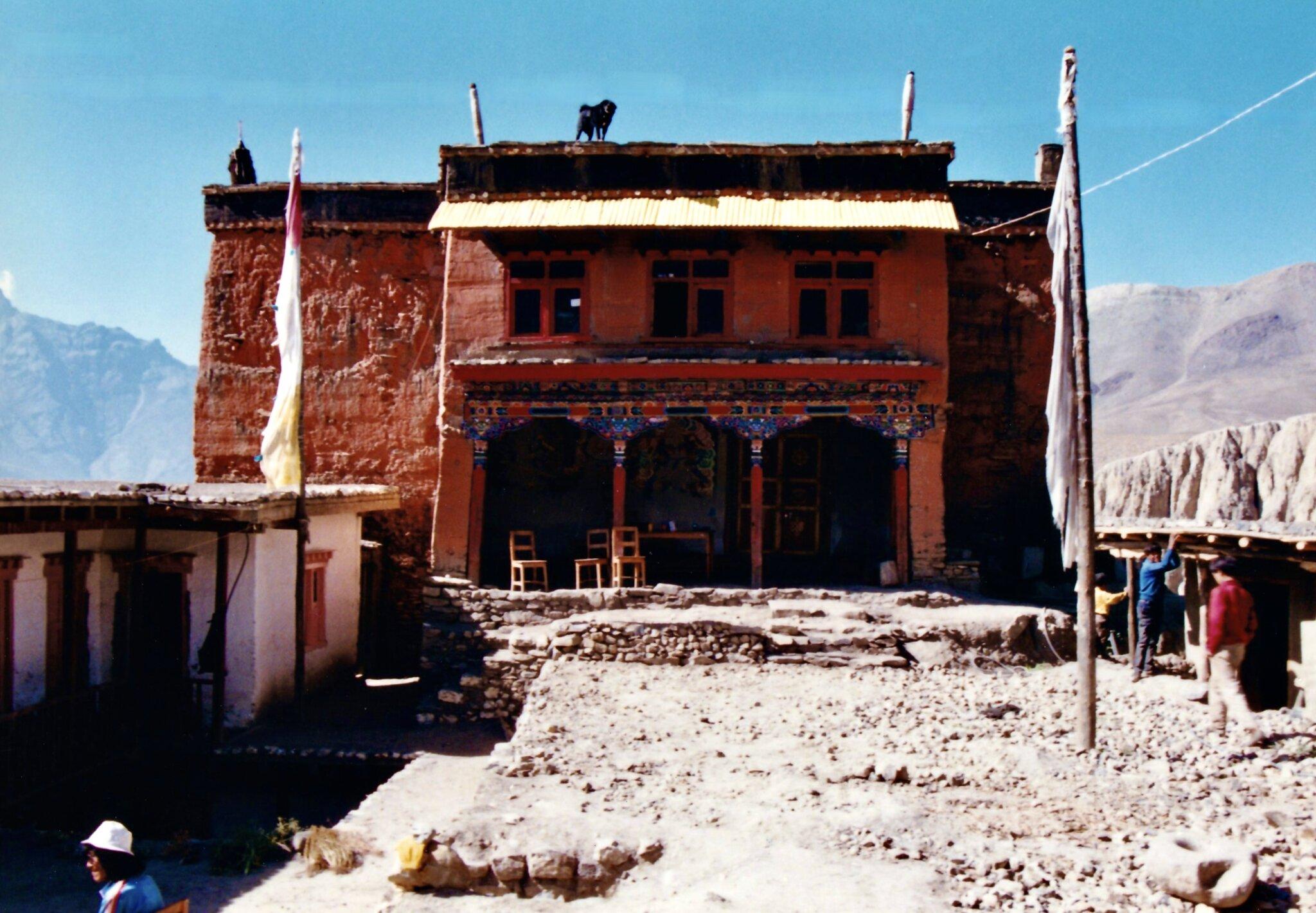
Wending in towadr the end of the promontory we approach the red-painted Tibetan monastery, the dog we heard before – is on the roof – a large black mastiff like many we have encountered along the trail – only this one seems quite Ill-tempered probably because it wants to get off the roof.
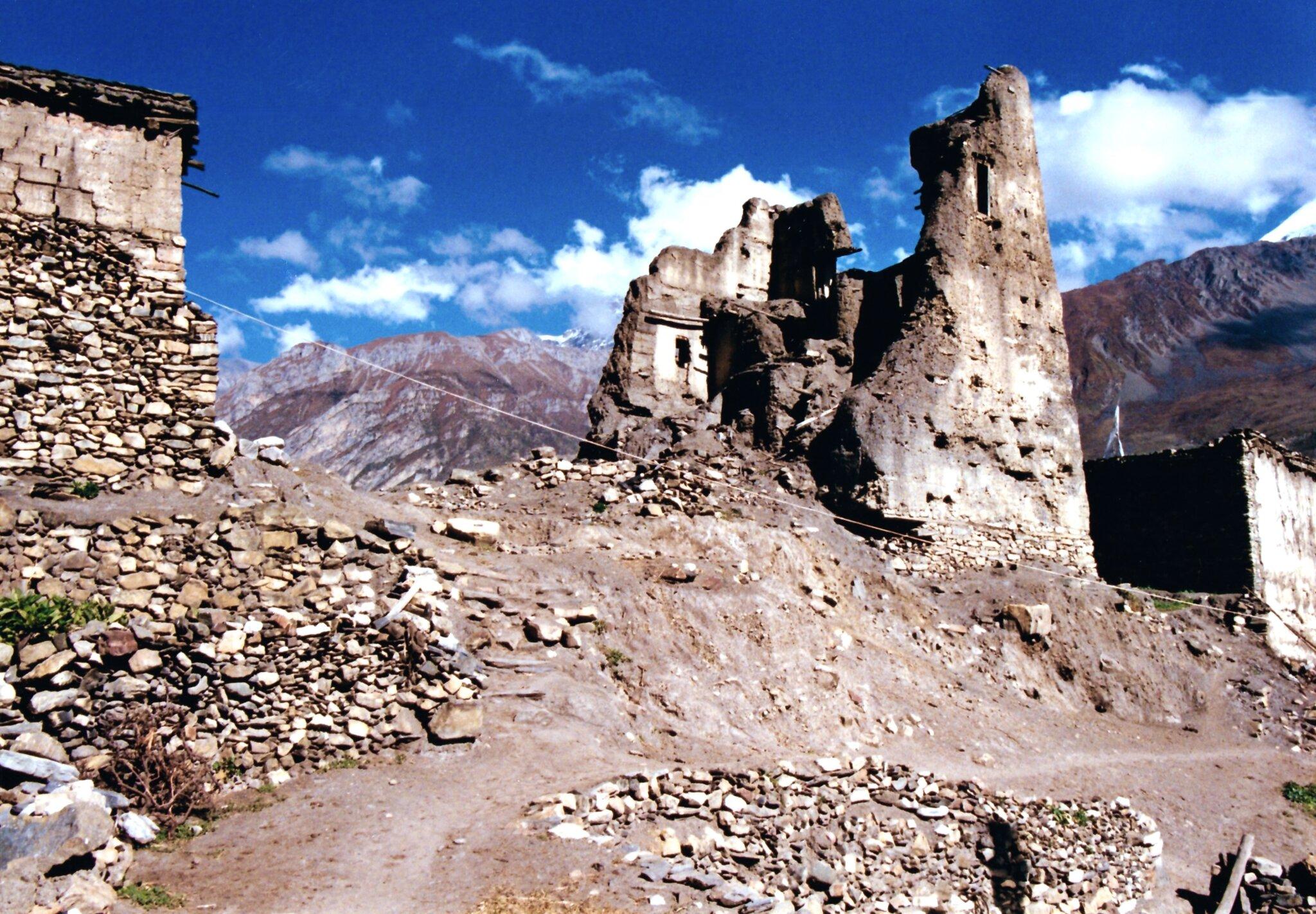 There doesn’t seem to be any monks around so we turn back to begin climbing the decaying pile of rubble to what was once the Citadel of Jharkhot – now with only two of its four walls left and those are only partially standing. It still presents an impressive image, however.
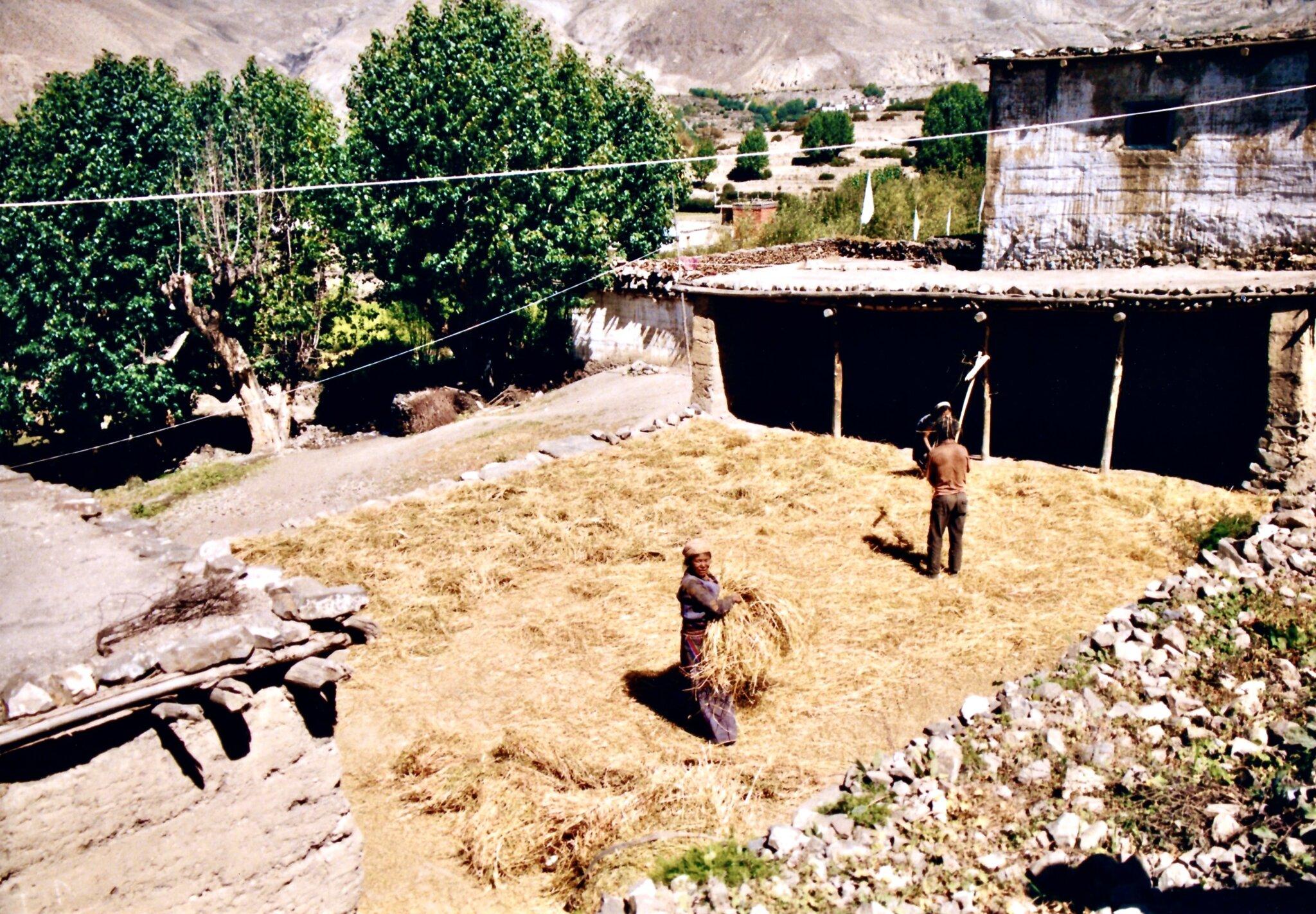 Further along the narrow pathway we encounter two women in a large courtyard busily winnowing millet using a large basket, likely the same task having been done in a similar fashion for generations, and one cannot but wonder what this citadel would have been like in its heyday. Off to the South we can see a sprawling building and are told it used to be a monastery and indeed there are prayer flags strung from its towers and the surrounding fields seem well-tended but the building itself has been long abandoned.
We have a meal and turn in for the night after dark. We seem to be setting aside enough hours for acclimatizing our bodies, but actually falling asleep is the hardest part as the altitude really affects breathing which I find difficult enough under normal circumstances given my crooked nose. There seems to be dust everywhere and the ceiling insulation appears to be yak dung – though truth be told we’ve seen little evidence of yaks on our trek so far save for the stuffed one. We have to get some sleep because tomorrow we face the wind.
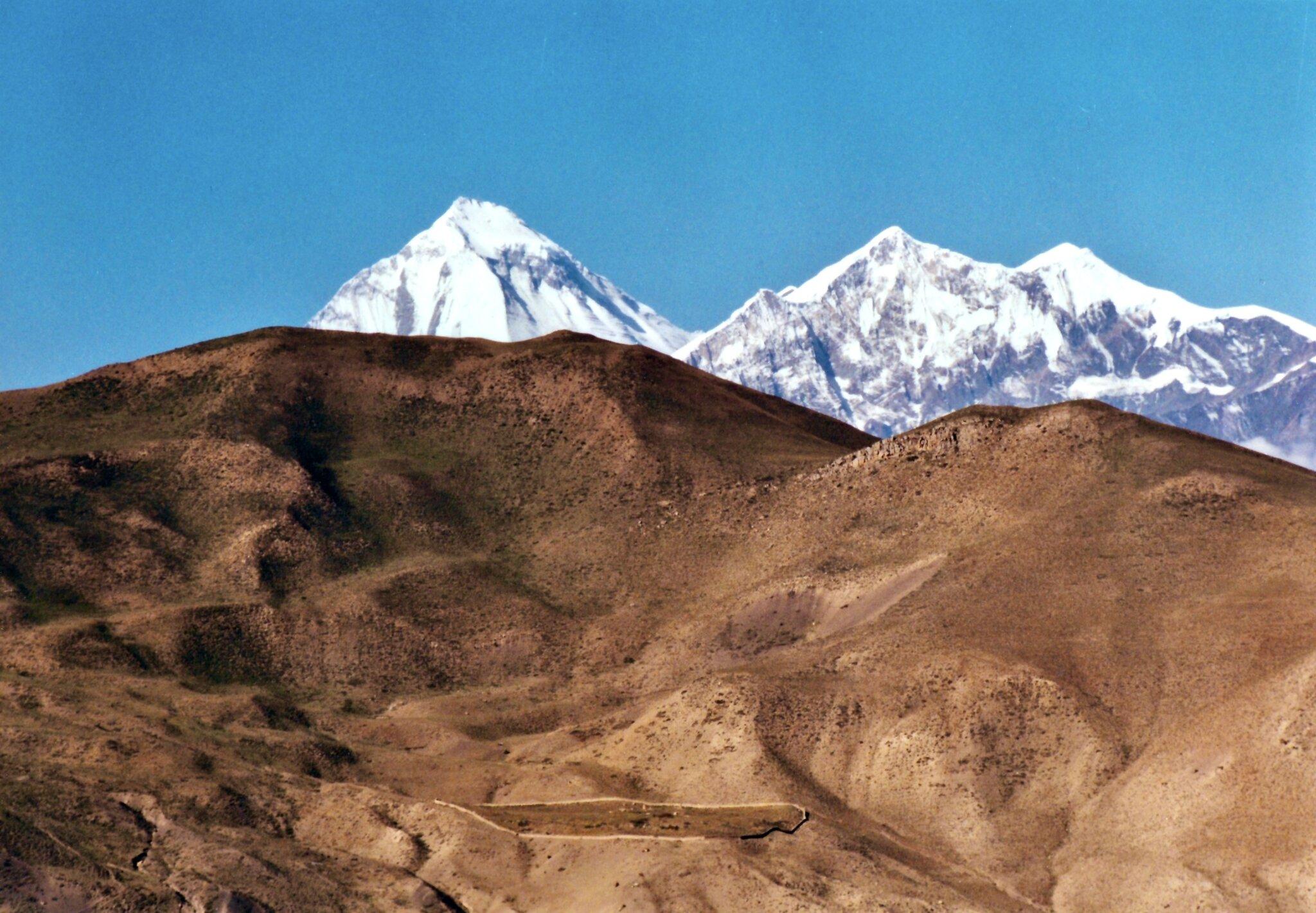
October 9.
Return to Jomosom.
We set out after a breakfast of milk tea and porridge – with apples of course. The weather is brisk – yet fairly warm in the Sun and the trail is sparsely populated. Marcia sends the guides on ahead to the trail junction. We plan to stop there for a snack before heading on to Jomosom. She and I take our time, savoring the panorama of mountains, valleys, and farmlands; glancing back at Thorong La Peak then ahead to the white pinnacles of Nilgiri and Dhaulagiri, marveling again at the subtle variations just in the color of brown!
An hour out and the wind has started already! We hug the cliffside to keep out of the stiff breeze as much as possible. The weather is still pretty mild but we know what we are in for. We stop for more milk tea served on this occasion in a pot large enough for the entire army so we invite our guides to share. As we finish two horses pull up loaded with provisions from Jomosom – the local UPS.
We set off along the river bed toward Jomosom and upon rounding a bend in the Thak Khola we hit the full force of the draft – possibly 25 knots. Quickly we don our sunglasses and scarves so we can see and breathe. From then on the mood of the journey takes on a completely different character – a determination sets in to finish our trek as quickly and safely as possible. Gone are the moments of quiet contemplation, speculative wonder, and spontaneous improvisation. We’re just trying to get off that gravel river bed in one piece!
Finally Jomosom – a quiet room with a hot shower. Of course Marcia wants to do some shopping for souvenirs and I want to track down the air line agent for Royal Nepal to re-confirm our flight to Pokhara tomorrow morning. We visit several shops, two of which seem to have wonderful carpets and horse blankets that Marcia is enamored of. They do seem to grow on you, once you know what to look for. We negotiate to buy one – and afterwards Marcia thinks we paid too much but time will tell.
October 10.
Back To Pokhara.
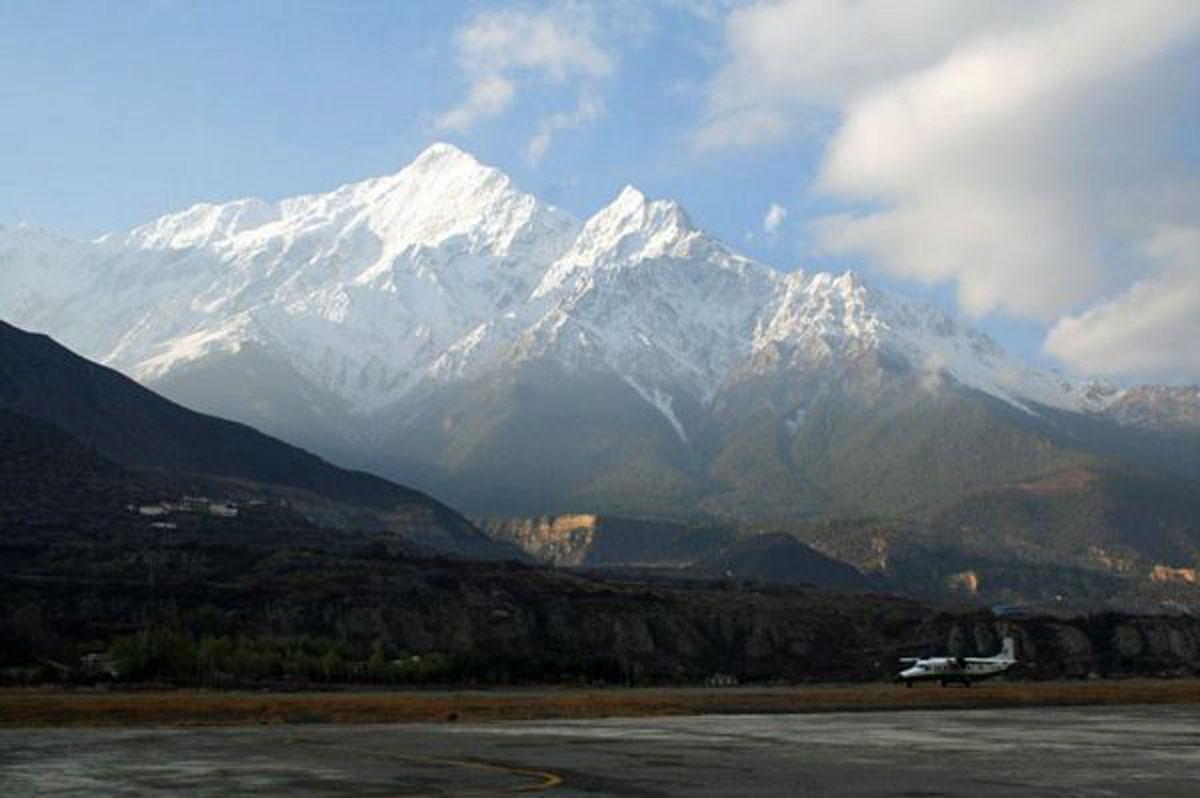
The plane is late and at the airport we see Ed again. He’s taking a later flight on another airline. His plans – as he’d related to us before – are to go on to Thailand & Vietnam evidently with or without his spouse’s approval. We look up to see Nilgiri as it greets the dawn with us. Majestic!
The flight is a little bumpy but cozy, bringing back memories of those I took in Puerto Rico 25 years ago between San Juan and Ponce riding aboard Commanders and Herons.
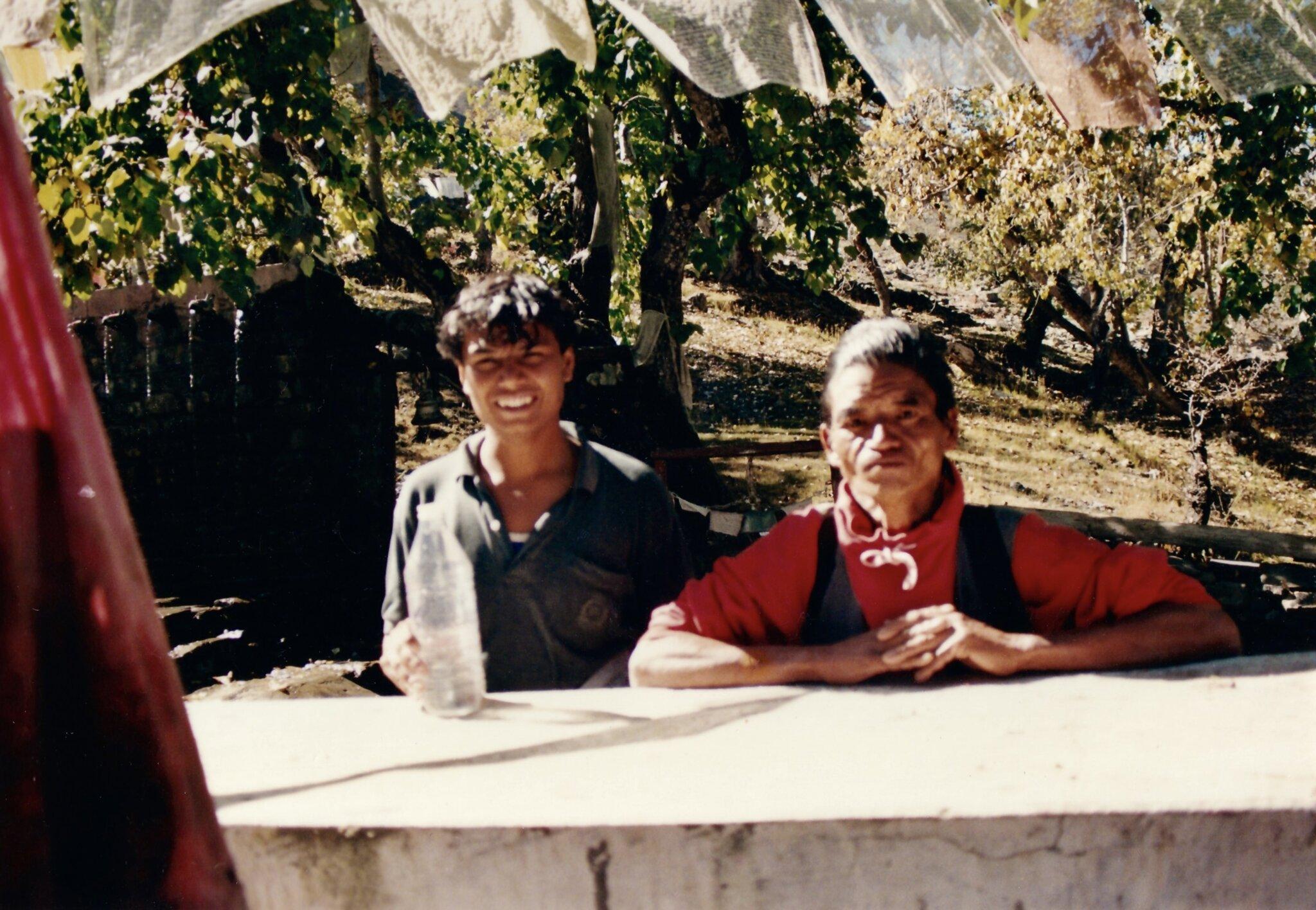
These Nepali pilots seem to know what they’re doing and what took us ten days to walk – we cover in fifteen minutes – touching down on the gravel runway in Pokhara back in the sub-tropics. From the air it seemed that it had recently rained and indeed the ground is wet in spots. We have a few hours before the flight back to Kathmandu so Marcia suggests a taxi back to Phewa Lake for breakfast. We drop off our guides Tatsu and Madhu bidding both fond farewells, then barter with the taxi driver to take us to the “right” German bakery – the one along the lake – for a sumptuous breakfast with a view and neither the food nor the view disappoint.
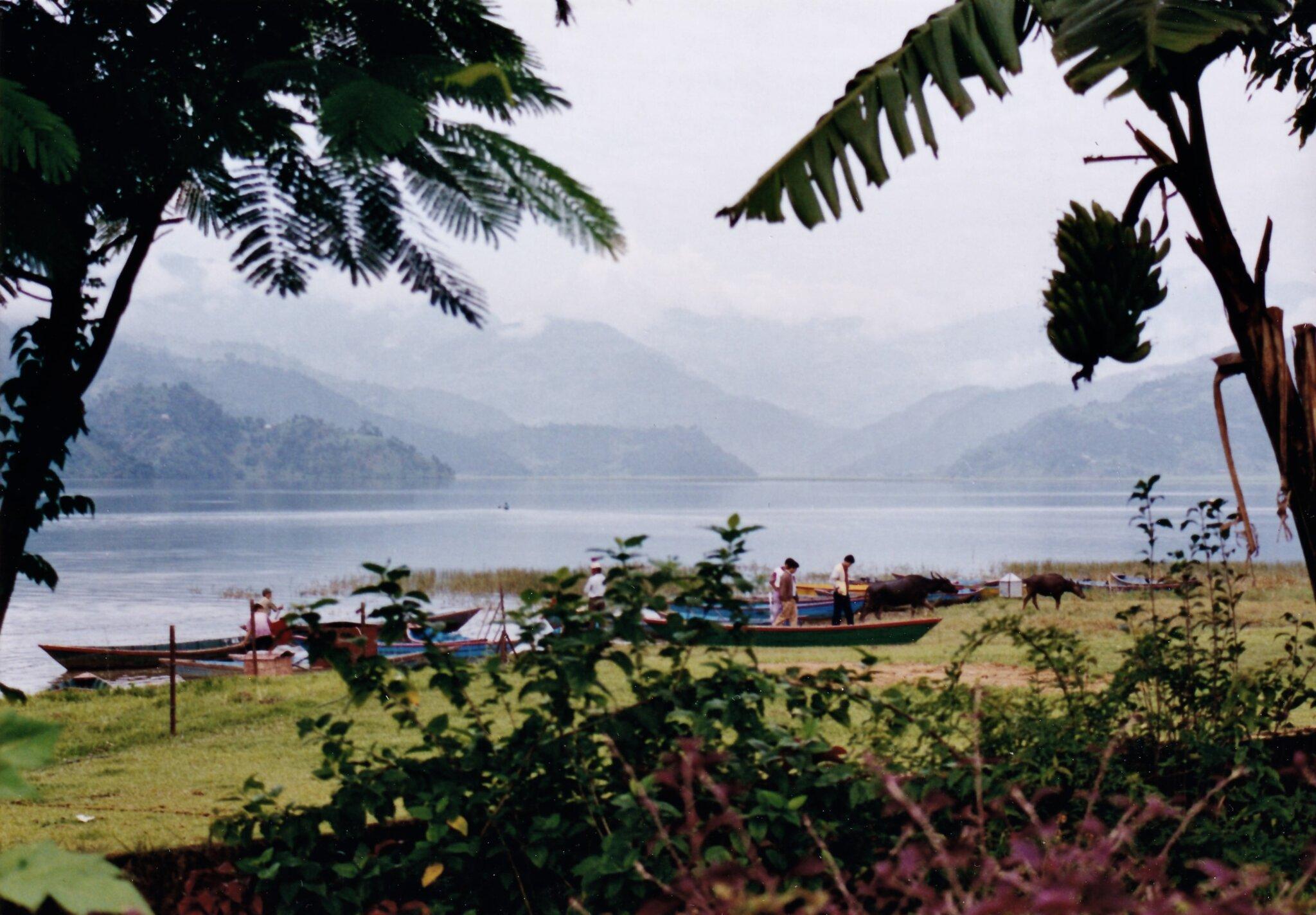
Finally – we feel a sense of accomplishment – of a journey completed. We’ve done it! Marcia and I embrace. We’d trekked the Kali Gandaki Gorge all the way to the legendary Holy Shrine of Muktinath. Before us stretches our lives – full of great promise with much to decide.
Epilogue.
The last days in Kathmandu were spent frenetically buying last minute collectibles as keepsakes or to sell at swap meets back home; some sight-seeing and as well as taking a couple of “side-trips”.
The Devi and The Wedding.
The first was to a Devi’s house in Kathmandu for a traditional Nepali wedding ceremony for a non-traditional couple; he an Italian American and she a Chinese American. They had been married several weeks before at the Renaissance Pleasure Faire in Marin County near San Francisco and for a honeymoon they decided to do a trek in Nepal. When they got to Kathmandu where they met author Ian Baker, who evidently suggested to them it might be great to get married in Nepal as well. They then spent the whole day before the ceremony running about town buying all the clothing and traditional offerings required by the Devi in order to perform the ritual.
The next evening we all gathered at a small home near the Bagmati River making sure we deposited our shoes in a dim hallway at its front door. There was no headroom to stand, so we all knelt or sat cross-legged – a problem for me since my knee was still swollen from the trek. What followed were a series of rituals presided over by the Devi who spoke to the celebrants in a low voice directing them through the ceremony with an occasional aside which drew laughs from the Nepalis in attendance. Every so often she would recite an incantation and throw flower petals or rice over the seated couple. Then a thin veil was dropped separating the audience from the celebrants – more prayers and offerings – and money exchanged [or so we were told]. Then the veil was lifted. The bride walked around the groom – he walked around her – kissed her feet – and voila! They were married.
Bhaktapur.
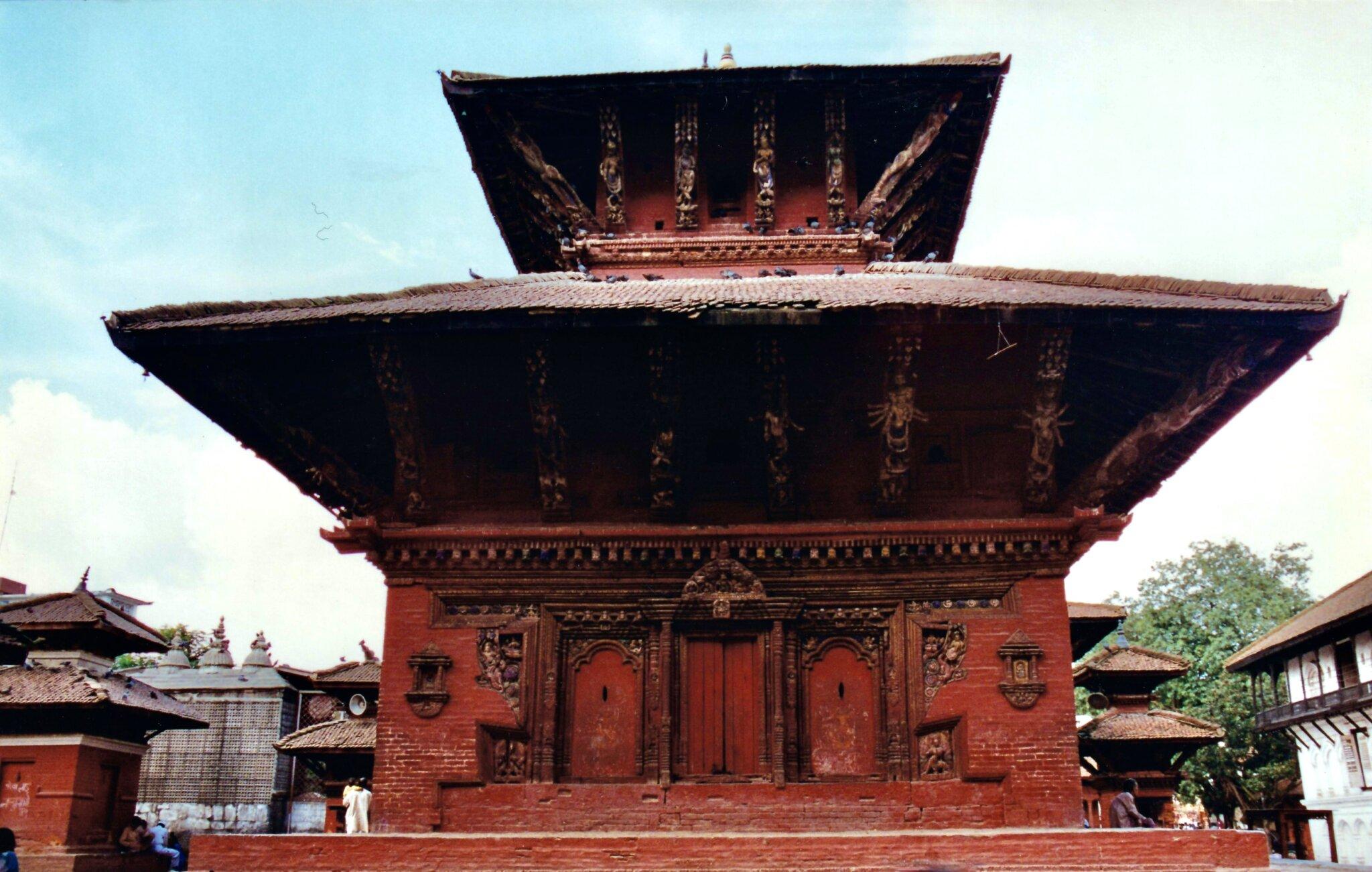
The second and last outing was to Bhaktapur, a small city with 12th Century origins known for metal work and its huge temples. There was to be a festival for Dashain which goes on for nine nights involving young men wearing ceremonial masks which represented seven or eight of the major Hindu gods. The men will don the masks and after several rounds of raksi, they would set off through the streets – preceded by bands [literally] of others clanging chimes, beating drums and playing flutes.
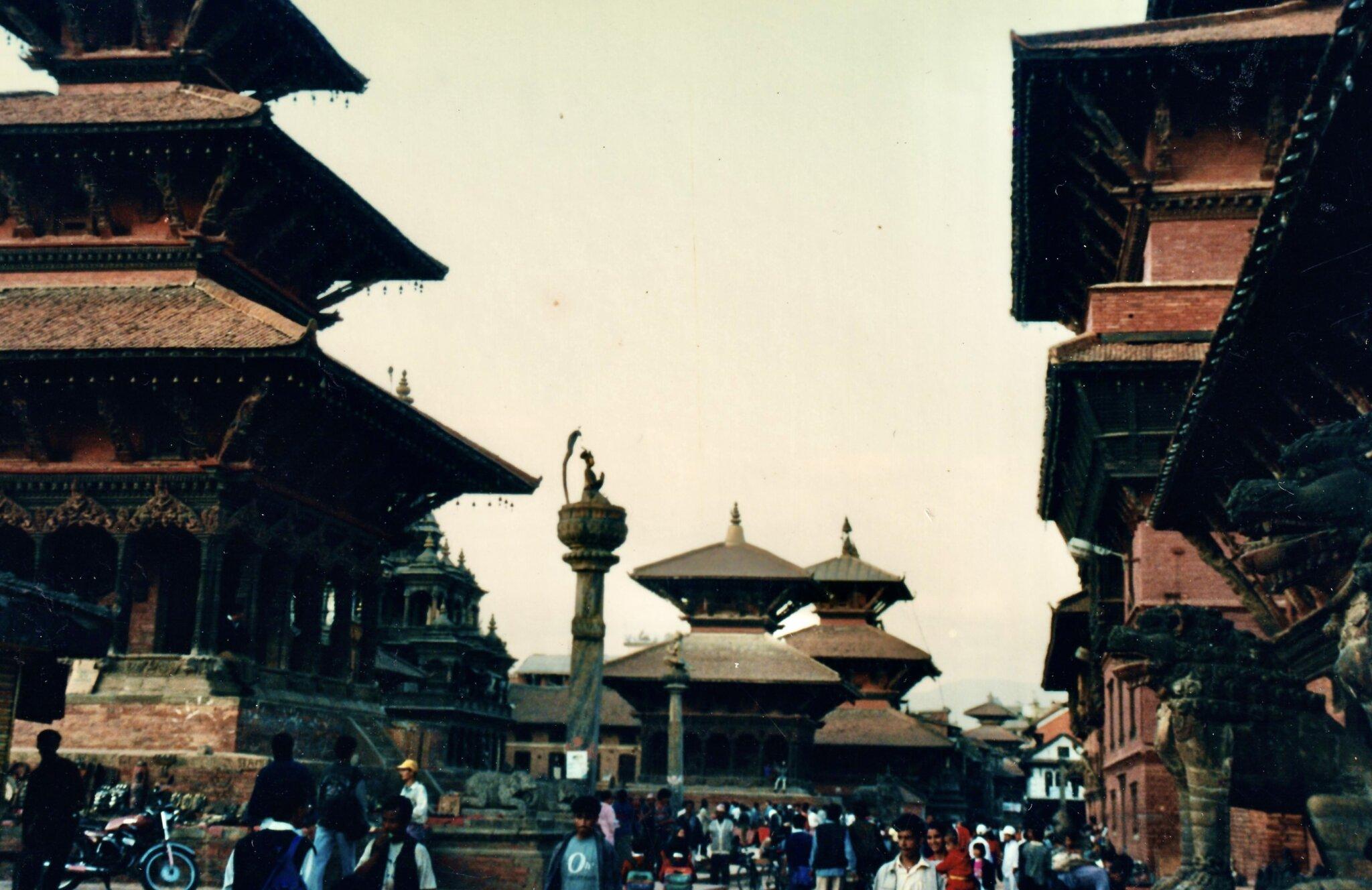
It was late afternoon when we arrived together with the writer China Galland who along with myself was taking photos of the area’s temples, decaying sculptures, and iconography. Apparently at the time there was little or no program for maintaining or preserving these national treasures – besides most of them had been stolen by art thieves. The light was failing rapidly as we found our way down to the Bagmati River where the ceremony was to begin. Along the way we passed under banners in red and white strung from buildings on either side od the road, met many street musicians roving in small groups proceeded by men doing a kind of shuffle to the music. It seems women were not allowed to participate in these festivities other than to prepare the food offerings and even these offerings are carried to the “gods” by men.
Finally the procession got underway under the glare of several butane lamps – glowing blue/white in the darkness. The chanting and the rhythmic drumming; here and there small groups of dancers whirling and lunging; and everywhere people were grinning ear to ear. It was obvious this was going to continue on well into the night so It was time to go back to the main Durbar – grab a choice spot in the restaurant there, sip some hot lemon, visit the WC, say our fond farewells, and then head back to Kathmandu feeling grateful and blessed by a fortuitous nexus in time and space.
Alavidā!
Be sue to check out our Nepal Galleries page [see blue button link below} where we’ve posted tons of photos showcasing our 1994 trek of the Kali Gandaki Gorge and visit to Kathmandu which we’re currently updating frequently with pictures from different segments of the trek.
And stay tuned! We’re working on another post about our 1996 trek to Solukhumbu in Nepal which will contain text from a journal we kept along with some video clips as well as photos documenting the trek. You won’t want to miss it!
Originally published as a hand written Diary by James Babij AKA Kazkar Babiy or The Daily Llama from September/October 1994.
All Content unless otherwise notated © 1994-2023 Ruthenians.net. All rights reserved.
Shared via Creative Commons


Views: 0